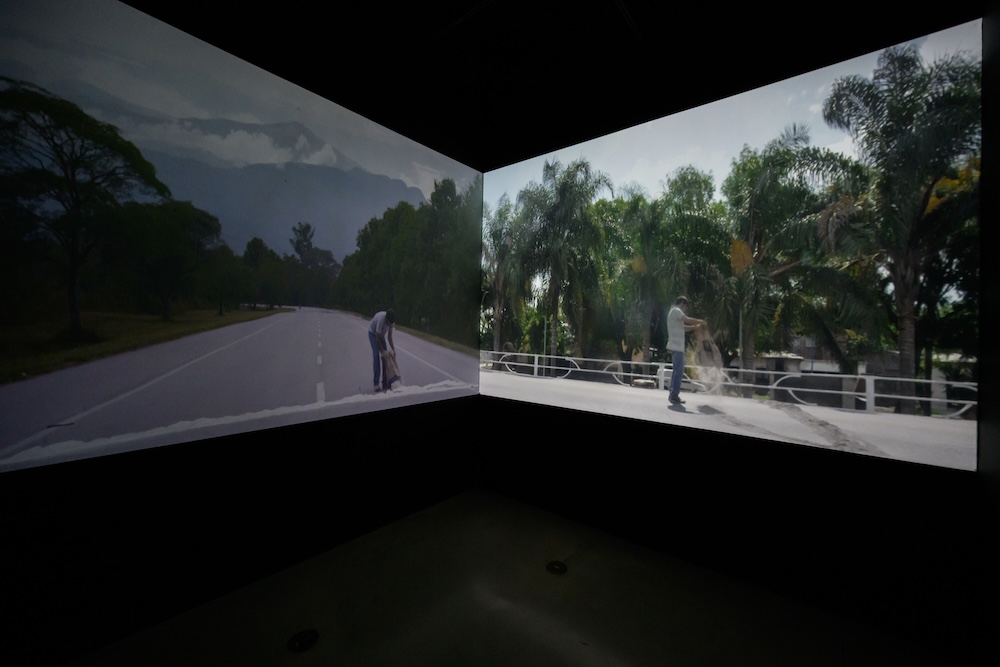
Habitar una nube/ To Inhabit a Cloud
Adrián Sosa
Curatorial essay — Sophie Bonet
To inhabit a cloud is not a gentle image. It is a condition.
In Tucumán, clouds do not always come from the weather. Sometimes they are produced. They rise from dust lifted by dirt roads, from spilled flour that turns the air white, from cement that remains suspended as if progress itself carried weight and texture. And then there is another cloud—the one produced by the sugar mills—which marks seasons, schedules, economies, and bodies. A plume visible from afar that, for those who grow up nearby, is neither landscape nor metaphor: it is living history. It does not need explanation. It is breathed.
This exhibition brings together a series of video-performances and actions by Adrián Sosa that do not present themselves as representations of rural life, but as situations in which territory, body, and material think together. These are not isolated gestures, but units of labor carried in sequence. In the sugarcane fields, work does not advance through individual actions, but through rhythms learned by the body—inherited forms of knowledge that organize time, effort, and space. Here, gesture does not represent the rural; it activates it.¹
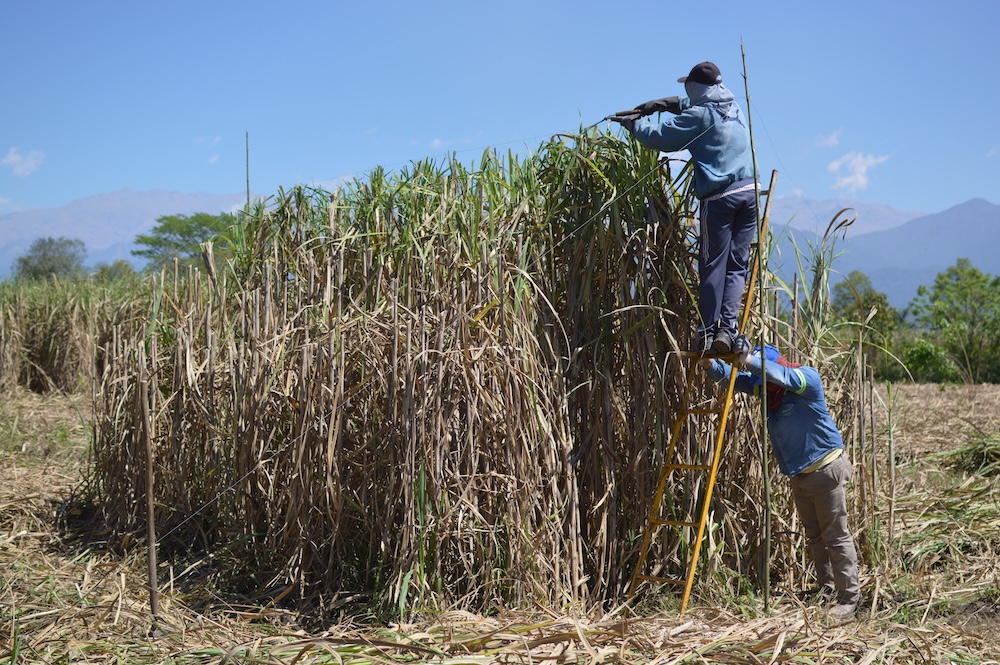
Video-performance still.
Los Sosa, Tucumán, Argentina.
Duration: 5 min 8 sec.
Courtesy of the artist.
Tucumán is a province in northwestern Argentina with a history that has been deeply shaped by the sugarcane agroindustry and by the economic, political, and social transformations associated with it. For decades, sugarcane fields and mills structured not only production, but also the rhythms of everyday life and an enduring relationship between body, territory, and time. From the mid-twentieth century onward, the closure of numerous sugar mills and the restructuring of the sector profoundly altered this productive and social fabric, generating displacement, precarity, and lasting ruptures within the region. These processes did not erase rural labor; rather, they displaced it—allowing its gestures, practices, and embodied knowledge to persist within bodies and within the material memory of the landscape itself.²
In Sosa’s work, actions do not emerge as commentary on territory, but from within it. He does not approach the landscape in search of a theme; he begins from an inherited world—familial, communal, historical—where decisions are never neutral. Fencing a house, tracing a line, wounding the land, raising a cloud: these are acts that organize reality while simultaneously contesting it. What is at stake is not the image of labor, but its persistence as a form of knowledge.
In CASA. el abrasar del cerco, fencing is not read as a domestic setting, but as an act of support. To delimit in order to inhabit; to inhabit in order to remain. The fence appears as a minimal structure that does not so much divide as it cares for: a learned, repeated, transmitted action. In Fuerza bruta, the land becomes a surface of inscription. The mark—made through tool and animal—is impressed upon the ground as if the territory could be read from above, as if labor itself were drawing a visible memory. In Tierra baldía, action becomes suffocation: toxic dust suspended in the air, violence without spectacle, a scene that unsettles because it is not interpreted—it is felt.
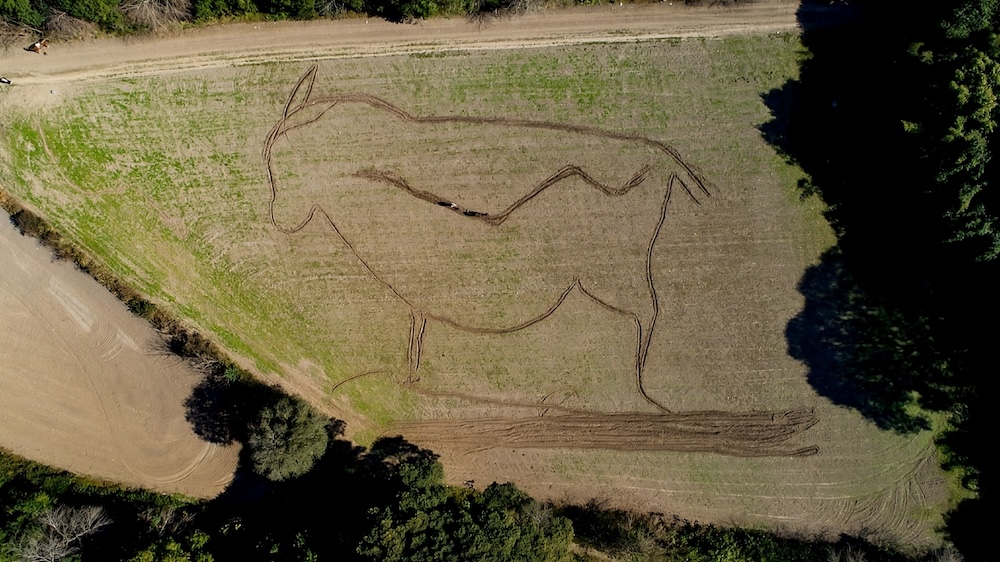
Video-performance still.
Los Sosa, Tucumán, Argentina.
Duration: 3 min 13 sec.
Action dimensions: 55 m × 70 m.
Courtesy of the artist.
Serie de Tareas introduces with particular clarity the logic that traverses the entire exhibition. In the context of sugarcane labor, a task is not an isolated action, but a unit of progress that organizes the body in relation to space. Knowledge is not verbalized; it is embodied. Tasks follow one another, repeat, adjust. In this work, sequence does not lead toward a final result; it sustains a rhythm. Repetition is not redundancy, but continuity. Here, labor appears as duration rather than event.³
And then, air.
In Cuando lo profundo está cerca—and in Ensayos de nube, whether presented as moving image or photographic record—dust ceases to be consequence and becomes language. The cloud appears as interruption, as signal, as insistence. The artist recounts that the work originates in a minimal, lived moment: a bag of flour fallen on a highway, cars slowing before a small but dense cloud, suspended by the constant passage of vehicles. Something light, almost absurd, that suddenly reveals a complete truth: what appears insignificant can become obstacle, warning, presence.⁴
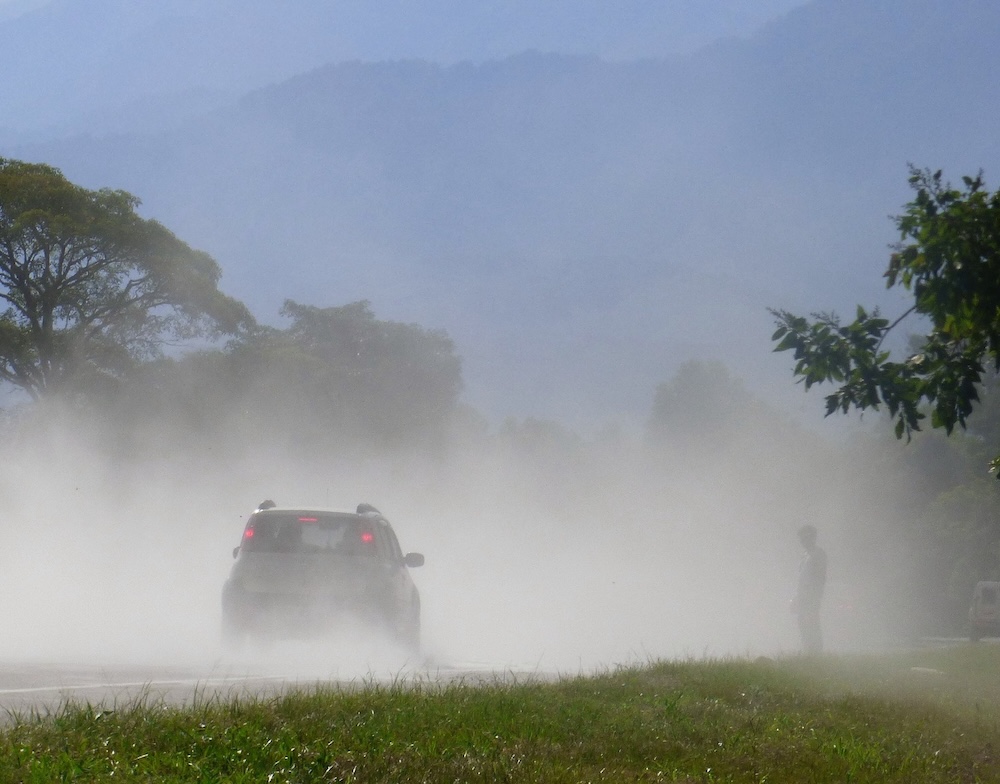
Video-performance still.
Famaillá and Santa Lucía, Tucumán, Argentina.
Duration: 4 min 54 sec.
Courtesy of the artist.
Here, the ephemeral is not what disappears without leaving a trace. It is what returns. The cloud forms and dissipates. The task repeats. The learned gesture persists beyond the individual. Labor leaves marks on the ground, yes—but it also leaves marks in the air. Memory is not fixed in a stable archive; it is transmitted through action, repetition, and bodily wear.⁵
For this reason, To Inhabit a Cloud names a way of living within conditions that are not always visible, yet determine breathing, movement, and vision—material and political conditions. At this point, the work becomes profoundly contemporary: because it speaks of the rural without folklorizing it, and of precarity without romanticizing it. It speaks from the dignity of labor and from the constant friction between “progress” and “survival.”
Here, video does not function as secondary documentation. It is the site where the work takes place for us. As the artist himself notes, a key shift in his process lies in recognizing that it is impossible to bring the audience to the sugarcane fields or to the road—and in turning that limitation into a decision. To conceive the action for the screen is to assume framing as ethics and as language. The camera does not neutralize the gesture; it organizes it. It determines where we look from, how much air reaches us, how much dust remains.⁶
This exhibition invites us to see with the body. To listen to effort. To perceive the slow time of the field and the sudden violence of certain interruptions. To understand that, in these works, matter does not accompany—it testifies. Earth, flour, cement, smoke, metal, air—everything is speaking. And what it speaks does not collapse into an individual story, even if it emerges from a lived life. Instead, it opens onto a broader field: that of worked territories, inherited knowledge, and the often invisible ways in which a community learns to inhabit what it is given.
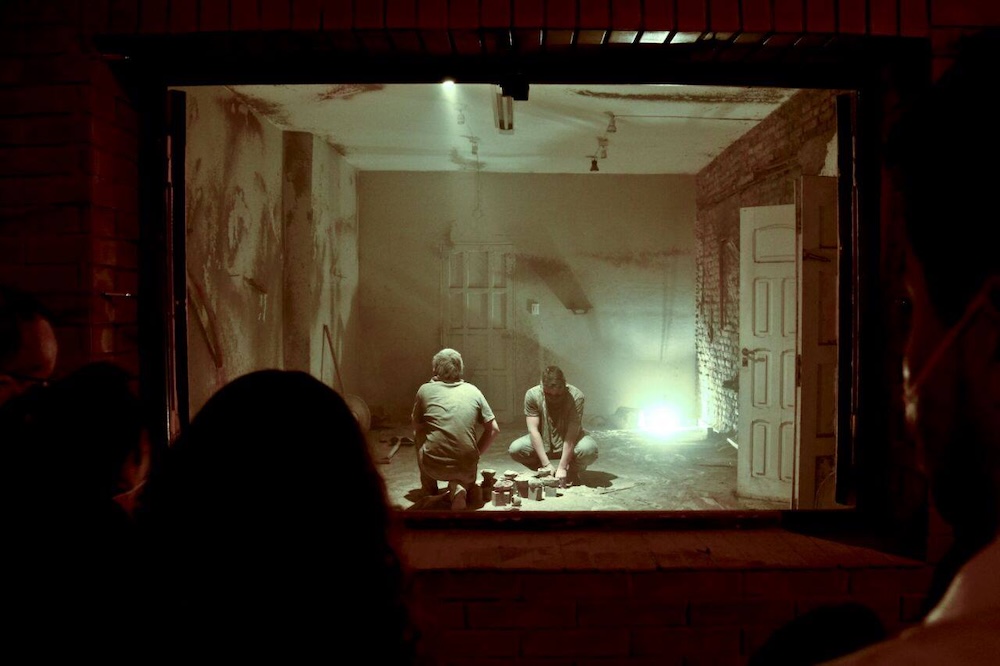
Performance documentation (video).
El Pasaje, Tucumán, Argentina.
Documentation duration: 5 min 49 sec.
Courtesy of the artist.
____________________________________________________________________________
Notes
- Maurice Merleau-Ponty, Phenomenology of Perception, trans. Colin Smith (London: Routledge, 2002).
- María del Rosario Juárez, Cierre de los ingenios en Tucumán (San Miguel de Tucumán: Universidad Nacional de Tucumán, n.d.).
- Adrián Sosa, conversation with Sophie Bonet, curator, 2025.
- Adrián Sosa, conversation with Sophie Bonet, curator, 2025.
- Diana Taylor, The Archive and the Repertoire: Performing Cultural Memory in the Americas (Durham: Duke University Press, 2003).
- Maurice Merleau-Ponty, “Eye and Mind,” in The Primacy of Perception, trans. Carleton Dallery (Evanston: Northwestern University Press, 1964).
Expanded Bibliography
Anzaldúa, Gloria. Borderlands / La Frontera: The New Mestiza. 4th ed. San Francisco: Aunt Lute Books, 2012.
Grosz, Elizabeth. Chaos, Territory, Art: Deleuze and the Framing of the Earth. New York: Columbia University Press, 2008.
Juárez, María del Rosario. Cierre de los ingenios en Tucumán. San Miguel de Tucumán: Universidad Nacional de Tucumán, n.d.
Merleau-Ponty, Maurice. Phenomenology of Perception. Translated by Colin Smith. London: Routledge, 2002.
———. The Primacy of Perception. Translated by Carleton Dallery. Evanston, IL: Northwestern University Press, 1964.
Taylor, Diana. The Archive and the Repertoire: Performing Cultural Memory in the Americas. Durham: Duke University Press, 2003.
Sophie Bonet (b. 1986) is a South Florida–based curator whose practice is deeply informed by her background in social and cultural anthropology. She approaches exhibitions as living ecosystems—responsive spaces shaped by memory, ritual, and transformation. Her transdisciplinary work is research-driven and grounded in the belief that art functions as a site of dialogue, cultural inquiry, and collective imagination.
Bonet has led exhibitions and public programs across prominent institutions in the United States and abroad, including the Contemporary Arts Museum Houston (CAMH), the Barcelona Museum of Contemporary Art (MACBA), and the Museum of Contemporary Art North Miami (MOCA), where she served as Exhibition Manager for landmark presentations such as Juan Francisco Elso: Por América (in collaboration with El Museo del Barrio), Didier William: Nou Kite Tout Sa Dèyè, and Jamea Richmond-Edwards: Ancient Future. Her early research at MACBA focused on the archival documentation and critical interpretation of Espai 13’s history, tracing three decades of artist-led experimentation at the Joan Miró Foundation.
Currently Chief Curator of The Frank C. Ortis Gallery in Pembroke Pines, Florida, Bonet leads an ambitious exhibition program centered on accessibility, sensory engagement, and community-rooted storytelling. Curating across disciplines—from ecological installation to fiber art and new media—she explores themes of identity, migration, belonging, and place through an anthropological and phenomenological lens.
Bonet holds degrees in Fine Arts, Art History, and Anthropology. She is currently pursuing graduate research examining curating as a ritual and phenomenological practice shaped by memory, embodiment, and cultural translation. She is a member of IKT – the International Association of Curators of Contemporary Art.