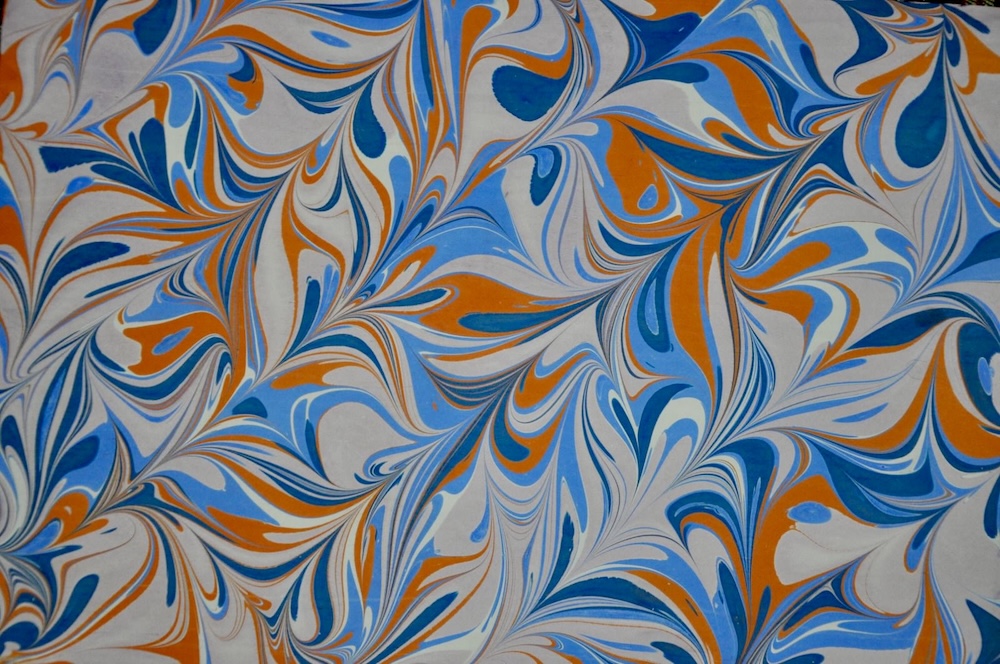
Ipek Saracoglu approaches Ebru not simply as a traditional technique, but as a living language shaped by memory, migration, chance, and transmission. Introduced to the practice by her father at the age of four, she developed an intimate relationship with marbling long before it became a medium through which she would connect with international audiences. In her work, pigments floating across water become more than material: they become a site of negotiation between control and surrender, permanence and impermanence, inheritance and personal expression.
After moving from Izmir to the United States, Ebru acquired an even deeper emotional significance for Saracoglu. What had once been embedded in family life gradually became a bridge to home, cultural identity, and memory. At the same time, exhibitions and workshops expanded the practice beyond the private sphere, allowing her to share its contemplative and communal qualities with audiences unfamiliar with the tradition.
In this conversation with Art Miami Magazine, Saracoglu reflects on the philosophical dimension of Ebru, the role of water as an active collaborator, the responsibility of preserving cultural heritage while allowing contemporary interpretation, and the way teaching can itself become an extension of artistic practice. Her reflections reveal an art form in which uncertainty is not an obstacle but a generative force, and where each image records a fleeting encounter between intention, material, and time.
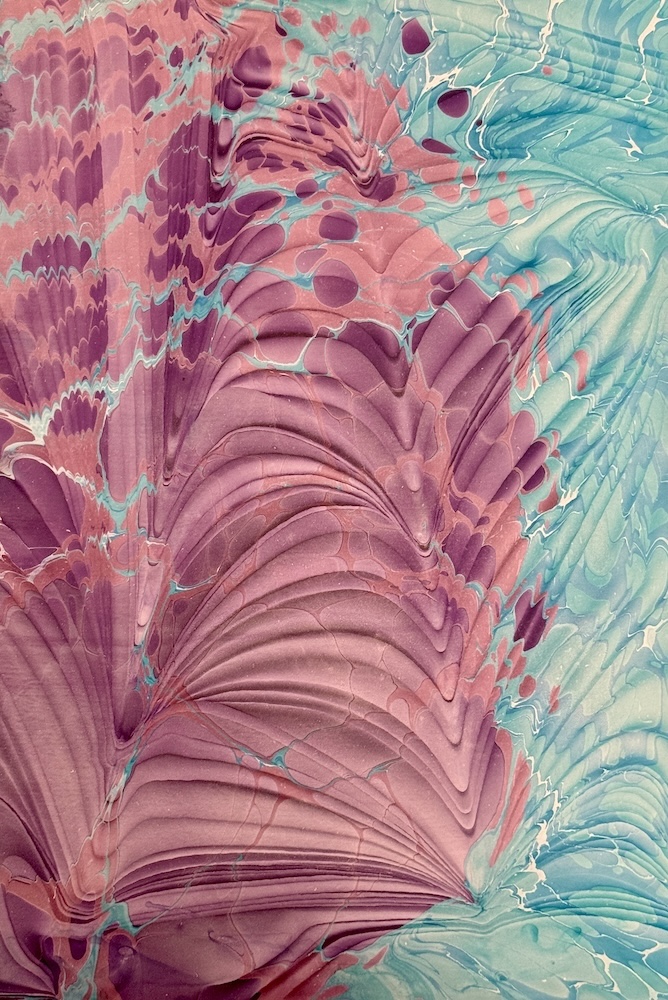
27.5 inch x 19.5 inch
Natural pigment on water, transferred to paper
2025
AMM. Ebru is often described as a dialogue between control and surrender, where the artist guides the pigments but ultimately collaborates with the unpredictable movement of water. How has this relationship between intention and chance shaped not only your artistic process, but also your broader understanding of creativity and authorship?
Ipek Nader. Sometimes in life, no matter what we do, something we initially didn’t want can unexpectedly lead to a beautiful and meaningful outcome. Because of this, I believe it is very important to know when to let go of control and practice a sense of trust and surrender. Ebru constantly reminds me of this. Of course, we try to do our best with the aspects that are in our hands such as technique, color harmony, and composition. But sometimes the pigments don’t spread the way we expect, the balance of the water changes or a drop of paint splashed from the brush lands somewhere completely unpredictable. In those moments, the water’s movement reminds me of life itself. I try to do the best I can, but sometimes the most meaningful result is not the one we try to control, but the one that unfolds beyond our control.
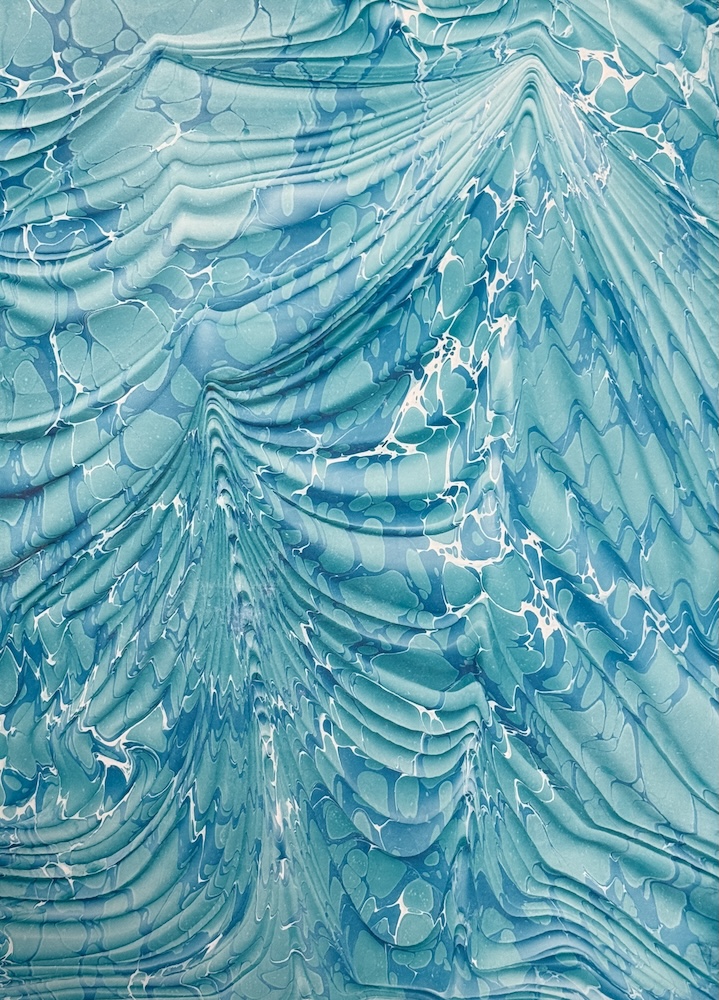
27.5 inch x 19.5 inch
Natural pigment on water, transferred to paper
2025
AMM. You learned Ebru from your father at a very young age, transforming what began as a family practice into an artistic language you now share with international audiences. How do you navigate the balance between preserving the cultural and historical integrity of this traditional Turkish art form while allowing space for your own contemporary interpretation?
IN. Since I learned Ebru from my father at a very young age, for me it is not only an art form but also a tradition passed down through generations and a meaningful part of my family history. Because of this, I feel a strong responsibility to respect its cultural roots and traditional techniques.
At the same time, I see Ebru as a living art. Every artist forms their own dialogue with water and color. I try to express my own emotions and aesthetic through my color choices and compositions. I also enjoy seeing this balance between past and present in other fields as well like in architecture where old and new coexist, or in fashion where vintage pieces are combined with contemporary ones.
Perhaps because of this perspective, I often gravitate toward the wavy Ebru style, which allows a traditional art form to feel more contemporary while still honoring its roots.
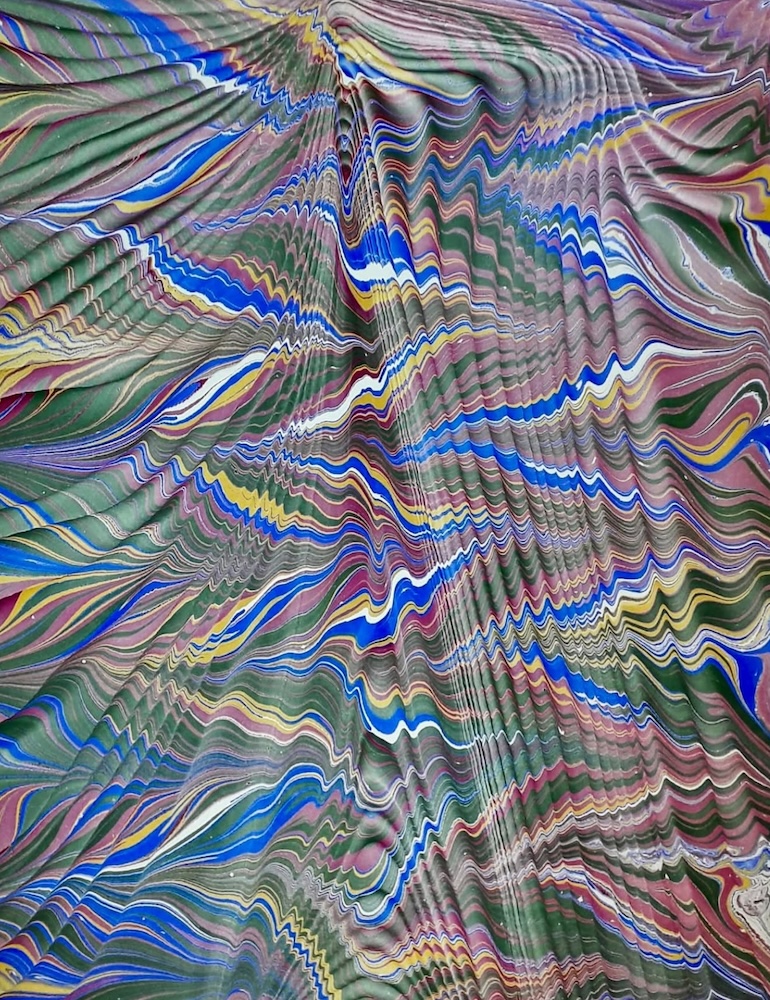
27.5 inch x 19.5 inch
Natural pigment on water, transferred to paper
2024
AMM. Your work emerged within the intimate environment of family and memory, yet it now circulates globally through exhibitions and workshops. In what ways has migration — particularly your move from Izmir to the United States — transformed the emotional and conceptual meaning of Ebru in your practice?
IN. Moving from Izmir to the United States changed the way I relate to Ebru. What once began as a quiet family practice with my father gradually took on a deeper meaning after I moved abroad. When you have something around you all the time, you don’t always realize its significance. But being away makes you more aware of what you carry with you, your culture, your childhood memories, your sense of home. Being far from home made me realize how deeply these feelings are connected to Ebru and how this art carries pieces of one’s identity across places.
At the same time, sharing Ebru through exhibitions and workshops revealed the unifying power of art. Even when people come from very different cultures and backgrounds, they often experience the same sense of calm and fascination when they watch colors float across water. In that moment, language and distance seem to disappear.
For me, Ebru has become a bridge connecting my past and present while also bringing different cultures together through a shared experience of beauty and curiosity. I see this especially in workshops, where the moments that first surprised me, seeing the pigments float on water and then transfer to paper, create that same wonder and joy for others. Those are the magical moments that spark curiosity and connection, both in myself and in the people I share the art with.
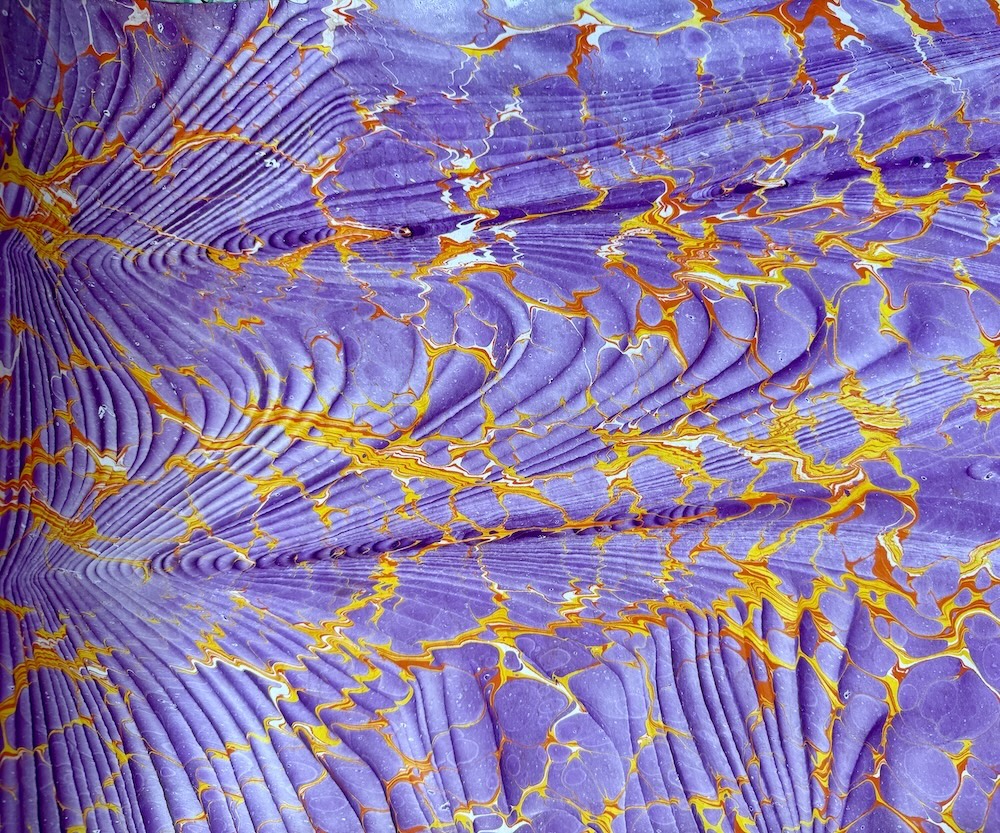
19.5 inch x 27.5 inch
Natural pigment on water, transferred to paper
2025
AMM. Unlike many contemporary artistic mediums that prioritize permanence and control, Ebru begins with a fleeting moment — pigments floating on water that exist only briefly before being transferred onto paper or textile. Do you see this ephemeral stage as carrying a philosophical dimension about time, impermanence, or the nature of artistic creation?
IN. Yes, I think that brief moment on the water carries a strong philosophical meaning as a reflection on time and impermanence.
In Ebru, as the pigments are fluid on the water surface, the composition first exists in a fragile and temporary state as the pigments float, expand, and interact in ways that cannot be completely predicted. Up until the moment the paper touches the surface, the paint continues to change. When the paper is laid down, it captures only one instant from a constantly shifting surface. A movement that when captured becomes forever still. The artwork becomes a record of that specific moment.
Because of this, Ebru invites a different relationship between the artist and the work. The artist prepares the colors and guides their movement, but the water also plays an active role. Creation becomes a dialogue rather than complete control. In that sense, the ephemeral stage highlights the beauty of uncertainty and reminds us that artistic creation can emerge from collaboration with natural forces rather than strict mastery over them.
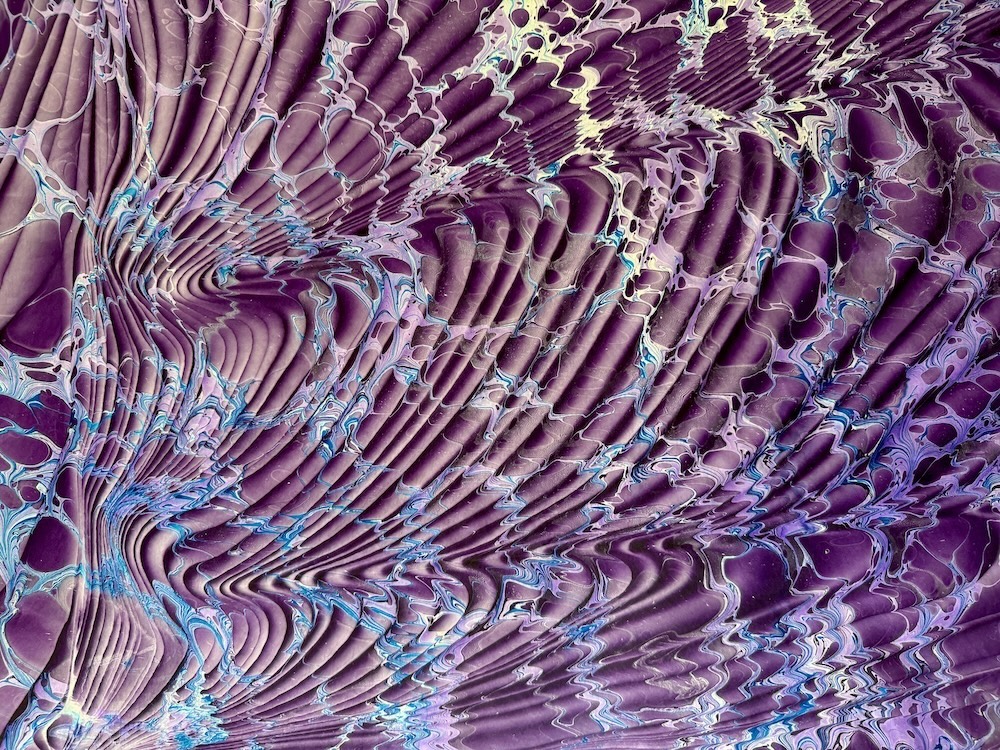
19.5 inch x 27.5 inch
Natural pigment on water, transferred to paper
2025
AMM. You frequently describe Ebru as a meditative and communal practice, something that historically unfolded within the space of family and now extends to workshops and public engagement. How do you see the act of teaching Ebru shaping the meaning of your work, and can the transmission of a traditional technique itself become a form of artistic practice?
IN. When I think of workshops, I often remember teaching kids first. It’s so special because they’re seeing and learning everything for the first time. Everything I show them is completely new. I see a similar experience with adults too, especially in the US, where many have never seen Ebru before. That first encounter creates a shared sense of wonder and joy.
Workshops also bring peace. People often leave feeling happy and fulfilled, even after just an hour session. What I usually do is set up tables with different paint colors and organize stations where groups of four or five can work together. They watch each other, share tools like jars and metal sticks, and help one another. That sharing naturally creates connection and communication among the participants.
I walk around the tables, answering questions and guiding them as they experiment. The first moment of joy comes when they see the results of their own paints on paper. That immediate sense of creation is really magical.
Teaching Ebru has really deepened my understanding of my own work. It reminds me that the art is not only about creating beautiful images, but also about the shared experience, the connections, and the joy that it brings to people. In that way, guiding others through Ebru becomes a creative act in itself. Every workshop is its own living expression of the art, and the process of sharing the technique is just as meaningful as making the art myself.
Ipek Saracoglu began practicing Ebru at the age of four, learning the art from her father. After moving to the United States for college, her father’s Ebru lessons became a meaningful way to stay connected to home and family. Over the years, Ipek has shared this tradition by hosting dozens of Ebru workshops across New York State, including at Syracuse University, Niagara University’s Castellani Art Museum, and the University at Buffalo, among others. Her work has been exhibited in the United States, Italy, France, and Brazil.