FIFA’s new cultural home inside MOAD at MDC’s Freedom Tower
Written By Olga Garcia-Mayoral
In Miami, soccer isn’t simply a sport—it’s a shared language. It lives in park pick-up games and weekend league rituals, in the way entire neighborhoods pulse during international tournaments, and in the multi-accented chorus that rises whenever a goal breaks the air. That’s what makes “Unidad: The World’s Game”—a permanent exhibition created by the FIFA Museum and presented at the Museum of Art and Design (MOAD) at Miami Dade College’s Freedom Tower—feel so natural here. It isn’t trying to convince Miami that soccer matters. Miami already knows. Instead, the exhibition asks a more interesting question: how does the game become a global emotional infrastructure—one capable of carrying memory, identity, struggle, and joy across generations?
“Unidad” is built as a journey through football’s worldwide heritage and meaning, using historic objects, interactive stations, and immersive installations to trace pivotal moments in the sport’s evolution—while also spotlighting soccer’s development in the United States. And because it sits inside the Freedom Tower, the exhibition gains a second narrative layer: Miami’s most iconic symbol of arrival, belonging, and cultural transformation becomes the container for a story about the world’s most universal pastime.
A museum experience that plays like a game
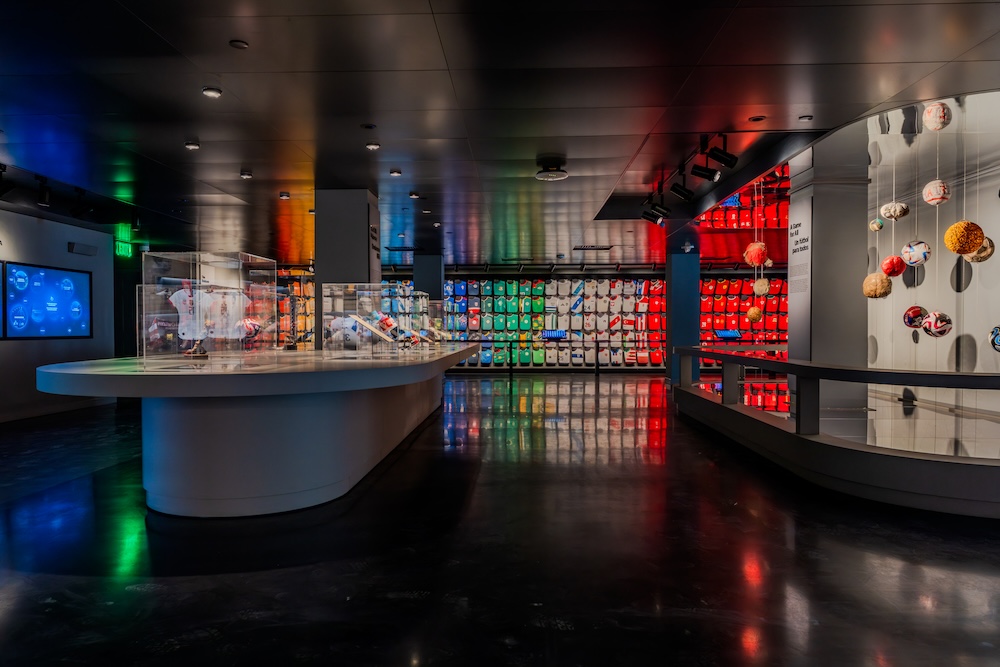
Unlike traditional trophy-room presentations that can flatten sports history into a timeline of wins and losses, “Unidad” is structured around the idea that football is, at its core, a connector between countries, communities, and personal histories. FIFA frames it explicitly as a celebration of the game’s ability to inspire, connect, and unite people across continents and generations, and MOAD/Freedom Tower presents it in that same spirit, as an exhibition where learning is physical and participatory.
The space itself signals ambition: the FIFA Museum describes “Unidad” as spanning two floors and occupying roughly 7,500 square feet, a scale that immediately shifts it from “pop-up” to institutional anchor. The exhibition is designed to be moved through the way you move through a match: scanning, noticing patterns, stopping at moments of intensity, then drifting toward the next narrative beat.
That interactivity isn’t decorative—it’s pedagogical. “Unidad” treats football not as an object of passive admiration but as a living system you can enter: its aesthetics (kits, graphics, design languages), its rituals (chants, fandom, collective memory), and its historic turning points rendered through media and objects that reward curiosity.
The Rainbow of Shirts: 211 identities, one field
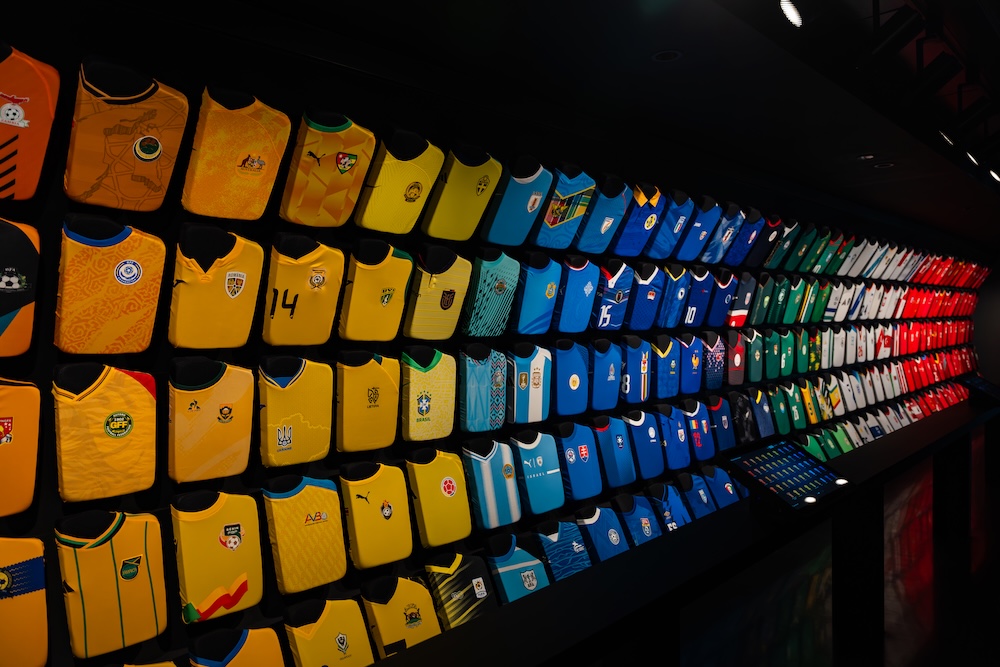
One of the exhibition’s central symbolic gestures is the “Rainbow of Shirts,” a display of jerseys representing all 211 FIFA Member Associations. It’s difficult to stand before that many national identifiers and not feel something shift. Jerseys are not neutral fabric—they are portable flags, emotional armor, family inheritance, diaspora shorthand. In a city like Miami—where so many people carry more than one homeland in their bodies—the Rainbow reads as both unity and multiplicity. It suggests that football’s global power isn’t built on sameness, but on the astonishing fact that millions of distinct identities can share one set of rules and still recognize each other in motion.
There is also a design lesson embedded here. A jersey is graphic communication: color, emblem, typography, and material engineering—design decisions that become shorthand for belonging. “Unidad,” housed inside MOAD at MDC, implicitly highlights how much the “beautiful game” has always relied on visual culture to transmit meaning.
Legacy of Champions: collective memory, projected at scale
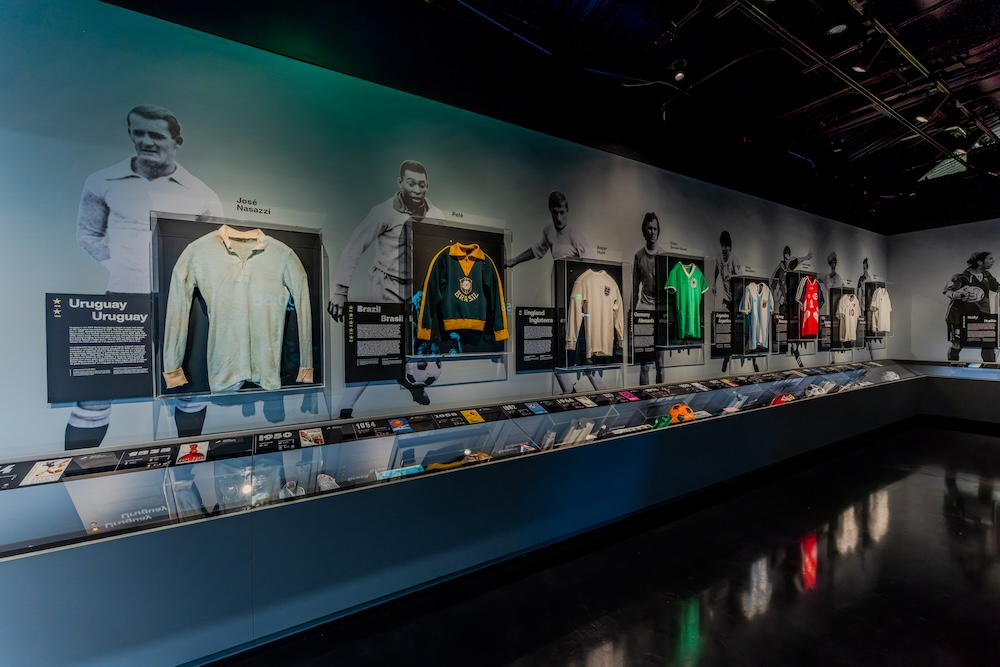
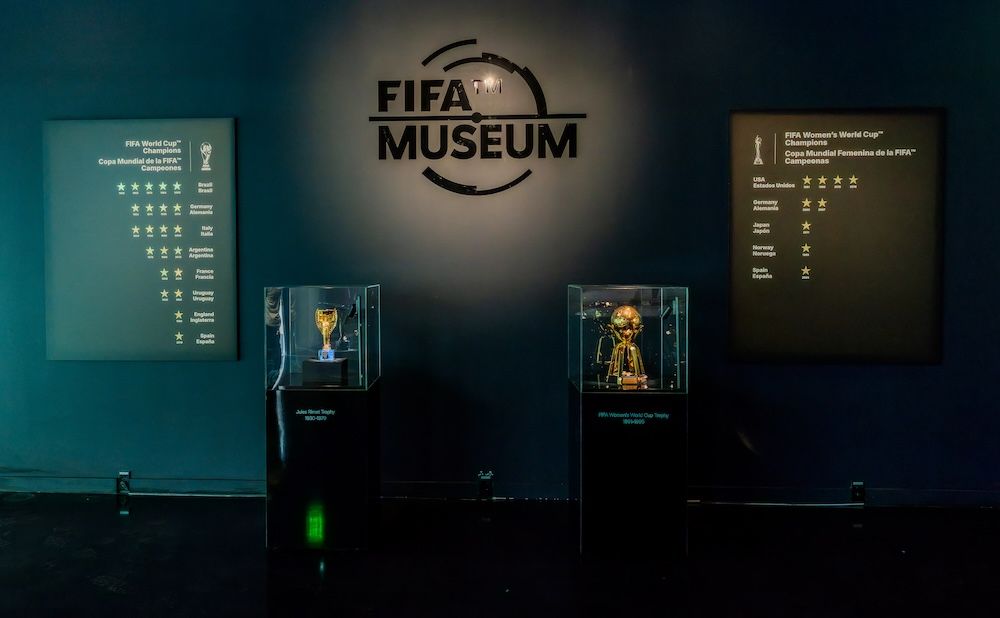
Another key section, described by the FIFA Museum as “The Legacy of Champions,” honors the nations that have claimed glory in both the FIFA World Cup™ and the FIFA Women’s World Cup™, using historical artifacts and large-scale audiovisual elements to celebrate the heroes, legends, and defining moments that move fans across generations.
That inclusion of the Women’s World Cup lineage matters. It places women’s football within the same monumental frame, not as an addendum but as a co-author of global football history. In an era when women’s sports are finally receiving overdue institutional visibility, “Unidad” makes the point through exhibition design: history is not just what happened—it’s what we choose to preserve, display, and teach.
Miami, the Freedom Tower, and the meaning of “permanent.”
“Unidad” is more than a touring show; the FIFA Museum itself has designated it as its first permanent exhibition in North America, a designation that carries cultural weight in the lead-up to FIFA World Cup 2026™ and beyond. Permanence is a kind of promise: that Miami is not only a host city or a fan destination, but a long-term site where football culture can be studied as heritage—where the sport’s artifacts and stories belong inside an institution, not just a stadium.
That decision aligns with the Freedom Tower’s evolving role as a cultural hub. Tourism and civic sites describe the Tower not only as a historic landmark but as a place where Miami’s layered narratives—migration, identity, art, and memory—are actively curated through exhibitions. In that context, “Unidad” reads almost like a civic mirror: a global sport installed inside a building that has witnessed waves of newcomers and the cultural reweaving of the city itself.
Soccer as culture, not commodity
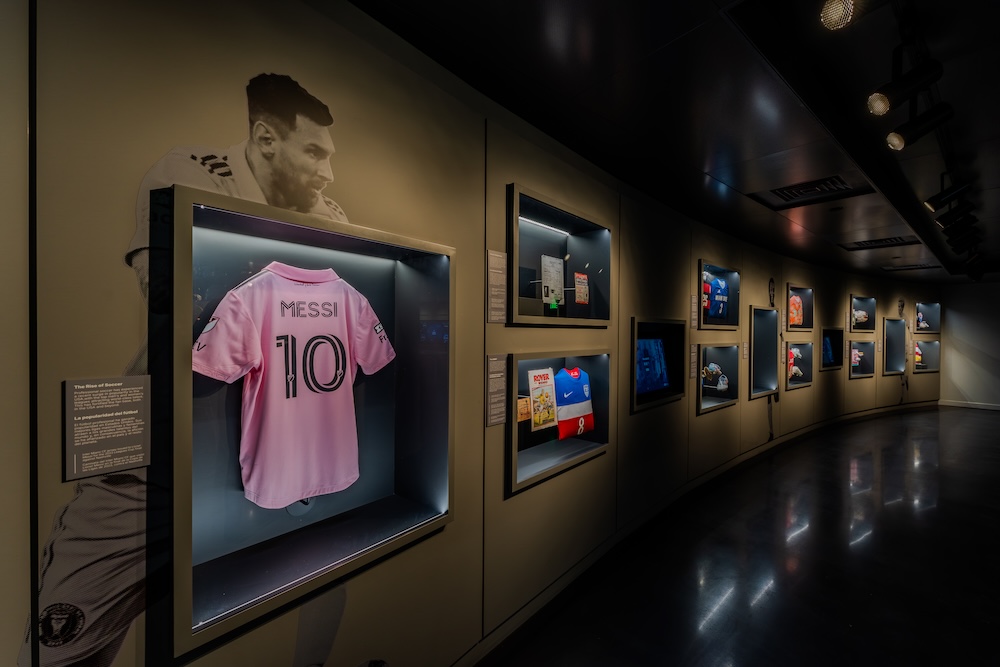
What “Unidad” does especially well is refuse the narrow framing of sports as entertainment only. It positions football as culture—a force that shapes music, fashion, language, photography, graphic design, and public life. The exhibition’s blend of historic objects and immersive media helps visitors understand the sport not just through championships but through how it feels: the intensity of collective anticipation, the way a single moment becomes a memory shared by millions. These rituals make strangers into allies for ninety minutes.
For Miami audiences, that framing is instantly legible. Miami is a city where cultural identity is practiced daily—through bilingual conversation, neighborhood festivals, family traditions, and the ongoing choreography of diaspora life. “Unidad” links that mosaic explicitly to the “world’s game,” presented in partnership with MDC and described as connecting the global passion for football to Miami’s cultural diversity.
A museum built for many kinds of visitors
Because “Unidad” is designed around interactive and immersive elements, it also functions as a gateway exhibition. This experience can welcome visitors who might not typically enter an art-and-design museum. That matters for institutions like MOAD at MDC, which sits at a crossroads of education, civic memory, and public culture.
A great permanent exhibition should do two things at once: serve as an accessible entry point for first-time visitors and sustain repeated visits with new details each time. “Unidad” is built for that. It’s a show you can visit as a family and enjoy at the level of play, then return to as an adult and read through deeper layers: geopolitics, migration, identity, gender, design history, and how global narratives are constructed through iconic moments.
Why “Unidad” matters now
With the World Cup coming to North America, it’s easy for football culture to be reduced to marketing and mega-events. “Unidad” offers something quieter and more durable: an argument for football as a shared human archive.
The FIFA Museum has positioned the Miami exhibition as part of a broader effort to safeguard football heritage while engaging diverse audiences, and it explicitly links “Unidad” to the idea of legacy—something meant to remain after the tournament spotlight moves on. That goal feels especially resonant in Miami, a city that constantly negotiates what it chooses to keep, commemorate, and build anew.
In the end, “Unidad: The World’s Game” succeeds because it understands what fans already know: football is never only about the ball. It’s about the people around it—the ones who carry jerseys across borders, the ones who teach their kids to love a team as a kind of inheritance, the ones who find community in a chant, the ones who feel at home for ninety minutes even if they’re far from home.
And perhaps that’s the deepest fit between exhibition and site. Inside the Freedom Tower—Miami’s monument to arrival—“Unidad” reminds us that belonging can be built in many ways. Sometimes, it’s built through papers and policies. Sometimes, it’s built through art and memory. And sometimes, it’s built through the simplest global ritual of all: a game where everyone, everywhere, understands what it means when the net moves.