As New World School of the Arts celebrates its 40th anniversary, an intergenerational exhibition brings alumni, students, and faculty together and reveals the creative relationships that continue to shape Miami’s cultural landscape.
An artistic legacy cannot be measured solely by its graduates’ celebrated careers or the works produced in its classrooms. Its deeper significance often emerges through relationships that endure long after students leave an institution—friendships, mentorships, artistic collaborations, and shared experiences that quietly shape a city’s cultural identity.
At New World School of the Arts (NWSA), these connections become the subject of Living Networks, an exhibition on view October 24 through November 10, 2026, at the New World Gallery in downtown Miami.
Curated by Virmari Garcia-Davila and Dean O. Gustavo Plascencia, the exhibition celebrates NWSA’s 40th anniversary through an ambitious gathering of artworks by alumni, current high school and college students, and practicing artist-educators, alongside archival materials documenting the institution’s evolution.
Rather than presenting four decades as a completed historical narrative, Living Networks approaches the school’s legacy as something continually unfolding.
Each artist represents an individual creative journey, yet every journey remains connected to a much larger cultural ecosystem.
Rediscovering an Artistic Community
The exhibition began with a seemingly simple ambition: reconnecting the generations of artists who had passed through NWSA.
Last year, Plascencia began reaching out to former students using alumni databases that were often outdated or incomplete. Gradually, responses arrived from about 150 alumni from different decades, artistic disciplines, and geographic locations across the United States and beyond.
What emerged was a remarkable portrait of an artistic community whose influence extended far beyond the school’s downtown Miami campus.
For Garcia-Davila, herself an NWSA alumna, the project revealed something she had increasingly noticed while navigating South Florida’s galleries and cultural spaces: many accomplished artists shared an educational connection without necessarily knowing one another.
Their artistic paths had crossed through exhibitions, institutions, and creative communities, yet they often didn’t recognize their shared origins.
The exhibition made those relationships visible.
As Garcia-Davila explained during our conversation, the intention was to celebrate artists across generations while creating new opportunities for them to reconnect through the language they understood best: visual art.
Her motivation was both professional and personal.
“Not only am I an artist, but I’m someone who really cares to bring people together as much as possible,” she reflected.
That conviction became the foundation of Living Networks, transforming the exhibition from an anniversary celebration into an active exercise in cultural reconnection.
Curating Forty Years of Artistic Expression
Selecting works that represented four decades of artistic education was a significant challenge.
Garcia-Davila and Plascencia reviewed more than 250 images from over 90 applicants, encountering an extraordinary variety of media, artistic approaches, and personal histories.
The challenge was not simply identifying compelling works, but deciding how to represent a community whose creative possibilities could never fit in a single exhibition.
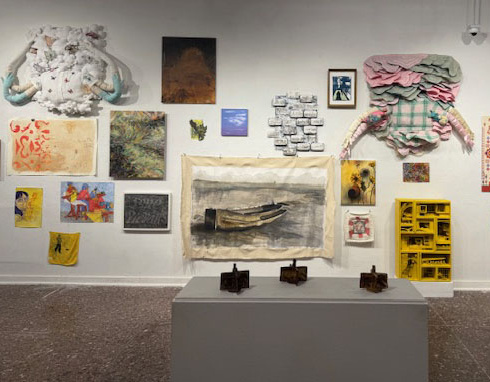
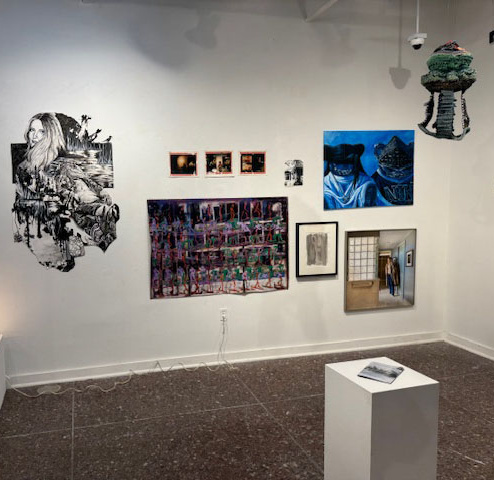
Their solution was a salon-style presentation, allowing numerous works to coexist across the gallery walls.
The resulting installation embraces visual abundance.
Paintings, drawings, photography, sculptural objects, and mixed-media compositions form an intricate arrangement of contrasting scales, colors, textures, and artistic languages. Monumental works share space with intimate images, while objects displayed on pedestals extend the conversation beyond the walls.
This curatorial approach feels particularly meaningful.
Rather than establishing a rigid hierarchy between emerging and established artists, the exhibition lets different practices share a visual environment.
A work created by a student can enter into dialogue with one by an artist who has spent decades developing a professional practice.
The arrangement encourages visitors to discover connections through proximity, even when the works themselves differ considerably in subject, medium, or intention.
The gallery becomes a metaphor for the institution: an environment shaped not by a single artistic voice, but by the accumulation of many.
A Curator’s Own Creative Evolution
For Garcia-Davila, Living Networks also represents an important moment in her professional development.
According to Plascencia, this is her first opportunity to develop and curate an exhibition from beginning to end, adding another dimension to NWSA’s commitment to creating professional opportunities for its alumni.
The experience required her to navigate the complex responsibilities of curatorial practice, from evaluating submissions and developing an exhibition concept to establishing relationships between artworks and considering how audiences would encounter them.
For an artist accustomed to creating her own work, the transition toward shaping a collective artistic narrative introduced new responsibilities.
“It meant that I had to trust myself in this process,” she explained, describing how the selection evolved through careful observation and the emotional and visual qualities that drew the curators toward particular works.
Her perspective as a practicing artist became essential to that process.
She understood the labor, uncertainty, experimentation, and personal commitment behind artistic production. Rather than emphasizing institutional prestige or career accomplishments alone, she wanted to acknowledge the creative dedication present at every stage of an artist’s journey.
In this sense, the exhibition reflects an expanded understanding of what artistic success can mean.
The Artist at Every Stage
One of the exhibition’s most compelling ideas is its recognition that artistic development does not follow a single trajectory.
Students, emerging artists, established professionals, and educators inhabit different circumstances, yet each remains engaged in the ongoing process of discovery.
Garcia-Davila spoke candidly about the self-doubt that can accompany these stages, whether an artist is beginning to develop a personal language or has spent decades sustaining a practice.
For her, Living Networks offers an opportunity to affirm that creative work possesses significance regardless of the maker’s professional standing.
Including current high school and college students is especially important.
Young artists encounter work produced by earlier generations of NWSA graduates, gaining a tangible understanding of the many directions an artistic education can lead.
Equally meaningful is recognizing faculty members who balance teaching responsibilities with their own creative practices.
Their participation reminds visitors that mentorship is not a one-directional relationship. Educators remain artists themselves, continually experimenting, questioning, and contributing to the broader cultural landscape.
Archival materials add another dimension, inviting visitors to consider how the institution’s teaching philosophies, creative approaches, and artistic communities have developed over time.
Rather than functioning as static historical records, these documents become part of an ongoing exchange between memory and contemporary practice.
Beyond the Gallery: A Legacy That Continues
The opening gathering vividly expressed the exhibition’s purpose.
Visitors moved through the densely arranged installations, paused before artworks, exchanged observations, and reconnected with familiar faces. Conversations unfolded among different generations, giving physical form to the network the exhibition seeks to illuminate.
For Garcia-Davila, this sense of belonging matters because artistic practice can often feel solitary.
“Sometimes being an artist feels so isolating,” she observed, emphasizing the importance of remembering that a larger creative community exists beyond the studio.
That recognition may be the exhibition’s most enduring contribution.
As New World School of the Arts commemorates four decades of artistic education, Living Networks shifts attention from individual achievement toward the collective relationships that sustain creative life.
Its significance extends beyond documenting the past. By reconnecting alumni, introducing current students to practicing artists, and giving Garcia-Davila an important curatorial opportunity, the exhibition actively creates the relationships it celebrates.
Forty years after its founding, NWSA’s legacy is not confined to its archives, classrooms, or gallery walls. It continues through artists who carry their experiences into Miami’s cultural institutions, independent studios, and creative communities worldwide.
Living Networks reveals that an artistic education is not simply a chapter in an artist’s life. It begins a relationship that can continue to evolve, inspire, and connect generations.
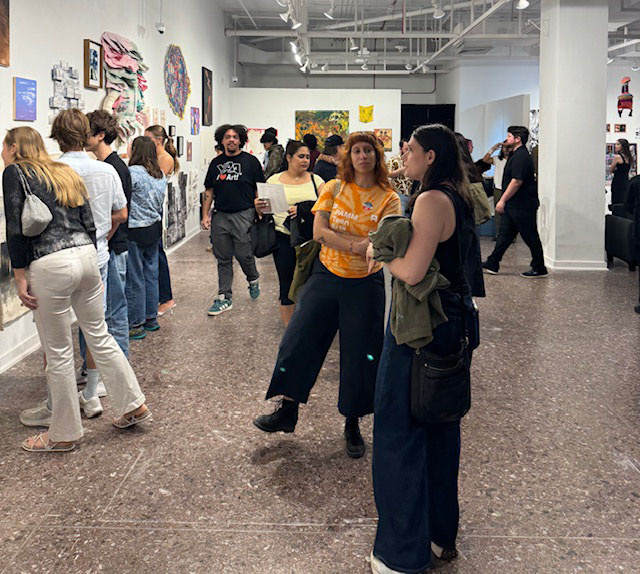
Caption: Members of the New World School of the Arts community and visitors come together at Living Networks, celebrating the artistic connections cultivated throughout the institution’s 40-year history. The exhibition creates opportunities for dialogue, reconnection, and new relationships among generations of artists. Photo credit: Dean O. Gustavo Plascencia. Courtesy of New World School of the Arts.
Exhibition Information
Living Networks
October 24–November 10, 2026
New World Gallery, New World School of the Arts
25 NE 2nd Street, Lobby, Miami, FL 33132
Free and open to the public. Gallery hours: Monday–Friday, 9 a.m.–4 p.m.For more information, visit nwsa.mdc.edu.