Kenneth C. Griffin Basquiat Collection
Power, Capital, and the Afterlife of Image
The collection assembled by Kenneth C. Griffin around the work of Jean-Michel Basquiat is not merely a concentration of masterpieces—it is a statement about the evolving relationship between cultural value and financial power in the 21st century. With acquisitions exceeding $500 million, Griffin’s holdings represent one of the most significant private consolidations of Basquiat’s oeuvre, centered on the artist’s pivotal year: 1982.
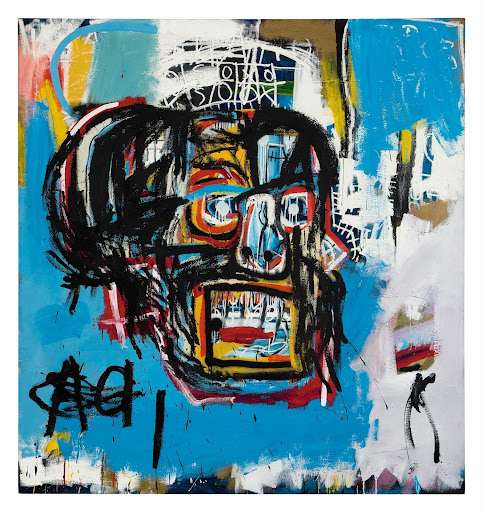
At the core of the collection stands Untitled (Skull), acquired for approximately $200 million. This painting is not simply an icon of the market; it is a visceral anatomy of consciousness—where the skull becomes both mask and map, oscillating between mortality and transcendence. Alongside it, Boy and Dog in a Johnnypump embodies Basquiat’s capacity to fuse play and violence, childhood and urban tension, within a single pictorial field.
Works such as Pez Dispenser and In Italian further reveal the artist’s linguistic and symbolic density—where text fragments, anatomical diagrams, and historical references collide into a charged semiotic system. In Untitled (Tenant), the skeletal figure emerges as a bearer of socio-political weight, inscribed within structures of power and displacement.
Griffin’s role extends beyond acquisition. Through Griffin Catalyst, he has facilitated institutional access to Basquiat’s work, supporting exhibitions that reposition the artist within broader cultural dialogues.
Yet, this collection also raises critical questions: What does it mean for works born from resistance, marginality, and critique to be absorbed into the highest tiers of capital? Perhaps the paradox is inevitable. Basquiat’s work, after all, was always about power—its construction, its symbols, and its contradictions.