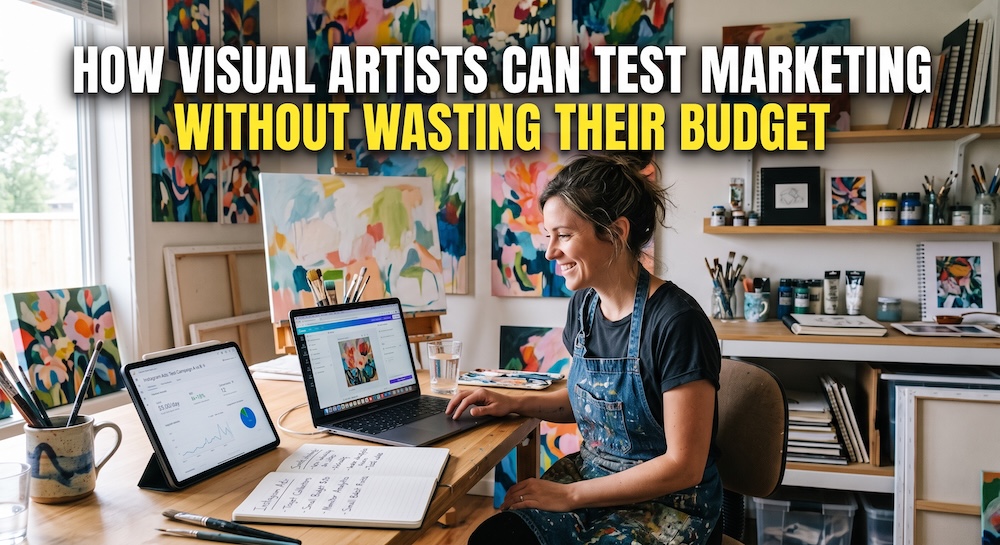
For many visual artists, marketing creates an uncomfortable contradiction. Artists understand that visibility matters, yet they often hesitate to invest in promotion because the results can feel difficult to measure. Posting on Instagram, running an advertisement, appearing in a publication, sending a newsletter, or promoting an exhibition all require time—and sometimes money—but how do you know whether any of it is actually working?
Three questions should guide almost every marketing decision an artist makes:
How do I measure it?
How much should I spend?
Am I simply reaching the same people I already reach elsewhere?
These questions are not signs of uncertainty. They are the foundation of a more intelligent marketing strategy.
Measure What Matters to Your Career
Artists sometimes make the mistake of measuring success only through likes and followers. These numbers can provide useful information, but they rarely tell the whole story.
A marketing campaign should be measured according to its objective.
If your goal is visibility, look at reach, profile visits, website traffic, and the number of new people discovering your work.
If your goal is building professional relationships, pay attention to inquiries from collectors, galleries, curators, journalists, designers, consultants, or institutions.
If your objective is selling work, then inquiries, qualified leads, studio visits, and actual sales become more important than social-media engagement.
The central question is not simply, “How many people saw my work?”
It is:
“Did the right people see my work, and did that visibility lead to something meaningful?”
An artist with 5,000 highly relevant followers may ultimately have a stronger professional network than an artist with 100,000 followers who have little connection to contemporary art.
Do Not Start With a Large Budget
Artists do not need enormous advertising budgets to understand whether a marketing channel works.
Start with a controlled experiment.
Instead of committing significant resources immediately, run a small campaign alongside what you are already doing. Continue using Instagram, your website, exhibitions, email, editorial coverage, or whichever channels currently form part of your strategy.
Then introduce one additional promotional channel and compare the results.
The purpose of the first campaign is not necessarily to sell artwork immediately. Its first purpose is to learn.
Which images attracted attention?
Which audience responded?
Did people visit your website?
Did they spend time looking at several works?
Did they follow your Instagram account?
Did someone contact you afterward?
This information has value because it allows the next campaign to become more precise.
A small test can teach you more than a large campaign executed without a clear strategy.
Think About Audience Overlap
One of the least discussed problems in art marketing is audience duplication.
An artist may promote the same exhibition through Instagram, Facebook, email, and several online platforms and assume that each channel is introducing the work to an entirely new public.
Often, however, many of the same people are seeing the message repeatedly.
Repetition itself is not necessarily negative. Familiarity can strengthen recognition. But artists should distinguish between frequency and incremental reach.
Frequency means the same audience encounters your work several times.
Incremental reach means your campaign introduces your work to people who were not already encountering it elsewhere.
For a developing artist, incremental reach can be particularly valuable.
The objective should therefore not be to abandon existing platforms, but to identify channels capable of expanding the artist’s professional ecosystem.
A contemporary-art publication may reach a different audience from Instagram. An art fair may introduce the artist to people who never subscribed to the artist’s newsletter. A targeted digital campaign may reach architects, collectors, interior designers, or cultural professionals who were previously outside the artist’s immediate network.
Each channel should perform a different function.
Stop Thinking About Marketing as a Single Campaign
Perhaps the most important shift is conceptual.
Artists often approach promotion episodically:
“I have an exhibition, so now I need marketing.”
A stronger approach treats visibility as part of an ongoing professional practice.
An exhibition creates content.
An interview creates credibility.
A magazine feature creates documentation.
Social media distributes that documentation.
A website archives it.
Search engines make it discoverable.
Email maintains the relationship.
One channel reinforces another.
Marketing therefore becomes less about advertising and more about constructing a recognizable professional presence over time.
The Question Is Not Whether Artists Should Market Themselves
Contemporary artists operate inside an extraordinarily crowded visual environment. Thousands of images compete for attention every minute, and artistic quality alone does not guarantee discovery.
This does not mean that artists should become marketers instead of artists.
It means they should understand how visibility works.
A thoughtful marketing strategy does not replace the work. It creates more opportunities for the work to be encountered, studied, remembered, and discussed.
Start small. Measure carefully. Compare audiences. Learn from the results.
Then invest more heavily only in the channels that genuinely expand your reach.
For artists, the most valuable marketing question may ultimately be very simple:
Am I merely being seen more often—or am I being seen by people who did not know my work before?
Referencias principales
- Batra, R., & Keller, K. L. (2016). Integrating Marketing Communications: New Findings, New Lessons, and New Ideas. Journal of Marketing, 80(6), 122–145.
- Rogers, R. (2021). After Vanity Metrics: Critical Analytics for Social Media Analysis. Oxford University Press, pp. 271–290.
- Prasad, A., & Sethi, S. P. (2009). Integrated marketing communications in markets with uncertainty and competition. Automatica, 45(3), 601–610.
- Nielsen (2024). Why do we need cross-media measurement?
- Nielsen (2019). Understanding Campaign Audiences Across TV + Digital.
- Google Ads. Test with confidence with the Experiments page y documentación de Campaign Experiments.
- Art Basel & UBS / Arts Economics. Survey of Global Collecting 2025.
- Art Basel & UBS / Arts Economics. The Art Market Report 2026.
- American Psychological Association. Mere-exposure effect.