I think I’d like to start the Q&A with the question that I thought interested me the most about the book. You talked a lot about basing characters on people you know in real life, and I wondered how that works; how much of the person you know goes into the character, and how do you piece together those inspirations?
I feel that I have so many prejudices. So if I create a character, I will dump on that character everything I think the character should be – and the results might be a caricature. They’re very flat. So I look for a human being that’s either someone I remember from the past, or someone that is around; I look for the person that might be the model.
That doesn’t mean I will use every piece of information. It’s like an outline that I will fill in later. And sometimes I pick up two people to create a character. Because I can have one personal that physically and the way they talk and whatever is what I want, but their life is not what I want. And so I might put somebody else’s life into that.
Because it’s fiction and I’m turning it around any way I want, I don’t think there’s any liability there. It’s totally different in a memoir when you mention someone with that person’s name and that person can be recognised. Then you have to be very careful, but in fiction, as long as you disguise and change the name or whatever, it’s fine. People might be offended anyhow; you are not liable.
A lot of your books are historical. When you’re deciding when and where to set a book, are you drawn to specific historical events? Or does it come to you in terms of an emotion or feeling you want to evoke in the book?
It depends. Sometimes I don’t even know why I’m writing a book about a certain time and place that has nothing to do with me. For me, the best example is a novel I wrote some time ago called Island Beneath the Sea. It is the story of the slave revolt in Haiti.
In Chile, we never had plantations, we never imported African slaves. Culturally, I have nothing, no connection at all. With the event, or the country, or the race. But I wasn’t even looking for that [at first]. I wanted to write about the pirates of the Caribbean. Because it was a democratic society, the first truly democratic society. So I thought, oh, that’s a fascinating thing. So I went to New Orleans because the Lafitte brothers, who were the great pirates of the time, had a colony of 3,000 people. So I thought I was going to investigate that, but when I got to New Orleans, I thought why, why is this so French? In food and everything. Because it was a French colony for a very, very short time. And then I discovered that it was a town of 2,500 people when the revolution started in Haiti. And then 10,000 white people, with some of their domestic slaves, escaped to New Orleans in a matter of months. So the input was four times the population, and they were French. So that really left a big input in the city.
And so I thought, why did they escape? And then I started investigating Haiti. And that was a much more fascinating story than the Pirates of the Caribbean. Then I spent four years researching and writing. And it was a very hard book to write, and I had no idea why I was writing it because, as I said, I had no connection. But when I finished the book, I realised the book was about absolute power with impunity. The power of the master over the slave.
That theme has been in my life always. I’ve always explored that: what power is and, when power has no accountability, what happens, the horrible things people do. And that can happen in the home, it can happen in the police station, it can happen anywhere. The bully in the school, whatever. So that, that has always fascinated me, and I realised the extreme example is slavery. So that’s why I was writing the book.
So you ask me, why do I choose it? Sometimes it’s a character. I wrote Ines of My Soul, which is about the conquest of Chile in 1541, because there was one, only one Spanish woman who came to the conquest. That woman, historians have ignored her, because historians ignore women. If you look at history books, there are no women and no poor people.
I suppose that story [of Ines Suárez] is an ultimate gift to a writer. It’s a person who has such an exciting life, but there’s very few concrete details, so you can fill it in how you please.
As a writer, if you can find a character like that, it’s wonderful. Because you can recreate the time and imagine how that person would be.
And when you’re doing historical novels, how do you manage the research?
You know, people who can write an outline can control the research, and I think I give the example in the book of Ken Follet. He writes an outline of 50 pages with every detail of each scene, and so he knows exactly what he has to research, and probably he has a team. I don’t know.
But I do my research alone. I don’t have an outline. I have no idea where I’m going. So I waste a lot of time, which is not a good idea. Before, I would pile up books with the research I had been doing, and then I couldn’t find where exactly I had seen something. Now I put post-its [in the books], but I also keep records, so I write down where I find things. That way, I can go and look for it.
[When I research], first I study the big event. Let’s say the Haitian Revolution. I read something that gives me a panoramic view of what happened. Who are the main characters, what happened, how, and I look at the map and I see exactly what it looks like. And then, I look for details. I read about how they imported bottles of Cuban rum. And then I find out that they didn’t come in bottles, they came in barrels. So the detail is what makes the story believable. And so focus on the little details. You don’t have to have a lot, but just a few. Little things, for example, you’re talking about wigs. How itchy, and how dirty, and many of them would have lice. So you would wear this hot, sticky thing on your head all day, I mean, it was just horrible.
What’s your favourite historical period to write about? Are there any that you keep coming back to?
No. I realise that if I go back in history to the 1500s, it’s easier. Because people know less, the reader knows very little about that. So anything I discover, anything I research, anything I write is a surprise for the reader. But if I write about the Second World War, there’s a mountain of books and novels and movies and documentaries and photography. There is so much that unless you come up with something that is totally original, for me it doesn’t work that much. Unless you specialise in a period, but I don’t.
So right now, I have a story in my head. And I want to put it in some time and place, and I have to choose. Where am I going to do it? That will determine everything, it will determine the research, but it will determine the characters, too.
What helps you make that choice, or is it one that comes spontaneously?
Both, yeah. I research, I mean, I look around and ask myself what do I want to do? But eventually, it’s your gut that tells you.
I have an inkling of this from reading the book, but your writing discipline, how does that work? Do you find that it helps to have a discipline?
My lord, how can you do anything without discipline? I mean, what can you do without discipline? Sex is the only thing. But in writing, it’s essential.
There’s this myth that writers get inspiration from the muse, and they sit down, and the pour out the great American novel. That doesn’t happen. It’s work. You research, you write, you rewrite a thousand times. So what I tell young people who want to write is to show up.
The first step is to show up in front of your computer and put something down. You can always correct something that you have written, but you cannot correct a blank page. Or a blank screen. You need to have something, and that comes, even if you’re not inspired, from showing up, from discipline.
So I start all my books on January 8th. Why? Because I have a complicated life. I’ve always had a complicated life. So I need to organise my calendar for the year, so that at the beginning, when I start a book, I don’t travel. I don’t socialise. I really need to have a grip on the story before I get out in the world.
By having a time to start, I can organise my life and everybody knows that on January 8th, I’m not available. My family, my friends, my agents, the only people who don’t are the dogs, but the rest, by now, I’ve been writing for 45 years and I’m 84 years old. People respect me.
So let me show you something.
[Isabel gets up and returns with a little sign. I can’t recall the exact words on it, only that it has a drawing of a dog on it and something to the effect of ‘do not disturb’].
I hang this on my door. Nobody knocks at the door. Nobody offers me a glass of water. The house might be on fire, but I have no idea. The door is closed.
If you don’t respect your own work, nobody does.
The other thing I get a lot is [people saying] well, I don’t have a place of my own. I don’t have a room of my own. I work.
Okay, you reserve some time. One hour, two hours, three hours, as much as you can. Every day, that is your sacred time, your sacred space for your writing. And it doesn’t have to be a room. It is a room inside your head. It is a space you create inside you that allows you to do that. I wrote The House of the Spirits, 560 pages, on the kitchen counter in our apartment in Caracas. And I worked 12 hours a day, I had two shifts. So I would get home, prepare food for my family, have a shower, and when everybody was watching TV, I would lock myself in the kitchen, because it was the only room that would be empty at that time of day, except the bathroom.
My second book, I took all the clothes out of a closet, put a board in, and put a lightbulb in. And I had a space of my own, because I could close the door, and the book was untouched. Safe.
That’s what I thought was so impressive. The story of [how you wrote] The House of the Spirits and how you managed to fit all that in, because it’s such a good antidote to people saying I never have the time.
At that time, my life was going nowhere. I was going to be 40 years old. I felt that I had done nothing. I was living in exile. We didn’t have much money. My kids were going to university so I didn’t have to take care of them so much, and I was working like crazy in something that I didn’t like at all. Administering a school – I am terrible at that kind of stuff! And that was my life. So I started writing, I think, out of boredom and catharsis.
I don’t know what happened. It was just a sort of miracle, and it saved my life. That year was fantastic. It was a schizophrenic year in which I was working like a housewife, and then at the school and whatever, and then I had this private room in my head where this thing was happening. And these characters and these stories and everything was happening magically.
For me, every book starts with a really bad two or three weeks, in which I feel that I’m working in sand. Nothing happens, and every page I write, I have to delete the next day. It’s useless. But I know that it’s part of the process, that I’m finding my way, that in two or three weeks, one of the characters will do something that will surprise me or, because I have the book in my head all the time, something will occur to me, or I will have a dream that will guide me in a certain direction, or I will overhear a conversation in a restaurant and will say ‘ah, that’s it’. And then you start.
Once you’ve got most of a story, how do you work out when it’s finished?
I think that’s the other big problem. That’s hard. I am very sceptical of happy endings. I want realistic endings. Possible endings. And life is complex, contradictory, and never clear. So ambiguous endings are usually better for me.
Sometimes, I’m thinking of an ending. I know that I have told the story, and I’m thinking, thinking of an ending. And then I get it. I come to my computer, and I realise that the book ended the day before. That anything I add will subtract. So I… now I have developed an eye for that. But when I wrote my first few books, especially my short stories, my mother would read them, and she would tell me, ‘this ends here’. And she would be, in that sense, a very good editor.
I don’t share my writing with anybody. I did share it with her, because we were so close, because she spoke Spanish.
And do you think having a collaborator or editor is important, to iron out the things that you maybe can’t see by yourself?
I don’t know because I’ve never done that. I write a book, a novel, let’s say, and when I think it’s finished, I share it with my agent, who speaks Spanish. Before, I’d share it with my mother and maybe my brother. But I didn’t really have editing, because in the United States, we have this tradition of the editor working very closely with the author, but that’s not the case in Spanish. In Spanish, you submit your book, it’s accepted or not, but the input is minimal.
In my case, from Spain, I get the input of correcting things they call Anglicisms, which is when the sentence is not really Spanish, it’s translated from English. Because I live in English; sometimes I get all mixed up, so they correct that, they correct spelling and grammar, that kind of stuff. But not the content.
For the last almost 10 years, I have had a Spanish-speaking agent who was an editor before, so she has an eye, and we share the book, but only when it’s finished. And then I always ask her to find the title, because I’m terrible at finding titles. When I was a journalist, I couldn’t put a title on my own reporting because I was so bad. So she helps me with that. And also, because she has an eye – I wrote a book called Long Petal of the Sea, and the book started, when I wrote the first manuscript, with a man who is old, and he’s remembering. And she said, ‘why would you start with the most depressing part? Leave that for the end and start upbeat. Something that will engage the reader’. Which was exactly the second chapter. So it was just a matter of picking up the first chapter and putting it at the end. But she got it, and it changed the book.
Does it feel different when you’re writing a book in Spanish and it then gets translated into English? Do they feel like two different books?
You know, I don’t know if you speak another language [the interviewer, shamefully, does not!], but languages are like blood, so personal, so cultural.
Some things are not translatable. You have to adapt them. I had a very good translator for 19 books, and we had a psychic connection. She was excellent. And she was from Kansas. This completely white, American lady, descended from the Puritans – and me, can you imagine? But we had this connection. And she would call me and say, you know, this love scene, I would tone it down. And I say, sounds so good in Spanish, but she says, in English it’s suspicious. No lover would say those things in English. She would tone it down.
That’s interesting. There are things that different languages think of differently, aren’t there?
Yeah, you know what doesn’t work? Humour. Because humour is very… It belongs to a place and a time. I wrote humour for years when I was a journalist. And many times, I have been offered to make a book out of my columns, but it doesn’t carry in time. What was funny in the 60s makes no sense today. You need to have the references. You need to be living at the moment so that it’s funny. For example, now there’s all these jokes about Trump, which will not be funny later and they were not funny before. They’re funny now.
Yes, hopefully sooner rather than later, they will pass into irrelevancy.
I hope he dies. You have no idea how awful this is. Because we are bombarded day and night with awful stuff. Awful stuff. He has made two billion dollars in a year and a half. The corruption is rampant. They don’t stop it in Congress, or the Supreme Court, it’s just appalling.
There was a question I had at the end of my list, but I think it works now. Looking at the world today, I mean, I wasn’t alive in the 60s etc so I can’t say how it compares, but I know there are a lot of people who are scared and angry at the state of the world, and maybe scared and upset about writing too, afraid to write in this climate. What would you say to those people?
It’s hard to write about an event as it’s happening. The great literature of the Second World War, of the Holocaust, came much later.
We had a military coup in Chile and censorship for 17 years. You couldn’t write anything. But after the event, and not soon after, sometimes a long time after, there is this wave of literature and movies and documentaries, of looking at the event, looking at what happened and trying to understand it. Why it happened, how it happened, all the angles. But for that, you need distance. I think literature needs distance and irony.
Sometimes a memoir works, when it’s very raw, in the moment when it’s happening. It happened to me, for example, with my book Paula, which is a memoir of my daughter’s death that I started writing a month after she died. It was cathartic for me. It was therapy for me. And sometimes that works, but not always. There’s this beautiful book called A Year of Magical Thinking. Um, who’s the author? Joan Didion, ah. Her husband died suddenly, and for a year, she’s thinking that he’s around. She’s imagining him. And the book is beautiful, just beautiful, but that’s rare.
I divorced my second husband in 2015, that’s now 11 years ago. In 2025, I decided to write a memoir about the end of love, a time alone and finding love again at an old age. And I couldn’t remember for my life, why I had divorced this man that was so nice – well, he wasn’t that nice, but I had forgotten how not nice. Because I tend to change everything in my mind. But I needed 1o years to go back to what had happened and look at it as a story.
It doesn’t hurt me. I don’t care. It’s not me anymore. It’s another person that lived 10 years ago. And with that distance, it’s much easier.
I wrote The House of the Spirits, which is about my family and the military coup, many years after the coup. The coup was in 1973. In 1974, I could have written that book, but I was immersed in the process, and then exiled. And in exile, you have to make a living first. And then it takes a long time to look back and start thinking about why you left. What would have happened if you didn’t leave? All the intricate consequences of every act, of every movement. You can see it from a distance, not in the moment.
How do you solve problems if you find yourself stuck in a book?
I skip it.
Well, first I try two or three times. A scene, or a chapter, or whatever, I try and try. It doesn’t work, so I skip all that and jump forward to some other place in the book. And I write something else, and then I go back. If I go back twice and I still can’t do it, it’s because it shouldn’t be there. So I know that it is not part of the book. And no matter how much I have worked on it, I am merciless when it comes to cutting.
That works for me very well when I’m stuck in a scene in a book. But if I am in a writer’s block, what helps me is that I was trained as a journalist, so I can go back to non-fiction. The thing is, keep writing. Keep writing. And so I give myself a subject, and I write something that I can just research and keep going.
When I wrote the book about my daughter, when I finished the book, I couldn’t write anything. I was totally empty, and like, for three years, I couldn’t write a thing. And then I remembered that I’m a journalist by training. I can give myself a subject. And so I gave myself a subject that would be as removed from grief, and death and sorrow as possible, something that would life me. I wrote a book about aphrodisiacs, which is the bridge between food and sex. Oh, it’s really about gluttony and lust. The two deadly sins that are worth the trouble, by the way! The research for that was wonderful, and it pulled me out of a very dark time.
Your books seem to span so many amazing genres, time periods and points of view. When you’re writing a book, do you decide in advance if it’s going to be 1st person or 3rd person, or is that something you figure out along the way?
Sometimes I change it. I just wrote a novel that is all in 3rd person. But then the last chapter, which is the epilogue, I wrote it in 1st person because I wanted to approach the reader.
I like 1st person very much because it has that intimate, conversational tone. But it is very limiting, because you can only know, as the narrator, what you have witnessed. What you were there for, what you heard.
I recently wrote a historical novel about a civil war in Chile in 1891. And it is told in 1st person, the narrator is a journalist, a woman journalist, which were very rare at the time. And she needs to describe the battles. So I need to put her inside the battle. How would that happen? She’s not a nurse. So I need to put her there with some excuse. And it’s manageable, you can always do that. But then I need to also tell this battle that is happening in another place simultaneously that affected this battle. How do I tell this battle if she wasn’t there? So I can do that in a conversation that happens after. She talks to a guy who was there, and in that conversation I inform my reader of what happened there.
But it’s limiting. Because the information she gets from that battle has to be in the voice of the other guy. And that creates a conflict.
Yeah, which can be a fun problem to solve, or it can become very annoying.
It’s annoying, but it’s fun. I think everything has a solution in literature. You just have to find it. You have to find the twist, the tone, the character. Something that is there. You will delete a lot, it doesn’t matter. In writing, that stuff happens.
One thing I wanted to ask you is about feminism and its place in your work. I don’t know whether you would consider your works ‘women’s literature’, or whether you think that’s a limiting category.
I think it’s limiting. Very limiting.
When we talk about literature without an adjective, that’s written by white men. Usually older white men. That’s literature. And then you add adjectives. African American literature, feminist literature, women’s literature, young adults, children, whatever, it diminishes immediately. It’s one step or two or three or four. And that bothers me. It annoys me a lot.
Yeah, I agree with you on that very much.
And I then I have very strong women in my books and I have stories about women that… why do I write about them? Because they’re fascinating. I wouldn’t write about a woman that has no life and that has done nothing. Why would I, well, woman or man?
I’m interested in extraordinary people who do extravagant things, who take risks, who suffer. There is no book in happiness and peace. What kind of book is that? We need conflict. And women who go through hell and survive, and get back on their feet and fight back, they’re fascinating to me because we live in a patriarchy. The world culture is against them, so the effort they have to make to survive is way bigger than any man. So that fascinates me.
By portraying them, I am, between the lines, saying how I admire strong women, independent women, courageous women. But I don’t have to say it. They are feminist in essence.
Yes, I think that’s really important. And I think writing strong women in historical novels is especially important because they had so many challenges to overcome. Finding ways to put women in the rooms where significant things are happening is such an interesting problem to solve.
Yeah. And women have always been there. In every battle, but they’re never mentioned, [it’s like] they don’t exist.
Look at the obituaries of the New York Times. Women don’t live and die, obviously, because very few get to have an obituary in the… Once I got a call, because they were preparing my obituary; when you turn 80, they expect you to die at any moment, so they want to have the obituary ready. And I felt so honoured that being a woman, I would be in the New York Times. It’s crazy.
That’s very interesting. Possibly a little presumptuous of them!
No, the guy was very kind. You know, I am at an age where death is very present. But my husband, who is exactly my age, doesn’t want to hear about it. He thinks he’s immortal or that I will be immortal. But I think of death and the little time we have left every day, and not in a morbid away. It’s reality, and I want to enjoy what I have for as long as I have it.
Do you think your age, and the fact that you feel like death is closer to you these days, informs your writing?
It would inform a memoir, but not a novel. Because, for me it’s very personal, it’s what’s going to happen to me, but I’m so curious about the world and other people’s stories and the stories flying around in the ether that I have to grab them.
So, dare I ask, what are you working on next?
I can’t tell you… well, it’s a novel. I’m in the process of editing a first manuscript, so the book is not finished at all. And so that’s what I’m writing.
I don’t talk about the book until it’s finished. It’s superstition, it’s like you jinx it. It’s also a bit like, I don’t share it because the input of many people makes me feel, I don’t know, not sure of myself.
I think we’re reaching the end of our hour, so we’ll go to the last question on my list. If you had one piece of advice to give to a budding writer, what would that be?
Write. Don’t wait. Write.
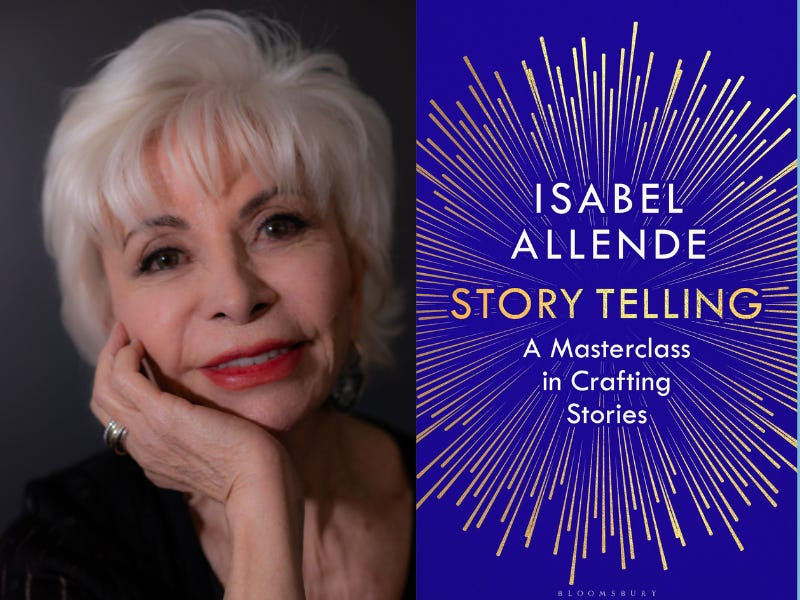
Isabel Allende, born in Peru and raised in Chile, is a novelist, feminist, and philanthropist. She is one of the most widely read authors in the world, having sold more than eighty million copies of her books across 42 languages. She is the author of several bestselling and critically acclaimed books, including The Wind Knows My Name, Violeta, A Long Petal of the Sea,The House of the Spirits, Of Love and Shadows, Eva Luna and Paula. In addition to her work as a writer, Isabel devotes much of her time to human rights causes. She has received 15 honorary doctorates, been inducted into the California Hall of Fame and received the PEN Center Lifetime Achievement Award and the Anisfield-Wolf Lifetime Achievement Award. In 2014, President Barack Obama awarded her the Presidential Medal of Freedom, the nation’s highest civilian honour, and in 2018, she received the Medal for Distinguished Contribution to American Letters from the National Book Foundation. She lives in California with her husband and dogs