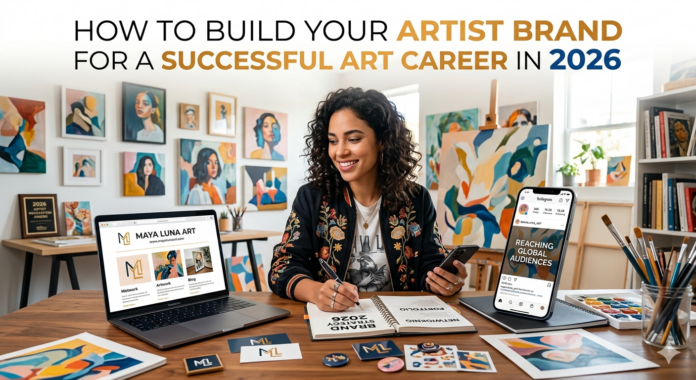
How to Build Your Artist Brand for a Successful Art Career in 2026
How to Build Your Artist Brand for a Successful Art Career in 2026
In 2026, the art world is more competitive, digital, and global than ever before. It’s no longer enough to create compelling work—you also need a strong personal brand to reach collectors, galleries, and curators. As an art critic and SEO strategist with a PhD in both art history and digital marketing, I’ll share a step-by-step guide to help artists build a professional, recognizable brand that supports a sustainable art career.
1. Define Your Artistic Identity
Your artistic identity is the foundation of your brand. Ask yourself:
What themes, materials, or concepts define my work?
What emotions or ideas do I want my audience to feel?
Who is my ideal audience: collectors, galleries, museums, or online buyers?
A clear identity creates consistency across your portfolio, social media, exhibitions, and press, which increases recognition and trust in your work.
Pro Tip: Write a short artist statement that combines your inspiration, methods, and vision in 3–5 sentences. This will be your anchor for your brand narrative.
2. Build a Professional Online Presence
Your digital footprint is now the primary way collectors discover artists. Key components include:
a. Artist Website
Showcase your portfolio with high-quality images (1200–2000px wide).
Include an artist statement, biography, CV, press mentions, and contact info.
Implement SEO best practices: optimize titles, alt text for images, meta descriptions, and URLs for search engines.
b. Social Media Strategy
Platforms like Instagram, TikTok, and Pinterest remain essential for visual artists. Tips:
Post consistently and share behind-the-scenes content.
Use relevant hashtags and geotags.
Engage with followers through comments, polls, and live videos.
Pro Tip: Link all social media to your website to drive traffic and track engagement.
3. Leverage Storytelling to Stand Out
Collectors and galleries remember stories more than images. Your artistic journey—from inspiration to studio process—creates an emotional connection.
Share anecdotes about your techniques, challenges, or cultural influences.
Include your philosophy and what makes your work unique.
Use video or short-form content to communicate your story visually and personally.
Example: Instead of simply posting a painting, explain the process, materials, or emotions behind it.
4. Network Strategically
Branding isn’t just about visibility—it’s about building authentic relationships:
Attend gallery openings, art fairs, and artist residencies.
Collaborate with curators, critics, and fellow artists.
Seek interviews and features in art publications.
In 2026, hybrid networking—both online and in-person—will continue to grow. Use LinkedIn, Clubhouse, and Discord groups dedicated to artists to expand your reach.
5. Offer Collectors Multiple Entry Points
Diversify your audience by offering work at different levels:
Original artworks for galleries and collectors.
Limited editions or prints for emerging buyers.
Digital works or NFTs for online collectors.
This not only increases revenue streams but also strengthens your brand’s presence across markets.
6. Collaborate with Marketing Professionals
Even the most talented artists need support to amplify their reach. Collaborating with PR agencies, SEO marketers, or social media managers can:
Increase press coverage in art magazines and local media.
Optimize your website and social media for search engines.
Develop newsletters and email campaigns to engage collectors directly.
Pro Tip: Track your marketing ROI by monitoring website visits, social media engagement, and inquiries.
7. Commit to Continuous Growth
Branding is not static. In 2026, successful artists:
Update their portfolio regularly.
Reassess goals and target audiences.
Experiment with new media and platforms.
This iterative approach ensures your brand evolves with the art market while staying authentic to your vision.
Conclusion
Building your artist brand in 2026 is about visibility, storytelling, and strategic engagement. A strong brand doesn’t just showcase your work—it conveys your vision, builds trust, and positions you for sustainable success in the global art market.
By combining a clear artistic identity, a professional online presence, compelling storytelling, and strategic networking, you can create a brand that resonates with collectors, galleries, and audiences worldwide.
Action Step: Start by auditing your online presence today. Update your website, define your narrative, and create a posting schedule that consistently shares your work and story. Your brand is your career—invest in it wisely.
The history of American art in the late 20th and early 21st centuries cannot be written without acknowledging the profound contributions of women artists. From conceptual and political interventions to monumental sculpture and innovative painting, these artists have reshaped the language of contemporary art while confronting issues of identity, power, gender, and history.
The following figures represent some of the most influential American women artists whose work continues to shape the cultural landscape in 2026.
1. Julie Mehretu
One of the most celebrated painters of her generation, Julie Mehretu is known for monumental abstract compositions that merge cartography, architecture, and political history. Her layered paintings create complex visual systems that reflect globalization, migration, and urban transformation. In recent years, her works have achieved strong institutional recognition and major auction success, reinforcing her status as a central figure in contemporary abstraction.
2. Amy Sherald
Amy Sherald gained international recognition after painting the official portrait of Michelle Obama, but her work extends far beyond that iconic moment. Sherald’s portraits present Black Americans in contemplative and dignified settings, challenging traditional narratives of representation in art history. Her impact continues to grow, and she was named among Time Magazine’s Women of the Year in 2026.
3. Kara Walker
Kara Walker is widely recognized for confronting the history of slavery, race, and power in the United States. Her signature black paper silhouettes and large-scale installations create haunting narratives that explore the violent legacy of American history. Walker’s work remains a powerful force within both museum exhibitions and academic discourse.
4. Simone Leigh
Simone Leigh has become one of the most important sculptors working today. Her ceramic and bronze sculptures explore Black female identity, African diasporic traditions, and the politics of representation. Leigh’s work merges historical references with monumental forms that challenge Western sculptural conventions.
5. Mickalene Thomas
Mickalene Thomas is known for richly textured paintings and collages that celebrate Black femininity, beauty, and empowerment. Her use of rhinestones, patterned surfaces, and photographic references creates vibrant portraits that challenge traditional art historical representations of women.
6. Cindy Sherman
A pioneer of conceptual photography, Cindy Sherman revolutionized the medium with her Untitled Film Stills series. By transforming herself into multiple fictional characters, Sherman interrogates identity, media stereotypes, and the construction of femininity.
7. Barbara Kruger
Barbara Kruger’s graphic works—combining bold text with black-and-white imagery—have become some of the most recognizable visual statements in contemporary art. Drawing from advertising aesthetics, her work critiques consumer culture, power structures, and gender politics.
8. Jenny Holzer
Jenny Holzer transformed language into a visual medium. Her LED installations, projections, and public texts deliver powerful political messages in urban spaces and museums. Holzer’s works—such as the famous Truisms series—use language to provoke reflection on authority, violence, and truth.
9. Guerrilla Girls
Formed in 1985, the Guerrilla Girls are an anonymous feminist collective that exposed sexism and racism in the art world through posters, performances, and public campaigns. Their activism highlighted the underrepresentation of women in major museums and galleries, sparking a global conversation about equity in the arts.
10. Judy Chicago
A pioneer of feminist art, Judy Chicago reshaped the art historical canon with groundbreaking works such as The Dinner Party. Her practice integrates craft traditions, collaborative processes, and historical research to highlight the overlooked achievements of women throughout history.
11. Sheila Hicks
Sheila Hicks is one of the most influential textile artists of the modern era. Her monumental fiber installations blur the boundaries between craft, sculpture, and architecture, demonstrating the expressive potential of textile materials within contemporary art.
12. Kiki Smith
Kiki Smith’s multidisciplinary work spans sculpture, printmaking, and installation. Often addressing themes of the body, mythology, and spirituality, her work explores the fragile relationship between humanity and nature.
13. Lynda Benglis
Known for her experimental sculptures made from poured latex, foam, and wax, Lynda Benglis challenged traditional definitions of sculpture in the 1970s. Her work continues to influence generations of artists interested in material experimentation.
14. Marilyn Minter
Marilyn Minter’s hyper-sensual paintings and photographs explore beauty, glamour, and desire. By focusing on surfaces—glitter, sweat, cosmetics—Minter critiques the seductive power of advertising and the beauty industry.
15. Shahzia Sikander
Although born in Pakistan and working internationally, Shahzia Sikander has become an influential figure in American contemporary art. Her work transforms the language of Indo-Persian miniature painting into contemporary installations, animations, and drawings that explore migration, gender, and postcolonial identity.
16. Jaune Quick-to-See Smith
A pioneering Native American artist, Jaune Quick-to-See Smith uses painting, collage, and printmaking to critique colonial history and environmental destruction. Her work brings Indigenous perspectives into mainstream contemporary art discourse.
17. Yoko Ono
Although internationally known as a conceptual artist and musician, Yoko Ono’s influence on performance and participatory art remains immense. Her works invite viewers to become active participants, turning art into an act of collective imagination and peace activism.
Conclusion
The artists featured here represent multiple generations and artistic strategies—from conceptual text works and activist collectives to monumental sculpture and contemporary portraiture. What unites them is their ability to redefine the boundaries of art while addressing the urgent social, political, and cultural questions of their time.
In 2026, American women artists are not simply participants in the art world—they are among its most powerful innovators and critical voices.
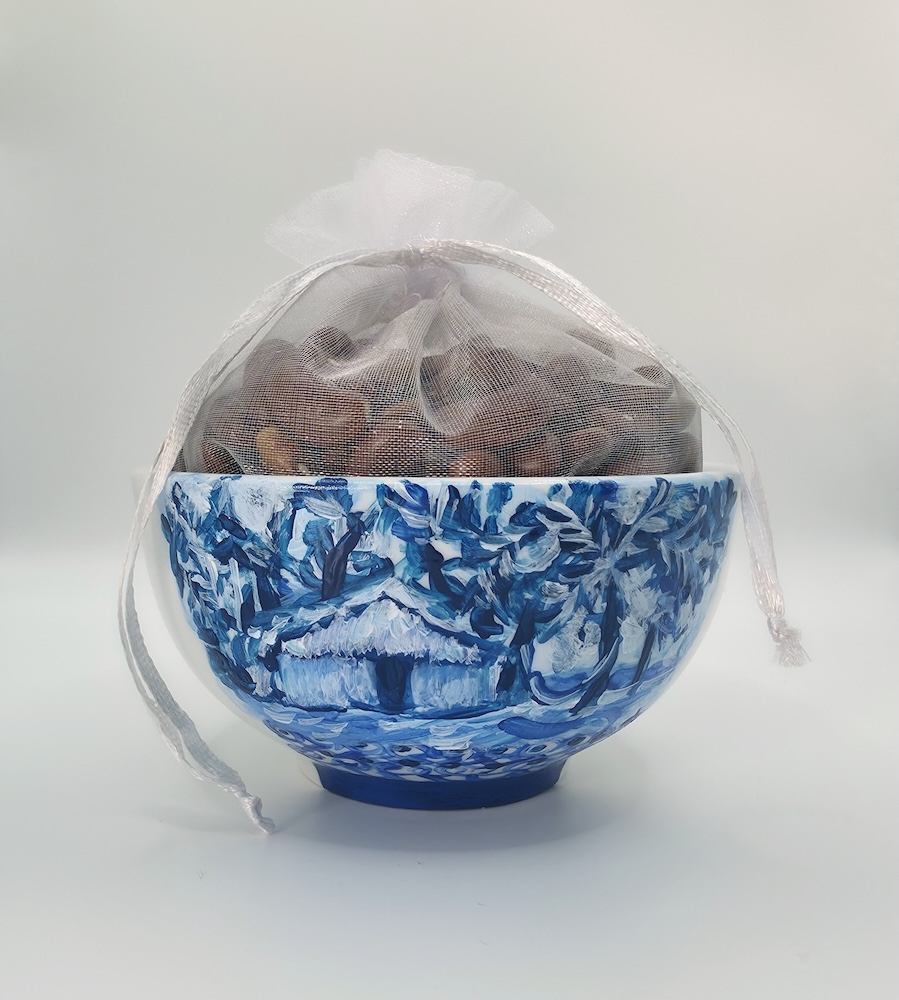
Las Poroteras (detail), painted rice cup and beans. Courtesy of the artist.
MaiYap: A House of Small Altars
Sophie Bonet
A House of Small Altars is an exhibition about what survives. Not the spectacular markers of culture, but the quiet systems of care—objects, gestures, and repetitions—that carry identity across time, migration, and loss. Rooted in the lived experience of Chinese–Panamanian artist MaiYap, the exhibition unfolds as a domestic architecture shaped by memory, ritual, and labor. It is a house built not from walls, but from what is held, repeated, and remembered.
The project emerged from a moment of rupture. During the COVID-19 pandemic, amid a global surge in anti-Asian violence, MaiYap began reexamining her identity as an Asian Panamanian woman living in the United States. That reckoning prompted a deeper inquiry: what defines heritage when culture has been carried across oceans, adapted through survival, and preserved largely within the home? She returned to a guiding question that anchors the exhibition: What was in my house that wasn’t in yours?
The answer did not reside in formal tradition or public ritual, but in domestic life—in food, repetition, and unspoken gestures of care. In diasporic contexts, the home often becomes the most resilient site of cultural transmission, where memory is carried through the body rather than the archive, through practice rather than instruction. While language, dress, and public customs may shift across generations, foodways and domestic rituals persist. They are enacted daily, without explanation, and learned through repetition.
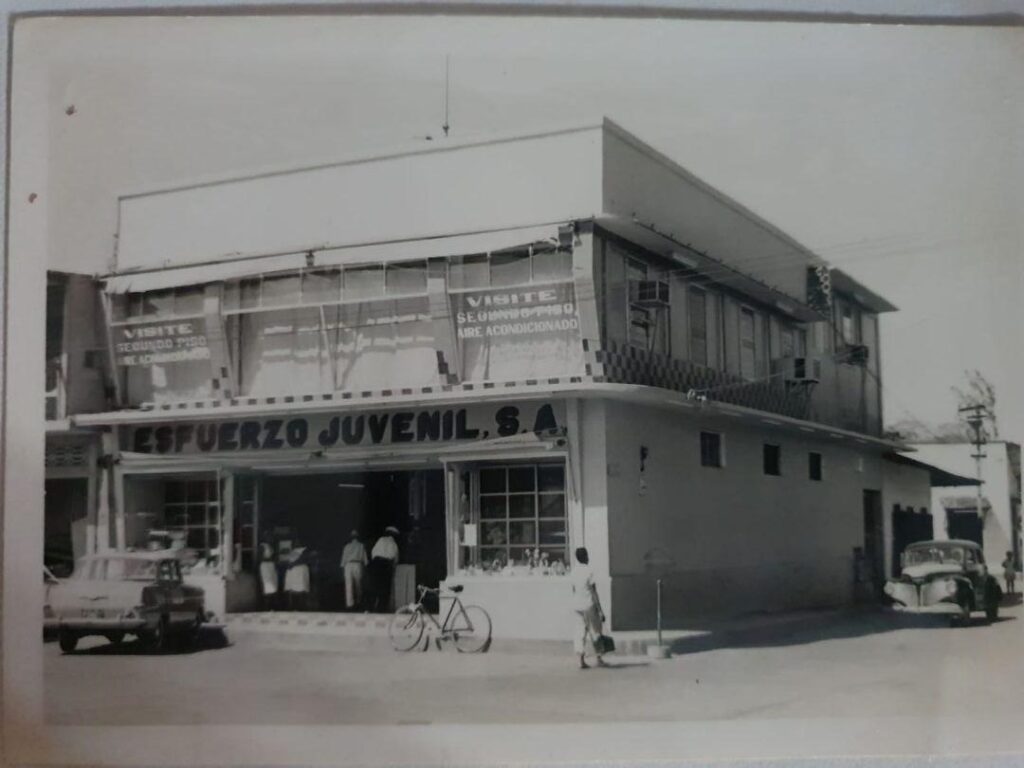
For MaiYap, the house was never a singular structure. It existed as a constellation: her family home adjacent to her parents’ store, and the park across the street. These spaces formed a porous ecosystem of labor and play, safety and solitude, devotion and neglect. When she was five years old, her siblings and grandparents moved away to pursue better education, leaving her behind without explanation. That early fracture—being free to roam yet emotionally abandoned—becomes a quiet undertow throughout the exhibition. Memory here is not stable or complete; it is improvised, embodied, and unresolved.
The works in A House of Small Altars do not attempt to reconstruct the past. Instead, they acknowledge memory as fragmented—commemorative without nostalgia, devotional without doctrine. Each installation operates as an altar in the anthropological sense: a mediating structure where the visible and invisible, the personal and collective, the living and ancestral intersect. These altars are small not in significance, but in scale—formed through everyday materials and repeated acts rather than monumentality.
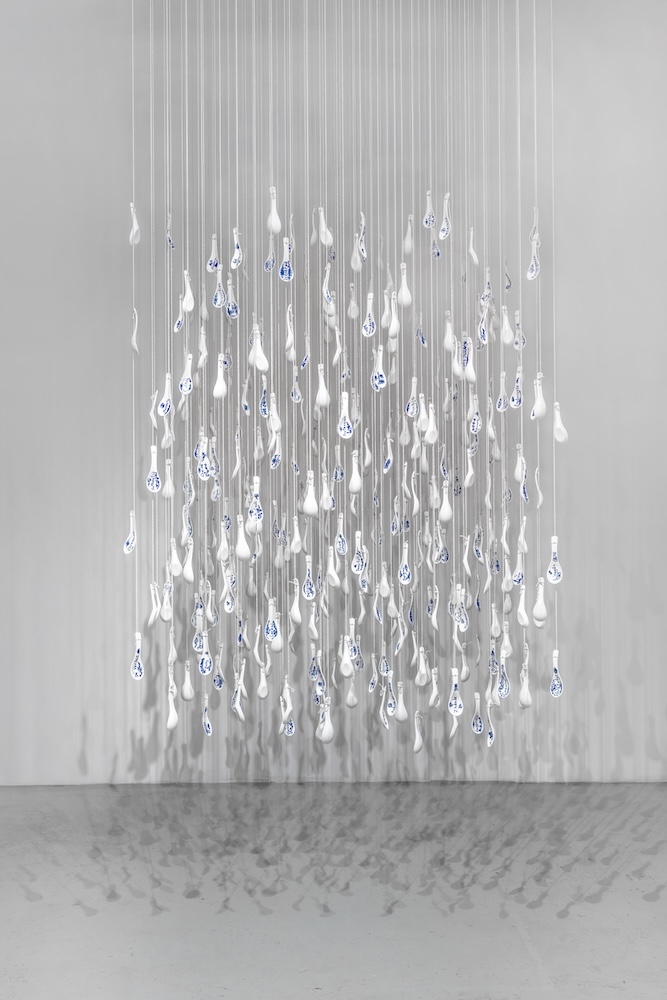
The Gathering, installation view. Porcelain soup spoons, hilo pabilo (Panama). Image by Zaire Aranguren. Courtesy of the artist.
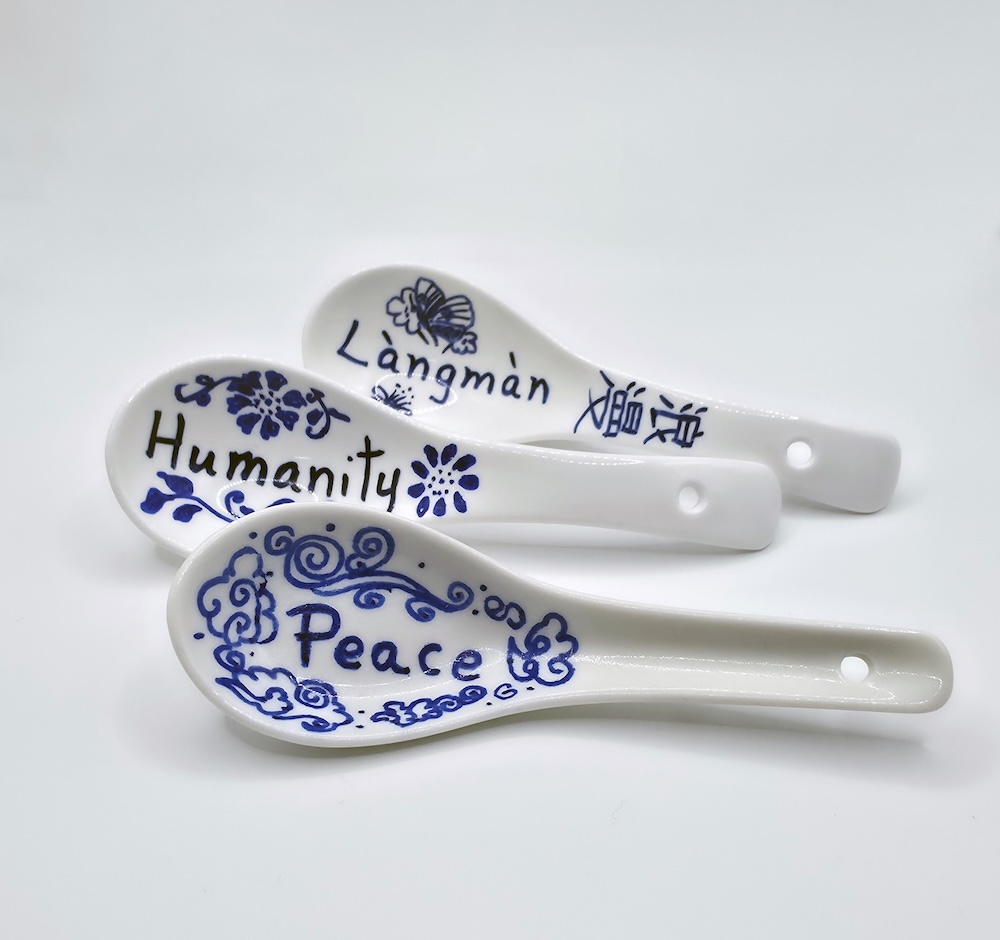
At the center of the exhibition is The Gathering, an installation originally composed of 520 hand-painted white porcelain soup spoons suspended at eye level with hilo pabilo brought from Panama. In Chinese households, the tāng gēng (湯羹) soup spoon holds particular intimacy. Unlike chopsticks, which require dexterity and autonomy, the spoon is often used to feed others—children, elders, the sick—and is associated with warmth, attentiveness, and care.
The Gathering (detail), hand-painted porcelain spoons. Courtesy of the artist.
In diasporic homes, food rituals frequently become the most enduring carriers of cultural memory. Ingredients adapt to new geographies and recipes shift, but the rhythm of preparation and sharing remains. Each spoon in The Gathering bears a word in Chinese, Spanish, or English—languages that shape MaiYap’s cultural formation. These words name emotions that arise around cooking, sharing, and receiving food: love, patience, obligation, exhaustion, joy. Meaning does not translate seamlessly; it accumulates through repetition.
The number 520 carries layered significance. In contemporary Chinese culture, it phonetically resembles wo ai ni (“I love you”) and refers to May 20, an unofficial Valentine’s Day. Within the installation, the number also mirrors the scale of domestic labor—cooking not once, but endlessly; loving not as declaration, but as sustained practice. Suspended in the round, the spoons require viewers to move slowly, implicating the body in remembrance.
The choice of hilo pabilo is equally deliberate. A humble cotton twine commonly used in Panamanian homes and small businesses, it belongs to a material culture of repair—tying, bundling, mending, holding things together. Here, it becomes a material archive of labor and care, binding nourishment to work and geography to memory.
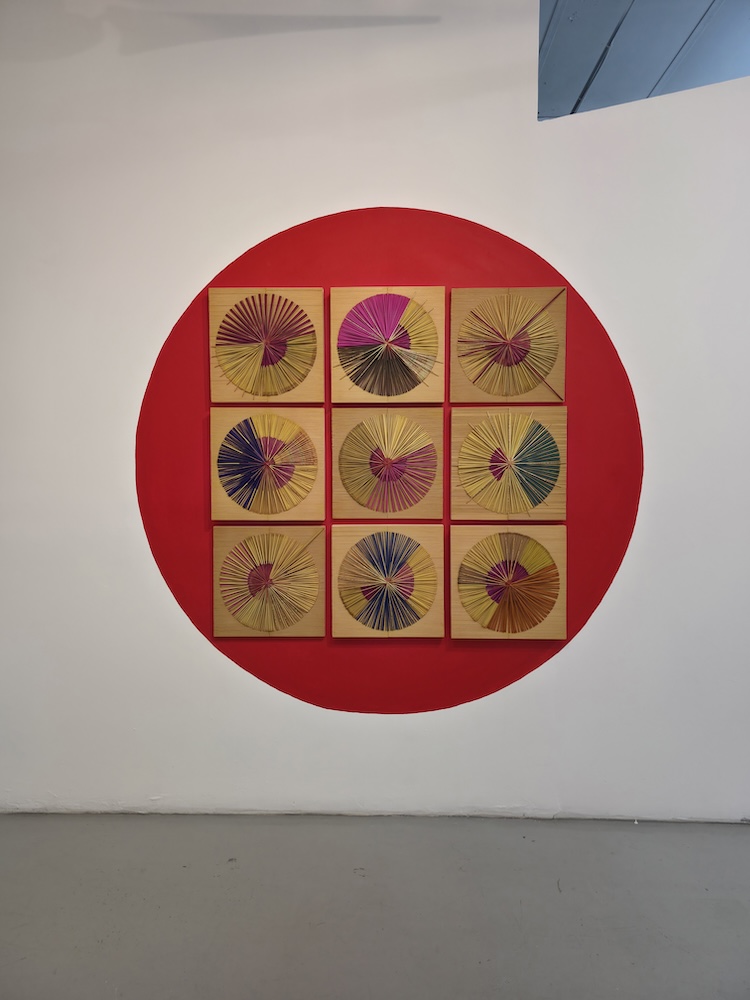
Utter Devotion, installation view. Incense sticks, rope, matches. Courtesy of the artist.
Utter Devotion functions as a threshold within the exhibition. Composed of incense sticks, the work draws from the artist’s memory of her mother’s daily ritual of offering three incense sticks before the statue of Guan Yu, widely revered for loyalty, righteousness, protection, and moral integrity.
Although MaiYap was raised Catholic in Panama—a predominantly Catholic country—this private ritual persisted quietly within the home. Such practices exemplify religious syncretism, common in diasporic contexts where belief systems coexist rather than replace one another. Domestic altars often function as sites of cultural preservation under conditions of migration and assimilation. They are not performative or doctrinal; they are sustained through repetition, without witnesses.
In Chinese cosmology, the square symbolizes Earth and the circle Heaven—stability and eternity held in balance. In Utter Devotion, repetition itself becomes sacred. Faith is enacted not through spectacle, but through continuity—through showing up every day.
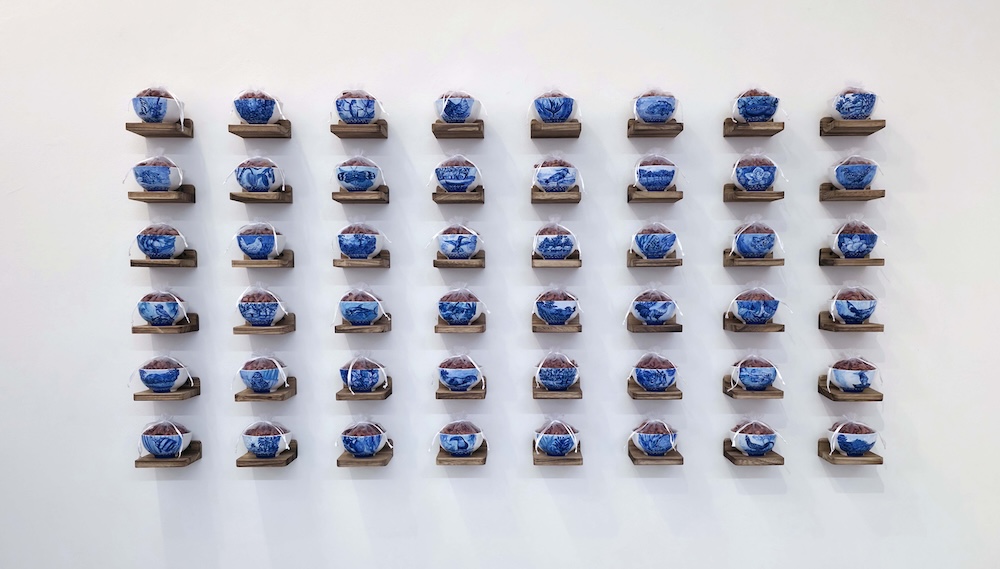
Las Poroteras, installation view. Chinese rice cups, beans, organza. Courtesy of the artist.
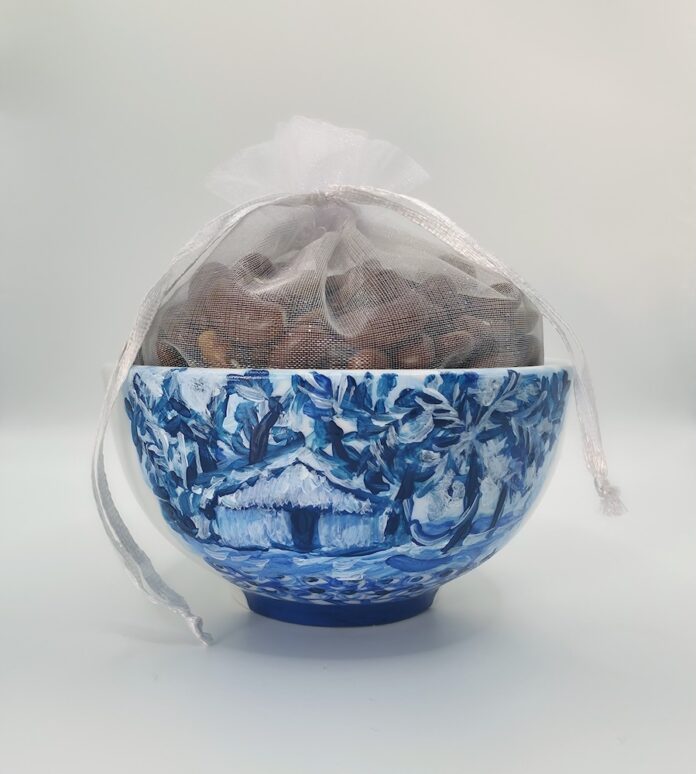
In Las Poroteras, MaiYap presents a body of 88 sculptural vessels made from Chinese rice cups filled with beans and wrapped in organza. Rice cups occupy a specific place in Chinese foodways, offering a practical solution for eating rice with chopsticks while symbolizing sustenance and abundance. The number 88 signifies double happiness, prosperity, and continuity in Chinese numerology.
Las Poroteras (detail), painted rice cup and beans. Courtesy of the artist.
Painted in blue and white in the style of Ming dynasty ceramics, the cups feature imagery drawn from the artist’s childhood in Aguadulce, Panama—palm trees, roosters, fish, jungle landscapes, and the islands of San Blas. These motifs resist singular cultural origin. The vessels are neither Chinese nor Panamanian alone; they are sites of cultural negotiation shaped by migration and adaptation.
The beans reference fertility, agriculture, and women’s labor—particularly the often-invisible work of cultivation, preparation, and sustenance. Across cultures, beans are associated with nourishment and survival. Here, placed in delicate organza bags, they transform the cups into offerings, honoring matrilineal knowledge passed through hands rather than texts.
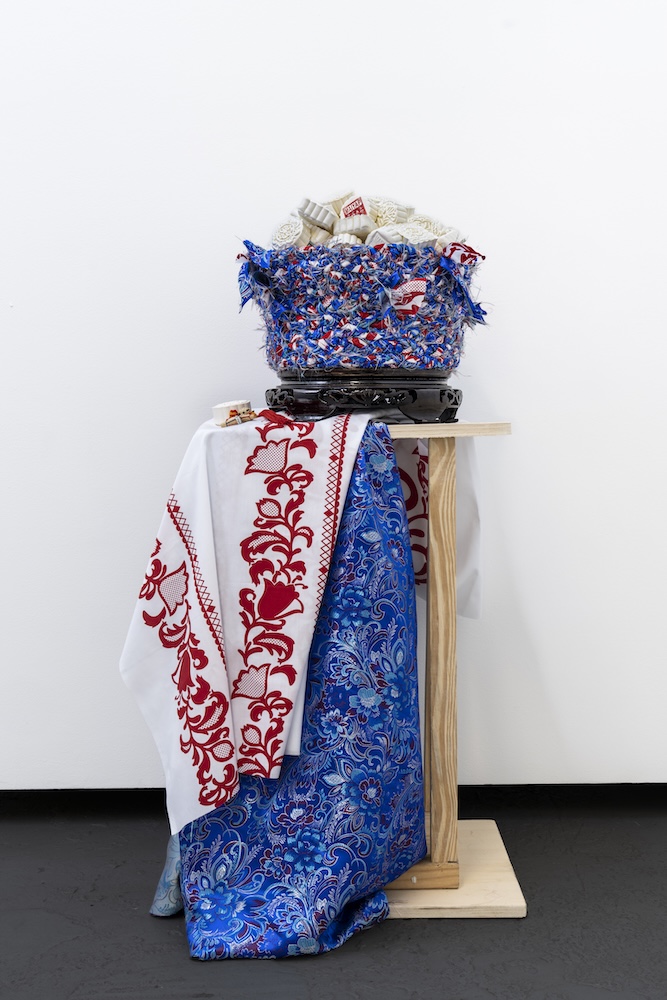
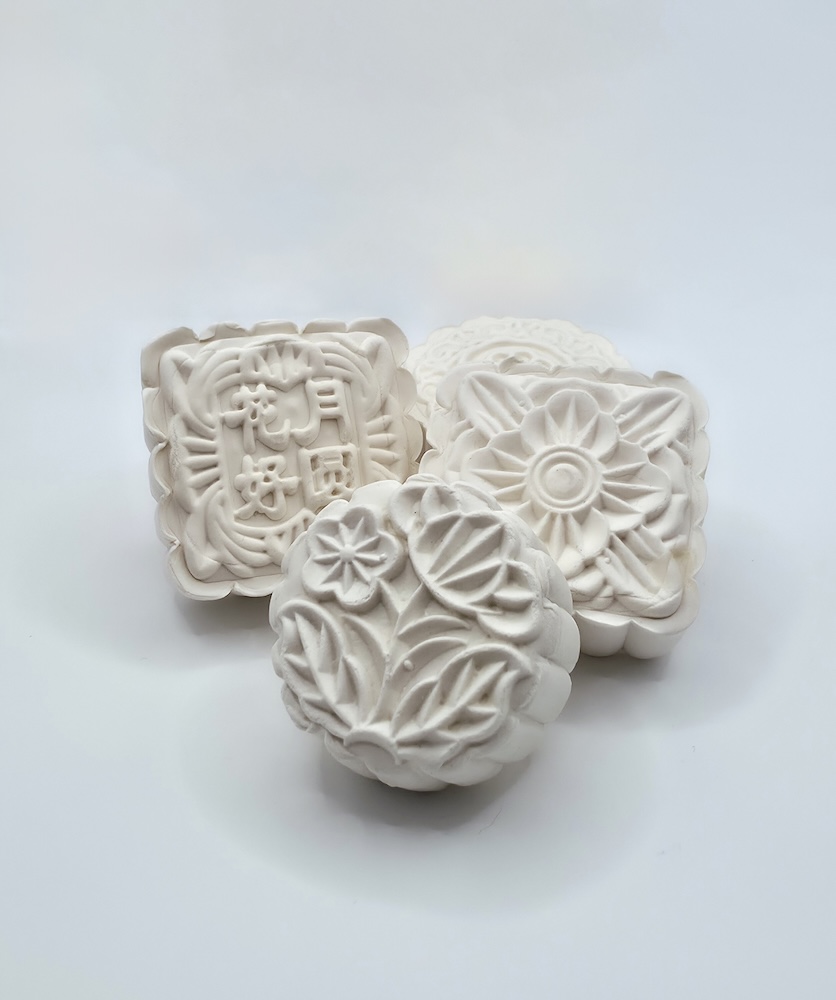
Over the Moon completes the environment. The installation consists of sculpted mooncakes—originally conceived in a set of 520—resting within a nest constructed from traditional Panamanian pollera fabrics and traditional Chinese tapestries. The nest introduces a register of memory that is soft, tactile, and protective, grounding the work in textile traditions historically tied to femininity, ceremony, and cultural transmission.
Over the Moon, installation view. Sculpted mooncakes, nest of traditional Panamanian pollera fabrics, and traditional Chinese tapestries. Image by Zaire Aranguren. Courtesy of the artist.
The pollera, one of Panama’s most emblematic garments, carries histories of craftsmanship, ornamentation, and regional identity. Its embroidered floral motifs and layered construction are associated with celebration, visibility, and collective pride. Chinese tapestries, by contrast, often function within domestic interiors as carriers of symbolic imagery and auspicious meaning, passed down through generations as markers of lineage and continuity.
Textiles—among the earliest technologies of care—clothe bodies, line domestic spaces, and absorb touch, wear, and time. Here, fabric becomes shelter rather than surface. The nest does not frame the mooncakes as objects for display; it holds them as offerings—protected, cradled, and gathered.
Over the Moon (detail), mooncakes within textile nest. Courtesy of the artist.
Mooncakes themselves are objects of layered history. Traditionally exchanged during the Mid-Autumn Festival, they symbolize reunion, completeness, and cyclical time. Historically, they also functioned as vehicles for resistance: during the thirteenth century, messages were hidden inside mooncakes to coordinate revolt against Mongol rule. Celebration and survival coexist within their form.
Taken together, the installations form a single environment rather than a sequence of objects. A House of Small Altars operates as a living ethnography—one that understands culture not as static inheritance, but as embodied practice shaped through repetition, care, and everyday labor. As a curator, I approach this exhibition not as an act of classification, but of listening. MaiYap’s guiding question—What was in my house that wasn’t in yours?—becomes an invitation rather than a boundary.
Archival Images. Yap Family, 1960. Courtesy of the artist.Archival Images. Yap’s Family Store “Esfuerzo Juvenial”. Courtesy of the artist.
Ultimately, this exhibition is an offering: to a mother who migrated at eighteen and worked her entire life; to ancestors whose knowledge traveled through hands rather than texts; and to viewers, invited not as observers but as participants—asked to slow down, to witness, and to recognize that healing, like devotion, is built through small, repeated acts. In this house, nothing is monumental—yet everything matters.
This essay is informed by interdisciplinary scholarship on memory, ritual, care, and diasporic cultural transmission. It draws particularly from frameworks that understand memory as embodied practice rather than fixed archive (Diana Taylor; Paul Connerton), domestic ritual as a site of cultural continuity under conditions of migration (Arjun Appadurai), and care as an ethical and material practice sustained through repetition, repair, and labor (Joan Tronto).
Bibliography
1. Appadurai, Arjun. Modernity at Large: Cultural Dimensions of Globalization. Minneapolis: University of Minnesota Press, 1996.
2. Connerton, Paul. How Societies Remember. Cambridge: Cambridge University Press, 1989.
3. Hirsch, Marianne. The Generation of Postmemory: Writing and Visual Culture After the Holocaust. New York: Columbia University Press, 2012.
4. Mintz, Sidney W. Sweetness and Power: The Place of Sugar in Modern History. New York: Penguin Books, 1985.
5. Taylor, Diana. The Archive and the Repertoire: Performing Cultural Memory in the Americas. Durham: Duke University Press, 2003.
6. Tronto, Joan C. Moral Boundaries: A Political Argument for an Ethic of Care. New York: Routledge, 1993.
Sophie Bonet (b. 1986) is a South Florida–based curator whose practice is deeply informed by her background in social and cultural anthropology. She approaches exhibitions as living ecosystems—responsive spaces shaped by memory, ritual, and transformation. Her transdisciplinary work is research-driven and grounded in the belief that art functions as a site of dialogue, cultural inquiry, and collective imagination.
Bonet has led exhibitions and public programs across prominent institutions in the United States and abroad, including the Contemporary Arts Museum Houston (CAMH), the Barcelona Museum of Contemporary Art (MACBA), and the Museum of Contemporary Art North Miami (MOCA), where she served as Exhibition Manager for landmark presentations such as Juan Francisco Elso: Por América (in collaboration with El Museo del Barrio), Didier William: Nou Kite Tout Sa Dèyè, and Jamea Richmond-Edwards: Ancient Future. Her early research at MACBA focused on the archival documentation and critical interpretation of Espai 13’s history, tracing three decades of artist-led experimentation at the Joan Miró Foundation.
Currently Chief Curator of The Frank C. Ortis Gallery in Pembroke Pines, Florida, Bonet leads an ambitious exhibition program centered on accessibility, sensory engagement, and community-rooted storytelling. Curating across disciplines—from ecological installation to fiber art and new media—she explores themes of identity, migration, belonging, and place through an anthropological and phenomenological lens.
Bonet holds degrees in Fine Arts, Art History, and Anthropology. She is currently pursuing graduate research examining curating as a ritual and phenomenological practice shaped by memory, embodiment, and cultural translation. She is a member of IKT – the International Association of Curators of Contemporary Art.
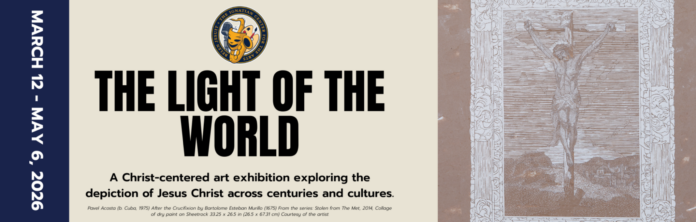
The Light of the World Exhibition Opens at the Olga M. and Carlos A. Saladrigas Gallery in Miami
Miami, FL — The Olga M. and Carlos A. Saladrigas Gallery at Belen Jesuit Preparatory School proudly presents The Light of the World, a Christ-centered exhibition exploring the artistic representation of Jesus Christ across centuries and cultures. The exhibition will be on view March 12 through May 6, 2026, at Belen Jesuit Preparatory School, located at 500 SW 127 Avenue, Miami, Florida.
The exhibition opens with a public reception on Thursday, March 12, from 6:00 to 9:00 PM, featuring live music and refreshments. Admission is free and open to the public.
A Journey Through Sacred Art
For nearly two thousand years, artists have interpreted the figure of Jesus Christ, shaping some of the most powerful and enduring images in the history of art. The Light of the World invites visitors to explore this profound tradition through an extraordinary selection of paintings, sculptures, and drawings spanning from the 16th century to the present day.
The exhibition includes Russian icons, Renaissance works, paintings from the Cuzco School, late 19th- and early 20th-century Latin American pieces, and contemporary works by local and international artists. Among the highlights are icons created in the 21st century as devotional prayers, demonstrating how sacred imagery continues to evolve within contemporary artistic practice.
Curated by Carol Damian, Ph.D., and Adriana Herrera, Ph.D., the exhibition offers a rich and immersive narrative that traces how artists from Europe, Russia, South America, and the United States have interpreted the life and symbolism of Christ.
Participating Artists
Artists featured in the exhibition include:
Pavel Acosta, Stella Bernal de Parra, Karim Borjas, Pablo Cano, Willy Castellanos, Mercedes Durrieu, Fernanda Frangetto, Héctor Fuenmayor, Flor Godward, Silvia Lizama, Marcela Marcuzzi, Andrés Michelena, Vero Murphy, Darío Ortiz, Pamela Palmieri Bettner, Natalia Plascencia, Víctor Hugo Rivas, María Luisa Santamarina, and Raimundo Travieso.
Public Programs and Community Engagement
Throughout the exhibition, the gallery will host curator-led tours, artist talks, and panel discussions with participating artists and art critics. The programming aims to deepen the public’s engagement with sacred art and foster dialogue about the cultural and spiritual significance of these works.
Committed to accessibility and education, The Light of the World invites visitors from all backgrounds to experience the enduring power of sacred imagery.
Exhibition Details
What:The Light of the World Where: Olga M. and Carlos A. Saladrigas Gallery, Belen Jesuit Preparatory School 500 SW 127 Avenue, Miami, FL 33144
When: March 12 – May 6, 2026 Opening Reception: Thursday, March 12, 6:00 – 9:00 PM
Gallery Hours: Wednesdays and Thursdays, 8:00 AM – 4:00 PM, or by appointment. For appointments: [email protected]
Admission: Free
Media Contact
For media inquiries, please contact: Teresa Martinez Director of Communication [email protected]
For artwork inquiries, images, or interview requests, please contact: Carol Damian – [email protected] Adriana Herrera – [email protected]
About Belen Jesuit Preparatory School
Founded in 1854 by the Society of Jesus in Havana, Belen Jesuit Preparatory School was re-established in Miami in 1961 following the confiscation of private schools in Cuba. Today, the institution serves approximately 1,400 students in grades 6–12 and counts more than 8,000 alumni, continuing its long tradition of academic excellence, cultural engagement, and community leadership.
Visugallery.com 2160 Park Ave, Miami Beach, FL 33139 (513) 659-4690 Rated 5 stars on Google.
VISU Contemporary is where South Beach’s vibrant energy meets the evolving edge of contemporary art. Founded with a sharp curatorial vision, the gallery is a space for artists who challenge form, narrative, and material — from internationally recognized names to rising talents whose work resonates with today’s cultural pulse.
VISU has exhibited bold, provocative voices such as David LaChapelle, Tyler Shields, Amber Cowan, Dustin Yellin, Barry Ball, Tamary Kudita, Rose Marie Cromwell and others whose practices blur the lines between photography, sculpture, painting, and new media. The gallery is especially drawn to artists who experiment with material — glass, metal, stone, and beyond — pushing the boundaries of contemporary surrealism, abstraction, and conceptual art.
More than just a gallery, VISU is a platform. Located in the heart of South Beach, it serves as a cultural connector — a place where collectors, curators, and curious minds converge to experience art that is as thought-provoking as it is visually arresting.
VISU is not just showing what’s now — it’s curating what’s next.
About Owner and Curator Dr. Bruce M. Halpryn
Dr. Bruce M. Halpryn is a passionate collector and cultural leader whose refined eye for contemporary art has been honed over more than four decades. As owner and curator of VISU Contemporary, he has helped shape the gallery into one of Miami Beach’s most compelling new destinations for serious collectors—“….a coup that cements VISU’s growing rep as a small gallery making very big noise,” wrote Time Out.
A trusted figure in the international art community, Halpryn serves on the Board of Directors of Aperture, the globally recognized photography foundation, and as Vice-Chair of the Miami City Ballet. He is the former President of the board of FotoFocus, the largest biennial of photography and lens-based art in the United States, and continues to serve on its board after he termed-out as president of the board. His longstanding involvement with the Cincinnati Art Museum’s Friends of Photography has supported important acquisitions and exhibitions. He was also appointed by the City Commissioners of Miami Beach to the Arts and Culture General Obligation Bond Oversight Committee, reflecting his ongoing commitment to the city’s cultural landscape.
Known for his close relationships with artists, and his intuitive understanding of evolving art trends, Halpryn brings both intellect and instinct to the art of collecting. His vision for VISU Contemporary reflects a belief that great contemporary art not only endures—it reveals what is best, and what is next.
City State | Opening Reception + Open Studios We Have a Problem — Brooke Frank and Bucky Miller present a duo exhibition examining human relationships with space, perception, and the vast unknown of the cosmos. The project reflects on our limited understanding of the universe through painting and photography. 6 – 9 PM 6381 NW 2 Ave, Miami, FL 33150 Exhibition on view through May 17, 2026.
Little Haiti
Momentum Gallery | Exhibition Opening Talamh: Contemporary Irish Photography presents works by eight photographers from the Dublin-based Island Photographers collective, exploring landscape, place, and identity through contemporary photographic practice.
280 NE 59th St, Miami, FL 33127
Upper Eastside / Morningside
Fountainhead Residency | Open House & Artist Reception Meet the artists-in-residence Alina Orlov, Jacqueline Surdell, and Leilah Babiye during an open studio evening. Visitors will have the opportunity to experience new works and engage directly with the artists about their practices. 6 – 8:30 PM (Artists talk 7 – 8:30 PM) 690 NE 56th St, Miami, FL 33137
Miami Beach
FIU Miami Beach Urban Studios | Panel Discussion The Creole Pig: Community, Culture & Lakou — filmmaker Dudley Alexis in conversation with Nyya Toussaint, exploring heritage, storytelling, and cultural memory through film and research. 7 – 8:30 PM 1602 Washington Ave, Miami Beach, FL 33139
Midtown / Wynwood North
Coral Gallery | Opening Reception Afterglow — Chiara Baccanelli, a solo exhibition curated by Marco Tagliafierro, presents a new series of expressive abstract paintings exploring gesture, color, and spatial tension. 5 – 8 PM 30 NW 34th St, Miami, FL 33127
Tamiami
Olga M. and Carlos A. Saladrigas Gallery (Belen Jesuit Preparatory School) | Opening Reception The Light of the World — curated by Carol Damian, Ph.D., and Adriana Herrera, Ph.D., this exhibition examines representations of Jesus across centuries and cultures, bringing together works that explore faith, art history, and visual interpretation. 6 – 9 PM 500 SW 127 Ave, Miami, FL 33144
Doral / Miami Springs / Medley
Miami International Fine Arts (MIFA) | Opening Reception Outfit — Daniele Ballerini, curated by Félix Suazo, is a pop-up exhibition that explores gesture, fashion, and everyday urban observations through expressive works on paper. 6 – 8 PM 5900 NW 74th Ave, Miami, FL 33166
Turn Your Artistic Passion into a Sustainable Career
For many visual artists, the dream is clear: to dedicate their lives fully to creating art. Yet the reality of building a sustainable career can feel overwhelming. Questions about visibility, collectors, marketing, and direction often slow down even the most talented artists.
At Art Miami Magazine, we believe artists should not only create meaningful work — they should also have the tools and strategies to build a thriving career.
With more than two decades of experience working in the art world, our team helps artists strengthen their online presence, connect with collectors, and develop a clear path toward becoming full-time professional artists.
Build Your Art Career in Three Simple Steps
1. Identify Your Ideal Buyer
One of the biggest challenges for artists is understanding who their collectors are.
We help artists learn how to identify buyers who have both the interest and the financial capacity to acquire artwork. Understanding your audience allows you to position your work strategically and communicate its value effectively.
2. Expand Your Local and International Presence
In today’s art world, visibility is essential. A strong digital presence can open doors to collectors, galleries, and institutions across the globe.
Through SEO strategies, social media positioning, and digital visibility, we help artists ensure their work can be discovered by the right audience — both locally and internationally.
3. Gain Clarity and Strategic Direction
Many artists work incredibly hard but lack a clear roadmap.
We help you define your goals and identify the fastest and most effective route to achieve them. Whether your objective is to sell more work, increase your visibility, or position yourself within the contemporary art market, our guidance helps transform ambition into a practical strategy.
Mentorship and Professional Support
Artists working with us may also have the opportunity to connect with Jaroid and his team, gaining insights from professionals experienced in the art and digital marketing industries.
This mentorship can provide valuable perspective on positioning your work, expanding your network, and building a sustainable artistic career.
Take Your Art Career to the Next Level
Becoming a full-time artist is not only about talent — it requires visibility, strategy, and the right connections.
At Art Miami Magazine, we are committed to helping artists develop the tools they need to succeed in today’s global art ecosystem.
If you are ready to grow your presence, reach collectors, and take the next step in your artistic career, we invite you to learn how our team can support your journey.
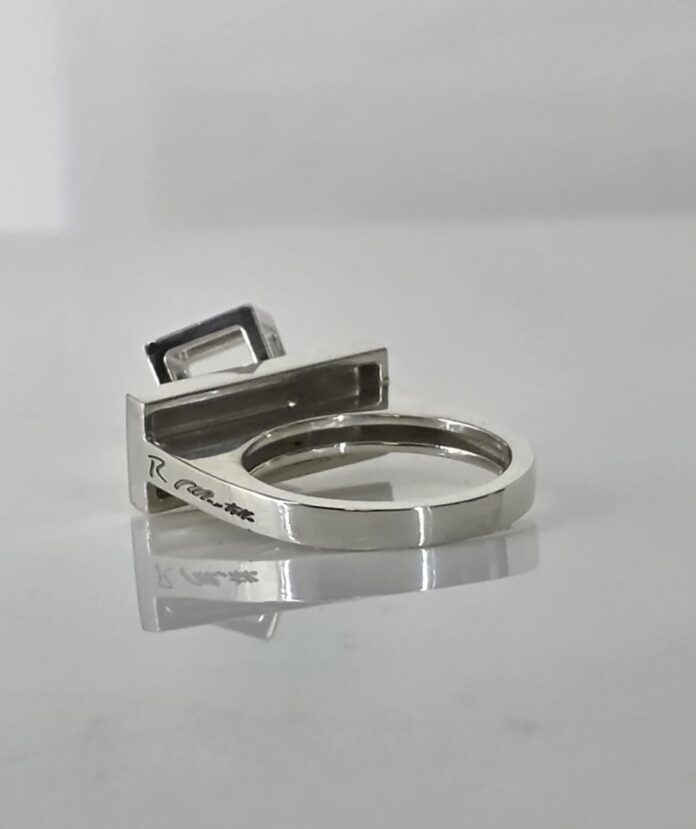
Yes — jewelry can absolutely be considered art, though it depends on context and intent.
Here’s how it breaks down:
Jewelry as Art
Design & Creativity – Like sculpture or painting, jewelry involves design choices about form, color, texture, symbolism, and materials.
Cultural Expression – Throughout history, jewelry has carried meaning (status, protection, ritual, identity), making it both functional object and cultural artwork.
Artistic Movements – Many jewelry designers (e.g., René Lalique, Alexander Calder, Elsa Peretti) are recognized in the art world, with works displayed in museums like the Met and the Smithsonian.
Wearable Sculpture – Contemporary artists often describe their pieces as “wearable art,” blurring the line between fine art and adornment.
Jewellery as Craft / Design
Utility & Ornament – Traditionally, jewelry has also been categorized as applied art or craft because it serves a functional role: adornment, status, or personal identity.
Mass Production vs. Artistry – A factory-made ring may be considered fashion or design, while a hand-crafted, conceptual piece might qualify as art.
The Art World Today
Museums, galleries, and biennials increasingly recognize jewelry as part of the fine arts, especially when it:
challenges conventions of body and adornment,
integrates storytelling or conceptual meaning,
pushes technical or material boundaries.
In short: all jewelry is design, but some jewelry rises into art — when it communicates beyond decoration, engaging with culture, identity, and imagination.
Would you like me to give you examples of jewelry works that have been exhibited in major art museums to illustrate this?
Beyond the Surface: Luis Pedro Picasso and the Skeleton Beneath the Portrait
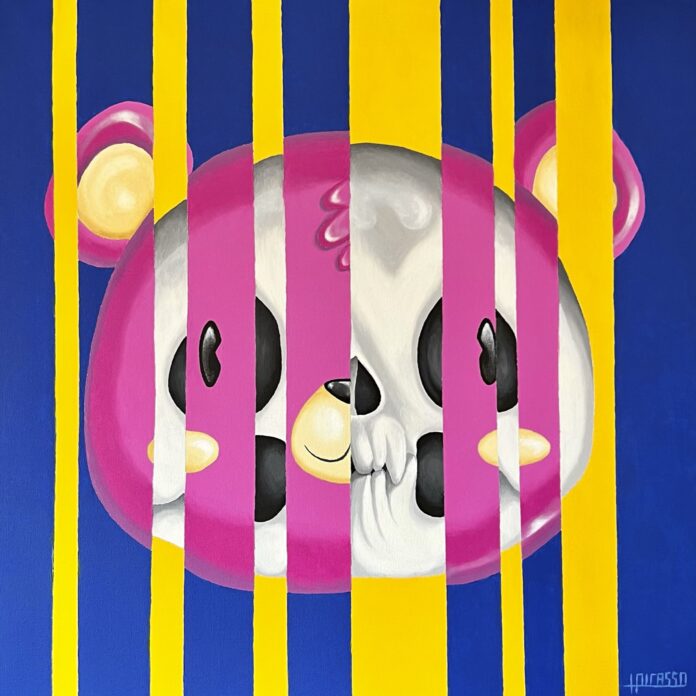
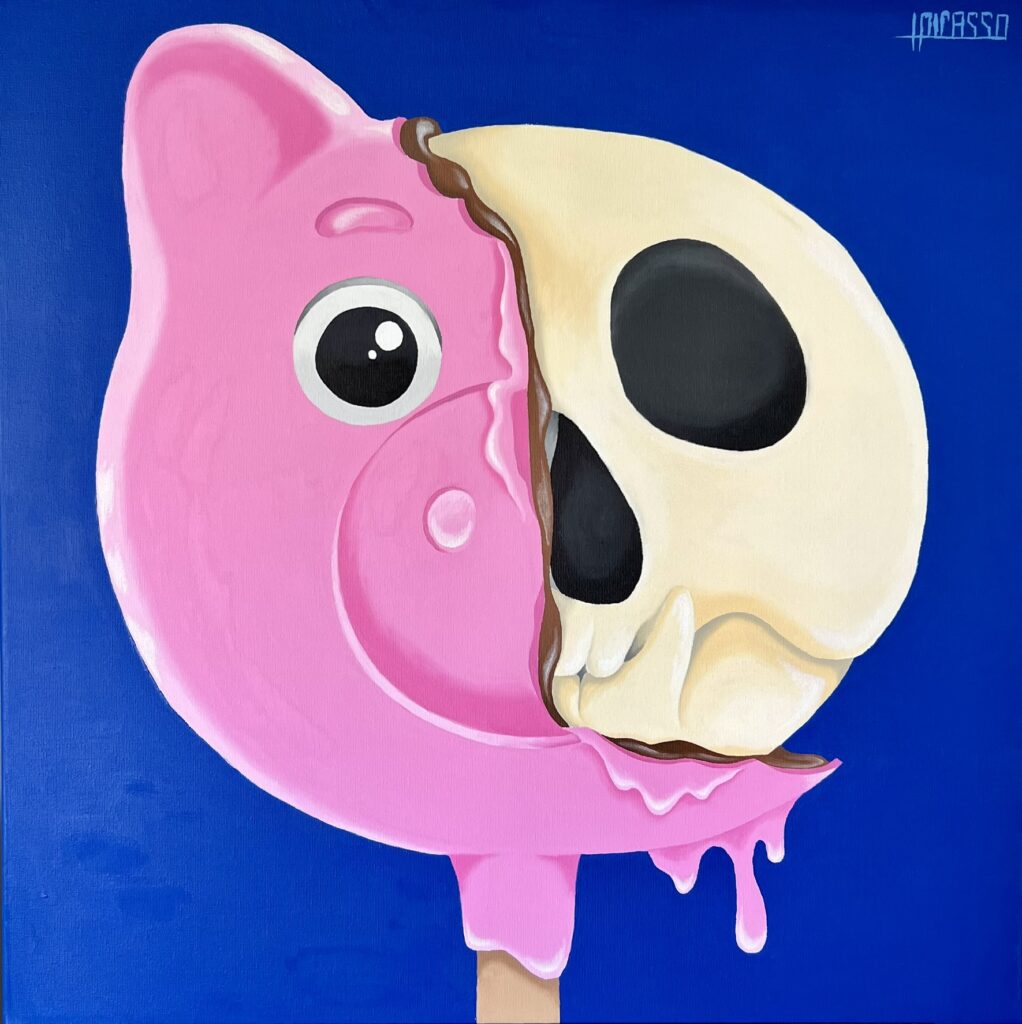
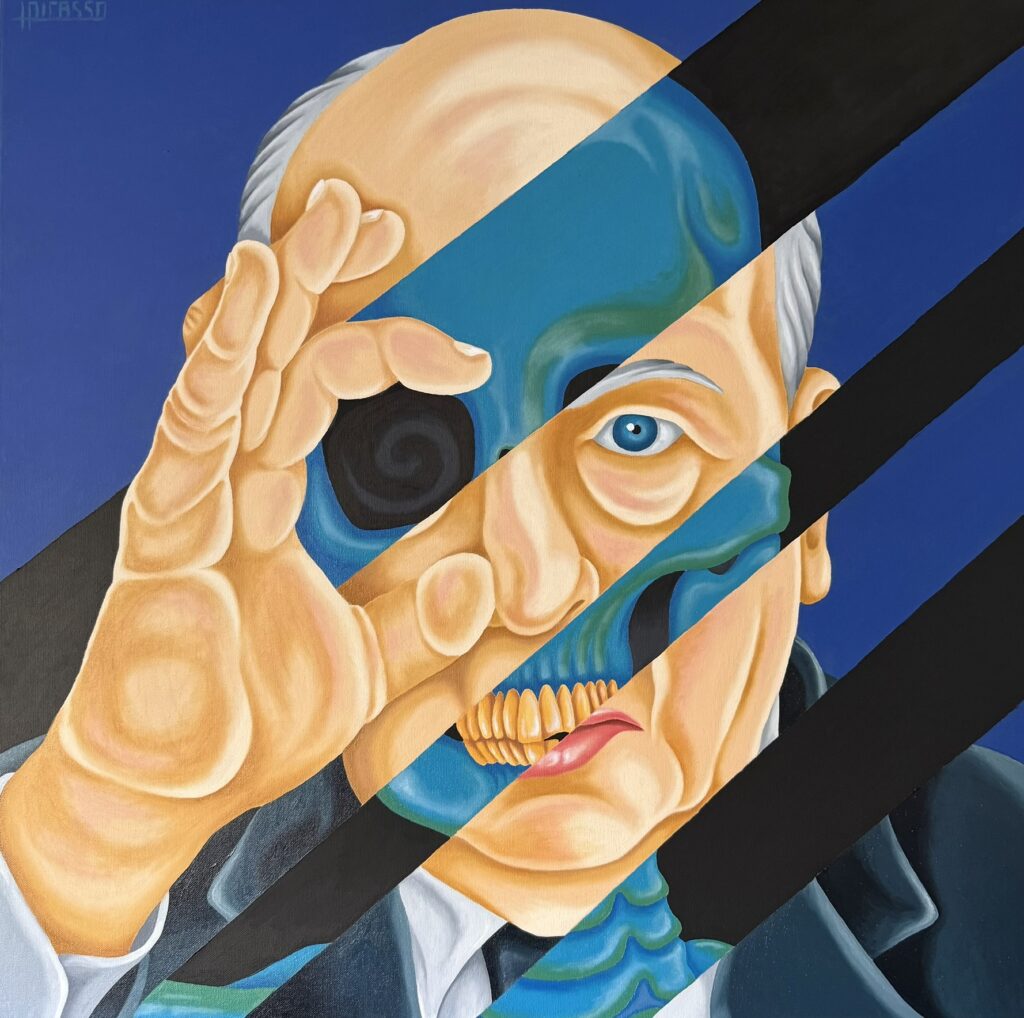
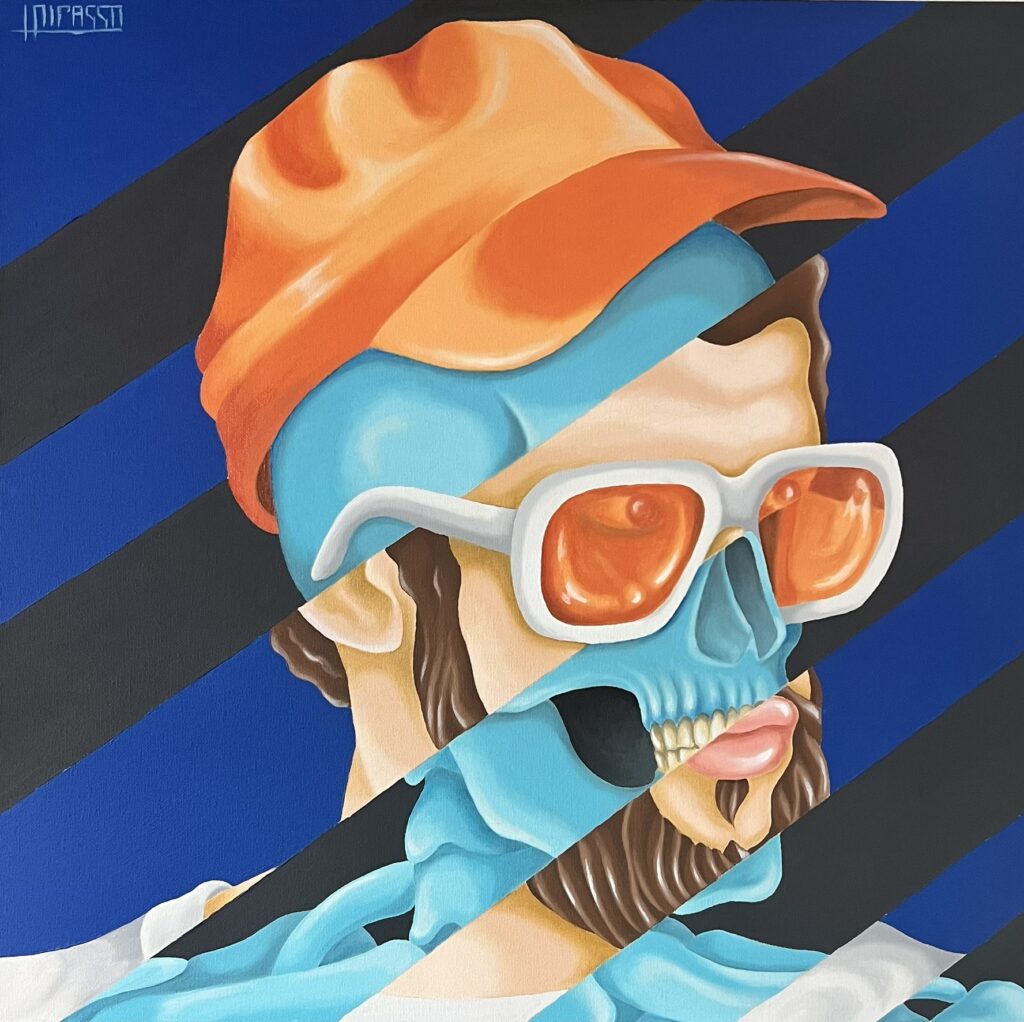
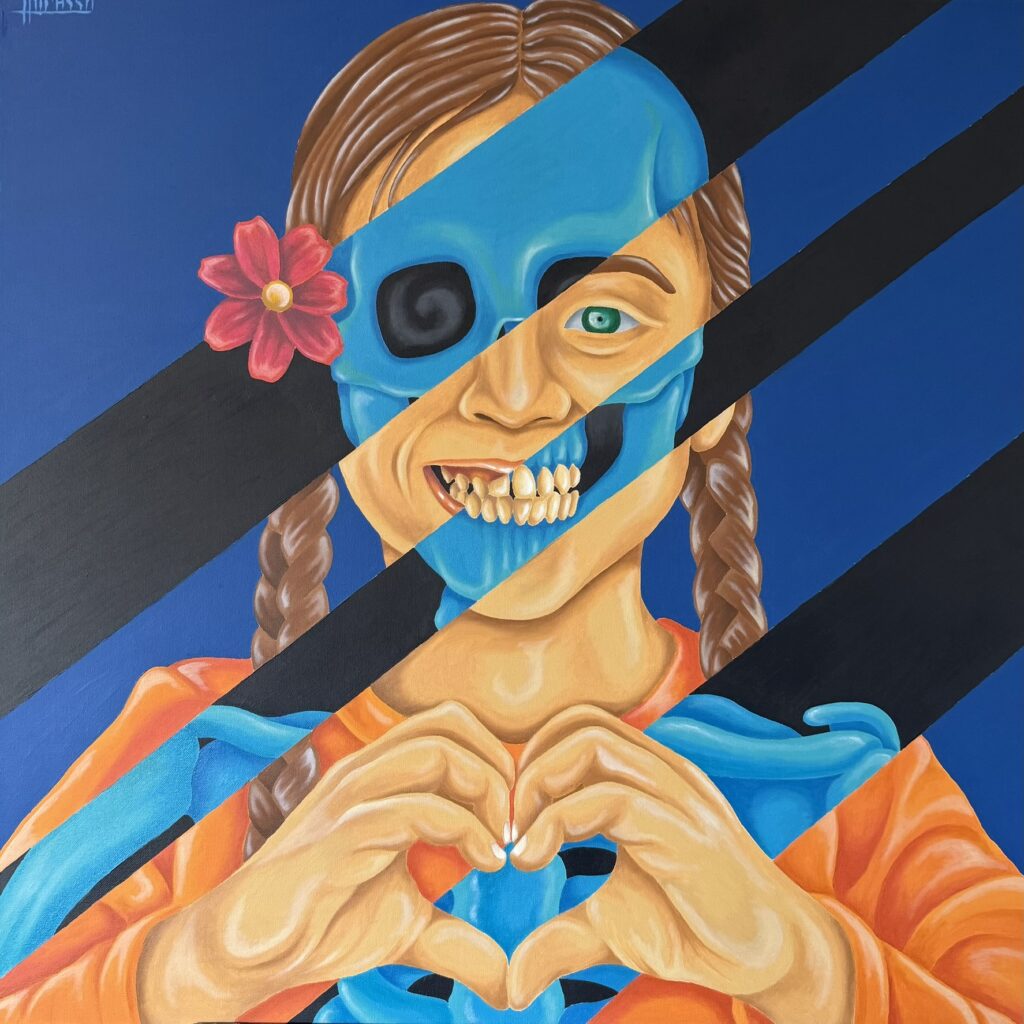
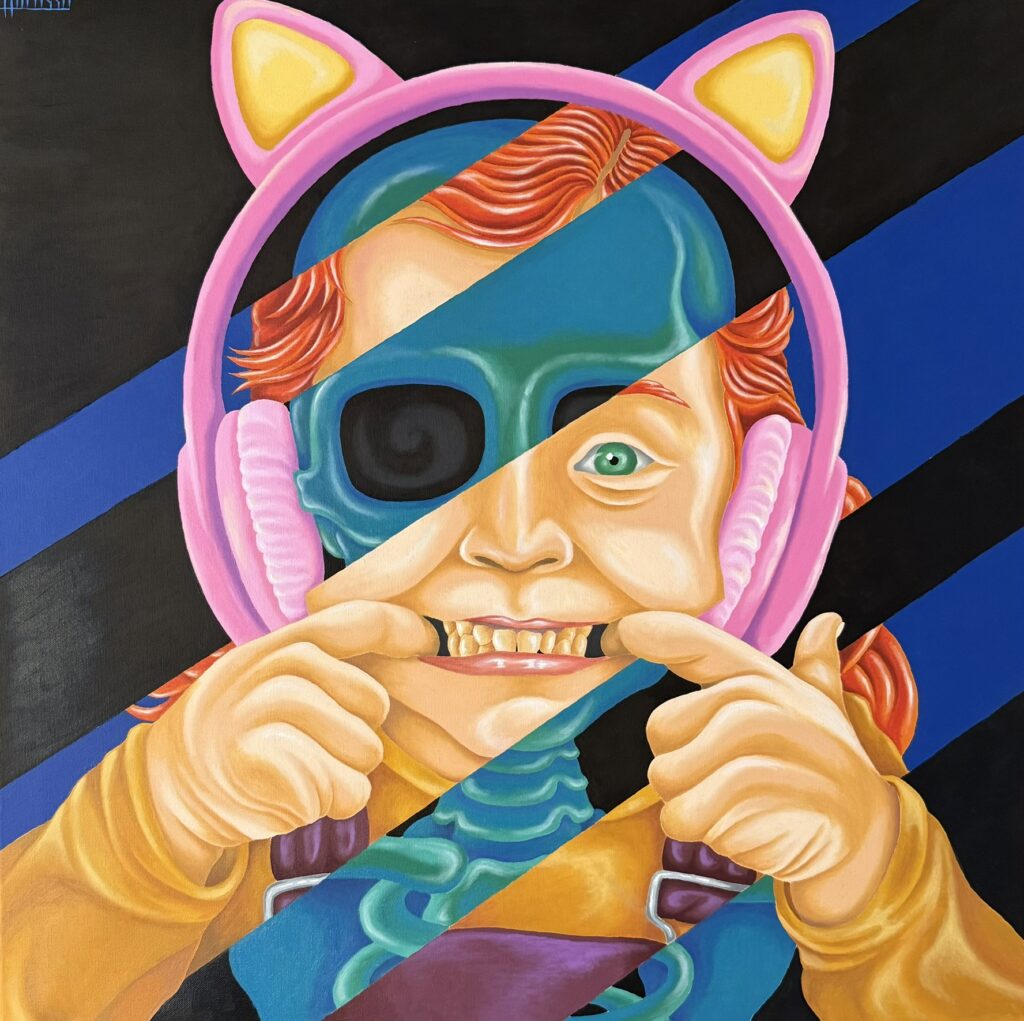
In the vibrant landscape of contemporary figurative painting, Luis Pedro Picasso has developed a distinctive visual language that he describes as “pop dissection.” His work merges the bold chromatic energy of pop culture with an unexpected exploration of anatomical structures, revealing skeletons and internal frameworks beneath expressive portraits. The result is a body of work that simultaneously celebrates the surface of identity while probing the biological structures that unite all living beings.
Raised in the countryside of Uruguay and deeply connected to nature and animal life, Picasso’s early experiences fostered a fascination with anatomy, form, and the underlying systems that sustain life. Later, his studies in graphic design introduced him to the aesthetics of pop art, a visual vocabulary that would become central to his artistic practice. Through this fusion of influences, his paintings challenge the conventions of traditional portraiture, transforming the human face into a site of investigation where color, bone, and identity intersect.
In this conversation, Picasso reflects on the origins of his concept of pop dissection, the role that anatomy and graphic design play in shaping his visual language, and the delicate balance between maintaining artistic originality and engaging with the broader contemporary art world. His reflections reveal an artist interested not only in representation, but in uncovering the shared structures that connect us beneath the surface of our visible differences.
AMM. You describe your style as “pop dissection.” How did this concept emerge, and what does it allow you to express that traditional portraiture does not?
LPP. I grew up in the countryside, surrounded by animals and nature, which led me to develop a special connection with animals, their anatomy, and their behavior. From an early age, I became passionate about drawing, especially human faces. I began by imitating them and creating faces that appeared in my mind.
During my teenage years, when I started studying graphic design, the world of pop art entered my life and strongly shaped my aesthetic. The fusion happened very naturally — I feel that it found me more than I found it.
Traditional portraiture fascinates me, but it is not the only thing I seek to express. My message is not only about people, but about what unites all living beings. From birth and creation, the cornerstone of our organism is the skeleton and the structures that compose it. My work searches for that core that connects us beyond our visible differences.
AMM. Your work combines vibrant pop colors with skeletal structures. What draws you to anatomy, and how do you see the relationship between the external face and the internal bone structure?
LPP. Vibrant colors are part of pop culture. My fascination with anatomy began during adolescence when I studied biological sciences in high school, although it probably started much earlier during my childhood in the countryside. The connection with flesh, life, and skeletons was a natural part of growing up in rural Uruguay in the 1990s.
The relationship between exterior and interior fascinates me because one could not exist without the other. At the same time, the exterior separates and differentiates us, while the skeleton makes us almost identical to one another.
AMM. Because of your background in graphic design, some viewers question whether your works are digital or painted. How intentional is that ambiguity, and what role does graphic design play in shaping your visual language?
LPP. My background in graphic design is part of who I am and helped shape my style. I seek an imperfect perfection in my work: rough details, perfectly imperfect color blends, and lines that appear precise but are not.
The intention is not to confuse the viewer, but rather to allow each observer to dissect the work and decide what they want to see. Graphic design is very present in my visual language, but it is only one ingredient within the recipe of my artworks.
AMM. You’ve said that an artist earns the title through the people who experience the work. How do you define success as an artist, and how important is the viewer’s emotional response in validating your practice?
LPP. Artists live, in some way, through the validation of viewers. Even though some say they create only for themselves, the reality is that an artist also lives for their audience and to win over new hearts. That is why I believe the people are the ones who truly grant the title of artist.
For me, the greatest success is when a work becomes instantly recognizable — when someone stands in front of a painting and can say, “Ah yes, that’s a Picasso” (and not a Pablo one, of course ha!).
AMM. You mention the challenge of avoiding repetition and not being shaped by the art world. How do you protect your originality while still remaining aware of contemporary artistic conversations?
LPP. I believe one of the most beautiful aspects of being an artist is sharing experiences and moments with other artists. Connection, exchange, and collaboration enrich both the artwork and the artist. However, they can also influence one’s style. I’m not saying this applies to everyone, but it does affect me.
I aim for my work to be as pure and original as possible, even though in today’s world — with social media and globalization — being 100% original is almost impossible. My artistic practice is like a moment of meditation, something I prefer to do in solitude and complete isolation.
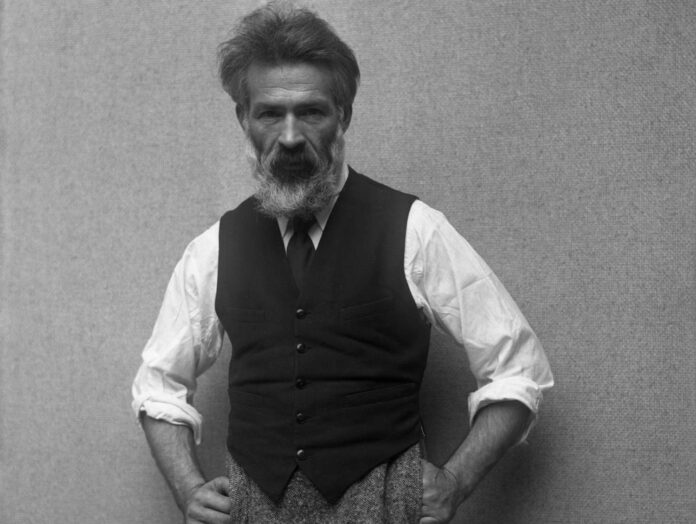
“Lo que es real no es la forma externa, sino la esencia de las cosas.”
Constantin Brancusi
Constantin Brancusi, el alquimista de la forma, nunca estuvo interesado en la mera apariencia de las cosas. Para él, lo real no era la cáscara visible, la silueta reconocible, sino la vibración esencial que habita dentro de cada ser, cada objeto, cada idea. “Lo que es real no es la forma externa, sino la esencia de las cosas”, decía, y en esa sentencia se encuentra toda su poética: la búsqueda de lo absoluto a través de la reducción, la simplificación como un acto sagrado.
Brancusi bebió de la mitología como si fuera un manantial inagotable. Sus esculturas son ecos primordiales, vestigios de un mundo donde lo sagrado y lo cotidiano se funden en una misma sustancia. Sus “Pájaros en el espacio” no son aves concretas, sino el alma misma del vuelo, la velocidad convertida en piedra. Su “Columna sin fin” es un eje cósmico, una escalera hacia lo divino que no tiene inicio ni final. Sus formas pulidas no son abstracciones frías, sino manifestaciones de un tiempo anterior a la historia, donde el arte aún servía para conectar con lo eterno.
Brancusi entendió que la mitología no es una fábula del pasado, sino una estructura latente en todo lo que existe. Sus esculturas no buscan describir, sino revelar. No representan; encarnan. Nos enfrentan a una verdad que no necesita ornamentos, una espiritualidad sin dogmas, un arte que ya no es reflejo del mundo, sino su esencia misma.
La simplicidad sublime Brancusi creía que la simplicidad no era una meta en sí misma, sino un medio para alcanzar la divinidad.Sus obras, despojadas de todo adorno innecesario, revelan la verdad desnuda de la materia.1
Brancusi fue un brujo de la materia, un chamán de la forma que entendió que el arte no es mera representación, sino revelación. Su obsesión por la esencia de las cosas no fue un capricho estético, sino una misión casi mística. Mientras otros escultores se aferraban al peso de la realidad, él se dedicó a destilar, a arrancarle lo superfluo hasta encontrar su núcleo vibrante, su espíritu puro. No tallaba, sino que liberaba.
La pureza formal de sus obras no es un ejercicio de minimalismo, sino una búsqueda de lo absoluto. En cada superficie pulida, en cada línea depurada hasta lo esencial, hay un intento de alcanzar lo eterno, lo que trasciende la contingencia del tiempo y el espacio. Sus esculturas no son meros objetos, sino presencias. Sus formas alargadas y estilizadas no buscan imitar la naturaleza, sino capturar su impulso vital, su energía primordial.
Por eso, muchas de sus piezas parecen querer despegarse de sus pedestales, romper la gravedad y elevarse. No es casualidad: Brancusi estaba obsesionado con la idea del vuelo, de la ascensión, de la fusión con lo inmaterial. Su “Pájaro en el espacio” no es un pájaro, es el acto de volar convertido en escultura. Su “Columna sin fin” no es solo un tótem, sino una escalera sin destino fijo, un puente entre lo terrenal y lo cósmico.
Brancusi comprendió lo que pocos artistas logran: que la esencia de las cosas no está en su apariencia, sino en su latido interno. Y en su búsqueda de esa verdad inmutable, nos dejó un legado que no envejece, porque pertenece a la misma sustancia de la que están hechos los sueños, los mitos y la memoria colectiva.
Brancusi, poeta del mármol, escultor de aves y sueños: https://neomaniamagazine.com/es/brancusi-poeta-del-marmol-escultor-de-aves-y-suenos/