Home Blog Page 6

Mindy Solomon Gallery

Mindy Solomon Gallery — An Incubator for Contemporary Visual Language

848 NW 22nd Street
Miami, FL 33127
United States
Tel: 786-953-6917

Mindy Solomon Gallery has, since its founding in 2009, established itself as a significant node within Miami’s contemporary art ecosystem—particularly in the Allapattah district, where a new generation of galleries has redefined the city’s cultural geography. The gallery’s program is distinguished by its sustained commitment to emerging and mid-career artists, positioning it as both a platform for discovery and a site of critical development.

From a curatorial and museological perspective, Mindy Solomon Gallery functions as an incubator of artistic voices. Its exhibitions foreground practices that traverse painting, sculpture, photography, and video, often collapsing the boundaries between narrative figuration and non-objective abstraction. This duality is not incidental; rather, it reflects a broader curatorial interest in the instability of visual language—how meaning is constructed, disrupted, and rearticulated through form, material, and context.

A defining characteristic of the gallery is its long-standing engagement with material experimentation, particularly within ceramics and sculptural practices. In this regard, the gallery contributes to the ongoing revaluation of mediums historically positioned at the margins of fine art discourse, aligning itself with a broader institutional shift that recognizes craft-based processes as sites of conceptual rigor.

Equally significant is the gallery’s intersection with design. By working closely with interior designers, advisors, and curators, Mindy Solomon extends the life of artworks beyond the exhibition space into lived environments. This approach challenges the conventional separation between art as autonomous object and art as integrated experience, suggesting a more fluid relationship between aesthetic production and spatial inhabitation.

Critically, the gallery’s role exceeds that of a commercial venue. It operates as a mediating structure—connecting artists, collectors, and design professionals while fostering a discourse that is both accessible and intellectually grounded. Its advisory services reinforce this position, encouraging a mode of collecting that is informed, intentional, and responsive to the evolving trajectories of artists’ practices.

In the context of Miami’s rapidly expanding art scene, Mindy Solomon Gallery distinguishes itself through a balance of risk and continuity. It invests in artists at pivotal moments in their careers while maintaining a coherent curatorial vision that privileges experimentation, material intelligence, and cross-disciplinary dialogue.

Ultimately, Mindy Solomon Gallery embodies a model of contemporary practice where emergence is not a category, but a condition—a continuous process of becoming that unfolds across exhibitions, collaborations, and the broader cultural landscape.

Mindysolomon.com

Represented Artists

Arbelaez, Natalia
Barkley, Glenn
Casto, Andrew
Cohn, Genevieve
Contreras, Alejandro
Daniel, Melanie
Future Kid, Super
Gill, John
Hayes, Donté
Hayon, Jaime
Hicks, David
Hoque, Asif
Howard, Lanise
Jimenez, Sydnie
Johnson, Ezra
Kincaid, Basil
Kobayashi, Osamu
Kunin, Julia
Kvapil, Jay
Leonard, Virginia
Lopez, Linda
MacDowell, Kate
Miller, Adam D.
Moon, Jiha
Olson, Jeremy
Phillips, Matt
Pocetti, Ornella
Salazar Tlatenchi, Moises
Sanchez, Ernesto Garcia
Schweiger, Zoe
Smith, Ali
Stacklab
Temba, Malaika
Trombly, Frances
Yang D’Haene, Jane
Yehezkelli, Shai


Works Available By

Alcaide, Ricardo
Ando, Yuki
Baxter, Xavier
Billet, Joyce
Buckman, Zoë
Canevari, Marcelo
Cardozo, Eduardo
Casella, Jonathan
Casey, Autumn
Clements, Dee
Collado, Yanira
Cowan, Amber
Davis, Damon
Edmondson, Stan
Fanning, Brittany
Fraleigh, Angela
Friedman, Terri
Generic Art Solutions
Gomez Paz, Daniela
Guo, Shuling
hettler.tüllmann
Jimenez, Haylie
Kabangu, Jack
Kaneshiro, Kiyoshi
Karpov, Darina
Lee, Jaiik
Lee, Minkyu
Lee, Siennie
Lefort, Jennifer
Martinez, Victoria
McGaughey, Sean
Merriweather, Murjoni
Mojo, Brittany
Montgomery, Lindsay
Ortiz, Anna
Partington, Claire
Petersen, Gary
Rebhuhn, Christine
Rodriguez-Casanova, Leyden
Rubinstein, Heather Bause
Rudolph, Kelsie
Ruiz-Berman, Christian
Sanchez, Gabriel
Sierra, José
Tessi, Juan
Turner, Vadis
Tyler, Russell
Valenzuela, Rodrigo
Vasquez Yui, Celia
Wright Sr., Jamele
Yoon, Justin

Zemack Contemporary Art

Zemack Contemporary Art — A Platform Between Local Urgency and Global Circulation

Tel Aviv  •  West Palm Beach  •  Tel Aviv-Yafo  •  Hong Kong  •  Miami  •  Chicago  •  Basel

zcagallery.com
[email protected]
+972 3-691-5060

Zemack Contemporary Art (ZCA) has, since its تأسablishment in 2010, positioned itself as a dynamic force within the Israeli contemporary art landscape—operating at the intersection of local artistic production and international visibility. In a relatively short period, the gallery has demonstrated an accelerated institutional maturity, marked by an ambitious exhibition program, consistent participation in global art fairs, and a sustained engagement with publishing as a curatorial extension.

From a critical and curatorial perspective, ZCA’s program reflects a deliberate balancing act: it champions both established and emerging artists, constructing a dialogue across generations that mirrors the evolving identity of contemporary Israeli art. This dual commitment is not merely strategic; it signals a broader understanding of the gallery as a discursive platform, where continuity and rupture coexist within the same curatorial framework.

One of the gallery’s most significant contributions lies in its role as a cultural incubator. Through its annual exhibitions of recent graduates from leading Israeli art institutions, ZCA actively participates in shaping the next generation of artists. This initiative situates the gallery within a lineage of spaces that extend beyond representation into pedagogical and developmental territory, reinforcing the idea that galleries can function as early-stage institutions of validation and visibility.

Museologically, ZCA’s activities—particularly its production of artist books and catalogs—expand the exhibition into the realm of documentation and scholarship. These publications serve not only as records but as interpretive frameworks, contributing to the construction of artistic narratives that persist beyond the temporality of exhibitions. In this sense, the gallery aligns itself with institutional practices typically associated with museums, while maintaining the agility of a commercial space.

The gallery’s participation in over 45 international art fairs further underscores its commitment to global circulation. Yet, rather than dissolving into the homogenizing tendencies of the global art market, ZCA retains a distinct sensitivity to its local context. The works it presents often engage—directly or indirectly—with questions of identity, geopolitics, memory, and place, reflecting the complexities of contemporary Israeli society.

Critically, Zemack Contemporary Art can be understood as a mediating structure between periphery and center. It negotiates the tension between a geographically specific art scene and the demands of international recognition, enabling artists to operate within both spheres without losing conceptual integrity.

In an era defined by rapid market expansion and cultural convergence, ZCA distinguishes itself through a model that is both responsive and rooted—a gallery that not only reflects its context but actively participates in shaping the intellectual and aesthetic contours of contemporary art in Tel Aviv and beyond.

Represented Artists

Arsenyuk, Elisheva
Arsenyuk, Sara
Assaf, Kobi
Balilty, Oded
Ballen, Roger
Bandaid, Dede
Boog, Piet van den
Brunsher, Sharon
Caillard, Léo
Feuerman, Carole A.
Harari Navon, Neta
Herbst, Martin C.
Hofshi, Orit
Kislev, Haran
Koren, Michal Baratz
Levinson, Avner
Mintz, Nitzan
Ozeri, Yigal
Pasqua, Philippe
Rubinstein, Tamar
Sher, Angelika
Shor, Shirley
Verginer, Willy
Yairi, Yuval
Yanor, Lee
Young, Russell
Zaltzman, Dana
Ziv, Tal


Works Available By

Aboudia
Adoni, Nir
Azoulay, Shai
Bakal, Rubi
Balaklav, Leonid
Ballen, Roger
Baranga, Ronit
Baruch, Ilan
Basquiat, Jean-Michel
Ben Cnaan, Matan
Ben Dov, Osnat
Ben-Or, Anne
Bernhardt, Katherine
Brainwash, Mr.
Brunsher, Sharon
Butman, Roma
Calder, Alexander
Chelbin, Michal
Chen, Li
Chen, Yarden
Cohen-Kedar, Dvir
Colbert, Philip
Condo, George
Dafna, Reut
Dana, Yves
Dennis, Marc
Dryzin, Yael
Dryzin Reboh, Yael
Feuerman, Carole A.
From, Bar
Fuchs, Orit
Fuhrer, Michal
Geva, Tsibi
Gershon, Adi
Gershuni, Aram
Gilliam, Sam
Golani, Tal
Gold, Jonathan
Gold, Maya
Goldman, Jonathan
Gorynin, Aleksandr
Gunther, Katrin
Harari Navon, Neta
Hemed, Dror Yisrael
Herbst, Martin C.
Hirst, Damien
Indiana, Robert
Jacobi, Liya
Kandel, Ella
Kaiss, Mahmood
Katz, Alex
KAWS
Kedmi, Ron
Keller, Aviv
Koons, Jeff
Koren, Michal Baratz
Koren, Killy
Kroll, Liron
Kusama, Yayoi
Lellouche, Ofer
Lemay, Eugene
Lichtenstein, Roy
Liv, Lena
Markus, Iddo
Milchan, Elinor
More, Eti
Muniz, Vik
Murakami, Takashi
Nipo, David
Nov, Raz
Oliva, Osnat
Opie, Julian
Pasqua, Philippe
PESH
Picasso, Pablo
Pilpeled
Rauchwerger, Jan
Raz, Ronen
Reboh, Yael Dryzin
Ronen, Dubi
Romberg, Osvaldo
Rozenson Ben-Hur, Anat
Rubinstein, Tamar
Salem, Refael
Salustiano
Sasportas, Yehudit
Scharf, Kenny
Senior, Haim
Shakine, Eran
Shanan Dery, Fatma
Shamir, Elie
Shani, Assaf
Shor, Shirley
Someck, Ronny
Stanley, Arinze
Sultan, Donald
Takele, Nirit
Tal Inbar, Zohar
Tarka, Moshe
Tirosh, Hagar
Tzur, Ayala
Vaadia, Boaz
Verginer, Willy
Vitkon, Eitan
Warhol, Andy
Weiwei, Ai
Wiley, Kehinde
Worke, Michal
Yaheli-Sarbagili, Osnat
Yairi, Yuval
Yanor, Lee
Yoel, Gaia
Young, Russell
Zaltzman, Dana
Zeng, Fanzhi
Zimbalista, Ofra
Ziv, Tal

Fugitive Gestures: Jean-Michel Basquiat and the Trans-Caribbean Visual Tradition

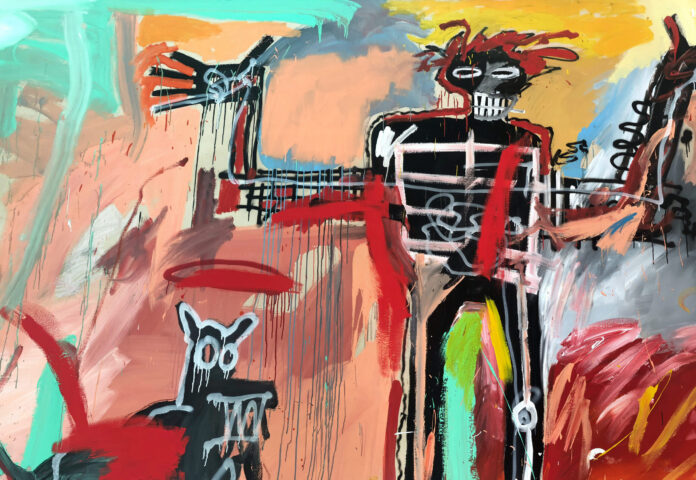
Boy and Dog in Johnnypump-1982

The Johnnypump and the Stop and Search:

Jean-Michel Basquiat, Banksy, and the Enduring Politics of the Street

An Essay Inspired by Richard J. Powell’s Talk at the Hirshhorn Museum and Sculpture Garden

Presented in Tandem with Basquiat × Banksy (September 29, 2024 – October 26, 2025) Organized by Betsy Johnson, Assistant Curator, Hirshhorn Museum and Sculpture Garden Part of the Hirshhorn’s 50th-Anniversary Season

Prologue: Two Paintings, One Wall, One Argument

When the Hirshhorn Museum and Sculpture Garden — the Smithsonian’s national museum of modern and contemporary art, situated with particular authority on the National Mall in Washington, D.C. — chose to mark its fiftieth anniversary by placing two paintings in conversation, the choice was itself a critical act. On one side: Jean-Michel Basquiat’s Boy and Dog in a Johnnypump (1982), a monumental canvas nearly fourteen feet wide and eight feet high, executed in acrylic, crayon, and spray paint, in which a skeletal Black boy and his equally skeletal dog are rendered in the midst of an open fire hydrant’s spray. On the other: Banksy’s Banksquiat. Boy and Dog in Stop and Search (2018), a work on birch wood panel in which the same two figures from Basquiat’s painting are now being frisked by stenciled officers of London’s Metropolitan Police, their joyful raised hands reframed in an instant as the universal gesture of surrender.

For Richard J. Powell — the Distinguished John Spencer Bassett Professor of Art and Art History at Duke University, one of the foremost authorities on African American and African diasporic visual culture, and the scholar invited by the Hirshhorn to deliver the major public lecture accompanying this exhibition on October 10, 2024 — this pairing is not simply a curatorial conceit. It is a crystallization of the argument that has animated his scholarly career across more than three decades: that the art of the Black Atlantic diaspora, from the street to the canvas to the museum wall, operates within a continuous set of cultural, political, and aesthetic negotiations that mainstream art history has persistently failed to read with sufficient rigor or sufficient care.

This essay follows in Powell’s intellectual wake, using the Basquiat × Banksy exhibition as its primary occasion and its two central paintings as its central texts.

I. 1982: The Zenith of a Landmark Year

Basquiat himself said it plainly: looking back on 1982 from an interview with The New York Times in 1985, he observed that he had made the best paintings he had ever made during that period. The historical record supports the self-assessment. The year 1982 is widely recognized as Basquiat’s most artistically concentrated and most critically significant, a year in which the translation from street to studio — from SAMO© on the walls of SoHo and the Lower East Side to paintings that commanded galleries from New York to Modena to Los Angeles — was fully and irreversibly accomplished. It is the year that produced the skull painting Untitled (1982), which would later sell for $110.5 million, and it is the year that produced Boy and Dog in a Johnnypump, which sold for over $100 million in 2020.

But these auction figures, arresting as they are, tell us almost nothing about the painting itself. Boy and Dog in a Johnnypump is, on its surface, a scene of childhood: a boy and his dog playing in the spray of an open fire hydrant on a New York City summer day. “Johnny pump” is New York vernacular for a fire hydrant opened in summer for children to cool off in the heat — a genuinely democratic urban pleasure, free, improvisational, communal, available to whoever happened to live on the block. The scene is, in that sense, an idyll.

But Basquiat paints it with the formal vocabulary of his full Neo-Expressionist power: skeletal figures rendered with jagged, rapid brushstrokes, the boy’s three-pointed hair already gesturing toward the recurring crown motif that runs through his entire body of work. The figures are placed at the center of a polychromatic field — warm oranges and reds suggesting summer heat, the colors of a Pan-African tricolor investing the background with a political resonance that the surface innocence of the scene might otherwise obscure. The skeletal rendering of the Black figure does not suggest death or danger. It does something more complex: it simultaneously evokes the anatomical drawings of Gray’s Anatomy that captivated Basquiat since childhood and asserts a kind of structural clarity, a refusal of sentimentality, an insistence that the Black body be seen for what it is — sovereign, present, fully itself — without the mediating softness of idealization.

In this, as Powell’s framework helps us understand, Basquiat is working within a tradition of representing Black figures not as victims or exotica but as what the poet Robert Farris Thompson called “epic heroes,” kings in ordinary circumstances, crowned — if only by three-pointed hair — even in the simple act of playing in a hydrant’s spray.

II. From Graffiti to Gallery: The Street Art Lineage

To place Boy and Dog in a Johnnypump in the Hirshhorn is to enact the very argument the painting implicitly makes. Basquiat came out of the street. His earliest significant practice, beginning in the late 1970s, was as a graffiti artist and street poet under the tag SAMO©, a collaboration with Al Diaz that produced enigmatic, aphoristic messages on the walls of SoHo, the Lower East Side, and beyond. SAMO© was never merely decorative vandalism: it was a critical practice, a form of public poetry that used the most democratic possible medium — the city’s own exterior surfaces — to deliver philosophical and political observations to whoever happened to pass by.

The move from that practice to the canvas was not, Powell would insist, a rupture or a conversion experience. It was a continuous extension of the same impulse: to make marks on surfaces that communicate with maximum directness, that refuse the gatekeeping protocols of official culture, that assert the legitimacy of voices and forms that the mainstream art world has historically ignored or suppressed. When Basquiat began exhibiting at galleries — the Fun Gallery in the East Village in 1982, the Annina Nosei Gallery, the Larry Gagosian Gallery in Los Angeles — he brought the energy of the street with him. The paintings were never entirely domesticated by the white cube. They retained the explosive, improvisational force of the wall, the door, the found surface.

It is this lineage that connects Basquiat to Banksy — and that makes the Hirshhorn’s exhibition, organized by curator Betsy Johnson, not merely an exercise in comparative aesthetics but a genuine inquiry into the social and institutional meanings of street art’s journey into the museum. As Hirshhorn Director Melissa Chiu has observed, positioning Basquiat with Banksy “brings into focus elements of Basquiat’s legacy, notably the movement of street art tropes into museums through his studio practice.” Both artists began on walls. Both became internationally celebrated. Both have seen their work command extraordinary prices at auction. And both have been, in their different ways, artists whose primary subject is the relationship between power and the powerless, authority and insurgency, the official and the illicit.

III. Banksy Reads Basquiat: The Critical Transformation

On the night of September 16–17, 2017, in the early hours before dawn, Banksy made his way to the Barbican Centre in central London and stenciled a new image onto its exterior wall. His timing was deliberate: Basquiat: Boom for Real — the first major retrospective of Basquiat’s work in the United Kingdom since his death — was opening at the Barbican that week. Banksy announced the new work on Instagram with characteristic wit: “Major new Basquiat show opens at the Barbican — a place that is normally very keen to clean any graffiti from its walls.” The image he left on the wall — and later translated, in 2018, into the panel work Banksquiat. Boy and Dog in Stop and Search that now hangs across from the Basquiat at the Hirshhorn — showed the two skeletal figures from Boy and Dog in a Johnnypump being frisked by officers of the Metropolitan Police.

The formal operation Banksy performs on Basquiat’s painting is precise and devastating. He retains the figures — the boy and the dog, rendered in a faithful echo of Basquiat’s gestural, painterly style — but strips away Basquiat’s warm polychromatic background, leaving the figures against a largely monochromatic field. The boy’s raised hands, which in the original might be read as the exuberant gesture of a child playing in water, are now unmistakably the hands of someone complying with a police command — the “hands up, don’t shoot” gesture that has become the universal visual language of unarmed Black people confronting armed state authority. The Barbican’s light stone walls provide their own ironically charged backdrop: as Zora Neale Hurston once wrote, “I feel most colored when I am thrown against a sharp white background.”

The transformation is a form of art-historical commentary as much as political commentary. Banksy is arguing that the politics were always there in Basquiat’s painting — that the “urban idyll” was always a conditional idyll, available to the Black boy in the hydrant spray only until the moment when authority decided to intervene. The johnnypump becomes a stop and search. The summer afternoon becomes a confrontation. The joy is revealed to have been, all along, precarious.

What Banksy adds that was not explicit in Basquiat’s original is the police — the direct embodiment of the structural violence that threatened Basquiat throughout his own life, from his years on the streets of New York to his documented experience of racial profiling, to the death of his contemporary Michael Stewart at the hands of the New York City Transit Police in 1983. In Defacement (The Death of Michael Stewart) — painted directly onto the wall of Keith Haring’s studio in the immediate aftermath of Stewart’s death — Basquiat made that violence explicit and personal. In Boy and Dog in a Johnnypump, the violence is structural and latent, present in the social conditions that produced the scene even if not visible within it. Banksy makes the latent manifest, the structural literal, the implicit viscerally direct.

IV. Homage, Appropriation, and the Ethics of Citation

The relationship between Banksy’s work and Basquiat’s raises questions that Powell, as a scholar with deep expertise in both African American art and the politics of representation, is uniquely positioned to address. The Hirshhorn’s exhibition stages the encounter between them under the rubric of “homage and appropriation” — two terms that exist in productive tension with each other and that the work itself refuses to allow us to separate too cleanly.

Banksy is a white British artist of anonymous identity. Basquiat was a Black American artist of Haitian and Puerto Rican descent. When Banksy appropriates Basquiat’s figures and recontextualizes them as the subjects of a police stop-and-search, he is simultaneously honoring Basquiat’s legacy and performing an act of citation that has to be read carefully, particularly given the history of white artists and institutions appropriating Black creative work without adequate acknowledgment or compensation. To his credit, Banksy is explicit in naming his debt: the work’s title, Banksquiat, incorporates Basquiat’s name into his own authorial signature, and the ironic description of the piece as “an (unofficial) collaboration with the new Basquiat show” acknowledges the transatlantic, transgenerational nature of the artistic conversation.

The question of what Banksy adds to Basquiat — what his act of citation produces that was not already available in the original — is ultimately the question that the Hirshhorn exhibition asks its visitors to answer for themselves. Powell’s contribution, in his lecture accompanying the exhibition, is to provide the art-historical framework within which that question can be posed most rigorously: the tradition of African American and diasporic art that Basquiat inherited and transformed, the social conditions that made his practice both necessary and dangerous, the legacy that now continues to inspire artists across the globe — including an anonymous British street artist who paid tribute not by producing a pallid imitation but by producing a genuinely new work, one that uses Basquiat’s own visual language to say something that Basquiat, working in 1982, was perhaps not yet saying explicitly.

V. The Museum as Site: Institutional Stakes at the Hirshhorn

The fact that Basquiat × Banksy is on view at the Hirshhorn — presented as part of the museum’s fiftieth-anniversary season, marking it as the first time works by either artist have been exhibited at the nation’s museum of modern and contemporary art — is itself a statement of institutional reckoning. The Hirshhorn’s acknowledgment that it had not previously exhibited Basquiat is, in retrospect, a striking admission: one of the most significant American artists of the twentieth century, dead for more than three decades, was reaching the Smithsonian’s modern and contemporary museum for the first time through a loan of a single painting organized around his relationship to a British street artist.

This is not merely a logistical curiosity. It reflects the larger institutional history of American museums’ fraught and belated relationship with African American art — a history that Powell has documented and analyzed across his career. As Betsy Johnson’s curatorial vision for the exhibition recognizes, what the pairing of Basquiat and Banksy illuminates is precisely this institutional dynamic: the way in which the movement of street art into the museum is always a negotiation between the subversive energies that produced it and the legitimizing apparatus that displays it.

Basquiat experienced this negotiation in his own lifetime with acute discomfort. He was celebrated by the art market and by blue-chip galleries, but he was also subjected to the commodification of his practice and the exoticization of his person. He was the young Black artist who emerged from the streets and was welcomed into the gallery — and who understood, with painful clarity, the difference between being welcomed and being absorbed, between recognition and appropriation, between fame and dignity. The crown he wore in his own self-portraits — that three-pointed mark of sovereignty — was as much a defiant assertion against a market and an institution that he knew might consume him as it was a celebration of Black creativity.

To see Boy and Dog in a Johnnypump in the Hirshhorn, finally, forty-two years after it was painted, is to feel the full weight of that delay.

VI. Legacy Alive: Basquiat’s Continuing Resonance

Richard J. Powell has described Basquiat as one of the most significant artists of the twentieth century whose work remains a pivotal source of inspiration for artists today. The evidence for the second half of that observation is everywhere: in the work of painters, graffiti artists, installation artists, musicians, and filmmakers across the globe who cite Basquiat as formative to their own development; in the influence his visual language has had on the street art tradition from which Banksy himself emerged; in the continued scholarly and curatorial attention that his work attracts from every major art institution in the world; and in the sustained auction market that has made his paintings among the most expensive ever created by an American artist.

But Powell’s more significant contribution is the insistence on the first half of the observation: that Basquiat was not simply a wildly talented individual who made striking paintings, but one of the most significant artists of the twentieth century — a claim that rests on a rigorous understanding of the cultural and historical context in which he worked and the transformations his practice effected on the visual language of late modernity. His fusion of graffiti and Neo-Expressionism, his integration of writing and painting, his deployment of sign and symbol in the service of a counter-history of Black achievement and Black suffering, his polychromatic intensity drawn from both Caribbean muralism and commercial print culture, his sustained engagement with the body as both anatomical fact and political site — these constitute not the eccentric output of an outsider prodigy but the achieved expression of an artist who knew exactly what he was doing and why.

The small works on paper and wood from the collection of Larry Warsh — made between 1979 and 1985 and included in the Hirshhorn exhibition — provide crucial evidence for this claim. They demonstrate, as the Hirshhorn notes, Basquiat’s deep familiarity with art history, his disciplined use of language, and the systematic development of his signature motifs. The crowns and skulls that appear across his career are not accidental or arbitrary; they are elements of a carefully constructed visual vocabulary, deployed with the precision and intentionality of a painter who had studied the history of art with genuine seriousness and was fully conscious of the tradition within which he was working — and the tradition against which he was pushing back.

Epilogue: What the Johnnypump Holds

A fire hydrant opened in summer is a democratic miracle: it belongs to the street, to whoever lives on that block, to the children who play in it without permission or purchase. It is, in the vocabulary of urban life, a site of unclaimed pleasure, temporary freedom, the small sovereignty of the ordinary. Basquiat painted it in 1982 as exactly that — a moment of Black childhood delight, given epic scale and chromatic force by an artist who understood that the ordinary is never merely ordinary, that the boy in the hydrant’s spray is a king in his own right, that dignity does not require a gallery or an auction house or a fiftieth-anniversary exhibition at the Smithsonian to exist.

Banksy, thirty-six years later, reminded us of what that dignity is always up against. He did not contradict Basquiat’s painting; he completed it — or rather, he revealed that it had always already contained within it the conditions of its own undoing, that the joy is real and the threat is real and the two have always coexisted in the same body, on the same street, in the same country.

Richard J. Powell — who has spent his career insisting on the rigor, the complexity, and the historical depth of African American and diasporic visual culture — brings to both paintings the scholarly apparatus they deserve: an apparatus rooted not in the mythology of the overnight sensation or the market’s verdict, but in the long, unfinished, trans-Atlantic history of which both Basquiat and his inheritors are a part. To encounter Basquiat × Banksy at the Hirshhorn is, through Powell’s lens, not merely to attend an exhibition. It is to participate in a reckoning with that history — with what it has cost, what it has produced, and what it continues to demand of us as viewers, as scholars, and as citizens.


This essay was written in dialogue with Richard J. Powell’s lecture delivered at the Hirshhorn Museum and Sculpture Garden on October 10, 2024, and with the exhibition Basquiat × Banksy (September 29, 2024 – October 26, 2025), organized by Betsy Johnson, Assistant Curator, made possible with generous support from Kenneth C. Griffin and Griffin Catalyst, and presented as part of the Hirshhorn’s 50th-anniversary season. It draws additionally on Powell’s Black Art: A Cultural History (Thames & Hudson, 1997, 2002, 2021) and on the published record of Basquiat’s life and work.

When the Body Speaks in Color

Andrea Cardenal
When the Body Speaks in Color: Emotion, Memory, and the Creative Brain a talk by Andrea Cardenal

When the Body Speaks in Color:
Emotion, Memory, and the Creative Brain

a talk by
Andrea Cardenal

CEO & Founder, Art for Your Heart | Therapeutic Art Practitioner | Artist & Educator | Arts & Culture Leader | Creative Wellness Advocate

The Museum of Central American Art (MoCAArt.org)
Curator Suzanne Snider
[email protected]

Sunday, May 17, 2026 
2:00 – 5:00 pm

Delray Beach, Florida – Andrea Cardenal, a self-taught, third-generation Latin American artist and therapeutic art instructor, grew up in a family of opera singers, painters, and writers. 

Born in the USA to a Salvadoran mother and Nicaraguan father, her childhood in El Salvador during its civil war shaped her early connection to art as a means of emotional expression. Today, her work focuses on advancing creativity as a form of emotional wellness, community-building, and cultural expression; art as a tool for resilience, meaning, and connection.

MoCAArt at the Annex
290 SE 2nd Avenue, Delray Beach, Florida
Open by appointment Wed-Sat 12 noon to 5:00pm.

RSVP 
Email [email protected]. Or call 561-808-8587.

United States Artists Awards 2026 Knight Arts + Tech Fellowship to Five Artists

United States Artists Awards 2026 Knight Arts + Tech Fellowship to Five Artists

United States Artists Awards 2026 Knight Arts + Tech Fellowship to Five Artists
Five artists redefining media art through collaboration and critical engagement with technology awarded $50,000 each

United States Artists announced the awardees of the 2026 Knight Arts + Tech Fellowship, an annual initiative that supports five artists with unrestricted grants of $50,000 to further their disciplines, practices and innovative approaches in technology and new media.

Supported by the John S. and James L. Knight Foundation, the Knight Arts + Tech Fellowship awards artists who are expanding the boundaries of creative practice through emerging technologies — from augmented and virtual reality to immersive installations across sound, textile, digital fabrication and software-based work. Fellows use these tools in thoughtful, radical or poetic ways, pushing the field forward and critically engaging its possibilities.

“Through the Knight Arts + Tech Fellowship, we aim to not only strengthen the arts and technology ecosystem through long-term investment in the individuals and artistic practices that fuel innovation, but also foster a community among artists and cultural workers and continued growth across the field,” said Kristina Newman-Scott, Vice President for Arts at Knight Foundation. “Working across various disciplines and mediums, this year’s Fellowship class offers an examination of how evolving technological systems shape our environments, behaviors and forms of connection. Their work inspires consideration for innovation as a site of relational and communal possibility. We are thrilled to support each of these artists and we welcome their arrival and participation within our community.”

The 2026 Knight Arts + Tech Fellows works across media art, technology, performance and community practice, united by a deep commitment to reimagining technology as a social, cultural and embodied system rather than a purely technical or commercial one. Across their varied practices, their work collectively explores technology’s capacity to function as an active participant in shaping or redefining our human relationships and environments.

The 2026 Knight Arts + Tech Fellows are:

  • LIZN’BOW (Miami) – LIZN’BOW (Liz Ferrer and Bow Ty) are a collaborative duo whose practice spans performance, video, music, immersive installation and new media. Rooted in pop aesthetics and cultural critique, their work constructs environments that operate simultaneously as installations, performances and digital interfaces
     
  • Miguel Novelo (San Jose) – Miguel Novelo is an interdisciplinary artist and researcher whose work combines computational media with philosophical inquiry. Novelo’s artistic expressions include sculptures, interactive moving images and immersive installations that make use of computer vision, custom software, photogrammetry and game engines.
     
  • Rhonda Holberton (San Jose) – Rhonda Holberton is a new media artist whose multimedia installations integrate digital and interactive technologies with traditional methods of art production. Through these works, Holberton uses materials and platforms that physically connect human bodies via technology, revealing how the signals of digitally engineered worlds have tangible, destabilizing effects on our planet. 
     
  • Taeyoon Choi (Detroit) – Taeyoon Choi is an artist, writer and educator who explores the poetics of technology and human relations. He works with images, text and code oftentimes in collaboration with fellow artists, experts and community members.
     
  • Wesley Taylor (Detroit) – Wesley Taylor is a multidisciplinary artist whose practice combines installation, video art and sound to make a world. His decades-long practice hones the lessons and sharpens sensibilities learned from Detroit artists who came before him, shaping his craft of sampling, referencing and recontextualizing to demonstrate themes of placemaking, histories of entanglement with the present and the future and the necessity of Black imagination.

The 2026 Fellows were selected by Knight Foundation, United States Artists and a national panel of field leaders, including: Mindy Seu, Associate Professor, UCLA Department of Design Media Arts (Los Angeles, CA); Wade Wallerstein, Associate Curator, Gray Area (San Francisco, CA); and Leo Castañeda, Multimedia Artist and Video Game Designer (Miami, FL). 

To date, the Knight Arts + Tech Fellowship program has awarded 25 artists, each cohort working among various practices, disciplines and mediums, yet remaining grounded in storytelling, speculative thinking, knowledge sharing and education, and community engagement. This year’s cohort continues to reflect that legacy, emboldened by a spirit of collaboration, collectivism and experimentation across art and technology with a shared sense of care and consideration for our communities and environments. 

For more information on the Knight Arts + Tech Fellowship and the 2026 cohort of recipients, please visit this link.

ABOUT THE JOHN S. and JAMES L. KNIGHT FOUNDATION
We are social investors who support a more effective democracy by funding free expression and journalism, arts and culture in community, research in areas of media and democracy, and the success of American cities and towns where the Knight brothers once published newspapers. For more, visit kf.org.

ABOUT UNITED STATES ARTISTS
United States Artists plays a pivotal role in America’s cultural ecosystem, advancing the well-being of artists through unrestricted funding and tailored professional services, amplifying artists’ work, and improving conditions that support their essential roles in society. Founded in 2005 and based in Chicago, IL, United States Artists has awarded over 1,000 individuals with over $50 million of direct support across its flagship Fellowship program and its special Initiatives.

USA collaborates with foundations, philanthropists, and other field leaders to create pathways of support for artists across the nation, working closely with our partners to conduct research, design programs, and administer funds in response to their missions and the needs of artists.

ABOUT THE KNIGHT ARTS + TECH FELLOWSHIP
The John S. and James L. Knight Foundation launched the Knight Arts + Tech Fellowship in 2021 to celebrate and support artists working with innovative approaches to technology and new media. Knight Arts + Tech Fellows use emerging technologies and media, including software and coding, immersive installation, sound art, bioart, AI, augmented and virtual reality, digital fabrication and more, in thoughtful, radical or poetic ways to expand the field and critically contribute to its discourse. Technology may be a tool, platform, by product or end product within an artist’s practice.

PRESS CONTACTS
Rachel Roberts
Senior Account Executive, Cultural Counsel
[email protected]

Colleen Rodgers
Account Coordinator, Cultural Counsel
[email protected]

opa projects Presents “Warmth in TwoTones”

opa projects

opa projects Presents “Warmth in Two
Tones” — a Solo Exhibition by Camilla
Marie Dahl.

Exhibition from 16 April 2026 at opa projects, 7622 NE 4th CT, 33138 Miami

Opa projects is pleased to present Warmth in Two Tones, a solo exhibition by Camilla Marie Dahl.

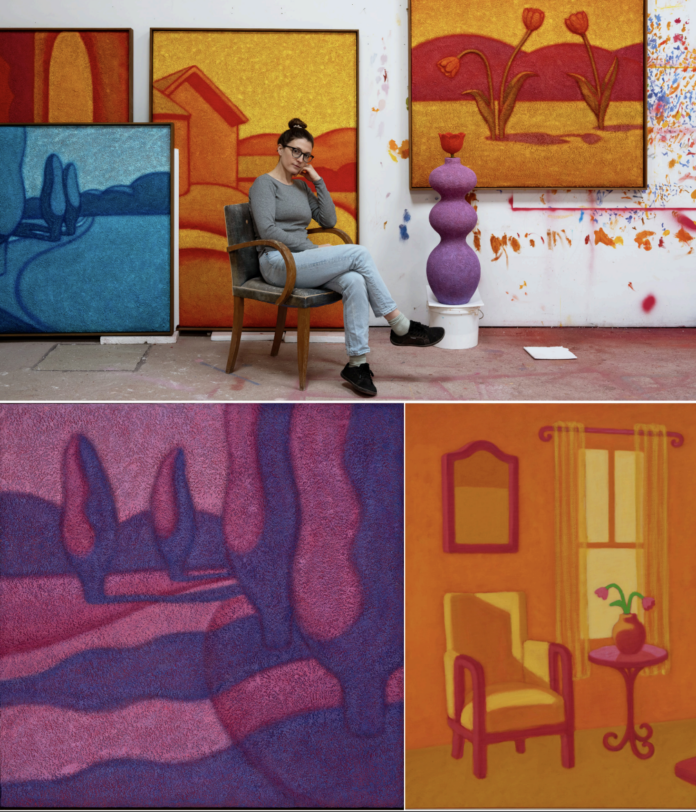
Working between painting and sculpture, Dahl creates richly textured surfaces in which carved foam, crushed marble, and oil paint converge to form images that feel both constructed and intimate.

In this new body of work, the artist reflects on the idea of home—not as a fixed place, but as an emotional landscape shaped by memory and daily rituals. Motifs drawn from Dahl’s lived environments reappear throughout the exhibition: barns recalling her childhood in New England, the cypress trees lining the driveway of her home in Spain, and tulips marking the arrival of spring. These elements function less as representations than as fragments of familiarity, filtered through recollection.

A parallel series revisits the interiors of the artist’s childhood dollhouse, transforming miniature domestic spaces into quietly theatrical scenes. Together, these works construct environments where texture, color, and light evoke the warmth of spaces both remembered and imagined.

opa projects
+1 516 807 5419 – [email protected]
7622 NE 4th CT, Little River, 33138 Miami

Searching for Willie Lynch

Searching for Willie Lynch

Searching for Willie Lynch

The M Ensemble Company

Apr 9 – 26, 2026

Location: 6103 NW 7th Ave, Miami, FL 33127

A story that confronts the past—and follows it into the present.
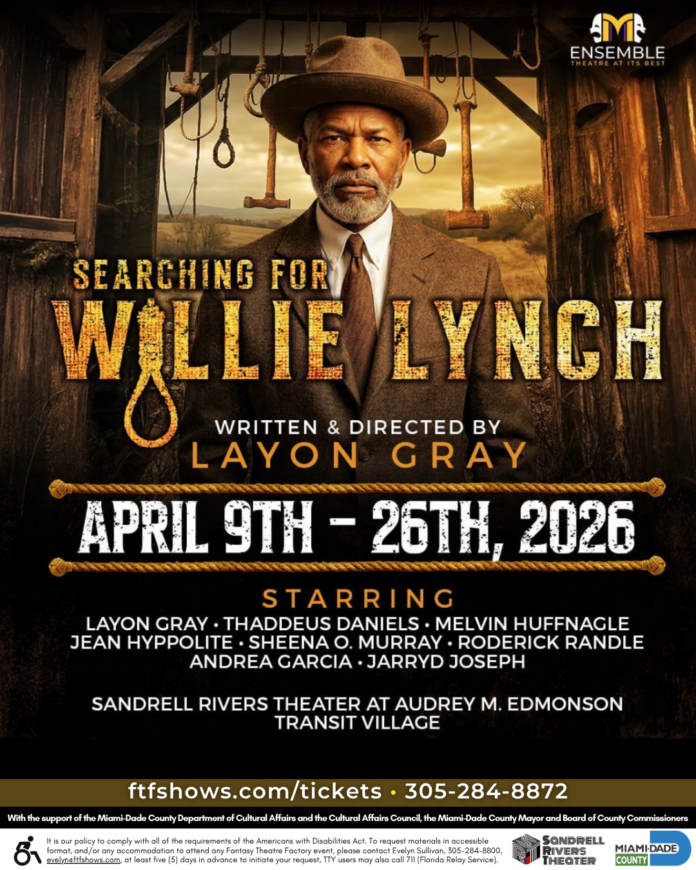
Opening this week at the Sandrell Rivers Theater, The M Ensemble Company presents Searching for Willie Lynch, a new play written and directed by Layon Gray.
Spanning 19301965, and 2008, the production follows three families connected across time—each uncovering pieces of a history that continues to shape their lives.
At the center is a question that doesn’t easily resolve:
What has been passed down—and what still needs to be understood?
Through a theatrical structure that blends realism with a mysterious portal linking generations, the story moves between eras, revealing how division, identity, and inherited narratives echo across decades.
Performance Schedule:
Opening Night: Thursday, April 9 • 8:00 PM
Evenings: April 10, 11, 17, 18, 24, 25 • 8:00 PM
Matinees: April 12, 19, 25, 26 • 3:00 PM


Produced by the M Ensemble Company, one of South Florida’s leading Black theatre institutions, this production continues a legacy of work that engages directly with history, culture, and community.

This is a play that invites reflection, conversation, and attention.

Now on stage for a limited run.
Buy Tickets for Searching for Willie Lynch

Lucrecia Zappi Higher Bodies 

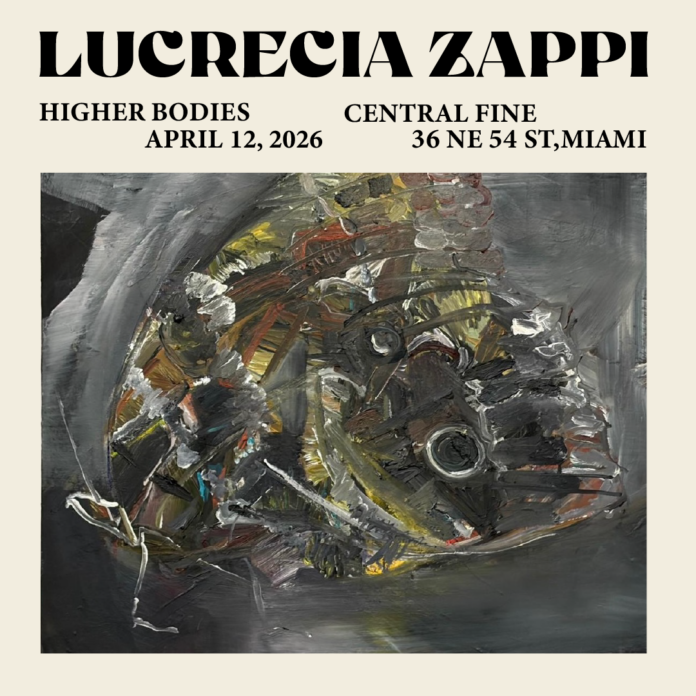
Argus 2025-2026 Oil on linen 15 x 18 in 38 x 45 cm

Lucrecia Zappi 
Higher Bodies 

Opening Reception: Sunday April 12th, 2026 6pm-8:30pm

36 NE 54th Street, Miami, FL 33137
Gallery Hours: Tuesdays, Thursdays & Saturdays, 11 AM – 5 PM (and by appointment)

We are proud to announce Higher Bodies, a solo presentation by Lucrecia Zappi.
Lucrecia Zappi presents her first solo exhibition, a group of gestural paintings centered on flesh, stage, and displacement. Born in Buenos Aires, raised in São Paulo, and based in New York, she brings a transnational sensibility to canvases that operate as arenas where the body endures and shifts.
Between spectacle and vulnerability, figures emerge exposed, only to recede again. The space at times becomes a stage – at once monumental and devotional – where the figure is both subject and witness. Her language, visceral and restrained, unfolds across surfaces slathered with metallic silver that glints like armor, recalling Moorish architectural elements as they appear in Brazilian vernacular – structures that filter vision and light. Mirrors echo nature itself, doubling and dispersing it, so that perception becomes multiplied and alive.

A central diptych inspired by Hansel and Gretel reimagines the tale through an innocent lens, inflected with Freudian undertones. It conjures a dreamlike realm, a passage marked by fantasy, uncanny disorientation, and the pursuit of a better place. The journey reads as initiation – a movement toward the unknown that hovers between myth and, in a contemporary register, a crossing.

At the core of her work lies what the artist calls “sulfate,” a residue of endurance. The paintings feel weathered, abraded, as if shaped by constant retelling. Within these layers, Lucrecia’s parallel life as a novelist surfaces in inscriptions that echo the work’s chromatic intensity. Her canvases hold fragments where narrative is embedded, interrupted, and rewritten, moving closer to rhythm than to overt speech.
In this debut exhibition, wonder and unease coexist. Migration expands into myth. And the body, whether human or feral, remains in a constant state of flux. Lucrecia Zappi was born in Argentina and grew up in Brazil. Last year she showed her work in two group exhibitions at CENTRAL FINE and participated at a group presentation at Art Basel Miami Beach 2025. She’s an awarded novelist, with three published novels in several countries and with a career in visual arts journalism, writing mostly for the major Brazilian newspaper “Folha de S. Paulo.”

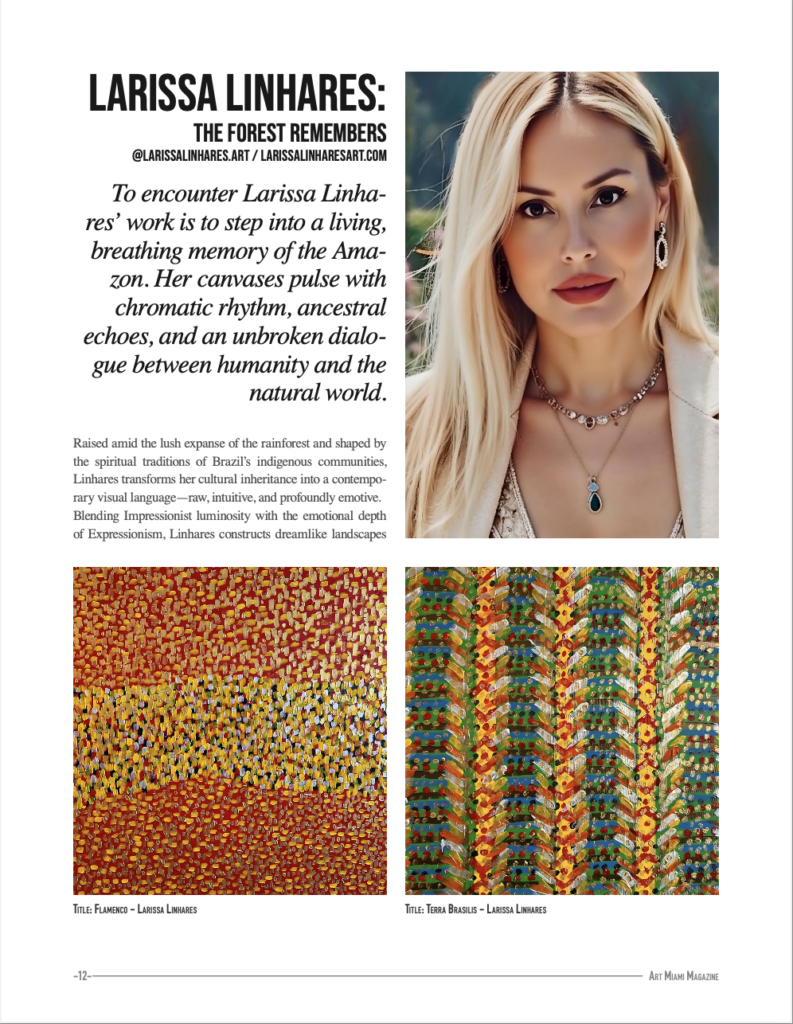
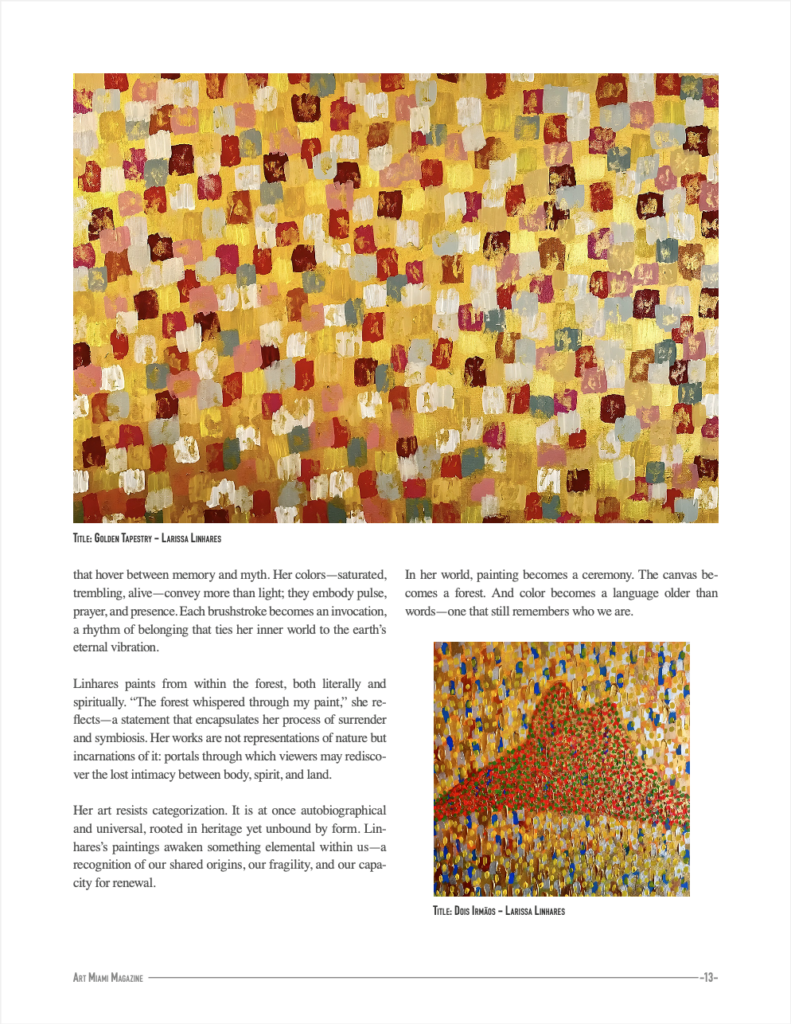
Larissa Linhares: The Forest Remembers

Larissa Linhares:
Larissa Linhares: Terra Brasilis

Larissa Linhares: The Forest Remembers

@larissalinhares.art / Larissalinharesart.com

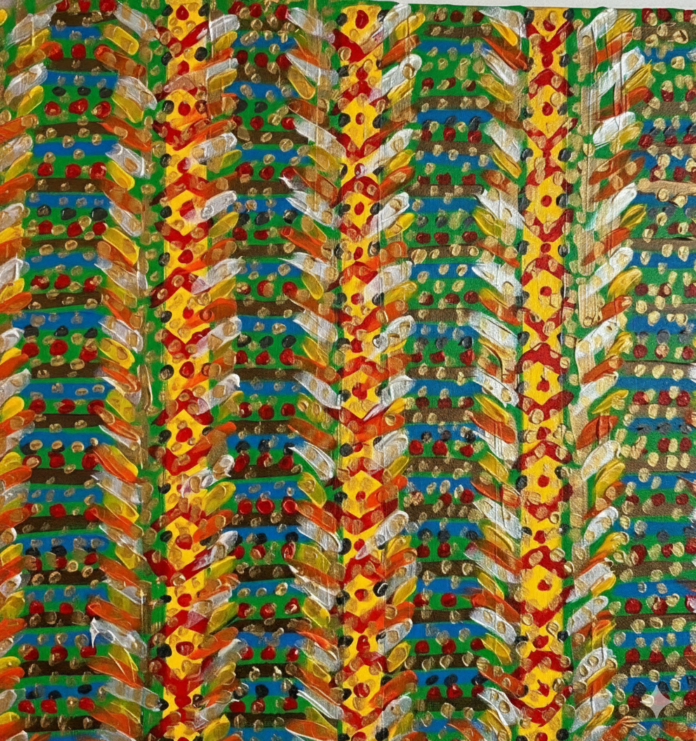
To encounter Larissa Linhares’ work is to step into a living, breathing memory of the Amazon. Her canvases pulse with chromatic rhythm, ancestral echoes, and an unbroken dialogue between humanity and the natural world. Raised amid the lush expanse of the rainforest and shaped by the spiritual traditions of Brazil’s indigenous communities, Linhares transforms her cultural inheritance into a contemporary visual language—raw, intuitive, and profoundly emotive.

Blending Impressionist luminosity with the emotional depth of Expressionism, Linhares constructs dreamlike landscapes that hover between memory and myth. Her colors—saturated, trembling, alive—convey more than light; they embody pulse, prayer, and presence. Each brushstroke becomes an invocation, a rhythm of belonging that ties her inner world to the earth’s eternal vibration.

Linhares paints from within the forest, both literally and spiritually. “The forest whispered through my paint,” she reflects—a statement that encapsulates her process of surrender and symbiosis. Her works are not representations of nature but incarnations of it: portals through which viewers may rediscover the lost intimacy between body, spirit, and land.

Her art resists categorization. It is at once autobiographical and universal, rooted in heritage yet unbound by form. Linhares’s paintings awaken something elemental within us—a recognition of our shared origins, our fragility, and our capacity for renewal.

In her world, painting becomes a ceremony. The canvas becomes a forest. And color becomes a language older than words—one that still remembers who we are.

Larissa Linhares:
Larissa Linhares:
Larissa Linhares:

Lauren Jane Clancy: Aesthetics of Endurance

Lauren Jane Clancy

Lauren Jane Clancy: Aesthetics of Endurance

@laurenjaneclancyart / Underoneart.com

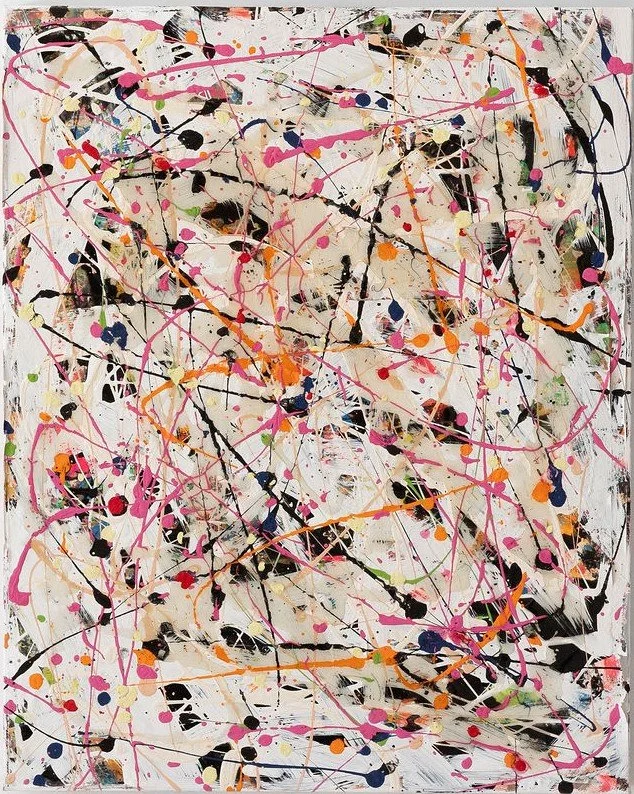
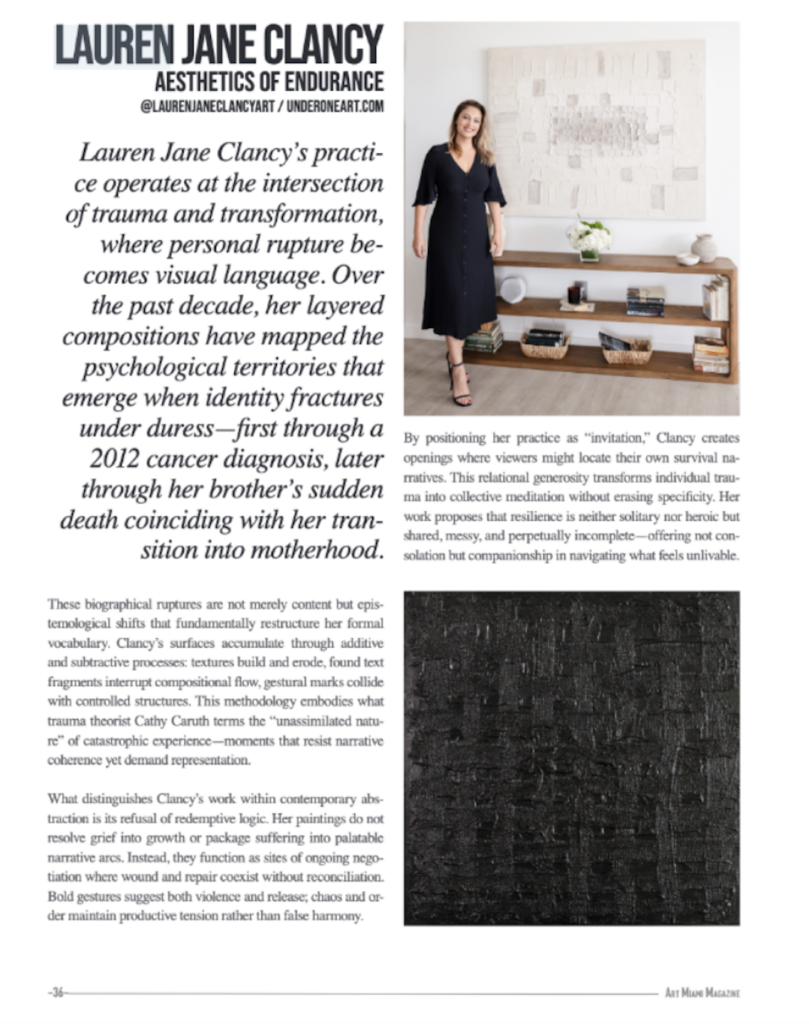
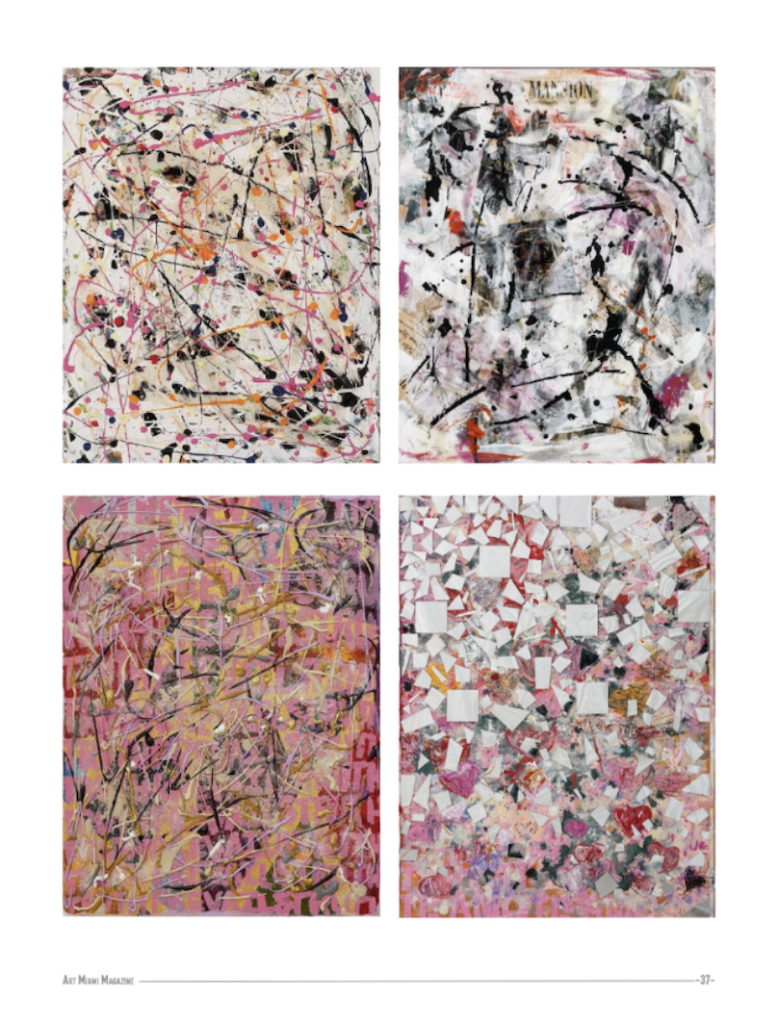
Lauren Jane Clancy’s practice operates at the intersection of trauma and transformation, where personal rupture becomes visual language. Over the past decade, her layered compositions have mapped the psychological territories that emerge when identity fractures under duress—first through a 2012 cancer diagnosis, later through her brother’s sudden death coinciding with her transition into motherhood.

These biographical ruptures are not merely content but epistemological shifts that fundamentally restructure her formal vocabulary. Clancy’s surfaces accumulate through additive and subtractive processes: textures build and erode, found text fragments interrupt compositional flow, gestural marks collide with controlled structures. This methodology embodies what trauma theorist Cathy Caruth terms the “unassimilated nature” of catastrophic experience—moments that resist narrative coherence yet demand representation.

What distinguishes Clancy’s work within contemporary abstraction is its refusal of redemptive logic. Her paintings do not resolve grief into growth or package suffering into palatable narrative arcs. Instead, they function as sites of ongoing negotiation where wound and repair coexist without reconciliation. Bold gestures suggest both violence and release; chaos and order maintain productive tension rather than false harmony.

By positioning her practice as “invitation,” Clancy creates openings where viewers might locate their own survival narratives. This relational generosity transforms individual trauma into collective meditation without erasing specificity. Her work proposes that resilience is neither solitary nor heroic but shared, messy, and perpetually incomplete—offering not consolation but companionship in navigating what feels unlivable.

Lauren Jane Clancy -Art Miami Magazine
Lauren Jane Clancy
Lauren Jane Clancy
Lauren Jane Clancy
Page 6 of 286
1 4 5 6 7 8 286