Home Blog Page 6

The Light of the World: Artist Talk

The Light of the World: Artist Talk

The Light of the World: Artist Talk

Thu Apr 232026 7:00 PM – 9:00 PM EDT

Saladrigas Gallery at Belen Jesuit

The Olga M. and Carlos A. Saladrigas Gallery at Belen Jesuit Preparatory School proudly announces the opening of The Light of the World, a Christ-centered art exhibition exploring the depiction of Jesus Christ across centuries and cultures. The exhibition will be on view from March 12 through May 6, 2026.

A Journey Through Sacred Art

For nearly two thousand years, artists have interpreted the figure of Jesus Christ—shaping some of history’s most profound and visually stunning masterpieces. The Light of the World invites visitors to experience this rich tradition, featuring paintings, sculptures, and drawings from the 16th century to today. The exhibition brings together Russian icons, Renaissance works, paintings from the Cuzco School, late 19th- and early 20th-century Latin American art, and contemporary works by local and international artists—including icons created as prayers in the 21st century.

Curated by Carol Damian, Ph.D., and Adriana Herrera, Ph.D., the exhibition offers an immersive journey through the story of Jesus Christ as seen through the eyes of artists from Europe, Russia, South America, and the United States.

Location

Saladrigas Gallery at Belen Jesuit

500 SW 127th Ave, Miami, FL 33184, USA

100 Collaborations with Félix Morelo. No. 1

artist Félix Morelo

100 Collaborations with Félix Morelo. No. 1

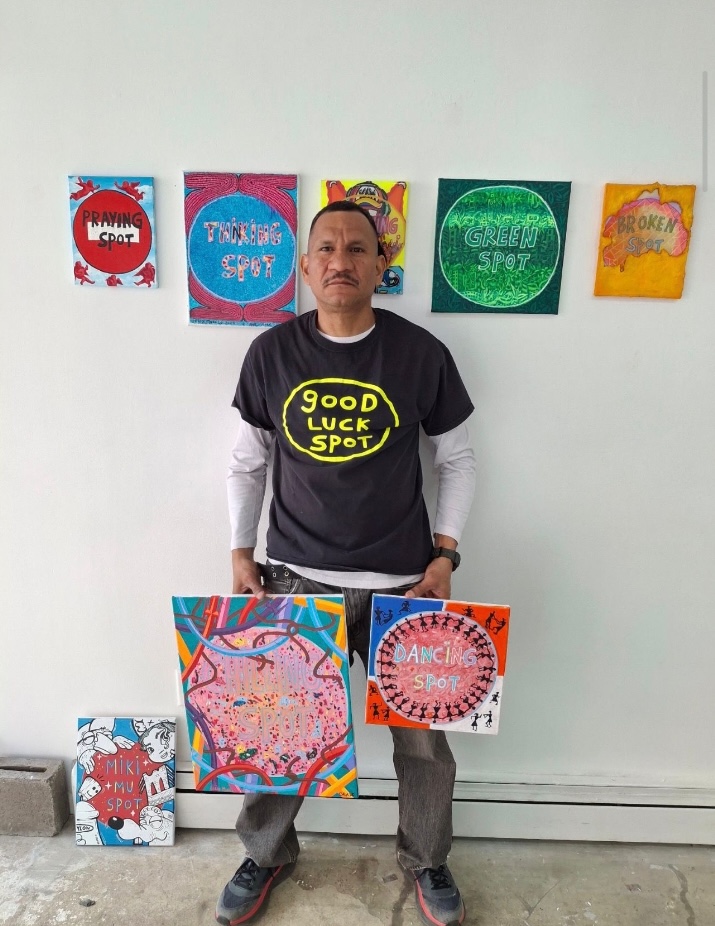
The PRIV. Y Gallery, located at 46 Hester Street in New York, is pleased to present the exhibition 100 Collaborations with Félix Morelo. No. 1, featuring one hundred artists in collaboration with Colombian-American artist Félix Morelo. The exhibition will open to the public on April 9.

Among the participants are ten notable artists contributing distinct visual proposals: Judy Glatzman (Grieving Spot), John Matos CRASH (Healing Spot), Alejandro Caiazza (Dancing Spot), Al Diaz (Language Spot), Glenn Goldberg (Quiet Spot), Eric Orr (Robot Spot), Peter Drake (Process Spot), HEKTAD (Hektad Spot), Ayakamay (Esoteric Spot), and MIKI-MU (Miki Mu Spot).

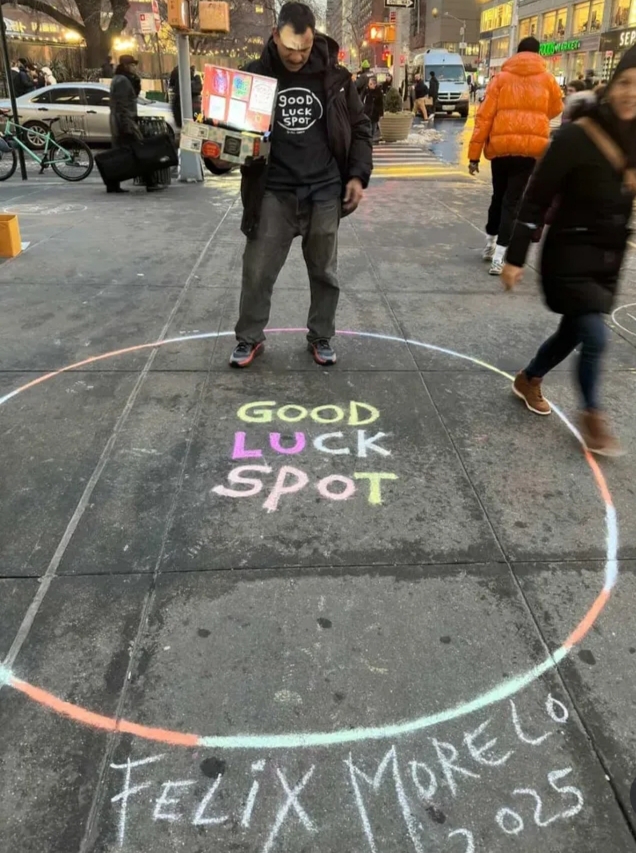
Morelo has established himself within the New York art scene through his unique approach to street art, a practice he began developing in 2009 while studying at Parsons School of Design. Initially focused on portraiture, his work evolved into his now-recognizable circular interventions made with chalk—white and color—applied to sidewalks, streets, and walls throughout the city.

These urban gestures transform public space into a participatory canvas, confronting passersby with phrases such as Good Luck Spot and Bad Luck Spot, as well as more provocative expressions like Suicide Spot, Pooping Spot, and Kissing Spot, momentarily shifting perception and awareness.

In this exhibition, participating artists reinterpret Morelo’s visual language—developed over 17 years in urban contexts—translating it into small-format works for the gallery setting. The project becomes both a tribute and a collective exercise, where minimal scale opens a dialogue between one hundred contemporary artistic perspectives.

artist Félix Morelo

The Idea of a Garden by Yossi Peled

Yossi Peled
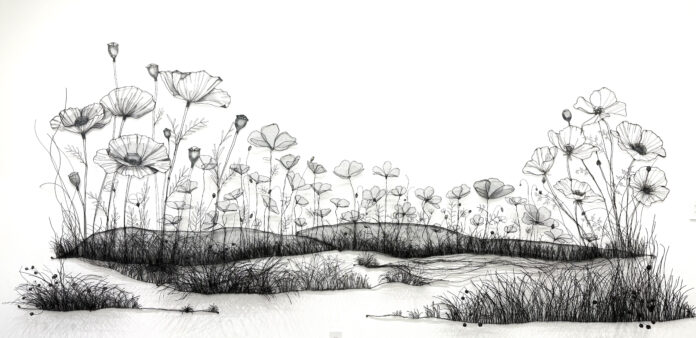
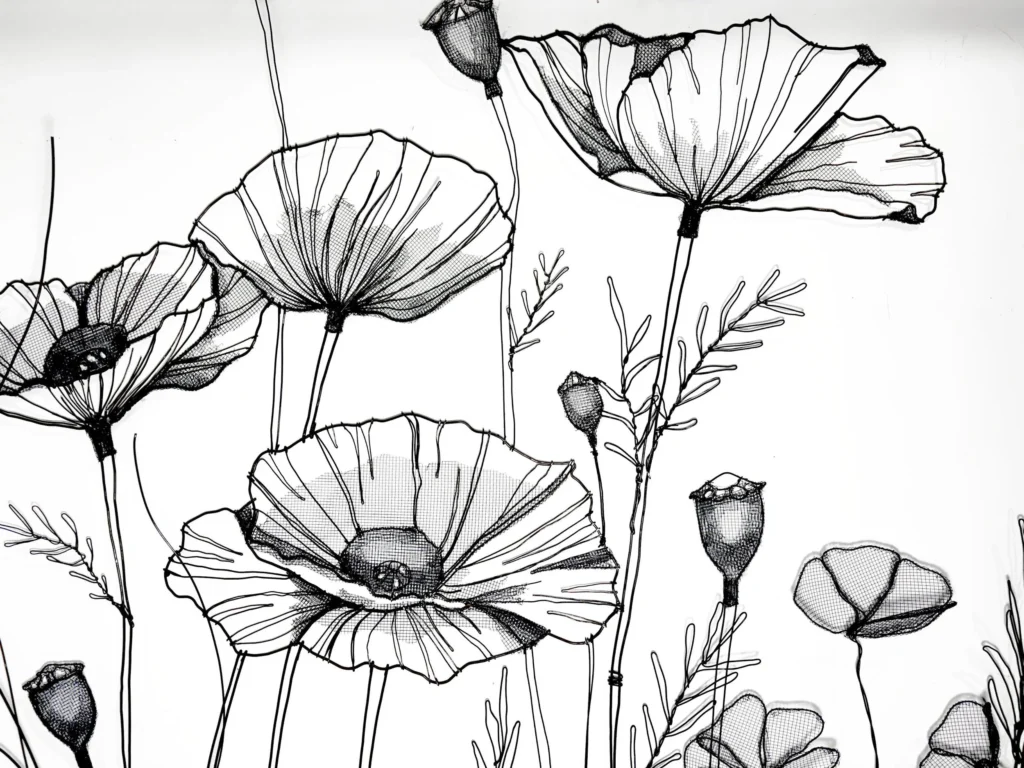
Spring Garden 163 W x 57 H x 6 D in Wire Metal, and Metal Mesh

The Idea of a Garden by Yossi Peled

Bernice Steinbaum Gallery
2101 Tigertail Avenue, Miami, FL 33133

“What does wire have to do with a garden?”

Yossi Peled’s exhibition The Idea of a Garden unfolds as a perceptual experience in which line transcends its two-dimensional condition to become structure, space, and a mode of thought. From the very first encounter, what compels is not form, but the line itself—insistent, expansive, seeking to inhabit space.

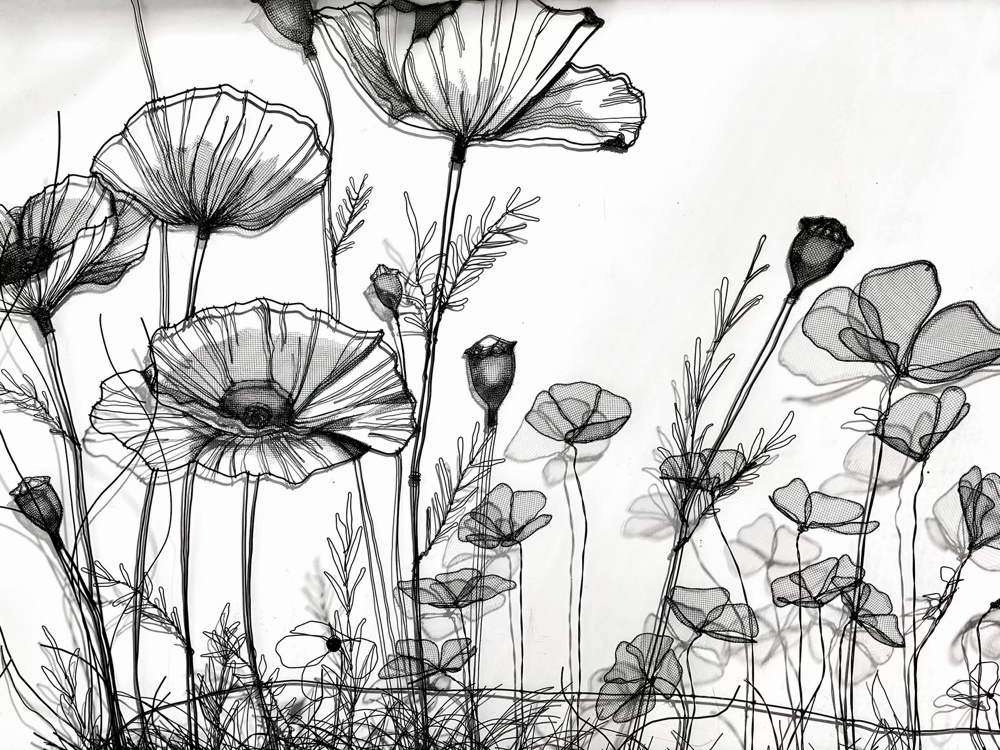
Peled’s “garden” is constructed not through mass, but through the tension between presence and absence. Wire and mesh—industrial, rigid materials seemingly distant from the organic—are transformed into living gestures that evoke growth, respiration, and movement. In this transformation, the work recalls the logic of the Hilbert curve: a continuous line capable of filling space without interruption. Yet, unlike this mathematical ideal, Peled’s lines break. They fragment, intersect, and restart. Where the Hilbert curve promises continuity, Peled introduces rupture.

This distinction is crucial. His garden does not aspire to totality, but to experience. It is in the interruption that the work becomes human—where perception hesitates, where the eye must reconstruct what is missing.

A third element intensifies this condition: the shadow. Not as a secondary effect, but as an extension of the work itself. In projection, the line multiplies and destabilizes, producing a layered field where drawing oscillates between presence and disappearance.

Peled ultimately redefines sculpture as expanded drawing. His garden is not merely seen; it is traversed, inhabited, and reconstructed through perception.

Bernice Steinbaum Gallery
2101 Tigertail Avenue, Miami, FL 33133
The gallery is open on Monday, Wednesday, and Friday
from 10:00 AM to 4:00 PM, or by appointment.

For more information, please contact us at (305) 860-3681.

Yossi Peled
Yossi Peled
Yossi Peled
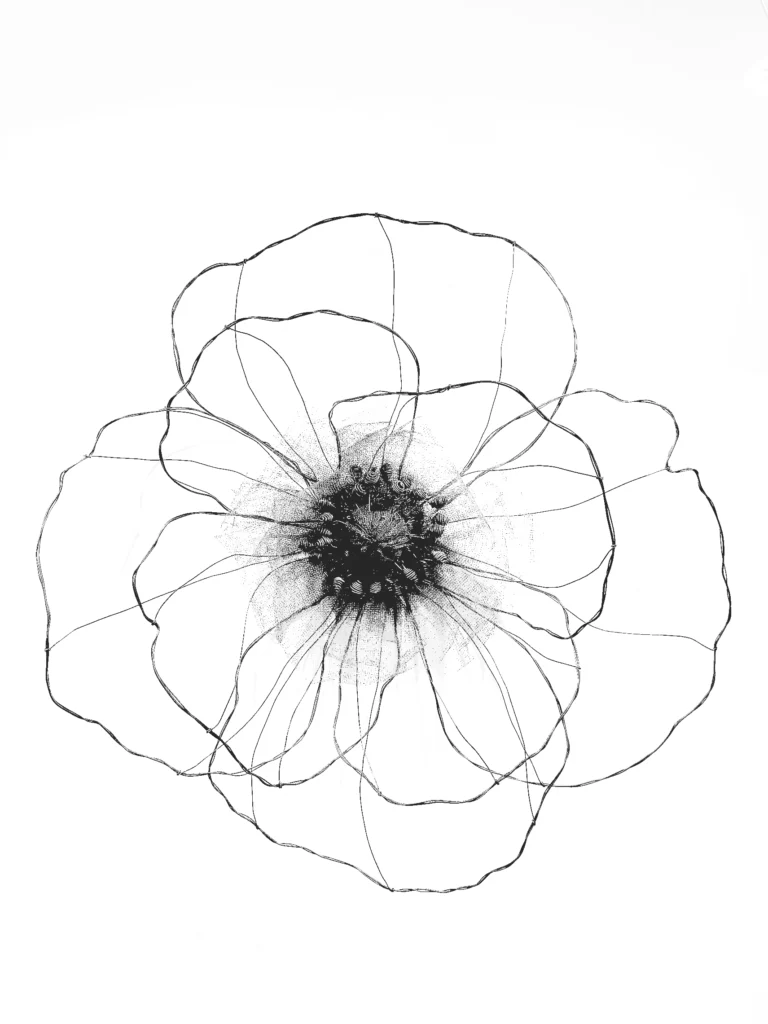
Poppy Flower
38 x 34 in
Wire Metal and Metal Mesh
Yossi Peled
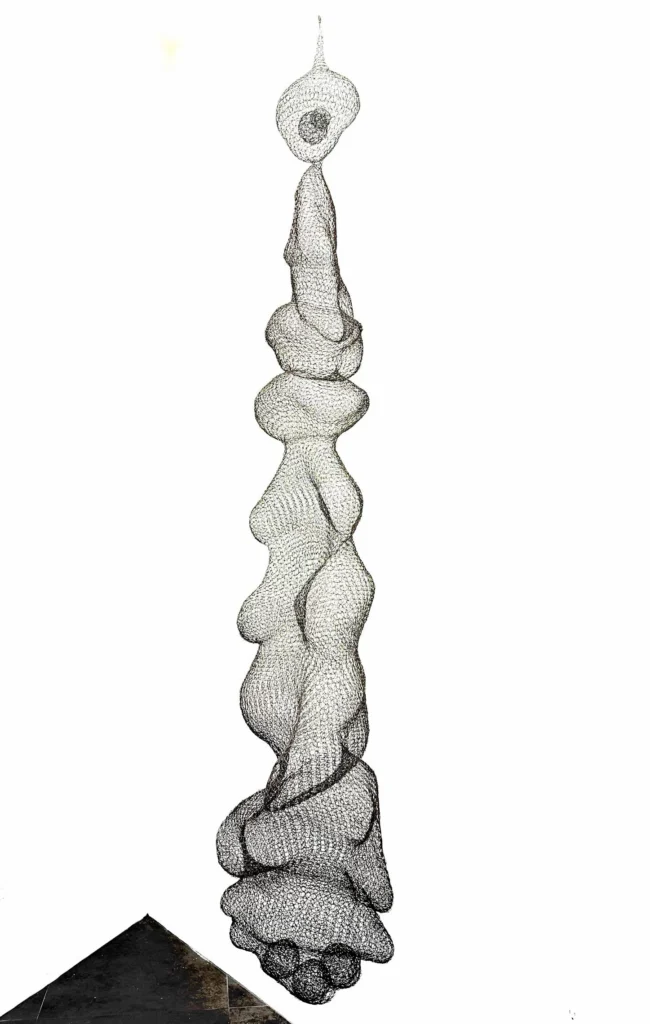
Catching the Light
94 x 21 x 10 in
Wire Metal and Metal Mesh

La métrica, la óptica, la dimensión y el color

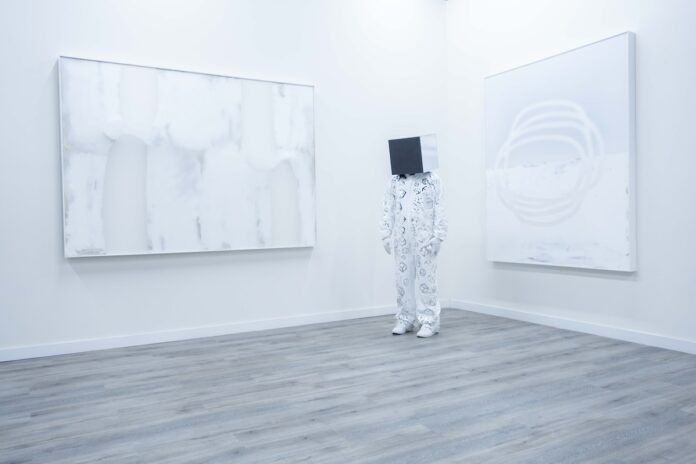
Kube Man by Rafael Montilla - photo Ricardo Cornejo

La métrica, la óptica, la dimensión y el color: Herramientas Claves en la Arquitectura y el Arte

El uso del color en la arquitectura es un elemento fundamental que va más allá de lo decorativo. En el contexto de movimientos como el Neoplasticismo y el De Stijl, el color se convierte en una herramienta esencial para definir espacios, crear contrastes y establecer relaciones visuales. A continuación, exploramos cómo la métrica, la óptica, la dimensión y la calidad cromática influyen en la percepción y el diseño arquitectónico.

1. La Métrica: Proporción y Equilibrio

La métrica en arquitectura se refiere a la proporción y el equilibrio entre los elementos que componen un espacio. En el Neoplasticismo, el color se utiliza para definir planos y establecer relaciones métricas entre ellos. Por ejemplo:

  • Líneas y planos: El uso de colores primarios (rojo, azul, amarillo) y neutros (blanco, negro, gris) ayuda a delimitar superficies y crear una sensación de orden y armonía.
  • Equilibrio asimétrico: A diferencia de la simetría clásica, el Neoplasticismo busca un equilibrio dinámico a través de la disposición de formas y colores que contrastan entre sí.

2. La Óptica: Percepción Visual

La óptica en arquitectura se relaciona con cómo percibimos los espacios y los elementos que los componen. El color juega un papel crucial en esta percepción:

  • Profundidad y perspectiva: Los colores claros (como el blanco) tienden a expandir visualmente un espacio, mientras que los colores oscuros (como el negro) lo contraen. Esto permite manipular la percepción de profundidad en un diseño.
  • Contraste y enfoque: El uso de colores contrastantes (por ejemplo, rojo sobre blanco) puede dirigir la atención hacia elementos específicos, como una pared o una columna.

3. La Dimensión: Espacio y Volumen

El color también influye en la percepción de la dimensión en arquitectura, es decir, cómo se perciben los volúmenes y los espacios:

  • Desmaterialización: En el Neoplasticismo, el color se utiliza para “desmaterializar” las formas, es decir, para reducir la sensación de masa y enfatizar la idea de espacio. Por ejemplo, en la Casa Schröder de Gerrit Rietveld, los planos de colores primarios parecen flotar, creando una sensación de ligereza.
  • Integración de interior y exterior: El color puede ayudar a difuminar los límites entre el interior y el exterior, creando una sensación de continuidad espacial.

4. La Calidad Cromática: Expresión y Simbolismo

La calidad cromática se refiere a las propiedades expresivas y simbólicas del color. En arquitectura, el color no solo es un elemento visual, sino también emocional y conceptual:

  • Colores primarios y neutros: En el Neoplasticismo, los colores primarios (rojo, azul, amarillo) representan la pureza y la esencialidad, mientras que los neutros (blanco, negro, gris) aportan equilibrio y contraste.
  • Luz y sombra: El color interactúa con la luz para crear efectos dinámicos. Por ejemplo, un plano rojo bajo la luz del sol puede parecer vibrante, mientras que bajo la sombra puede adquirir un tono más oscuro y dramático.
  • Simbolismo: El color también puede tener un significado simbólico. Por ejemplo, el rojo puede representar energía y dinamismo, mientras que el azul puede evocar calma y serenidad.

El Color en la Arquitectura Neoplástica: Un Ejemplo Práctico

Un ejemplo emblemático del uso del color en la arquitectura neoplástica es la Casa Schröder de Gerrit Rietveld. En esta obra:

  • Los planos de colores primarios (rojo, azul, amarillo) contrastan con los planos blancos y grises, creando una composición visualmente dinámica.
  • El color define los límites de los planos y los volúmenes, permitiendo que el espacio se perciba como una serie de elementos independientes pero interconectados.
  • La interacción entre el color y la luz natural crea efectos cambiantes a lo largo del día, lo que añade una dimensión temporal al diseño.

El color en la arquitectura no es simplemente un añadido estético; es una herramienta poderosa que influye en la métrica, la óptica, la dimensión y la calidad cromática de un espacio. En movimientos como el Neoplasticismo, el color se convierte en un elemento esencial para crear una arquitectura que trasciende lo físico y se convierte en una expresión pura de ideas y principios. A través del uso estratégico del color, los arquitectos pueden transformar la percepción de los espacios, creando obras que son tanto funcionales como profundamente significativas.

Álvaro J. Caviedes 

Alvaro Caviedes PORTALES II
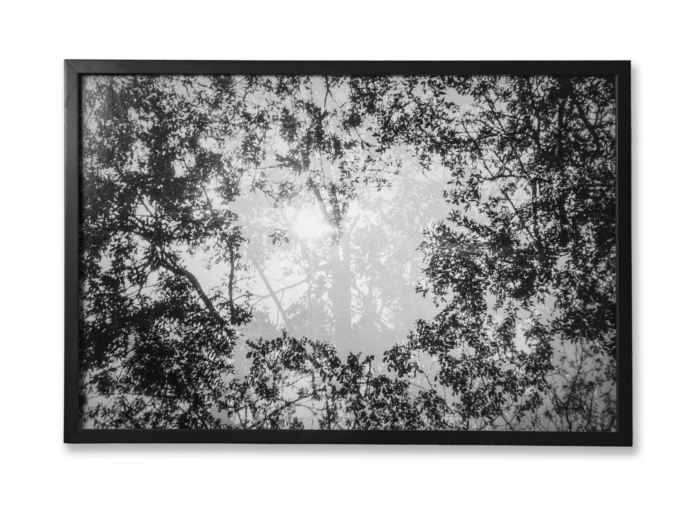
Title: Portales II Artist: Álvaro J. Caviedes Location: Pueblo Bello - Colombia Year: 2023 Size: 16 x 24 IN

Álvaro J. Caviedes 

En la práctica de Álvaro J. Caviedes, la fotografía deja de ser un mero registro de lo visible para convertirse en un campo de resonancia donde luz, memoria y conciencia se entrelazan. Su aproximación al medio—que él mismo describe como un “oficio alquímico”—desplaza la imagen hacia un territorio donde lo técnico y lo místico coexisten en tensión constante. A través de exposiciones múltiples analógicas, Caviedes no busca fijar un instante, sino expandirlo, permitiendo que distintas capas de tiempo, percepción y experiencia se inscriban sobre una misma superficie.

Su obra transita entre la intimidad del cuerpo, la vastedad del paisaje y la dimensión simbólica de la luz como portadora de memoria. Ya sea en la desnudez como gesto de comunión con la naturaleza, o en la exploración del paisaje urbano como un organismo vivo y mutable, su práctica revela una búsqueda persistente por disolver las fronteras entre sujeto y entorno, entre lo vivido y lo recordado.

En esta conversación, nos adentramos en los procesos, tensiones y preguntas que atraviesan su trabajo: la relación entre control técnico y azar, la imagen como acto de revelación, y la posibilidad de que la fotografía no solo capture la realidad, sino que la reconfigure desde una conciencia más profunda.

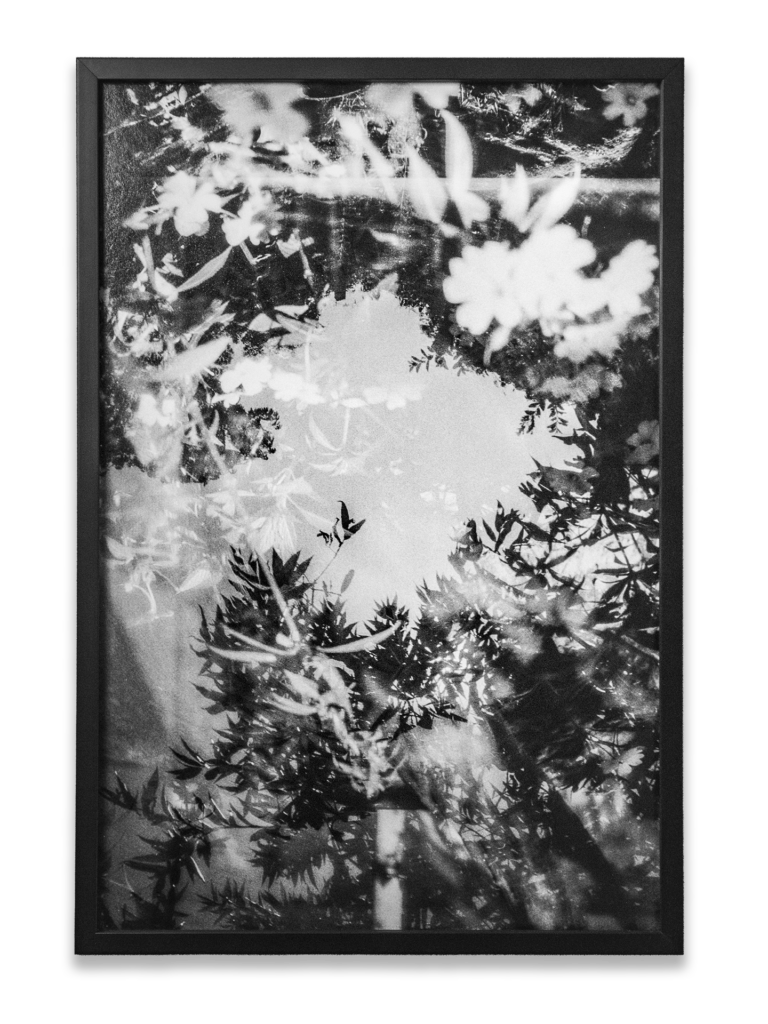
Alvaro Caviedes PORTALES I
Title: Portales I
Artist: Álvaro J. Caviedes
Location: Pueblo Bello – Colombia
Year: 2022
Size: 16 x 24 IN

AMM.  Describes la fotografía como un “oficio alquímico que inscribe la luz sobre haluros de plata” y afirmas que “la luz recuerda”. En tu proceso de trabajo con exposiciones múltiples analógicas, ¿cómo decides el momento exacto de cada superposición? ¿Existe un diálogo intuitivo entre la primera imagen capturada y las que vendrán después, o es un acto de rendición total al azar y la fortuidad? Me interesa entender cómo navegas la tensión entre control técnico e intuición mística en el cuarto oscuro.

AJC. A la hora de hacer fotografías de múltiple exposición siempre hay un diálogo entre capturas; es como la conciencia del camino, que traducida visualmente es una constante sumatoria de sujeto, paisaje y texturas del entorno, que van silueteando y dando forma a esa mirada transitoria. Me gusta decir que es fortuito, pues más allá de no sobreexponer demasiado la película, no hay fórmulas exactas para lograr retratar la esencia de aquello que se presenta ante nuestra lente.

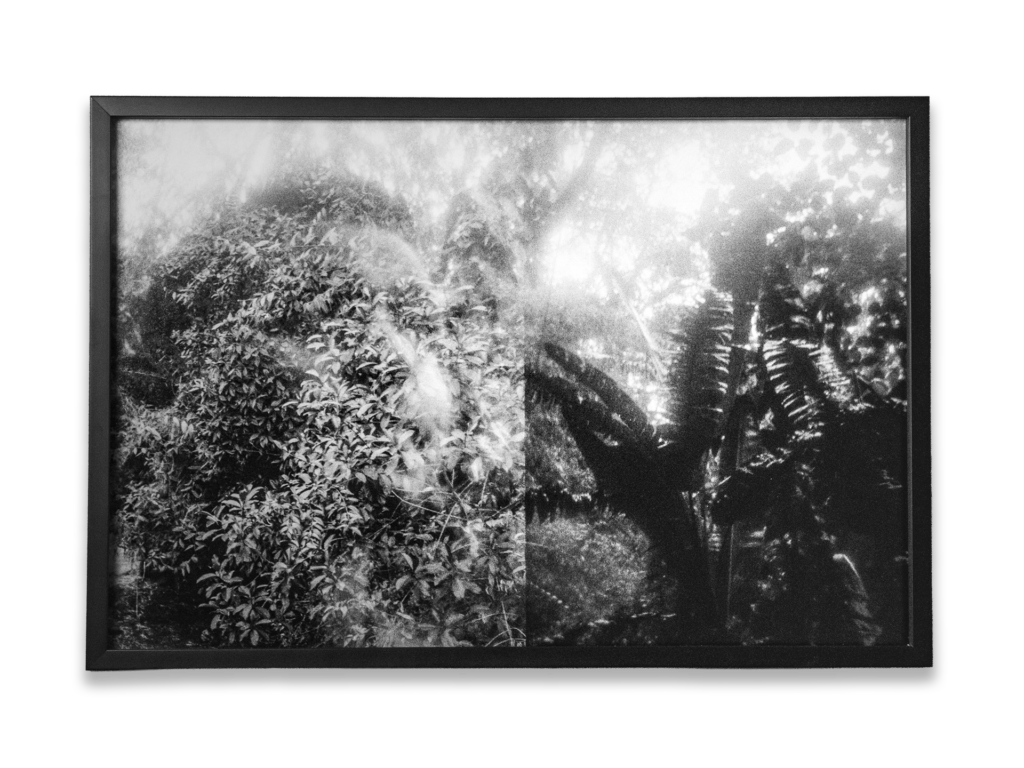
Al manipular mi cámara para lograr la superposición siempre influyen factores externos que determinan el resultado, es crucial la delicadeza o brusquedad con la que se mueve o se mantiene la posición de la película; un factor que está cien por ciento ligado a la presión del entorno y la presencia en mente y cuerpo. Hay ocasiones en donde una fotografía puede tomar dos horas de recorrido para meditar su imagen complementaria, como otros momentos en donde el ejercicio es inmediato, sin miramientos. Algo que realmente me encanta es romper el marco tradicional de 35mm y encontrar secuencias panorámicas de imágenes en donde encuentras tres, cuatro y más exposiciones.

El ensayo y el error, la inmensa cantidad de material velado y la incongruencia de muchas fotografías que se sentían perfectas en el instante; me ha enseñado a soltar el control técnico sobre la imagen análoga.  Me permito recibir con sorpresa y satisfacción cada nuevo grupo de negativos revelados así no encuentre en ellos la imagen deseada.  En ese sentido yo hablo de la alquimia, la mística y la memoria implícita de la luz, pues de ese caótico azar una verdad mayor se imprime sobre el acetato e ilumina una nueva conciencia, la imagen se constituye a sí misma y nosotros solo somos el canal.

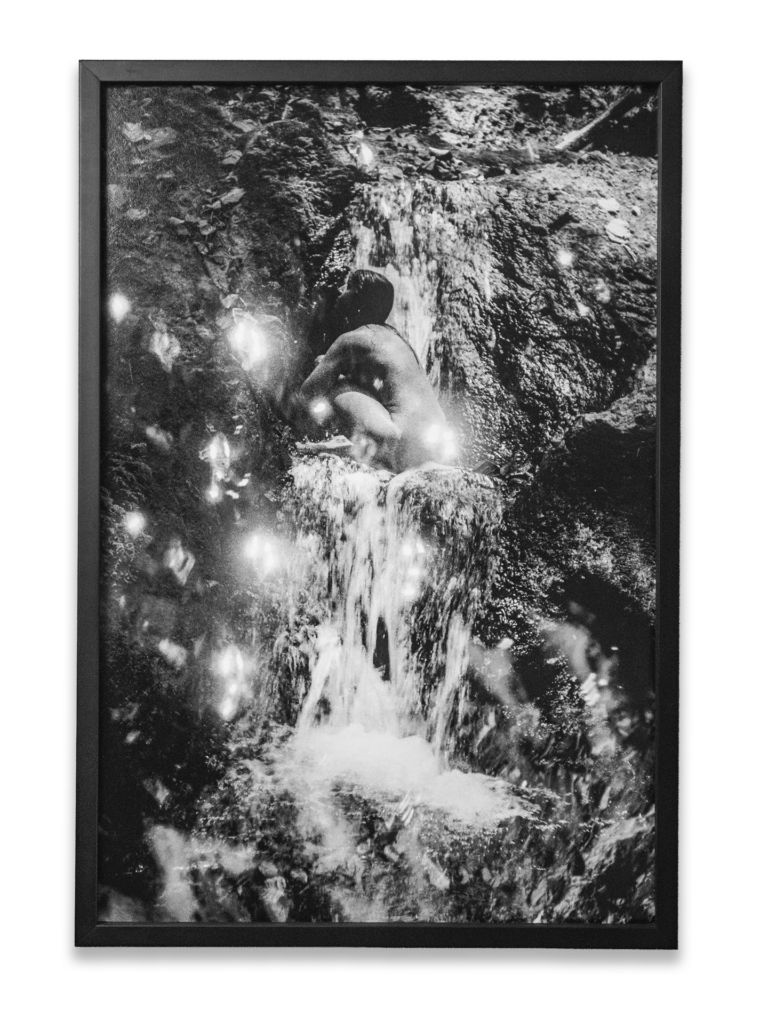
Alvaro Caviedes CUERPO LUMINISCENTE
Title: Cuerpo Luminiscente
Artist: Álvaro J. Caviedes and Maya Sebastianelli
Location: Eje Cafetero – Colombia
Year: 2023
Size: 16 x 24 IN

AMM.  En “Light Intuition” propones que “la desnudez se ofrece como un gesto de sublimación al ser, un acto de entrega y celebración”. Dado que trabajas tanto con amigos, artistas y seres queridos como modelos, ¿Cómo se asegura que esa vulnerabilidad no se convierta en una pose, sino que conserve su autenticidad? ¿Cómo se negocia la intimidad cuando el cuerpo desnudo se fusiona con el paisaje natural en una imagen que será eventualmente pública, expuesta en galerías y ferias internacionales como Red Dot Miami?

AJC. La desnudez fue un gesto espontáneo, como una ofrenda a nuestra propia divinidad, a la esencia animal y libre que sentimos al estar en contacto con la tierra. Estos retratos nacieron de esa forma, son el reflejo de una profunda búsqueda de identidad y reconocimiento en la naturaleza y sus fuerzas elementales, tienen gran relación con la poesía y el idilio.

Durante años tuvimos la fortuna de recorrer y admirar diferentes ecosistemas de Colombia, fue un periodo de grandes exploraciones y una inmensa expansión de nuestro ser. La cámara fue la bitácora de estos viajes, guardando memorias tangibles y emocionales de aquellas dimensiones que solo nuestras almas alcanzaron, eso es lo que quisimos expresar con el cuerpo.

Estar al desnudo fue el mayor desafío y sostener este argumento ante las circunstancias de separación y el tiempo, el mayor acto de autenticidad y respeto por nuestra obra. Por años estas fotografías fueron crudos que solo apreciamos en la intimidad, se volvieron amuletos y oráculos a los que muchas veces acudimos en busca de claridad e inspiración, sentido y belleza, podría decir incluso que fueron un catalizador y un salvavidas en momentos de mucha tensión e incertidumbre luego de dejar mi país.

El diálogo, la escritura y el mutuo acuerdo de hacer honor a estas memorias fue el puente que permitió que una selección de imágenes fueran expuestas al público e imaginadas en nuevos formatos y prácticas por venir. 

AMM. Tu formación es en cine y televisión, y has sido reconocido por tu cinematografía en películas como “La Europa”, “Rojo Marqueza”, “LIEBRES” y “Los Sueños Viajan Con El  Viento”. Sin embargo, tu práctica fotográfica parece operar en una temporalidad radicalmente diferente: no la narrativa secuencial del cine, sino el instante detenido, el “aura de un instante” como lo describes. ¿Cómo dialogan o se tensionan estos dos lenguajes visuales en tu trabajo? ¿Hay técnicas, filosofías o formas de mirar que transfieres del cine a la fotografía, o son mundos completamente separados en tu práctica creativa?

AJC. Ambas prácticas están eternamente conectadas, la luz y las fotografías guardarán la memoria de todo el cine que soñamos e hicimos junto a amigos, artistas y colegas, también son el corazón de decenas de historias que están por contarse. 

Una fotografía podría contarte toda la trama detrás de una película. 

Las herramientas que usamos para crear son la escritura de guiones y de poemas, la investigación de campo, la inspiración y fuerza que viene de la música que nace al interior del país, la lectura de oráculos y el deseo de inspirar e impactar al mundo más allá del lente. El cine y la fotografía son búsquedas tan personales como compartidas. 

Como por ejemplo la historia de Portales I – II 

Portales I–II (2022) más que una serie de fotografías, son el eco visual de una amistad. Estas imágenes, capturadas en los últimos días de rodaje del documental “El Silencio de la Montaña” son testimonio de una visión compartida entre mi amigo, el director del film y yo que lo acompañé con la cinematografía.

En el corazón de la Sierra Nevada, en Pueblo Bello, entre abundantes ríos y montañas se encuentran sus abuelos, el alma de la historia. En cada viaje de investigación, nos sumergimos en su cotidianidad. Nos unimos a sus tareas diarias en la casa y el campo, compartiendo el ritmo sereno de su vida. En ese territorio, el tiempo parecía detenerse y sublimarse en una dimensión cálida, silenciosa y pacífica. El sonido del río, el silbido de la brisa entre los árboles y el latir de la montaña eran la guía de estos viajes donde los segundos se disuelven en un arrullo continuo, en un ciclo hipnótico que envolvía todo en una meditación profunda e íntima.

En ese viaje buscamos hacer la fotografía del póster, el reto de lograr una imagen que reflejase la mística y la profundidad en los matices de nuestro discurso cinematográfico, el legado de un trabajo visceral desarrollado por años para homenajear en vida la memoria de la familia Iguaran. Inspirados por el póster de “Memoria” de Apichatpong, queríamos capturar la fusión entre el ser y el paisaje, entre la realidad y el sueño: fundir el rostro del abuelo con la bruma sobre la montaña y enaltecer los detalles como los rayos de sol que se cuelan en la selva.

Ese día iniciamos nuestro recorrido recolectando texturas y posibles ángulos para la foto, yo empecé a disparar intuitivamente sabiendo que pronto llegaría el momento preciso para lograr la foto del abuelo y luego las sobre exposiciones. La primera fotografía de esta secuencia resultó ser Portales II, que es el umbral del corazón: el reflejo en el río y el follaje entrelazado creando una ventana natural, un símbolo de lo que permanece más allá del tiempo, el corazón en la mirada. 

Portales I, tomada poco después, es su imagen hermana: la mimesis silenciosa entre la luz, el agua, la oscuridad de la trama y el jardín de la casa. En ella aparecen símbolos difíciles de advertir a primera vista: miradas, halos de luz y el fragmento de un brazo que acaricia una flor y se desliza como serpiente hacia el portal.

Al atardecer por último, el retrato del abuelo. Subimos la montaña y también regresamos al río. Esa última toma quedó como testigo de la magia y de la cosmovisión plasmada en el negativo, el gran guardián de esta historia.

La película y las fotografías son el resultado de esa complicidad, un reflejo de la amistad y de la búsqueda compartida para honrar en vida las memorias del abuelo y escribir cartas de amor al mundo a través del cine. También hacen parte de mi testimonio de cómo la cámara se ha convertido en mi diario visual: una forma de ilustrar los viajes, de trascender la palabra no dicha y materializar el vínculo eterno que queda impregnado a los territorios.

Alvaro Caviedes NIÑO SELVA
Title: Niño Selva
Artist: Álvaro J. Caviedes
Location: Eje Cafetero – Colombia
Year: 2021
Size: 16 x 24 IN

AMM. Tu serie fotográfica Espejismos sobre Entramados, galardonada por la Fundación Gilberto Alzate en 2023, lleva el subtítulo “El Centro: Un Paisaje Ruderal”. A primera vista, este trabajo parece alejarse de la naturaleza prístina que habita en Light Intuition, para adentrarse en un entorno urbano marcado por el deterioro y la resistencia. ¿Cómo dialogan estos dos cuerpos de obra en tu práctica? ¿Consideras que el paisaje ruderal urbano —esas plantas que brotan entre los escombros, esa naturaleza que persiste en medio del concreto— constituye otra forma de explorar la no-separación entre humanidad y naturaleza que atraviesa tu trabajo reciente?

AJC. En Light Intuition, la trascendencia del cuerpo y la presencia envolvente de la selva se convierten en lenguaje. La imagen nace de una mímesis entre la piel y el follaje, de un diálogo íntimo donde el cuerpo se ofrece y se deja atravesar por las fuerzas del entorno. Allí, la experiencia es corporal, sensible, casi un ritual.

En Espejismos sobre Entramados, en cambio, la figura humana se desvanece y es la mirada la que toma la palabra. Una mirada errante y delirante que recorre la ciudad, explora fachadas, grietas, monumentos y reflejos, y se detiene en los vestigios: restos de vida, naturalezas detenidas, destellos de luz atrapados en el concreto. La ciudad se presenta como un territorio vivo, mutable, lejos de ser solo infraestructura o diseño urbano.

Esta misma búsqueda se desplaza hacia la urbe entendida como organismo en constante transformación. Me interesa observarla desde el caminar, desde un recorrido atento y descentrado, donde el entorno deja de ser un fondo y se convierte en experiencia directa, en un estado alterado de percepción. Caminar sin un destino fijo permite que el espacio se revele poco a poco, que la imagen emerja como un espejismo sensible.

En este proceso, el yo se diluye a través del movimiento, la doble exposición y la superposición de tiempos y capas visuales. La ciudad no se representa: se atraviesa. Se inscribe en la imagen del mismo modo en que se inscribe en la memoria.

Más que un cambio de temática, entiendo estos proyectos como distintos capítulos de una misma investigación sobre la relación entre cuerpo, territorio y memoria. Ya sea en la selva, junto a un río o en una calle agrietada, el paisaje no es algo que se contempla desde afuera, sino algo que se inscribe en nosotros.

AMM. En 2022 fundaste La Ventanart.com, descrito como “estudio independiente y galería dedicada a la producción cinematográfica, narrativas culturales y promoción de artistas emergentes”. Existe una tensión inherente entre ser artista —con una práctica profundamente personal, íntima, casi eremítica como la que describes en tu statement— y ser gestor cultural que construye plataformas para otros. ¿Cómo equilibras tu necesidad de introspección creativa con las demandas extrovertidas de la gestión cultural? ¿De qué manera tu propia búsqueda espiritual a través de la imagen informa tu criterio curatorial al seleccionar y promover el trabajo de otros artistas emergentes?

AJC. Fundar y sostener La Ventanart, tal como la presento en mi statement, ha sido y sigue siendo uno de los mayores desafíos de mi vida. Hoy la entiendo como un organismo en proceso, un cadáver exquisito hecho de intentos, aprendizajes, avances y retrocesos, pero también de un propósito muy claro que me acompaña desde hace muchos años. No es un proyecto acabado, es una construcción viva.

Existe, sin duda, una tensión constante entre la introspección que exige mi práctica artística y la apertura, la energía y la responsabilidad que demanda la gestión cultural y la producción audiovisual. En muchos momentos esta dualidad puede ser abrumadora. Sin embargo, con el tiempo he comprendido que no se trata de elegir entre una y otra, sino de permitir que dialoguen como fuerzas complementarias.

Mi búsqueda espiritual y sensible a través de la imagen informa directamente mi manera de acompañar y resonar con el trabajo de otros. No me interesa promover obras únicamente por su valor estético o por su potencial de circulación, sino por su honestidad, la profundidad de sus historias y su capacidad de generar preguntas, vínculos y acciones con impacto real. Mi proyecto nace desde ahí como una extensión de mi propia práctica y como una ventana abierta para acompañar otras voces, así como yo mismo he sido apoyado en distintas etapas de mi carrera.

Equilibrar estos roles implica aprender a respetar los ritmos, acoger nuevos puntos de vista y lenguajes. Hay etapas de silencio, de repliegue y escucha, y otras de encuentro, colaboración y construcción colectiva. Creo profundamente en la comunidad como un espacio de aprendizaje mutuo, y en la colaboración como un acto poderoso y transformador. Sé que soy un soñador, pero también sé que no estoy solo. Camino junto a artistas y gestores que comparten esta misma visión. Así como ellos son ejemplo y sostén para mí, deseo ser también una mano amiga, un punto de apoyo y un espacio de cuidado para quienes buscan construir algo con sentido para el mañana.

Acompañar a otros no me aleja de mi camino. Lo profundiza, lo expande y le da un lugar en el mundo.

CANADA Gallery New York

Anke Weyer

CANADA Gallery, New York — An Artist-Run Countermodel

b60 Lispenard Street
New York New York 10013
Canadanewyork.com

Founded in 1999 in Lower Manhattan, CANADA Gallery emerges less as a conventional commercial enterprise and more as a sustained experiment in artist-led infrastructure. Conceived by a small collective of artists, the gallery was rooted in a desire to create a space responsive to the needs, urgencies, and improvisational energy of its own community—an ethos that continues to define its identity today.

From a critical perspective, CANADA occupies a unique position within the New York gallery ecosystem. It resists the polished neutrality of blue-chip spaces, instead cultivating a program that is deliberately irreverent yet rigorous, informal in tone but serious in its engagement with contemporary practice. This duality—approachability paired with intellectual depth—has allowed it to function as both a testing ground and a legitimizing platform for artists navigating between emerging and established contexts.

Now operating two spaces on Lispenard Street in Tribeca, the gallery extends its experimental structure into spatial terms. Its architecture—embedded within a former industrial building—unfolds as a sequence of rooms that move from intimate viewing areas to larger exhibition spaces, reinforcing a curatorial rhythm that privileges discovery over spectacle.

Historically, CANADA can be understood as part of a broader lineage of artist-run initiatives that challenge traditional hierarchies between artist, dealer, and audience. Yet unlike many such spaces that remain marginal, CANADA has successfully inserted itself into the international art conversation while maintaining its original ethos. Its programming reflects this balance: exhibitions often oscillate between painterly experimentation, conceptual gestures, and socially attuned practices, without adhering to a fixed stylistic identity.

What ultimately distinguishes CANADA is not merely its longevity, but its insistence on community as a curatorial principle. The gallery does not present art as a finished product to be consumed, but as an evolving dialogue shaped by artists, viewers, and context. In this sense, CANADA functions less as a gallery in the traditional sense and more as a living organism within the cultural fabric of downtown New York—one that continues to redefine what a gallery can be in the 21st century.

Artists:

David Askevold

Katherine Bernhardt

Katherine Bradford

Joe Bradley

Sarah Braman

Gerald Ferguson

Jess Fuller

Samara Golden

Marc Hundley

Denzil Hurley

Kahlil Robert Irving

Xylor Jane

Robert Janitz

Sahar Khoury

Elisabeth Kley

Sadie Laska

Willy Le Maitre

Lily Ludlow

Michael Mahalchick

Joanna Malinowska

Lee Mary Manning

Elizabeth McIntosh

RJ Messineo

Luke Murphy

Elena Pankova

Robin Peck

Scott Reeder

Tyson Reeder

Ken D. Resseger

Hasani Sahlehe

Anke Weyer

Wallace Whitney

Rachel Eulena Williams

ACA Galleries Through the Years

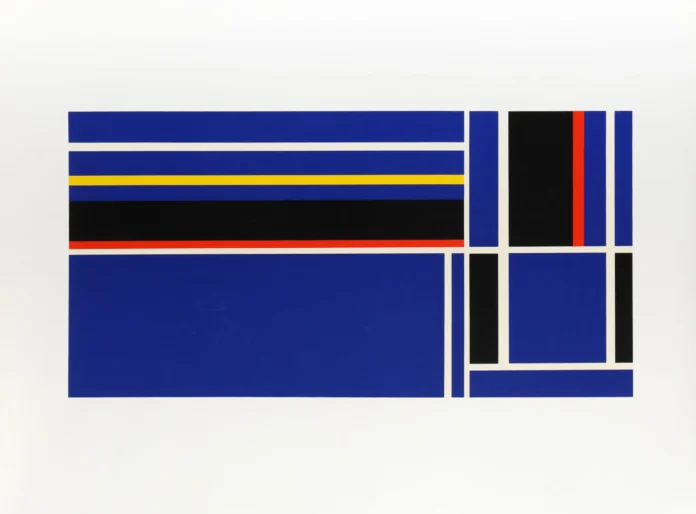
Ilya Bolotowsky

ACA Galleries Through the Years

73 10th Avenue (on the corner of 20th street)
New York, New York 10011
Open Tuesday – Saturday, 11am – 6pm.
529 West 20th Street, 5th Floor
New York, New York 10011
Open Tuesday – Friday, 11am – 6pm (Saturday by appointment only).
+1 (212) 206 8080
[email protected]

Founded in 1932 by Herman Baron, with modernist pioneers Stuart Davis and Yasuo Kuniyoshi among its founding charter members, ACA Galleries (American Contemporary Art Gallery) is one of New York’s most enduring and influential art institutions. At its inception, ACA was one of just three galleries in the city dedicated exclusively to exhibiting American art.

Over the past nine decades, the gallery has expanded its curatorial vision to include 19th-century, Modern, and Contemporary American and European painting, sculpture, and photography. ACA has mounted more than 800 exhibitions and published over 400 books and catalogues, while also organizing significant traveling museum exhibitions both nationally and abroad. Throughout its history, ACA has served as a trusted advisor to leading collectors, institutions, and investors.

From the beginning, ACA has been a champion of socially engaged art, presenting early exhibitions of artists such as Rockwell Kent, Alice Neel, Barnett Newman, Irene Rice Pereira, David Smith, and Charles White. In 1935, ACA hosted the inaugural meetings of the American Artists’ Congress (AAC), which later catalyzed the Federal Art Project (FAP) and Works Project Administration (WPA), pivotal programs supporting American artists during the Great Depression.

The gallery’s international footprint has also grown across decades. It established branches in Rome and Munich and presented major exhibitions in Hong Kong and Dubai, including the first large-scale show in the UAE of artists ranging from Brueghel to Warhol.

Today, ACA Galleries is led by Casey Bergen, fourth-generation owner and president. He continues the gallery’s legacy while expanding its global reach and contemporary relevance. Under his leadership, ACA has launched new gallery spaces, strengthened its curatorial presence in Europe and Asia, and developed a private sales division specializing in blue-chip American and European art.

A cornerstone of ACA’s current mission is its artist representation program, which is dedicated to identifying, empowering, and championing the most profound visual storytellers. These are artists whose work is stylistically singular and technically exceptional. The gallery’s curatorial focus centers on narrative figurative artists, whose distinctive visual languages and technical mastery challenge conventions and inspire cultural discourse. With a long-term, legacy-focused approach, ACA nurtures artistic careers that unfold over decades and endure across generations.

Now operating from its main location at 173 Tenth Avenue and a second exhibition space at 529 West 20th Street in Chelsea, ACA continues to honor its rich history by reimagining it in a contemporary context. The gallery remains committed to supporting artists who make bold and meaningful contributions to the field, reinforcing its role as a vital cultural force in American and global art.

Artists:

Phase 2

Pablo Amaringo

John Baeder

E.M. Bannister

Romare Bearden

George Bellows

Leon Berkowitz

Oscar Bluemner

Peter Blume

Aaron Bohrod

Ilya Bolotowsky

Achsah Barlow Brewster

Earl H. Brewster

David Burliuk

Robert Carter

Judy Chicago

Alan Davie

Joseph Delaney

David DeSimone

Philip Evergood

Augustus Francis

William Gropper

Robert Gwathmey

Richard Haas

Richard Hambleton

Grace Hartigan

Alonzo Hauser

Anita Huffington

Edgar Jerins

Luis Jimenez

Frederick Jones

Greg Lamarche

Jacob Lawrence

Ernest Lawson

Doowon Lee

Jack Levine

Norman Lewis

Rick Librizzi

Kandy G Lopez

Hugh Mangum

Wendy Mark

Reginald Marsh

Richard Mayhew

Francis Luis Mora

Tony Notarberardino

Chinemerem ‘Eme’ Omeh

Joseph Peller

Philip Reisman

Helen McBride Richter

Faith Ringgold

Aminah Robinson

Doug Safranek

Joseph Solman

Moses Soyer

Raphael Soyer

Theodoros Stamos

Bradley Theodore

Charles White

Dondi White

Edmund Yaghjian

Ben Zion

Interdisciplinary Artist vs. Multidisciplinary Artist

caldas candara

Interdisciplinary Artist vs. Multidisciplinary Artist

Beyond Mediums: How Contemporary Artistic Thinking Is Constructed

In contemporary art, the terms multidisciplinary and interdisciplinary are often used interchangeably. However, while both describe practices that operate across multiple mediums, the difference between them is not technical but conceptual. It is not about how many languages an artist uses, but how they are articulated.

Multidisciplinary: The Coexistence of Languages

A multidisciplinary artist works across different mediums—painting, sculpture, photography, video—but each can remain relatively autonomous. It is an expansive practice, where the artist moves between disciplines according to the expressive needs of each work.

Here, knowledge is accumulative: each discipline contributes a different tool, but they do not necessarily merge into a single system of thought. The result can be diverse, versatile, and technically broad, but it does not always imply deep integration between languages.

From a curatorial perspective, the multidisciplinary artist presents a constellation of practices, rather than a unified body of work.

Interdisciplinary: Integration as Thought

The interdisciplinary artist, by contrast, does not simply use multiple mediums—they interconnect them. Disciplines cease to be separate territories and instead become a hybrid field where boundaries dissolve.

Here, the work could not exist within a single medium. Photography becomes installation, sound becomes space, science enters into dialogue with poetry. There are no hierarchies between disciplines, but rather a conceptual synthesis in which each language transforms the others.

Knowledge is no longer accumulative, but relational. The interdisciplinary artist works from complex questions—about perception, memory, identity, technology, or nature—that require multiple systems of thought to be addressed.

From a curatorial standpoint, this practice generates ecosystems of meaning, rather than isolated objects.

Key Difference: Structure vs. System

The distinction can be summarized as follows:

  • The multidisciplinary artist works across mediums.
  • The interdisciplinary artist works across ideas that move through mediums.

One organizes a diversity of tools; the other constructs a system in which those tools become inseparable.

Why Does This Distinction Matter?

In a context where contemporary art increasingly shifts away from the object and toward experience, this distinction becomes crucial. The market may still categorize by medium—painting, sculpture, photography—but artistic practice today responds to questions that exceed those divisions.

The interdisciplinary artist does not simply expand the language of art: they redefine its conditions of possibility.

Toward an Expanded Practice

Today, many artists move fluidly between both categories. The distinction is not rigid, but evolutionary. A practice may begin as multidisciplinary and, over time, become interdisciplinary as the connections between mediums grow more organic and necessary.

Ultimately, the question is not what the artist does, but how the artist thinks.

Because in contemporary art, mediums are no longer the limit.
They are the point of departure.

Artista interdisciplinario vs. artista multidisciplinario

José Caldas
José Caldas

Artista interdisciplinario vs. artista multidisciplinario

Más allá de los medios: cómo se construye el pensamiento artístico contemporáneo

En el arte contemporáneo, los términos multidisciplinary e interdisciplinary suelen usarse indistintamente. Sin embargo, aunque ambos describen prácticas que operan en múltiples medios, la diferencia entre ellos no es técnica, sino conceptual. No se trata de cuántos lenguajes utiliza un artista, sino de cómo los articula.

Multidisciplinary: la coexistencia de lenguajes

Un artista multidisciplinario trabaja en diferentes medios—pintura, escultura, fotografía, video—pero cada uno puede mantenerse relativamente autónomo. Es una práctica expansiva, donde el artista se desplaza entre disciplinas según la necesidad expresiva de cada obra.

Aquí, el conocimiento es acumulativo: cada disciplina aporta una herramienta distinta, pero no necesariamente se fusionan en un mismo sistema de pensamiento. El resultado puede ser diverso, versátil y técnicamente amplio, pero no siempre implica una integración profunda entre los lenguajes.

En términos curatoriales, el artista multidisciplinario presenta una constelación de prácticas, más que un cuerpo unificado.

Interdisciplinary: la integración como pensamiento

El artista interdisciplinario, en cambio, no solo utiliza múltiples medios: los interconecta. Las disciplinas dejan de ser territorios separados para convertirse en un campo híbrido donde los límites se disuelven.

Aquí, la obra no podría existir en un solo medio. La fotografía se vuelve instalación, el sonido se convierte en espacio, la ciencia dialoga con la poesía. No hay jerarquías entre disciplinas, sino una síntesis conceptual donde cada lenguaje transforma al otro.

El conocimiento ya no es acumulativo, sino relacional. El artista interdisciplinario trabaja desde preguntas complejas—sobre percepción, memoria, identidad, tecnología o naturaleza—que requieren múltiples sistemas de pensamiento para ser abordadas.

Desde una mirada curatorial, esta práctica genera ecosistemas de sentido, más que objetos aislados.

Diferencia clave: estructura vs. sistema

La distinción podría resumirse así:

  • El artista multidisciplinario → trabaja entre medios.
  • El artista interdisciplinario → trabaja entre ideas que atraviesan los medios.
  • El artista transdisciplinary → ruptura del sistema de disciplinas

Uno organiza una diversidad de herramientas; el otro construye un sistema donde esas herramientas se vuelven inseparables.

¿Por qué importa esta diferencia?

En un contexto donde el arte contemporáneo se aleja cada vez más del objeto para acercarse a la experiencia, esta distinción se vuelve crucial. El mercado puede seguir categorizando por medios—pintura, escultura, fotografía—pero la práctica artística actual responde a problemáticas que exceden esas divisiones.

El artista interdisciplinario no solo amplía el lenguaje del arte: redefine sus condiciones de posibilidad.

Hacia una práctica expandida

Hoy, muchos artistas transitan entre ambas categorías. La diferencia no es rígida, sino evolutiva. Una práctica puede comenzar como multidisciplinaria y, con el tiempo, volverse interdisciplinaria a medida que las conexiones entre medios se vuelven más orgánicas y necesarias.

En última instancia, la pregunta no es qué hace el artista, sino cómo piensa.

Porque en el arte contemporáneo, los medios ya no son el límite.
Son el punto de partida.

Sol LeWitt: the line, the cube, and expanded consciousness

Sol LeWitt

Sol LeWitt: the line, the cube, and expanded consciousness

A reading of LeWitt’s influence on a contemporary artistic practice where the cube, technology, and artificial intelligence converge as extensions of thought

Rafael Montilla’s Artist Statement — Extract

“The Cube becomes a central structure within my practice, holding both internal and external dimensions, individual and collective awareness. Through the coexistence of natural and synthetic materials, I explore the language of our evolution, where technology and consciousness intersect. Artificial intelligence extends this inquiry as an expansion of thought — another layer of perception.”

I. The Inheritance That Goes Unseen — How LeWitt Remains Alive in Art Today

There are artists whose influence operates like mathematical axioms: it is not cited in every work derived from them, yet without them none of those works would be possible. Sol LeWitt (Hartford, Connecticut, 1928 – New York, 2007) is one such artist. The simultaneous founder of conceptual art and minimalism — though he rejected both labels as insufficient — LeWitt built over four decades a body of work that cannot be understood as a collection of objects, but as a system of thought. A system whose center of gravity is the line and whose supporting architecture is the cube. These two entities — the most elementary form in plane geometry and the most elementary form in three-dimensional geometry — are not, for LeWitt, decorative shapes or references to the visible world. They are the instruments through which thought materializes without betraying itself.

For the artist whose statement accompanies this text, LeWitt is not a historical reference but an active presence. The cube appears in their practice as a “central structure,” as that which “holds both internal and external dimensions, individual and collective awareness.” This description resonates directly with the Lewittian ontology of the cube: a form chosen precisely because, as LeWitt himself explained to the National Gallery of Art, it was “relatively uninteresting in itself… and lacked the expressive force of more interesting forms and shapes.” The neutrality of the cube was its power: it allowed the idea — and not the form — to take center stage. In that sense, the choice of the cube is always a philosophical decision before it is an aesthetic one.

II. “The Idea Becomes the Machine That Makes the Art” — The Founding Texts

In the summer of 1967, Artforum published “Paragraphs on Conceptual Art,” the text in which LeWitt first articulated his principles with precision. The most quoted sentence of that essay is also its most radical: “When an artist uses a conceptual form of art, it means that all of the planning and decisions are made beforehand and the execution is a perfunctory affair. The idea becomes the machine that makes the art.” This declaration is not a nihilistic provocation: it is a statement about the very nature of creative thought. LeWitt was not saying that execution does not matter; he was saying that the intelligence which designs the system is, in itself, the work.

Two years later, in “Sentences on Conceptual Art” (1968–69) — now in MoMA’s permanent collection — LeWitt was even more explicit about the paradoxical nature of his practice. The first sentence asserts: “Conceptual artists are mystics rather than rationalists. They leap to conclusions that logic cannot reach.” And the fifth, equally crucial: “Irrational thoughts should be followed absolutely and logically.” These two propositions together describe with precision the territory in which LeWitt operated: a space where formal rigor and irrational intuition do not oppose each other but feed one another. It is the same space in which the artistic practice this essay accompanies operates: where technology — synthetic, calculated — coexists with consciousness — organic, intuitive — neither one erasing the other.

“Irrational thoughts should be followed absolutely and logically.” — Sol LeWitt, Sentences on Conceptual Art, 1969

Sol LeWitt

III. The Wall Drawings — The Line as System, as Language, as Inhabitable Space

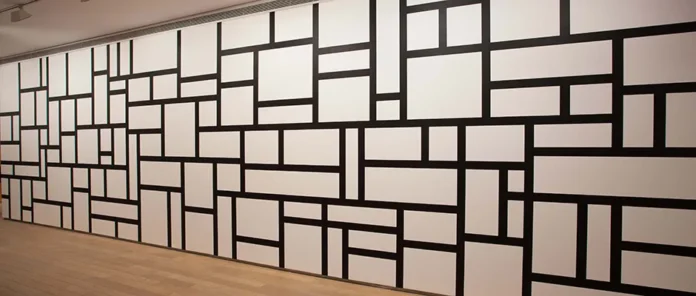
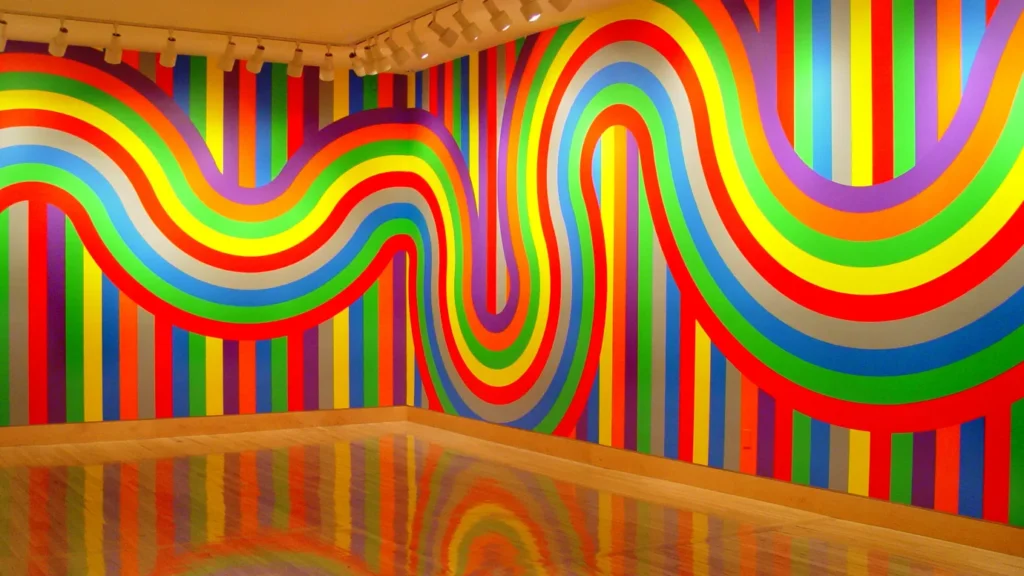
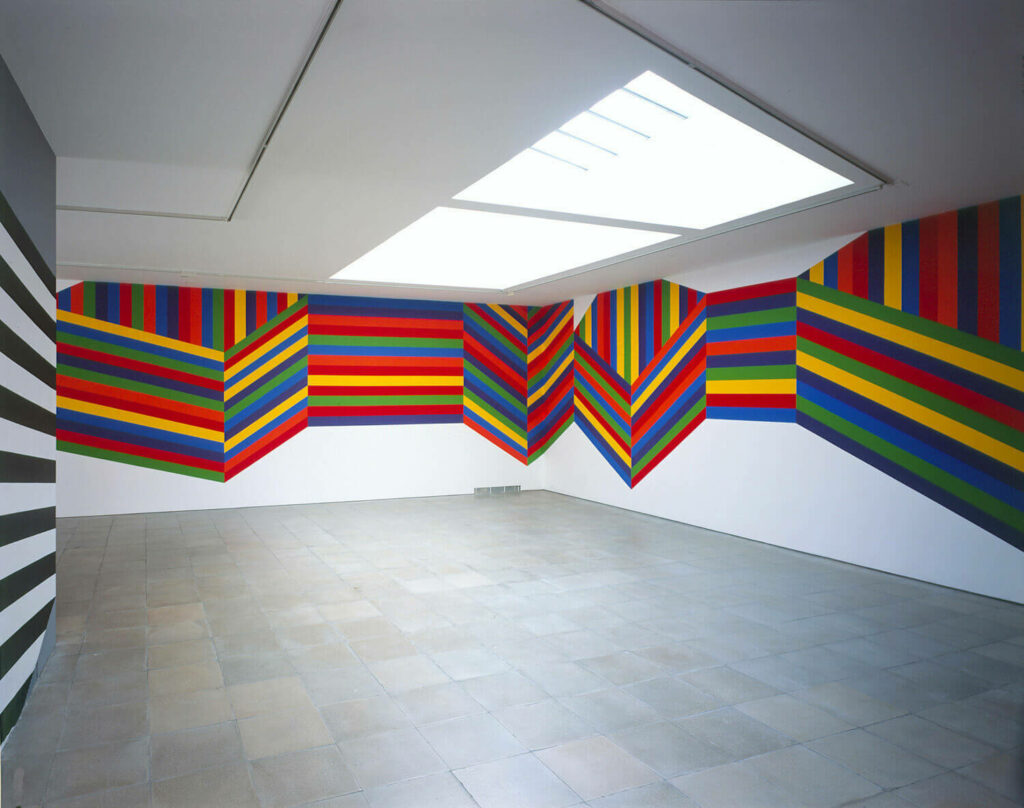
Between 1968 and 2007, LeWitt created 1,274 wall drawings. The number is itself a declaration: these are not isolated works but a permanently expanding system, each piece a variation on the same structural principles. The first wall drawing was exhibited at Paula Cooper Gallery in New York in 1968 — a network of pencil lines drawn directly on the wall — and from that first instance it established the conditions for everything that would follow: the written instruction as origin, the hands of others as execution, the wall as support and as activated space.

Art historian Carmen Juliá, in her essay “Ideas in Transmission: LeWitt’s Wall Drawings and the Question of Medium” (published in Tate Papers), argues that LeWitt’s wall drawings “problematised notions of autonomy, materiality and medium-specificity” in a way that no conventional painting or sculpture could achieve. The instruction as artwork implied a radical separation between the intelligence that generates the system and the hand that executes it — a separation that in the contemporary work this text accompanies acquires a new dimension when artificial intelligence enters as “another layer of perception.” If LeWitt delegated execution to assistants and specialist technicians, the contemporary artistic practice that integrates AI performs an analogous — and more radical — delegation: to algorithms. The distance between concept and materialization has shifted, but the question LeWitt posed remains the same: where does authorship reside, and where is the boundary between conceiving and making?

LeWitt’s instructions for the wall drawings were deliberately open. Wall Drawing #118 (1971) reads: “Place fifty points at random. The points should be evenly distributed over the area of the wall. All of the points should be connected by straight lines.” This instruction, as curator Gary Garrels observed when organizing LeWitt’s 2000 retrospective at the San Francisco Museum of Modern Art, could take — and has taken — many different forms. LeWitt “didn’t dictate,” Garrels recalled. “He accepted contradiction and paradox, the inconclusiveness of logic.” This controlled openness is precisely what makes the wall drawings more than exercises in applied geometry: they are generative systems that produce variation within order, difference within repetition. In the most contemporary vocabulary, they anticipate the logic of machine learning systems: rules that produce results that are not fully predetermined.

“Sol LeWitt: A Wall Drawing Retrospective” — a permanent installation at MASS MoCA, North Adams, Massachusetts — opened in 2008 in collaboration with the Yale University Art Gallery and the Williams College Museum of Art. It presents 105 wall drawings for 25 years, through 2033.

Sol LeWitt

IV. The Incomplete Cube — Structure, Absence, and Perceptual Consciousness

In 1974, LeWitt exhibited at the John Weber Gallery in New York the work many consider his most exhaustive and philosophically richest investigation: Variations of Incomplete Open Cubes. The project consists of 122 frame structures, each a cube from which between one and nine of its twelve edges have been removed, on the condition that the resulting structure remains three-dimensional and connected. Each variation exists in three simultaneous forms: as a three-dimensional model, as a two-dimensional perspective drawing, and as a photograph. The complete installation occupies a platform so wide it cannot be taken in at a single glance.

Art critic and theorist Rosalind Krauss, in her landmark essay “LeWitt in Progress” (published in The Originality of the Avant-Garde and Other Modernist Myths, MIT Press, 1985), wrote about the incomplete cubes with a penetration that has never been surpassed. For Krauss, the work produces “an experience that is obsessional in kind.” She identified in it what she called “the system of compulsion, of the obsessional’s unwavering ritual, with its precision, its neatness, its finicky exactitude, covering over an abyss of irrationality.” This description, seemingly cryptic, illuminates something crucial: LeWitt had followed his own instruction — “irrational thoughts should be followed absolutely and logically” — to its ultimate consequences. The result is a system perfectly closed in its formal logic that simultaneously produces an experience of disorientation, of vertigo, of opening toward the immeasurable.

SFMOMA, in the documentation of the work held in its permanent collection, offers a description that captures another essential dimension. LeWitt explained the visual nature of the cubes in these terms: “With some of the three-dimensional open cube pieces, the idea part is simple, but the visual perception is complex. If you make a drawing of each side, for instance, it’d be a square grid. But when it becomes three-dimensional, you look at it, it becomes chaos. And then you walk around it again and you see it in different lines of sight, it becomes orderly again.” This alternation between order and chaos, between structure and disorientation, is not a side effect of the work: it is its central subject. The incomplete cube is a meditation on the limits of perception.

A mathematical study published in the Nexus Network Journal (Springer, 2015) computationally verified LeWitt’s 122 variations using graph theory, concluding that the artist arrived at the correct number of structures — though the researchers identified a minor error in the presentation of one specific pair of cubes. This fact carries philosophical weight: LeWitt had produced an exhaustive inventory, a complete taxonomy of every possible way to make a cube without making it fully. The title of the work — Variations of Incomplete Open Cubes — contains a paradox within itself: completeness is achieved precisely through systematized incompleteness. For the artist whose statement declares that “the Cube becomes a central structure holding both internal and external dimensions,” LeWitt’s investigation offers a powerful conceptual precedent: the cube not as a finished form but as a field of possibilities, as a structure that can be inhabited in multiple ways without exhausting itself.

“The idea part is simple, but the visual perception is complex… you look at it and it becomes chaos. You walk around it again and it becomes orderly.” — Sol LeWitt on Incomplete Open Cubes, SFMOMA

V. From Instruction to Algorithm — LeWitt and Artificial Intelligence

There is a continuity worth naming with precision between LeWitt’s practice and the incorporation of artificial intelligence as a tool in contemporary artistic practice. LeWitt defined conceptual art as a system in which “all of the planning and decisions are made beforehand.” The resulting art does not depend on the artist’s manual skill or on the contingencies of the moment of execution: it depends on the quality of the instructions, on the internal coherence of the generative system. In the terms of contemporary computer science, what LeWitt was describing was an algorithm: a finite sequence of well-defined instructions that produces a result from a set of initial conditions.

The difference between LeWitt’s instructions and a machine learning algorithm is real but gradual, not categorical. LeWitt’s instructions are deterministic: given the same space and conditions, they will produce similar though not identical results. Generative AI algorithms are stochastic: they incorporate controlled randomness that produces systematic variation. But in both cases the founding gesture is the same — a rule system that generates outcomes exceeding the complete foresight of whoever designed the system. LeWitt formulated this with his characteristic precision in the “Paragraphs”: “To work with a plan that is preset is one way of avoiding subjectivity… The plan would design the work. Some plans would require millions of variations, and some a limited number, but both are finite. Other plans imply infinity.”

For the artist whose statement describes artificial intelligence as “an expansion of thought — another layer of perception,” LeWitt’s legacy is directly operative. If LeWitt separated the intelligence that conceives from the body that executes, the contemporary practice that integrates AI performs an analogous but more radical separation: between the artist’s intention and the machine’s generative process. This separation is not an abdication of authorship but its redefinition. As LeWitt wrote in his “Sentences”: “The artist’s will is secondary to the process he initiates from idea to completion. His willfulness may only be ego.” In this context, AI is not a threat to artistic practice but a tool that continues the investigation LeWitt initiated: what happens when execution is entrusted to a process that is not the artist’s hand?

VI. Natural and Synthetic Materials — Coexistence as Evolutionary Language

The artist’s statement declares that “through the coexistence of natural and synthetic materials, I explore the language of our evolution, where technology and consciousness intersect.” This proposition finds in LeWitt a resonance that may seem unexpected, given that LeWitt worked predominantly with industrial materials — painted aluminum, concrete blocks, graphite on plaster. Yet the conceptual operation is homologous: LeWitt transformed the most “neutral” materials, those most stripped of organic or sentimental connotation, into structures that produced deeply phenomenological experiences. The material denied its own materiality in order to become the pure support of the idea.

The practice this essay accompanies inverts — or rather, complicates — that operation: rather than neutralizing the material, it places it in tension. The natural and the synthetic do not cancel each other out; they speak to one another, producing between them a space of meaning that neither could generate alone. This is a strategy closer to post-minimalist art than to LeWitt himself — nearer to Eva Hesse, whose work LeWitt admired and encouraged in his celebrated letter of 1965, than to LeWitt’s own practice. But the underlying question is the same: what does the choice of materials say about our understanding of ourselves as beings in time, in evolution, in history?

VII. The Cube as Structure of Consciousness — Critical Convergence

We arrive at the heart of the relationship between LeWitt and the artistic practice this text accompanies. The cube — for LeWitt, the most neutral form, the one most “without expressive character,” most useful precisely because of its semantic emptiness — becomes, in the artist’s statement, “a central structure holding both internal and external dimensions, individual and collective awareness.” This transformation of the Lewittian cube is significant: what in LeWitt was an empty container becomes here a full one — not filled with subjective emotion, but with structural consciousness. The cube is not neutral: it is the space in which experience organizes itself, where the individual and the collective meet, where the internal and the external confront each other.

This reading of the cube has roots in Maurice Merleau-Ponty’s phenomenology, for whom any geometric structure perceived by a body in space is always already a structure of lived experience, not an abstract object. LeWitt arrived at a similar conclusion by entirely different means — through serial logic, through the systematic exhaustion of possibilities — when he observed that the cube “becomes chaos” when you look at it, and then “becomes orderly again” when you walk around it. The perception of the cube is always a process, a movement, a negotiation between the observer and the form. It is, in the terms of the artist’s statement, a form of consciousness.

What this artist has added to LeWitt’s legacy — and what makes their practice genuinely original with respect to that precedent — is precisely the evolutionary and technological dimension. If LeWitt exhausted the possibilities of form to reveal the structure of thought, this artist uses form as a meeting point between distinct natures: the organic and the calculated, the historical and the computational, human consciousness and artificial intelligence. The cube, in this context, is not the endpoint of a formal investigation but the starting point of an inquiry into what it means to think, to perceive, and to exist at a moment when the boundaries between natural and artificial mind grow ever less distinct.

“Conceptual artists are mystics rather than rationalists. They leap to conclusions that logic cannot reach.” — Sol LeWitt, Sentences on Conceptual Art, 1969

Coda — The Line That Connects

Sol LeWitt died in 2007. He left behind 1,274 wall drawings, 122 incomplete cubes, dozens of structures, hundreds of works on paper, and two texts — “Paragraphs” and “Sentences” — that remain the most lucid documents conceptual art produced about itself. He also left something harder to catalogue: the demonstration that the line — that elementary mark, that length without breadth — is capable of sustaining a complex thought about the nature of space, time, perception, and authorship.

For the artist whose work this essay accompanies, LeWitt is above all that: evidence that the line is not a decorative instrument but an instrument of thought. That the cube is not a form but a question. And that intelligence — whether human, collective, or artificial — can find in the simplest forms the vastest contents. This artist’s practice continues that investigation from a present radically different from LeWitt’s, yet faithful to the principle LeWitt first formulated: the idea is the machine that makes the art. And today, the machine can also be an intelligence that learns.

Academic and Institutional References

LeWitt, S. (1967). “Paragraphs on Conceptual Art.” Artforum, Summer 1967. Reprinted in Sol LeWitt: Critical Texts, ed. Ada-chiara Zevi. Rome: Libri de AEIUO, 1995.

LeWitt, S. (1969). “Sentences on Conceptual Art.” Art-Language, vol. 1, no. 1. [Original manuscript at MoMA, New York, Gift of Herman J. Daled, 574.2011.a-s].

Krauss, R. E. (1985). “LeWitt in Progress.” The Originality of the Avant-Garde and Other Modernist Myths, pp. 244–258. Cambridge / London: MIT Press.

Juliá, C. (2011). “Ideas in Transmission: LeWitt’s Wall Drawings and the Question of Medium.” Tate Papers, no. 14. London: Tate Research Publications.

Garrels, G. (2000). Sol LeWitt: A Retrospective. San Francisco Museum of Modern Art / Yale University Press.

SFMOMA. (2018). “Incomplete Open Cubes (1974).” Collection documentation. San Francisco: SFMOMA. [sfmoma.org/artwork/97.516.A-KKKKKKKKKK]

National Gallery of Art. (2023). “Sol LeWitt’s Concepts and Structures.” Educational Resources. Washington D.C.: NGA. [nga.gov]

Art Basel. (2023). “Sol LeWitt: Incomplete Open Cube 8/25, 1974.” Gallery documentation. Art Basel, Galleries sector.

Wierzbicka, M. & Milošević, A. (2015). “Is the List of Incomplete Open Cubes Complete?” Nexus Network Journal: Architecture and Mathematics, 17(3). Springer Nature.

Artforum. (1973). “Sol LeWitt: Modules, Walls, Books.” Artforum, vol. 12. New York.

Artforum. (2001). “Sol LeWitt: Incomplete Open Cubes” [exhibition review, Wadsworth Atheneum]. Artforum, June 2001.

Art Gallery of New South Wales. (2011). John Kaldor Family Collection: Sol LeWitt, pp. 100–131. Sydney: AGNSW.

Legg, A., ed. (1978). Sol LeWitt. New York: Museum of Modern Art.

Bloom, L. (2019). Sol LeWitt: A Life of Ideas. Middletown, CT: Wesleyan University Press.
Page 6 of 284
1 4 5 6 7 8 284