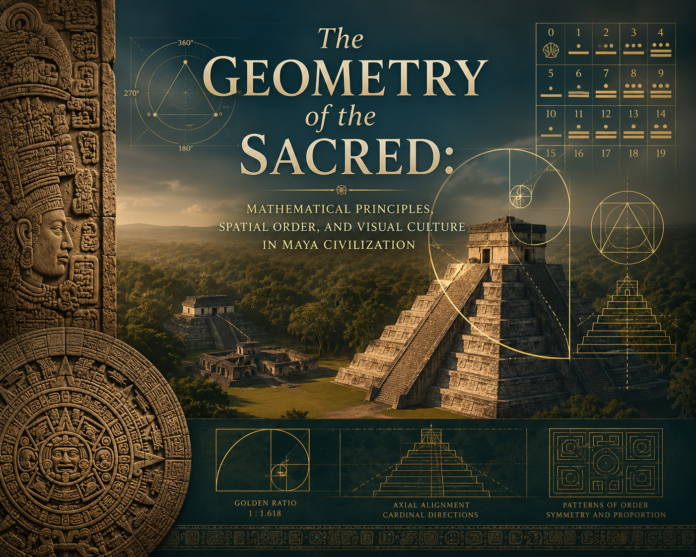
The Geometry of the Sacred: Mathematical Principles, Spatial Order, and Visual Culture in Maya Civilization
A Critical Interdisciplinary Essay
Abstract
This essay undertakes a critical interdisciplinary examination of the role of mathematical and geometric principles in shaping Maya visual culture, architecture, spatial organization, ritual practice, and artistic production. Drawing on archaeoastronomical research, epigraphic scholarship, anthropological theory, and art-historical analysis, it argues that for the ancient Maya, mathematics was not an abstract cognitive tool separable from culture but rather a foundational ontological language — a system through which the divine order of the cosmos was perceived, encoded, and reproduced in material form. The vigesimal number system, the conceptualization of zero, the interlocking calendar cycles, the proportional systems of architecture, and the astronomically aligned city plans together constitute a unified intellectual and spiritual project: the materialization of cosmic time and space within human-built environments. The essay engages critically with the cosmogram debate (Ashmore and Sabloff 2002; Smith 2003, 2005; Šprajc 2009), the archaeoastronomical literature (Aveni 1980, 2001), epigraphic and iconographic analyses (Schele and Freidel 1988, 1990; Freidel, Schele, and Parker 1993), and theoretical frameworks from visual culture studies, anthropology of knowledge, and the philosophy of space.
I. Introduction: Numbers as Theology
To approach Maya civilization through the lens of mathematics and geometry is not to impose a Western rationalist framework upon an indigenous knowledge system; it is, rather, to follow the Maya themselves, who embedded numerical and geometric structures into every domain of their material and symbolic production. The pyramids of Chichén Itzá are counted as well as looked at. The Dresden Codex is computed as well as read. The plazas of Tikal and Copán are measured cosmological statements before they are public spaces.
The critical claim of this essay is that Maya mathematical and geometric knowledge constituted a single, integrated epistemological project — one in which numerical precision, spatial orientation, proportional harmony, and calendrical order were not separate technical disciplines but mutually reinforcing dimensions of a unified worldview. As Anthony Aveni, the preeminent scholar of Mesoamerican archaeoastronomy, argued in Skywatchers of Ancient Mexico (1980, revised 2001), the astronomical orientations of Maya architecture “cannot be understood in purely utilitarian terms” because they were embedded in “a broader framework of cosmological concepts substantiated by political” and religious authority. Architecture was not built to observe the cosmos; it was built to become the cosmos.
This has profound implications for how we understand Maya visual culture, social organization, and collective identity. If mathematical precision was theologically charged — if numbers were divine, as the shell-glyph zero named Mi (meaning completion and the void) suggests — then every numerical encoding in stone, pigment, bark-paper, or urban plan was simultaneously an aesthetic act, a political statement, and a religious utterance. The mathematician, the astronomer, the architect, the ritual specialist, and the artist were, in the Maya world, expressions of a single vocation.
The following sections move from the foundations of Maya mathematical thought (the vigesimal system, the zero, the Long Count) through its architectural and spatial embodiments (proportional systems, astronomical alignments, city plans), its cosmological frameworks (the calendar round, the Dresden Codex, the E-Group observatories), and finally to its implications for social organization, identity, and material culture. Throughout, the essay maintains a critical distance from both romanticizing accounts that overstate Maya mathematical mysticism and reductive functionalist accounts that strip it of its symbolic depth.
II. The Mathematical Foundation: Vigesimal Numeration, Zero, and the Structure of Cosmic Time
2.1 The Vigesimal System and Its Cultural Logic
The Maya developed a base-20 positional numeral system — vigesimal notation — with three basic symbols: a dot (value 1), a bar (value 5), and a distinctive shell glyph representing zero. The choice of base 20 reflects an embodied cognition: the Maya counted on both fingers and toes, producing a numerical system that is literally inscribed in the human body (Aveni 2001; Ifrah 2000). This is not merely a curiosity of cognitive history. It signals that Maya mathematics grew from an intimate relationship between the human body, the natural world, and the cosmic order — a relationship that would persist throughout their intellectual tradition.
The vigesimal system enabled positional notation: the value of a symbol was determined by its place within the numeral, with each ascending position representing a power of twenty. This structural feature made possible the representation of very large numbers — the astronomical and calendrical spans of hundreds of thousands of days — with elegant economy. As Cajori (1928) and more recently the mathematical historians of the arXiv study (Huylebrouck 2020) have demonstrated, the Maya Long Count calendar was a “non-power positional number representation system” whose multipliers ran as 1, 20, 18×20, 18×20², and so forth — a deliberate modification of the pure vigesimal structure that brought the third-order unit (the tun) to 360 days, closely approximating the solar year.
This modification is intellectually remarkable and has been underappreciated in popular accounts. The Maya were not applying an abstract mathematical rule mechanically; they were bending mathematical structure to accommodate cosmological reality. The solar year does not divide evenly into twenty groups of twenty days; the Maya therefore adjusted their number system so that it could simultaneously function as an arithmetic tool and as a temporal map of the sky. This productive tension between mathematical elegance and empirical astronomical observation is one of the defining characteristics of Maya intellectual culture.
2.2 Zero: The Sacred Void
The Maya conceptualization of zero — arriving centuries before its independent discovery in India and long before its transmission to Europe through Arabic mathematics — deserves extended critical attention. The shell glyph Mi (or Nik in some Yucatec dialects) represented zero not merely as a placeholder in positional notation but as an entity with independent cosmological significance: completion, potential, the void that precedes creation, the end of a cycle that is simultaneously its beginning.
The scholarly consensus (Closs 1986; Huylebrouck 2020; Kaplan 2000) holds that the Maya arrived at a cardinal zero — a zero usable in arithmetic — through a process facilitated by their fluency with multiple and redundant number representation systems. Unlike cultures that invented positional notation and zero simultaneously under the pressure of computational necessity, the Maya approached zero through a prolonged familiarity with alternative counting systems, gradually recognizing the conceptual need for a symbol denoting the completion of a cycle. This is a cultural as much as a mathematical history: zero emerged from the same intellectual tradition that conceived of time as cyclical rather than linear, of endings as beginnings, of the void as generative.
In this light, the shell glyph is not a technical symbol but a cosmological one. Its visual form — a spiral shell, a figure of organic growth and mathematical proportion — encodes the very structure it names: the Fibonacci-like spirals of the natural world, the cyclical unfolding of time, the productive emptiness at the center of creation. The aesthetic choice of the shell to represent zero is itself a statement about the relationship between mathematical abstraction and natural form.
2.3 The Long Count and the Architecture of Deep Time
The Long Count calendar — recording elapsed time from a mythological creation date corresponding to approximately 3113 BCE in the Gregorian calendar — represents one of the most ambitious intellectual projects in the ancient world: the construction of a temporal database capable of situating historical events within cosmic time measured in millions of days.
The basic units of the Long Count (kin, uinal, tun, katun, baktun) form a hierarchical positional system encoding not just duration but cosmological significance: each unit was associated with specific deities, ritual obligations, and political events. A stela recording a baktun completion (144,000 days, approximately 394 years) was not merely marking time; it was announcing the fulfillment of a cosmic cycle and the political authority of the ruler who presided over it. As Schele and Freidel argued in A Forest of Kings (1990), the dynastic histories recorded on Maya stelae were simultaneously mathematical statements and cosmological claims — the king legitimated his authority by placing himself at the precise intersection of human history and divine time.
The Long Count also enabled what we might call temporal astronomy: the calculation and prediction of celestial events across spans of centuries. The Dresden Codex Venus Tables — which predict Venus’s 584-day synodic period across 481 years (301 complete cycles) — could only have been constructed using Long Count chronology. Aveni (2001) demonstrated that the Maya average for Venus’s synodic period, derived from these tables, was 583.92 days — a value that differs from the modern space-age measurement of 583.93 days by a margin of error of approximately 0.01 days per cycle. This astonishing precision was achieved through naked-eye observation, vigesimal arithmetic, and the systematic correction of accumulated drift using mathematical correction factors analogous to those later employed in the European Julian calendar reform. Gerardo Aldana’s (2016) epigraphic re-reading of Dresden Codex Page 24 further refined this picture, demonstrating that the Venus Table correction was likely a specific historical discovery made at Chichén Itzá during the Terminal Classic period, possibly under the patronage of the historical figure K’ak’ U Pakal K’awiil — revealing individual mathematical genius embedded in institutional context.
III. Sacred Geometry and Architectural Production
3.1 Proportional Systems and the Geometry of Construction
Maya architects, working without metal tools, compasses, or written algebraic notation, produced buildings of extraordinary geometric precision using knotted measuring cords to establish right angles, rectangle proportions, and specific mathematical ratios. Christopher Powell’s foundational doctoral dissertation The Shapes of Sacred Space (University of Texas at Austin, 2010) — the most systematic analysis of Maya geometric systems to date — demonstrated the existence of a coherent and teachable system of geometric proportion transmitted through architectural training across centuries and sites.
The recurring proportional ratios in Maya architecture include the square roots of small integers (√2, √3, √5) and, controversially, approximations to the golden mean (φ ≈ 1.618). The debate over whether the Maya consciously employed the golden ratio is instructive for the broader methodology of this field. Architectural surveys using modern laser measurement and photogrammetry at El Castillo (Chichén Itzá) and the Governor’s Palace (Uxmal) have identified proportions consistent with φ, but as the analysis on mayan.org carefully notes, “whether this reflects conscious mathematical use of the ratio, an intuitive aesthetic sense for harmonious proportions, or an artifact of construction geometry remains actively debated.” The critical point is not whether the Maya possessed an algebraic formula for φ — they did not — but whether the effect of their proportional systems, derived from geometric construction with knotted cords, consistently produced ratios with the mathematical properties associated with the golden mean. The evidence suggests they did, and that these proportions were not accidents but systematically reproduced features of an architectural grammar.
3.2 Calendrical Encoding in Stone: The Pyramid as Three-Dimensional Calendar
The most celebrated instance of mathematical encoding in Maya architecture is El Castillo at Chichén Itzá, the pyramid of Kukulcan. Its four stairways each have 91 steps; together with the upper platform, they total 365 — the number of days in the Haab’ solar year. The nine terraces on each face of the pyramid, bisected by the stairway, produce 18 sections per face — the number of months in the Haab’. The total number of panels on the pyramid’s faces encodes further calendrical relationships. During the spring and autumn equinoxes, the play of light and shadow on the northern balustrade creates a visual effect in which a serpent of light appears to descend the stairway — a phenomenon requiring precise architectural calculation of angle, orientation, and proportion, uniting astronomy, geometry, and iconography in a single material form.
This is not architectural decoration in any sense familiar to Western aesthetic tradition. It is what we might term computational materiality — the encoding of a mathematical system within a physical object such that the object’s spatial and temporal behavior continues to perform calculations: the pyramid tells the time of year, marks the calendar cycles, and enacts the descent of the feathered serpent god, simultaneously, through the interaction of geometry and sunlight.
Similar encoding governs the Temple of the Seven Dolls at Dzibilchaltún, where the rising sun passes precisely through the doorway at the spring and autumn equinoxes. These are not isolated curiosities but expressions of a pervasive design principle: Maya ceremonial architecture was built to function as an astronomical instrument and a calendrical statement.
3.3 The E-Group Formation: Observational Geometry at Urban Scale
The E-Group complex — the earliest known type of Maya astronomical architecture, appearing as early as 600 BCE — consists of a pyramid on the western side of a plaza and three smaller temples aligned north-to-south on the eastern side. An observer standing on the western pyramid at dawn sees the sun rise over the central eastern temple at the equinoxes and over the northern and southern temples at the summer and winter solstices respectively. This arrangement functions as a year-calendar encoded in spatial relationships between buildings.
The E-Group at Uaxactún (north of Tikal) was the first identified, but subsequent survey has revealed the pattern across dozens of Classic Maya sites, demonstrating that this was not an isolated local innovation but a shared architectural-astronomical knowledge system transmitted through the Maya world. The geometry of the E-Group — the calculation of the precise angular distances between solstice and equinox sunrise points as seen from a specific observation point, and the translation of those angular distances into building placement across a plaza — represents a synthesis of observational astronomy, trigonometric reasoning (without formal trigonometry as such), and urban planning that is without parallel in the ancient world.
Ivan Šprajc’s systematic analysis of Maya architectural orientations (2009) demonstrated that the “orientations in ancient Maya architecture were, like elsewhere in Mesoamerica, largely astronomical, mostly referring to sunrises and sunsets on particular dates and allowing the use of observational calendars that facilitated a proper scheduling of agricultural activities.” But Šprajc was careful to add that these alignments “cannot be understood in purely utilitarian terms” — the integration of agricultural functionality with cosmological and political meaning is precisely the point.
IV. Spatial Organization and the Cosmological City
4.1 The Cosmogram Debate
One of the most productive and contentious debates in Maya studies concerns the degree to which Classic Maya city plans functioned as cosmograms — spatial representations of the cosmic order. Wendy Ashmore and Jeremy A. Sabloff, in their landmark 2002 article “Spatial Orders in Maya Civic Plans” (Latin American Antiquity 13[2]: 201–215), argued that “the position and arrangement of ancient Maya buildings and arenas emphatically express statements about cosmology and political order,” identifying a recurring north-south axis at major sites in which northerly placement encoded elevated, celestial, ancestral, and royal associations while southerly placement encoded inferior, underworld, or subordinate relations.
Michael E. Smith (2003, 2005) challenged this interpretation on methodological grounds, arguing that the cosmological readings are “vague and unconvincing” and that “arguments for the cosmological significance of archaeologically recovered urban patterns are, in general, subjective and lack methodological rigor.” Smith’s critique is epistemologically important: the danger of cosmogram readings is that they can become unfalsifiable, reading cosmological significance into any spatial arrangement through sufficiently flexible interpretive frameworks. As he noted, “numerous authors assert confidently that architectural cosmograms abounded in Classic Maya cities” without providing the empirical specificity that would make such assertions testable.
Šprajc’s response (2009), and the broader archaeoastronomical community’s position, is that Smith’s critique, while methodologically legitimate, overcorrects. The empirical evidence for astronomical orientations — measured with modern instruments, statistically analyzed across multiple sites, and corroborated by epigraphic and iconographic sources — is substantially more robust than Smith acknowledges. The characteristics of urban layouts “reveal that Maya architectural and urban planning was dictated by a complex set of rules, in which astronomical considerations related to practical needs were embedded in a broader framework of cosmological concepts substantiated by political” authority.
This debate has not been fully resolved, and the critical scholar must hold both positions simultaneously: acknowledging the genuine evidence for cosmological spatial organization while maintaining methodological rigor about the difference between documented pattern and speculative interpretation. The most defensible position, supported by the archaeoastronomical evidence, is that certain specific spatial and orientational principles — particularly the E-Group alignment system, the north-south hierarchical axis, and the orientation of major temples to astronomically significant azimuth angles — were genuinely operative in Maya planning, while broader claims about entire cities as perfect cosmograms require case-by-case empirical analysis.
4.2 Cardinal Directions, Color Symbolism, and the Spatial Body of the Cosmos
The Maya conceived of space as organized around four cardinal directions, each associated with a specific color, deity, and symbolic complex: East (red, rising sun, birth and renewal, the Maize God); North (white, heavens, the North Star, Itzamná the creator deity); West (black, setting sun, death, the underworld entrance); South (yellow, earth, agricultural abundance). This fourfold spatial symbolism — the quincunx pattern of four directional points surrounding a central axis mundi — organized not only architectural planning but ceramic decoration, textile design, mural painting, and ritual performance.
The quincunx is geometrically precise: it is a structure of rotational symmetry (four-fold) combined with a vertical axis, producing a five-point spatial system that maps cosmological hierarchy (underworld, earth surface, four horizontal directions, celestial levels) onto the geometry of the built environment. This is not metaphor; it is structural homology — the same geometric organization recurs at multiple scales, from the layout of a city plaza to the decoration of a ceramic vessel to the arrangement of ritual objects on an altar. The mathematical principle of self-similar structure across scales — what we would today recognize as fractal organization — was an operative principle of Maya visual culture long before it was formalized in Western mathematics.
V. The Dresden Codex: A Mathematical Visual Object
The Dresden Codex — the most scientifically sophisticated of the four surviving pre-Columbian Maya books, written on fig-bark paper (amate) and painted with extraordinary precision — is perhaps the most concentrated expression of the integration of mathematics, astronomy, and visual culture in the Maya world. Its Venus Tables, Lunar Tables, eclipse tables, and divinatory almanacs constitute what may be described, following the terminology of library and information science, as a computational knowledge organization system: a structured database of celestial, calendrical, and ritual information organized through the interlocking architecture of the Tzolk’in (260-day sacred calendar), the Haab’ (365-day solar calendar), and the Long Count.
The Venus Tables (Pages 24–46) document the 584-day synodic cycle of Venus with the numerical precision already noted above. But their significance for visual culture extends beyond their mathematical content. The tables are organized as visual-numerical grids in which hieroglyphic text, numerical notation, and figural imagery are integrated into a single compositional system. The deity figures depicted in the almanacs are not illustrations accompanying a text; they are the text — each figure encodes specific ritual-astronomical information through its iconographic attributes, posture, and associated glyphs. The relationship between image and number in the Dresden Codex is one of structural equivalence rather than illustration: the visual form and the mathematical content are two modalities of the same information.
This integration of the visual and the mathematical is characteristic of Maya artistic production more broadly. As Linda Schele demonstrated through her decades of epigraphic and iconographic analysis (Schele and Freidel 1988, 1990; Freidel, Schele, and Parker 1993), “every major image from Maya cosmic symbolism was probably a map of the sky” — that is, the iconographic programs of Maya art are not merely decorative or narrative but are spatial-mathematical diagrams of celestial structure translated into figural form.
VI. Symbolic Abstraction and the Aesthetics of Mathematical Form
6.1 Glyph as Number, Number as Glyph
Maya hieroglyphic writing demonstrates a fundamental principle of Maya symbolic abstraction: the refusal of a categorical distinction between linguistic sign, numerical symbol, and visual image. The same glyph can function as a phonetic component of a word, a numerical value, a calendrical day-name, and an iconographic reference to a specific deity or cosmological concept. The “head variant” numerals — in which each number 0 through 19 could be represented by a specific deity’s head — further demonstrate this principle: numbers are divine beings; divine beings are numbers; the mathematical and the theological are a single categorical domain.
This has radical implications for the theory of Maya art. If numbers are divine, then every numerical encoding in a visual work is simultaneously a theological statement. The 52-year Calendar Round — the smallest period in which the 260-day Tzolk’in and the 365-day Haab’ return to the same combined day-name (52 × 365 = 73 × 260 = 18,980 days) — is not merely a mathematical fact about least common multiples; it is the cosmological heartbeat of the Maya world, the cycle on which the renewal of the world depended, marked by the New Fire ceremony in which all fires were extinguished and relit. The mathematical relationship is the cosmological event.
6.2 Geometric Abstraction in Maya Art
Maya visual culture employs geometric abstraction in a manner that is sophisticated and systematic. The step-fret motif (xicalcoliuhqui) that appears extensively in architectural decoration, ceramic design, and textile patterns encodes, in geometric form, a spiral that moves in right-angle steps — a visual approximation of the logarithmic spiral found in the shell (and in the shell-glyph for zero). The interlocking step-frets that decorate the facades of Uxmal and Mitla are not ornament in any decorative sense; they are geometric statements about the structure of cyclical time, the movement between complementary opposites (earth and sky, day and night, creation and dissolution), and the mathematical relationship between linear progression and circular return.
The scrollwork and volute forms that appear in Maya iconography — the wind scrolls, the smoke scrolls, the water scrolls — are similarly mathematical in their structure: they are visual representations of the logarithmic spiral, a form that encodes the mathematical constant e and appears throughout natural growth processes. The Maya’s choice of this form as a fundamental visual vocabulary reflects their recognition of the mathematical structures underlying natural phenomena — a recognition expressed not through algebraic formula but through visual form.
6.3 The Ball Court as Mathematical Space
The Mesoamerican ball court, a feature of virtually every major Maya site, is itself a geometric statement. The I-shaped playing field — two rectangular end zones connected by a narrower central alley — creates a spatial diagram that has been interpreted as representing the cosmological axis between the underworld and the celestial realm. The specific dimensions and proportions of ball courts, while varying by site and period, consistently adhere to mathematical ratios that encode cosmological relationships. As noted in the scholarship on Maya mathematics, the dimensions and layouts of ball courts “were not arbitrary but adhered to mathematical principles,” and the symbolic representation of numbers in the ballgame “emphasizes the pervasive influence of mathematics in Mayan culture beyond scientific and architectural domains.”
The rubber ball itself moves through the court in trajectories that approximate the paths of celestial bodies — and the association of the ballgame with Venus cycles, solar movements, and the myth of the Hero Twins (who defeated the lords of the underworld through the ballgame, as recounted in the Popol Vuh) confirms that the geometric space of the court was understood as a model of cosmological space.
VII. Mathematics, Power, and Social Organization
7.1 The Astronomer-Priest and Knowledge Hierarchy
The sophisticated mathematical and astronomical knowledge encoded in Maya architecture, codices, and art was not democratically distributed. It was concentrated in the hands of a specialist class — what we might call the ah kin (sun priests, day-keepers) and the royal scribes — whose control of calendrical, astronomical, and mathematical knowledge constituted a form of political power. The ability to predict eclipses, to announce the completion of calendrical cycles, to determine auspicious dates for warfare and agricultural activity, and to place rulers within the cosmic order of the Long Count — these were capacities that legitimated dynastic authority and organized social life.
This is the political economy of mathematical knowledge: in a civilization where astronomical prediction and calendrical knowledge organized agricultural cycles, ritual obligations, and political succession, the mastery of mathematics was a form of sovereignty. Schele and Freidel (1988, 1990) demonstrated extensively how the rulers of Classic Maya cities deployed cosmological and calendrical knowledge as instruments of political legitimation — the king was not merely a secular ruler but the axis mundi, the embodied intersection of the cosmic directions, whose authority derived from his positioning within the mathematical order of time and space.
The construction of major ceremonial structures — pyramids, temples, ball courts, E-Group complexes — was itself an exercise of mathematical knowledge as political display. The resources required to calculate astronomical alignments, design proportionally encoded facades, and orient entire city plans to celestial events were not merely technical; they were demonstrations that the ruling class possessed the knowledge necessary to maintain the cosmic order, and that the city they built was proof of their competence and divine mandate.
7.2 Collective Identity and the Shared Mathematical Cosmos
At the level of collective identity, Maya mathematical and geometric culture created a shared cosmological framework that transcended individual sites and political entities. The E-Group complex appears across scores of Maya sites spanning centuries and thousands of kilometers; the Long Count calendar was used from the Gulf Coast to the Yucatán to the highlands of Guatemala; the quincunx spatial symbolism organized architectural space from Preclassic Nakbé to Postclassic Chichén Itzá. This shared mathematical vocabulary constituted a form of cultural identity — a lingua franca of cosmological space and time that linked diverse Maya communities within a single intellectual tradition.
The calendar itself was the most powerful instrument of collective identity. The Calendar Round, cycling through its 18,980-day period, organized collective life: the obligations of ritual, the timing of markets, the scheduling of warfare, the determination of auspicious days for marriages, agricultural planting, and political appointments. The mathematical structure of the calendar was not merely a tool for individual decision-making but the shared temporal framework within which the entire community existed — what Miguel León-Portilla, in Time and Reality in the Thought of the Maya (1988), called a qualitative conception of time in which “each moment carries its own divine character.”
VIII. Critical Reflections and Methodological Cautions
The scholarship surveyed in this essay is rich and growing, but several methodological cautions deserve explicit articulation. First, there is a persistent risk of what we might call mathematical projection — reading sophisticated numerical structures into Maya artifacts and architecture on the basis of modern mathematical sensibilities rather than demonstrated ancient practice. The debate over the golden ratio in Maya architecture is exemplary: while the proportional consistency across sites is empirically documented, the inference that this reflects conscious mathematical deployment of φ as a theoretical constant goes beyond the evidence.
Second, the integration of mathematics, cosmology, and aesthetics that this essay has described was undoubtedly more complex, contested, and variable in practice than any synthetic account can convey. Maya civilization spanned approximately three millennia, multiple language groups, dozens of polities, and enormous geographic and ecological diversity. The cosmological uniformity suggested by terms like “the Maya worldview” is itself a scholarly construction that can obscure significant variation.
Third, the dominant frameworks in this field — archaeoastronomy (Aveni), epigraphy-iconography (Schele, Freidel, Stuart), and anthropological spatial analysis (Ashmore, Sabloff) — each bring their own theoretical assumptions and blind spots. A genuinely interdisciplinary approach must hold these frameworks in tension, using each to critique and illuminate the others rather than synthesizing them prematurely into a false coherence.
IX. Conclusion: The Mathematical Body of the World
The ancient Maya built a civilization in which mathematics was not a specialized discipline but a universal language — the language in which the cosmos spoke to humanity, and in which humanity spoke back to the cosmos. Their vigesimal number system encoded an embodied relationship between human anatomy and cosmic order. Their zero named the generative void from which cycles begin. Their Long Count calendar situated human history within deep cosmic time. Their architecture encoded calendrical cycles in stone, oriented ceremonial cities to celestial events, and organized urban space according to the four-directional geometry of the cosmos. Their art made mathematical relationships visible, translating astronomical diagrams into figural imagery, geometric forms into theological statements.
This integration of the mathematical and the cosmological, the geometric and the spiritual, the astronomical and the political, is not a primitive confusion of categories that a more advanced culture would eventually separate. It is a sophisticated epistemological achievement — a recognition that the structures underlying natural phenomena, human society, and cosmic order are, at some fundamental level, the same structures; and that the proper response to this recognition is not abstraction but materialization: building the mathematics into the stone, painting the astronomy onto the bark, dancing the calendar into the body.
The critical scholar of Maya visual culture must therefore resist the disciplinary temptation to analyze the mathematics separately from the art, the astronomy separately from the architecture, the theology separately from the urban plan. These are not separate objects requiring separate methods; they are aspects of a single project: the construction of a world in which human life participates in the geometric order of the cosmos.
As Linda Schele recognized in her life’s work, and as the accumulated archaeoastronomical, epigraphic, and anthropological research of the past half-century has confirmed, for the ancient Maya, “every major image from Maya cosmic symbolism was probably a map of the sky” — and every map of the sky was, simultaneously, a work of art, a mathematical proof, a political act, and a prayer.
References
Aldana, Gerardo. 2016. “Discovering Discovery: Chich’en Itza, the Dresden Codex Venus Table, and 10th Century Mayan Astronomical Innovation.” Journal of Astronomy in Culture 1(1). DOI: 10.4169/jac.2016.01.01.
Ashmore, Wendy, and Jeremy A. Sabloff. 2002. “Spatial Orders in Maya Civic Plans.” Latin American Antiquity 13(2): 201–215.
Ashmore, Wendy, and Jeremy A. Sabloff. 2003. “Interpreting Ancient Maya Civic Plans: Reply to Smith.” Latin American Antiquity 14(2): 229–236.
Aveni, Anthony F. 1980. Skywatchers of Ancient Mexico. Austin: University of Texas Press.
Aveni, Anthony F. 2001. Skywatchers: A Revised and Updated Version of Skywatchers of Ancient Mexico. Austin: University of Texas Press.
Aveni, Anthony F., and Horst Hartung. 1987. Maya City Planning and the Calendar. Transactions of the American Philosophical Society 76, Pt. 7. Philadelphia: American Philosophical Society.
Bricker, Victoria R., and Harvey M. Bricker. 2011. Astronomy in the Maya Codices. Philadelphia: American Philosophical Society.
Cajori, Florian. 1928. A History of Mathematical Notations. Chicago: Open Court.
Closs, Michael P. 1986. “The Maya Numeration System and the Concept of Zero.” Latin American Antiquity 17(2): 195–210.
Coe, Michael D., and Stephen Houston. 2015. The Maya. 9th ed. London: Thames & Hudson.
Coe, Michael D., and Mark Van Stone. 2005. Reading the Maya Glyphs. London: Thames & Hudson.
Demarest, Arthur A. 2004. Ancient Maya: The Rise and Fall of a Forest Civilization. Cambridge: Cambridge University Press.
Freidel, David, and Linda Schele. 1988a. “Symbol and Power: A History of the Lowland Maya Cosmogram.” In Maya Iconography, edited by Elizabeth P. Benson and Gillett Griffin, 44–93. Princeton: Princeton University Press.
Freidel, David, and Linda Schele. 1988b. “Kingship in the Late Preclassic Maya Lowlands: The Instruments and Places of Royal Power.” American Anthropologist 90: 547–567.
Freidel, David, Linda Schele, and Joy Parker. 1993. Maya Cosmos: Three Thousand Years on the Shaman’s Trail. New York: William Morrow.
Houston, Stephen. 2014. The Life Within: Classic Maya and the Matter of Permanence. New Haven: Yale University Press.
Huylebrouck, Dirk. 2020. “Non-Power Positional Number Representation Systems, Bijective Numeration, and the Mesoamerican Discovery of Zero.” arXiv preprint 2005.10207.
Ifrah, Georges. 2000. The Universal History of Numbers: From Prehistory to the Invention of the Computer. New York: Wiley.
Kaplan, Robert. 2000. The Nothing That Is: A Natural History of Zero. Oxford: Oxford University Press.
Kowalski, Jeff Karl, and Nicholas P. Dunning. 1999. Mesoamerican Architecture as a Cultural Symbol. Oxford: Oxford University Press.
León-Portilla, Miguel. 1988. Time and Reality in the Thought of the Maya. 2nd ed. Norman: University of Oklahoma Press.
Lounsbury, Floyd G. 1982. “The Mathematics of the Mayan Calendar.” Scientific American 246(6): 134–145.
Powell, Christopher. 2010. The Shapes of Sacred Space: A Proposed System of Geometry Used to Lay Out and Design Maya Art and Architecture and Some Implications Concerning Maya Cosmology. Ph.D. dissertation, University of Texas at Austin.
Schele, Linda, and David Freidel. 1990. A Forest of Kings: The Untold Story of the Ancient Maya. New York: William Morrow.
Schele, Linda, and Peter Matthews. 1998. The Code of Kings: The Sacred Landscape of Seven Maya Temples and Tombs. New York: Scribner.
Smith, Michael E. 2003. “Can We Read Cosmology in Ancient Maya City Plans? Comment on Ashmore and Sabloff.” Latin American Antiquity 14(2): 221–228.
Smith, Michael E. 2005. “Did the Maya Build Architectural Cosmograms?” Latin American Antiquity 16(2): 217–224.
Šprajc, Ivan. 2009. “Astronomical and Cosmological Aspects of Maya Architecture and Urbanism.” In Cosmology Across Cultures, edited by José A. Rubiño-Martín, Juan A. Belmonte, Francisco Prada, and Antxon Alberdi. ASP Conference Series 409. San Francisco: Astronomical Society of the Pacific.
Tedlock, Dennis, trans. 1996. Popol Vuh: The Mayan Book of the Dawn of Life. Rev. ed. New York: Simon & Schuster.