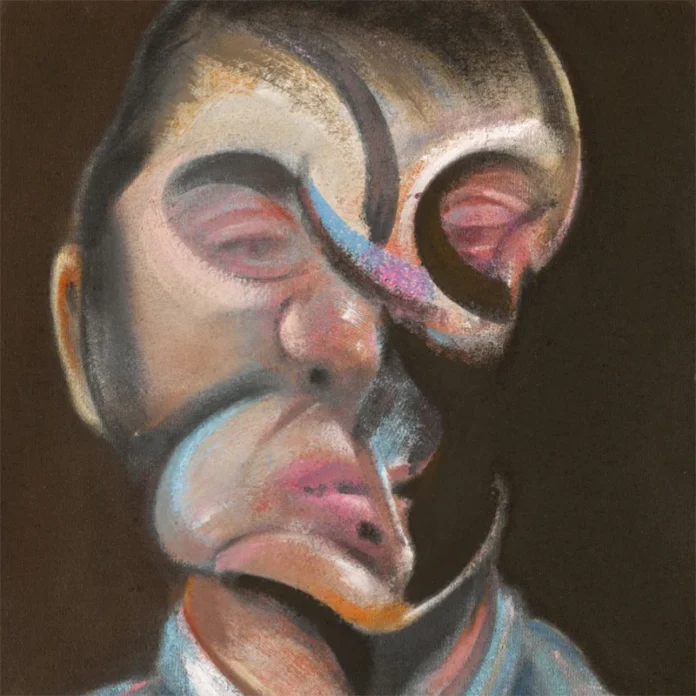
Francis Bacon, Self Portrait (1972). Source: Sotheby’s
London Prepares for a Historic Auction as the Art Market Regains Confidence. UK prepares for record‑breaking auction of billionaire’s art trove, promising more than £150 million in sales
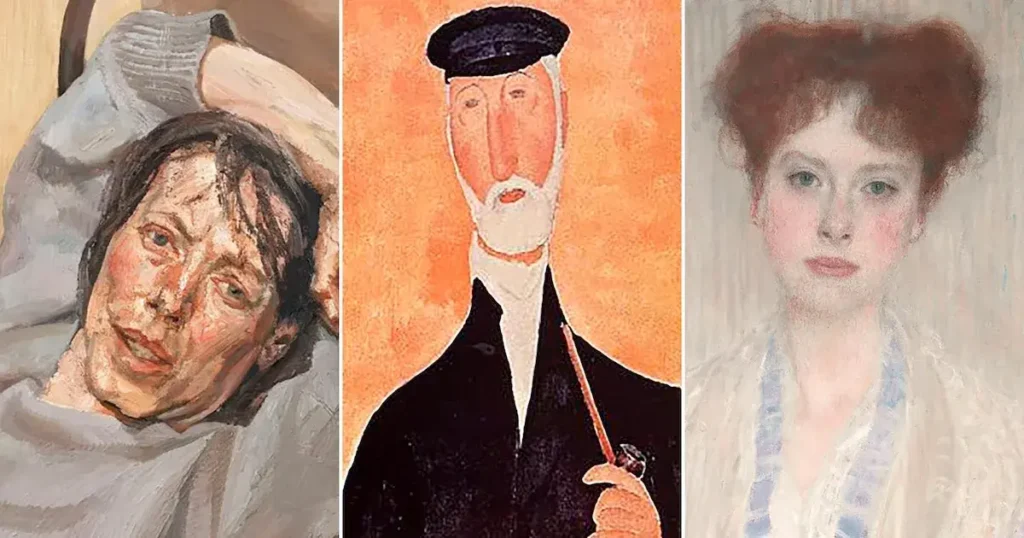
In June 2026, Sotheby’s is set to stage what is expected to be the most valuable single-owner sale ever held in London—a landmark event that not only highlights the auction house’s ability to secure high-profile consignments, but also reflects the art market’s continued dependence on the collecting power of a select group of ultra-wealthy individuals. The collection, assembled by the billionaire owner of Tottenham Hotspur and his daughter, brings together an exceptional group of works by Gustav Klimt, Egon Schiele, Amedeo Modigliani, Francis Bacon, Henri Matisse, Chaïm Soutine, Lucian Freud, and Gustave Caillebotte.
London is once again positioning itself at the center of the global art market, as Sotheby’s prepares to host what could become the most valuable auction ever staged in the city. This June, a selection of masterworks from the renowned Lewis Collection—assembled by British billionaire Joe Lewis and his daughter Vivienne—is expected to exceed $200 million, marking a defining moment not only for London but for the broader art economy.
The timing is no coincidence. After several years of uncertainty, the art market is showing renewed strength, and high-profile single-owner sales are proving to be a critical barometer of confidence. The success of last year’s Pauline Karpidas auction signaled a turning point; the Lewis Collection now pushes that momentum further, offering a rare concentration of museum-quality works that have largely remained out of public circulation for decades.
At the heart of the sale is Gustav Klimt’s Portrait of Gertha Felsőványi (1902), estimated between £20 and £30 million—a work steeped not only in aesthetic significance but also in a complex history of ownership tied to World War II-era disputes. Alongside it are equally compelling pieces: a rare Modigliani unseen for nearly half a century, a Lucian Freud painting making its auction debut, and works by Francis Bacon, Egon Schiele, and Chaïm Soutine, many of which have not appeared on the market in decades.
What distinguishes this sale is not simply its value, but its narrative coherence. The collection reflects a sustained engagement with figurative painting and the human condition—an approach that resonates strongly in today’s market, where collectors increasingly seek depth, rarity, and historical continuity.
For London, the auction represents more than a financial milestone. It is a symbolic reaffirmation of the city’s role as a global art hub, capable of attracting works of exceptional caliber at a time when competition among international markets is intensifying.
As one Sotheby’s executive noted, when works of this magnitude come to market, they do more than attract collectors—they reenergize the entire field.
Beatriz González: Between the Underdeveloped and the Eternal. The Art, Politics, and Memory.
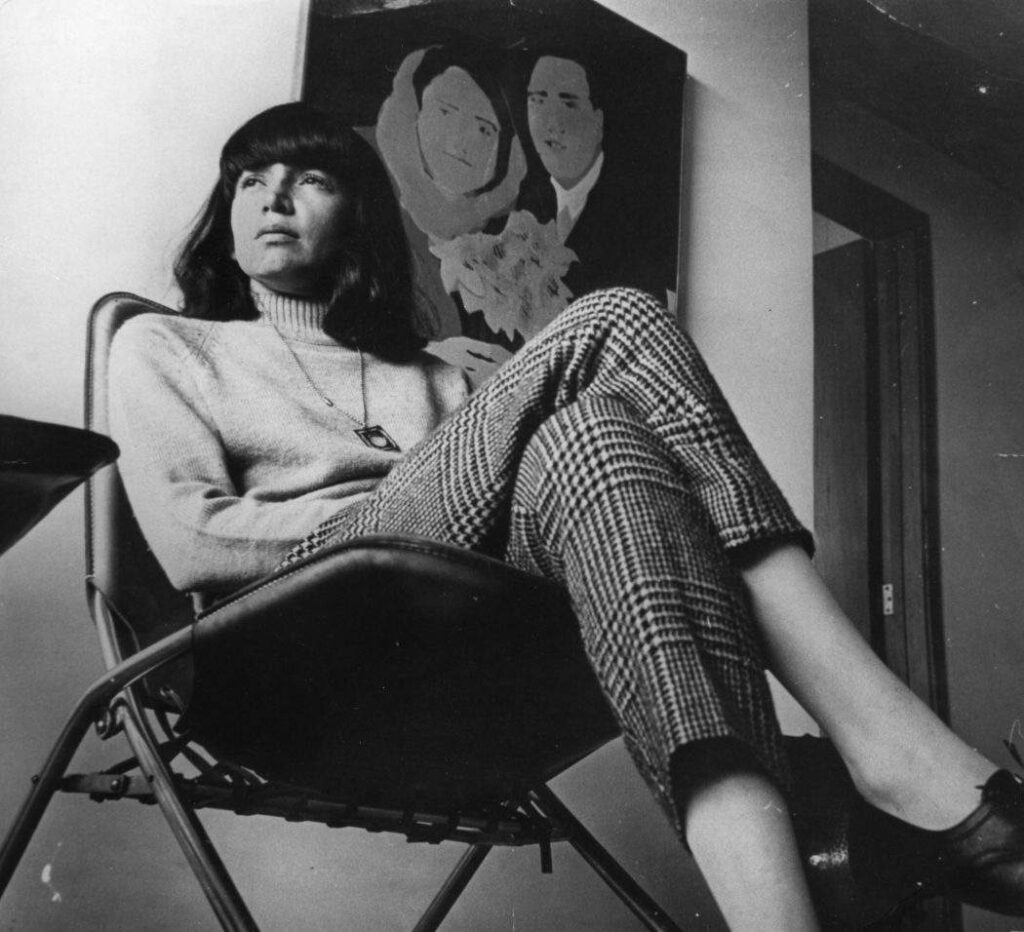
There are artists whose work is inseparable from the land that produced them — artists whose canvases are, in a very literal sense, made of history. Beatriz González (Bucaramanga, November 16, 1932 – Bogotá, January 9, 2026) was one of these artists. Across more than six decades of relentless production, she transformed Colombian popular culture, political violence, and the fraught reception of European canonical art into a singular visual language that refuses easy classification. To write about González is to write, simultaneously, about the condition of being Colombian in the twentieth and early twenty-first centuries: about La Violencia, about the absurdities of power, about the anonymous dead, and about the stubborn persistence of beauty in the midst of catastrophe.
As a Colombian art historian and curator, I find myself in the peculiar position of writing about an artist who is, to me, both object of study and intimate interlocutor. González was not merely a major figure in the Latin American art canon; she was la maestra — a teacher in the broadest possible sense — whose critical intelligence shaped the very institutions and discourses through which Colombian art is understood today. Her death in January 2026 brought an outpouring of mourning that cut across class lines and cultural boundaries, a recognition that an irreplaceable consciousness had left the world.
I. Formation and Context: Colombia as Curriculum
González came of age during one of the most traumatic periods in Colombian history. Born in Bucaramanga in 1932, she spent her formative years under the long shadow of La Violencia (1948–1958), the catastrophic civil conflict between Liberal and Conservative factions that claimed the lives of an estimated 200,000 Colombians. This historical wound would prove to be a permanent substrate of her artistic imagination — not as mere biographical backdrop, but as an epistemological condition that shaped how she understood images, power, and representation.
After briefly enrolling in architecture — a discipline whose structural logic would later inform her installations and furniture works — González transferred to the fine arts program at the Universidad de los Andes in Bogotá, graduating in 1962. There, she encountered two decisive intellectual forces: the Argentine art critic and historian Marta Traba, and the Spanish painter Joan Antonio Roda. Traba, in particular, was a towering presence in the formation of a Colombian modernism; she was combative, exacting, and deeply committed to the idea that Latin American art needed to define its own terms rather than simply follow metropolitan dictates (Ponce de León, 1988). It was Traba who, when González’s landmark painting Los suicidas del Sisga (1965) was initially rejected by the jury of the Salón de Artistas Colombianos as a “bad Botero,” intervened to demand its reconsideration. The painting not only gained acceptance but won González a special prize, launching her public career. The debt to Traba was both institutional and deeply personal — as González later acknowledged, it was Traba who first created conceptual and institutional space for women artists in the Colombian scene.
González later extended her training with printmaking studies at the Rijksakademie van Beeldende Kunsten in Amsterdam, an experience that reinforced her interest in reproducibility, seriality, and the mechanical circulation of images — themes that would animate her entire oeuvre.
II. “The Joy of the Underdeveloped”: Pop Art and Its Discontents
González’s relationship to Pop Art is perhaps the most theoretically productive tension in her work, and one she herself reflected on with characteristic precision and wit. She has been widely catalogued as one of Latin America’s leading Pop artists — her works appeared in the landmark Tate Modern exhibition The World Goes Pop (2015), and critical literature frequently situates her alongside Andy Warhol and Roy Lichtenstein as a practitioner of appropriation and mass-media imagery. Yet González consistently resisted this label, and her resistance is not mere modesty or provincial defensiveness; it is a substantive theoretical position.
“I’ve always considered myself more of a painter,” she told ArtReview in 2016, “and within this remit I painted the joy of the underdeveloped. For me the type of art that I was doing could only circulate internationally as a curiosity. Mine was a provincial type of art without horizons, confronting the everyday: art is international.” This self-description as painter of “the underdeveloped” is not self-deprecation — it is a semiotic and political declaration. Where North American Pop Art engaged with the surfaces of consumer culture and the glamour of commodity fetishism, González was interested in something altogether different: the way in which masterpieces of the Western canon — Vermeer, Manet, Velázquez, Leonardo — were received, distorted, and resignified in the periphery.
This theory was formalized in her presentation at the 1978 Venice Biennale, where she spoke of “the transformations that the work of art endures in underdeveloped countries.” As she explained: Vermeer’s Woman with a Pearl Necklace circulates in Colombia in a pamphlet about sexual education; Leonardo’s Last Supper is hung in homes as a talisman against thieves. The iconic becomes kitsch, the sacred becomes utilitarian, and the aura of the masterpiece is dispersed into the noise of everyday life. For González, this was not a tragedy to be lamented but a productive condition to be painted — with flat, saturated colors that deliberately evoked the cheap reproduction and the handmade sign. Scholar Ana María Reyes, in her important doctoral dissertation “Art at the Limits of Modernization: The Artistic Production of Beatriz González during the National Front in Colombia” (University of Chicago, 2011), frames this practice as a critique of the conditions of cultural modernization in Cold War Colombia, arguing that González’s paintings interrogate the very logic of taste that Western aesthetic discourse sought to impose on peripheral societies.
III. The Suicides of Sisga and the Ethics of the Image
No single work more clearly marks González’s artistic turning point than Los suicidas del Sisga (1965), a series of three paintings based on a newspaper photograph published in El Tiempo. The photograph depicted a young couple — a man and woman — who had thrown themselves from the Sisga Dam on the outskirts of Bogotá, having arranged for a professional photographer to document their final moments before what the man, in a state of mystical obsession, called a sacrifice to preserve the purity of their love.
González’s transformation of this newspaper image into a series of paintings is a decisive act of mediation. The painting does not sensationalize; it does not exploit. Instead, it abstracts the image, flattening it into zones of vivid color, removing the naturalism that would make it documentary, and in doing so asks fundamental questions about the status of photography as witness and painting as monument. As González herself articulated when asked what painting does that photography cannot: “Photography takes the place of the model in academia. I think that photography’s particularity lies in its ephemeral quality, while the essence of painting lies in its endurance.” In this distinction lies an entire theory of art history: the newspaper photograph is disposable, consumed and discarded in the flow of daily information; the painting, however crude or popular its register, insists on duration, on memory, on being seen again.
The critical literature on this series has been rich and growing. Carolina Ponce de León, in her foundational 1988 monograph on González, identified the driving force of the artist’s practice as its “ethical dimension” — a commitment not to political propaganda but to a deeper engagement with the moral texture of Colombian life (Ponce de León, 1988; ICAA Documents Project). This ethics of the image, as I would call it, means that González never simply appropriates: she transforms, she mourns, she insists on the humanity of the photographed subject even as she denies the photograph its claim to realism.
IV. Furniture, Power, and Satire: The Political Works
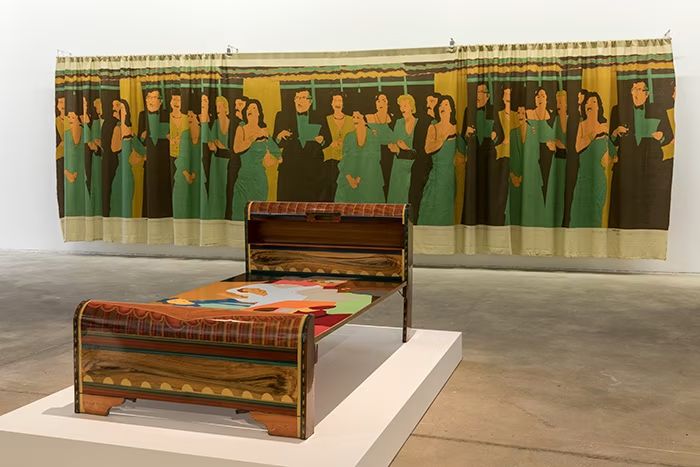
One of the most formally inventive episodes in González’s career began with an accidental discovery in a hardware store in the 1970s: store-bought furniture — cribs, beds, curtains, tables — as pictorial support. González began painting directly on found domestic objects, typically middle-class furniture that she found on the streets of Bogotá, incorporating images from her canonical series of political figures, Renaissance reproductions, and tabloid imagery. Marta Traba wrote compellingly about these furniture works in her 1977 text Los muebles de Beatriz González, arguing that they occupied a unique position between fine art and the decorative arts, between the prestigious and the popular.
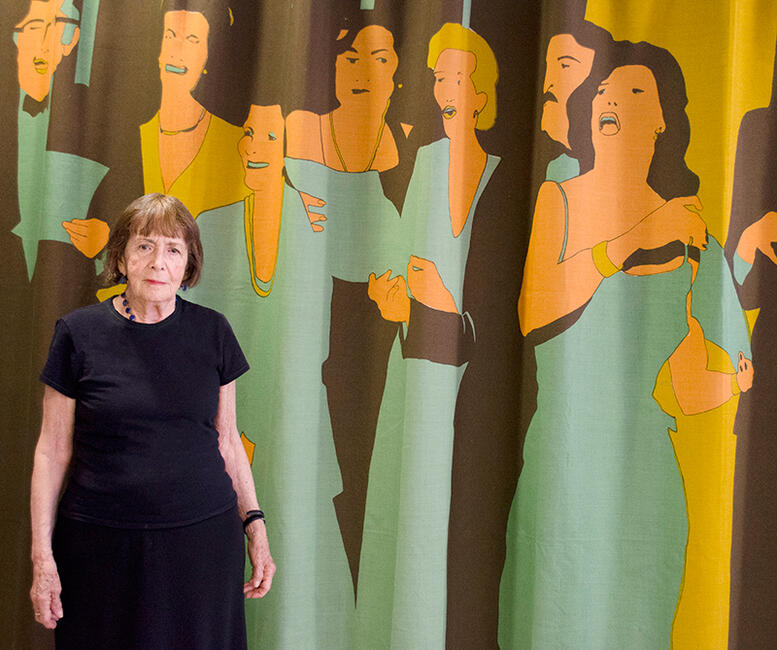
The political dimension of González’s work intensified from the 1980s onward, as Colombia descended further into cycles of narco-violence, guerrilla warfare, and state repression. Works such as Señor Presidente, qué honor estar con usted en este momento histórico (1986) — later the title of her major retrospective exhibition at El Museo del Barrio in New York in 1998 — deployed González’s signature flat figures and mordant irony to dissect the theater of political power. In the monumental undulating curtains titled Interior Decoration (1981), she repeatedly depicted a press photograph of President Julio César Turbay Ayala singing at a party; the flatness of the rendering, as ArtReview noted, sarcastically evokes the president’s ineffectiveness amid the growing violence of his era.
González was careful to distinguish her practice from political art in the propagandistic sense. “It’s been a critique of power that has impregnated my work,” she told ArtReview. “For that same reason, I don’t think of it as ‘political’; it just has a commitment to ethics.” This distinction is important: her satirical images of presidents and generals do not advocate for a particular political program; they inhabit a more unsettling register, one of absurdity, of the grotesque, of laughter that catches in the throat.
V. Auras Anónimas: Mourning as Monument
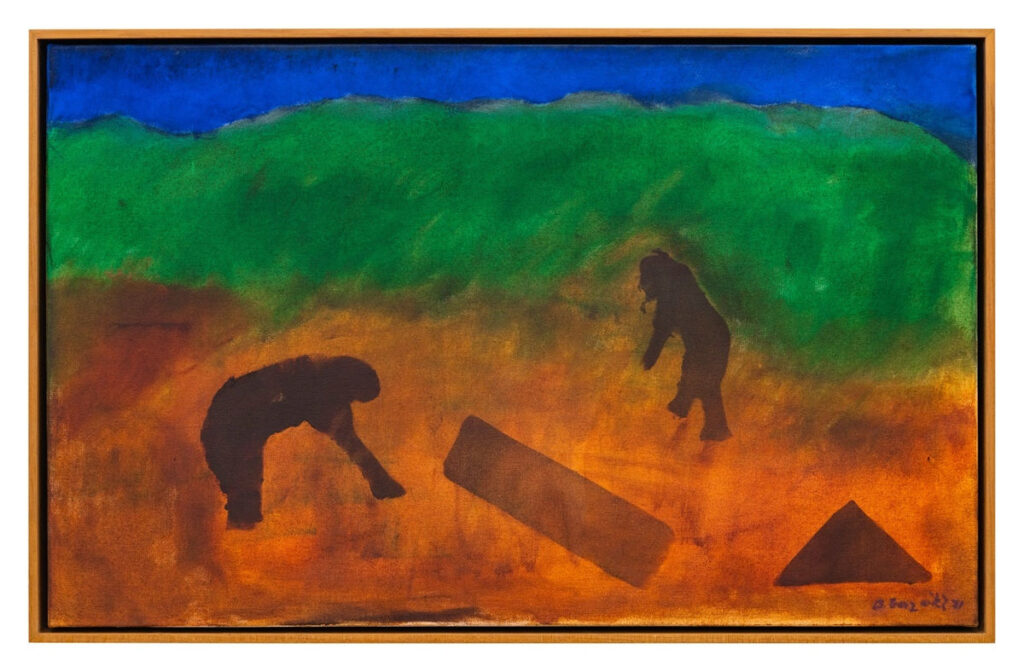
If any single work encapsulates the full reach of González’s ambition, it is Auras Anónimas (Anonymous Auras, 2007–2009), the monumental installation she created for the columbariums of the Central Cemetery in Bogotá. The work was born of both civic urgency and artistic vision: since 2003, González had been fighting to save the columbariums — six buildings constructed in 1943 to house the bodies of the poorest inhabitants of the city — from demolition. The columbariums had accumulated anonymous victims of Colombia’s decades of armed conflict, bodies laid in niches that were then left empty when no one came to claim them.
González created eight distinct silhouettes of cargueros — the porters who carry the dead in popular Colombian funerary tradition, a figure drawn directly from photojournalistic images of the violence — and reproduced them across 8,957 silk-screen prints installed over every tombstone in the columbarium walls. The image was haunting in its simplicity: figures bent under the weight of the dead, repeated thousands of times, a visual dirge for the anonymous casualties of a conflict that had no definitive beginning and no clear end.
The work transformed the columbariums into a site of collective mourning and public memory — and González’s persistence in defending the space against demolition eventually bore institutional fruit: the columbariums were declared a National Heritage site in 2019, the same year that saw González’s first career retrospective in the United States at the Pérez Art Museum Miami. The recognition was global: in 2024, Auras Anónimas was awarded the Regional Grant Award at the International Award for Public Art in Shanghai, with the jury praising its capacity to transform a forgotten space into a living monument to memory and healing.
Auras Anónimas represents a profound culmination of González’s lifelong engagement with the image as ethical act. The work draws together her sustained interest in photojournalism as source material, her commitment to seriality and repetition as structural principles, and her conviction — articulated most clearly in her later interviews — that art can perform a social function that history and politics alone cannot achieve. “Art says things that history cannot,” she stated succinctly, a position that in this context takes on the force of a manifesto.
VI. Curator, Critic, Educator: The Institutional González
Any account of González that confines itself to her paintings and installations risks underselling the full scope of her contribution to Colombian cultural life. Like her mentor Marta Traba, González understood that the conditions of art production and reception are themselves political — that you cannot make meaningful work in a vacuum of institutional indifference, and that part of the artist’s responsibility is to build the infrastructure through which art can be seen, debated, and remembered.
González coordinated the educational program at the Museo de Arte Moderno de Bogotá between 1978 and 1983, and served as chief curator of the Museo Nacional de Colombia from 1989 to 2003 — a tenure of fourteen years during which she undertook a systematic review and reinterpretation of Colombian art history. She published critical monographs on fellow artists, including the painter Luis Caballero (1943–1995), and participated in major international biennials: the 11th Bienal de São Paulo (1971), the 38th Venice Biennale (1976), the 8th Berlin Biennale (2014), and Documenta 14 in Kassel (2017). Her presence in these venues was not merely representative; she carried with her a coherent theoretical position about the specific conditions of artistic production in the so-called “underdeveloped” world, a position she articulated in catalogues, lectures, and interviews with unfailing rigor and wit.
VII. Legacy and Global Reception
The international reception of González’s work has accelerated dramatically in the years since her retrospective at the Pérez Art Museum Miami (2019), which presented nearly 150 works spanning six decades. This was followed by a major touring retrospective that passed through the Museo Nacional Centro de Arte Reina Sofía in Madrid (2018), and culminated — posthumously — in the grand retrospective at the Barbican Centre in London, which opened in February 2026, just weeks after her death. The Barbican described the exhibition as her “largest-ever exhibition in Europe,” and the critical response confirmed what Latin American art historians had long argued: that González belonged not in a regional category but in the first rank of twentieth-century artistic intelligence.
Her works now reside in the permanent collections of the Museum of Modern Art in New York, the Tate Modern in London, the Museum of Fine Arts in Houston, the Museo Nacional de Colombia, and the Casa de las Américas in Havana, among many others. The critical literature has grown accordingly: Teresa Eckmann’s analysis of González’s work in the context of Cold War aesthetics, published in conjunction with the 2019 retrospective catalogue, placed her firmly within the political and intellectual struggles of the postwar period; while Reyes’s doctoral dissertation (2011) remains the most rigorous academic treatment of her early work in its Colombian historical context.
Conclusion: “Art Says What History Cannot”
To stand before a Beatriz González is to inhabit a double consciousness: you are looking at Colombia, and you are looking at art history, and you are being asked — quietly, insistently, sometimes with devastating irony — to consider what happens when the second encounters the first. The bright colors of the underdeveloped, as she called them: those are not naïveté, not folk simplicity, not the primitiveness that European modernism always wanted to project onto its peripheries. They are a knowing, theoretically sophisticated response to the condition of being at the edge of a world system that sends its masterpieces as reproductions and its politics as violence.
González was, in the end, a singularity — an artist who was also an art historian who was also a curator who was also a public intellectual, and who understood all of these roles as aspects of a single ethical commitment: to make visible what Colombia’s violence, its politics, and its cultural dependency on the metropolitan center had made invisible. The cargueros of Auras Anónimas carry not only the unnamed dead of the armed conflict; they carry the weight of González’s entire life’s work. It is a weight that, as the Barbican retrospective and a world still grappling with its implications confirm, is far from exhausted.
References and Sources
Ariza, Carolina. “Beatriz González: From the Dismantling of Universal Iconography to Provincial Singularity.” Interview. AWARE: Archives of Women Artists, Research and Exhibitions, January 24, 2017. https://awarewomenartists.com/en/magazine/beatriz-gonzalez-du-demontage-de-liconographie-universelle-a-la-singularite-provinciale/
AWARE: Archives of Women Artists, Research and Exhibitions. “Beatriz González.” Artist entry. https://awarewomenartists.com/en/artiste/beatriz-gonzalez/ (last updated 2024).
Barbican Centre. “Beatriz González: Retrospective.” Exhibition press release. London: Barbican Centre, 2026. https://www.barbican.org.uk/our-story/press-room/beatriz-gonzalez
Casas Riegner Gallery. “Beatriz González Has Been Awarded the International Award for Public Art 2024 in China for Her Work ‘Auras Anónimas.'” Press release. Bogotá, 2024. https://www.casasriegner.com/blog-en_ca/beatriz-gonz%C3%A1lez-honored-with-the-2024-international-award-for-public-art-in-china
Eckmann, Teresa. Review of Ana María Reyes, The Politics of Taste: Beatriz González and Cold War Aesthetics, and exhibition Beatriz González: A Retrospective. Cited in Academia.edu: “Context, Cursilería, and Sorrow: Beatriz González.” https://www.academia.edu/44172354/Context_Cursiler%C3%ADa_and_Sorrow_Beatriz_Gonz%C3%A1lez
Hammer Museum / UCLA. “Beatriz González.” In Radical Women: Latin American Art, 1960–1985, Digital Archive. Los Angeles: Hammer Museum, 2019. https://hammer.ucla.edu/radical-women/artists/beatriz-gonzalez
Institute for Public Art. “Auras Anónimas (Anonymous Auras).” Case study by Laura Zarta. https://www.instituteforpublicart.org/case-studies/auras-anonimas-anonymous-auras/
International Council for Latin American Art (ICAA) / Museum of Fine Arts Houston. “Beatriz González in Situ.” ICAA Documents Project. https://icaa.mfah.org/s/en/item/1088587
Ponce de León, Carolina, ed. Beatriz González: What an Honor to Be with You at This Historic Moment: Works, 1965–1997. New York: El Museo del Barrio, 1998.
Ponce de León, Carolina. Beatriz González [monograph, first retrospective]. Bogotá, 1988. [Cited in ICAA Documents Project]
Rappolt, Mark. “The Interview: Beatriz González.” ArtReview, 2016 (reprinted February 19, 2026). https://artreview.com/the-interview-beatriz-gonzalez-mark-rappolt/
Reyes, Ana María. “Art at the Limits of Modernization: The Artistic Production of Beatriz González during the National Front in Colombia.” PhD dissertation, University of Chicago, 2011.
Sierra Maya, Alberto. Beatriz González: La comedia y la tragedia. Retrospectiva, 1948–2010. Medellín: Museo de Arte Moderno, 2011.
Tate Modern. “Who Is Beatriz González?” Artist profile with interview, 2015. https://www.tate.org.uk/art/artists/beatriz-gonzalez-11980/who-is-beatriz-gonzalez
Traba, Marta. Los muebles de Beatriz González. Bogotá: Museo de Arte Moderno, 1977.
Universes Art. “Beatriz González – In Memoriam.” 2026. https://universes.art/en/magazine/articles/2026/beatriz-gonzalez-in-memoriam
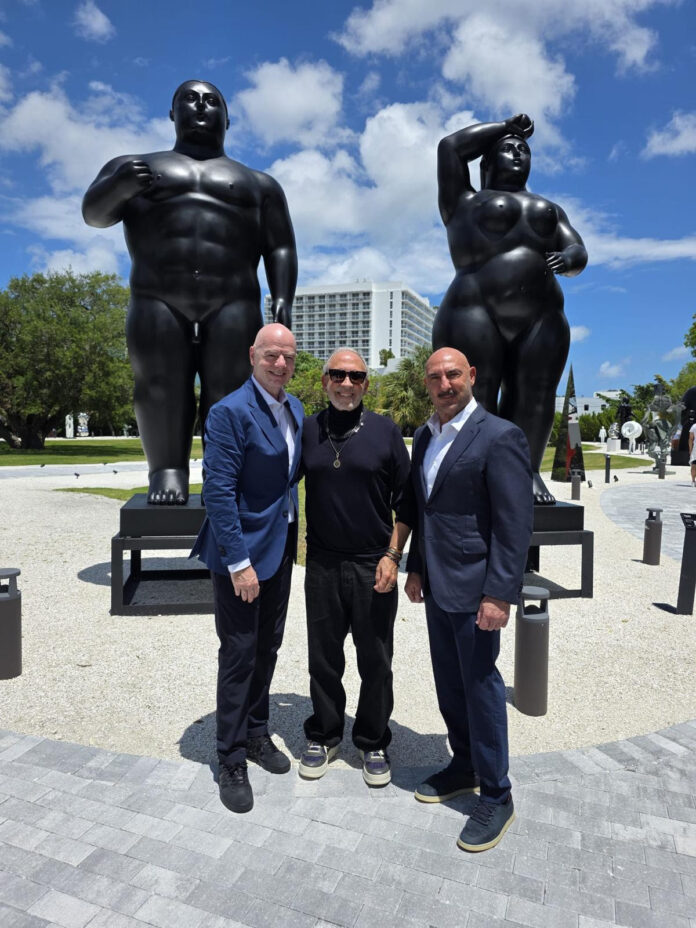
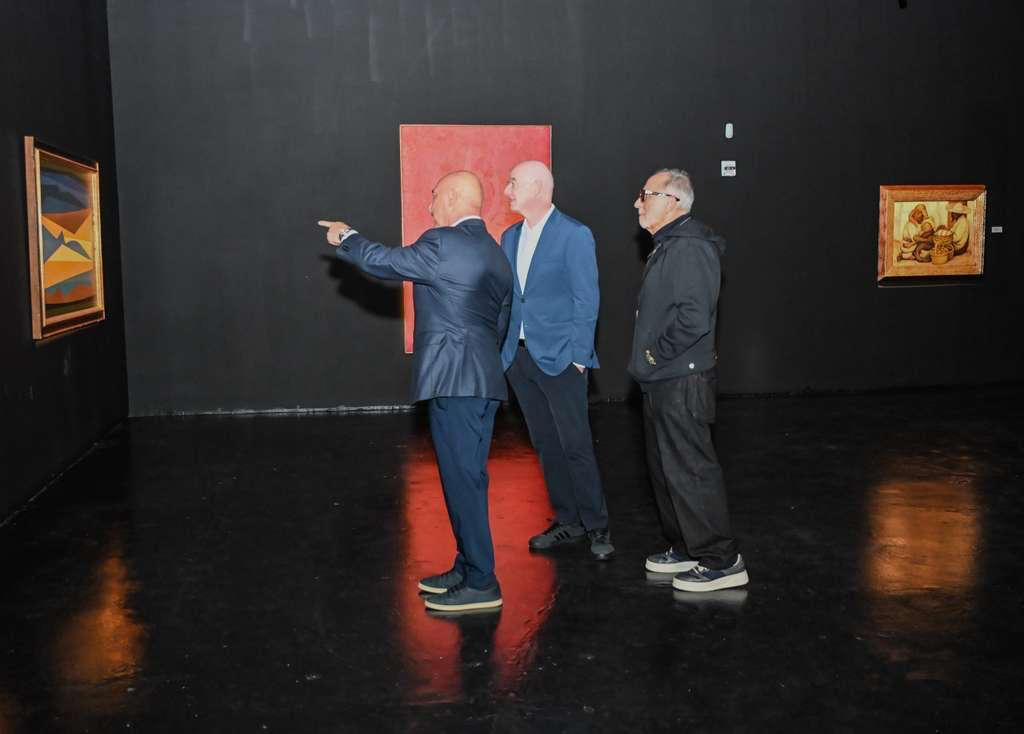
Gary Nader, FIFA President Gianni Infantino, and Emilio Estefan at Nader Sculpture Park in the Miami Design District, where the official launch of “Love Always Wins” will take place
Nader Sculpture Park to Host Official Launch of “Love Always Wins,” Part of the FIFA World Cup 2026™ Album
Gary Nader Art Centre is proud to announce that Nader Sculpture Park, located in the Miami Design District, will host the official launch of “Love Always Wins,” a song written and produced by 26-time Grammy Award winner Emilio Estefan, performed by Zema on lead vocals featuring Shaggy and Cimafunk.
The song is part of the Official FIFA World Cup 2026™ Album, a global music project celebrating the cultural spirit surrounding the world’s most anticipated sporting event.
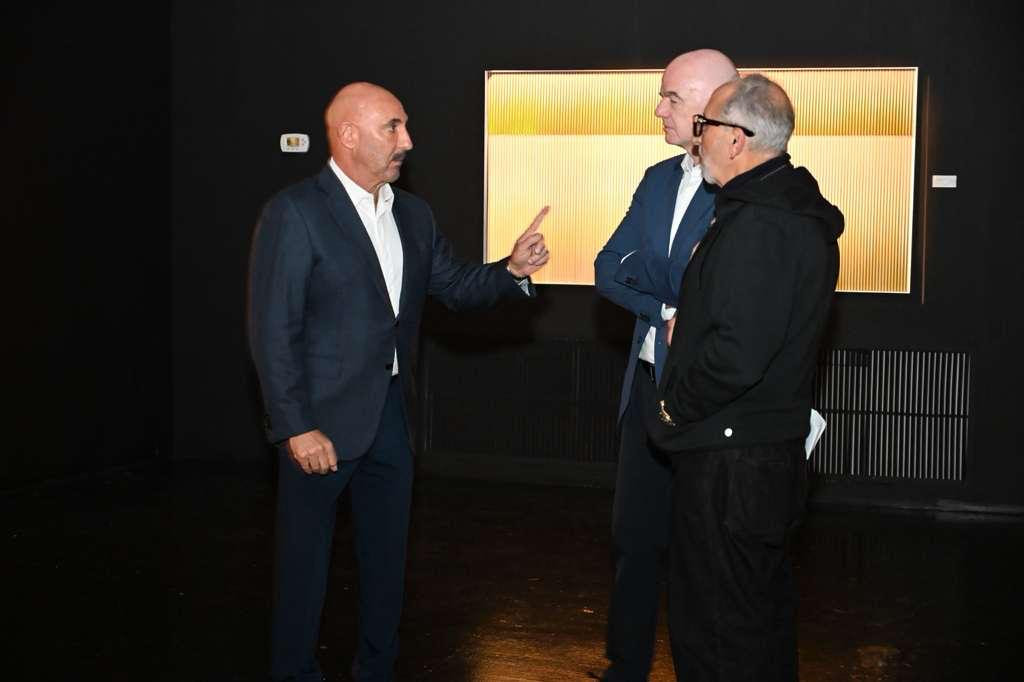
Gary Nader, FIFA President Gianni Infantino, and Emilio Estefan during a special visit to Gary Nader Art Centre, where art, music, and global culture came together ahead of the FIFA World Cup 2026™.
The announcement follows a special visit to Gary Nader Art Centre and Nader Sculpture Park, where Gary Nader welcomed FIFA President Gianni Infantino, joined by Emilio Estefan.
The visit brought together art, music, and football in a moment that reflects Miami’s role as a global cultural capital ahead of the FIFA World Cup 2026™. Mr. Infantino’s presence marked a great honor for Gary Nader Art Centre and Nader Sculpture Park, while Estefan’s participation added a meaningful cultural dimension to the announcement, connecting the world of music with the city’s artistic and international spirit.
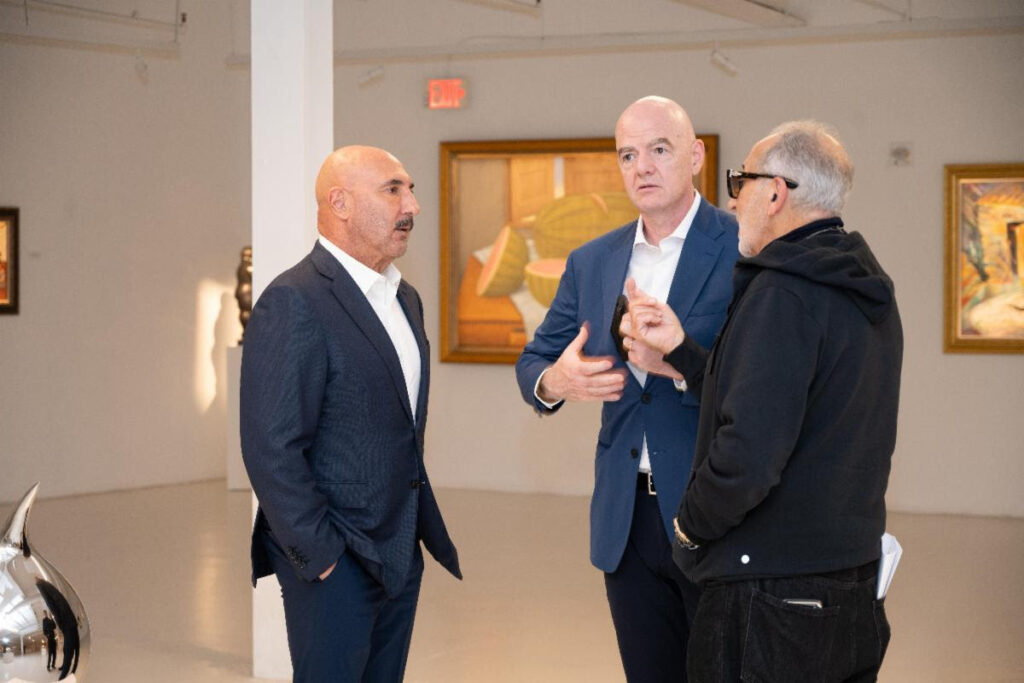
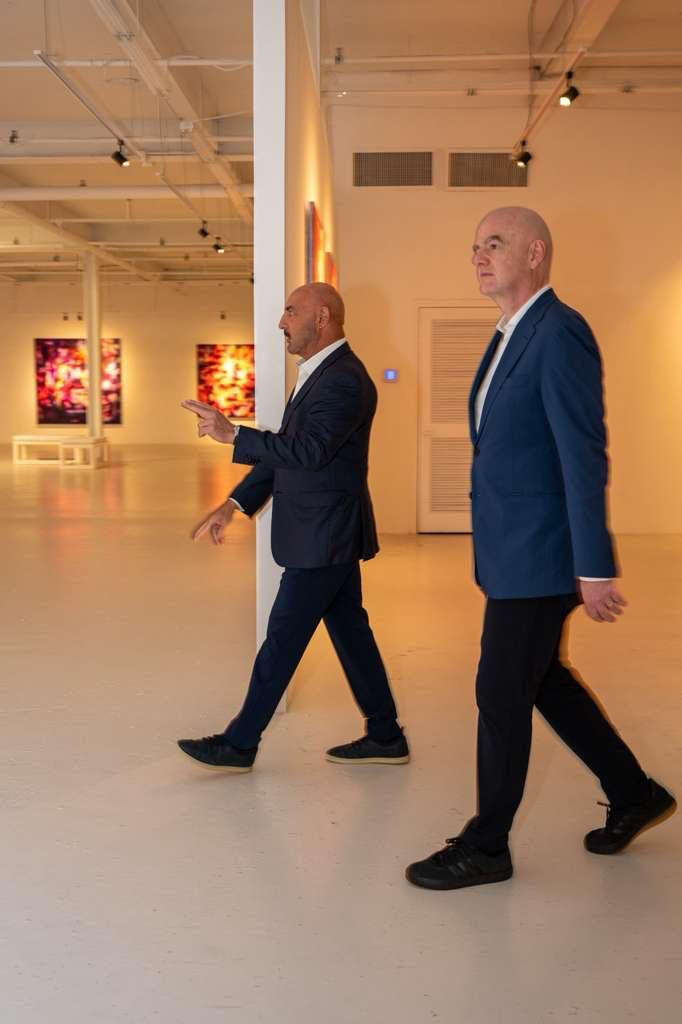
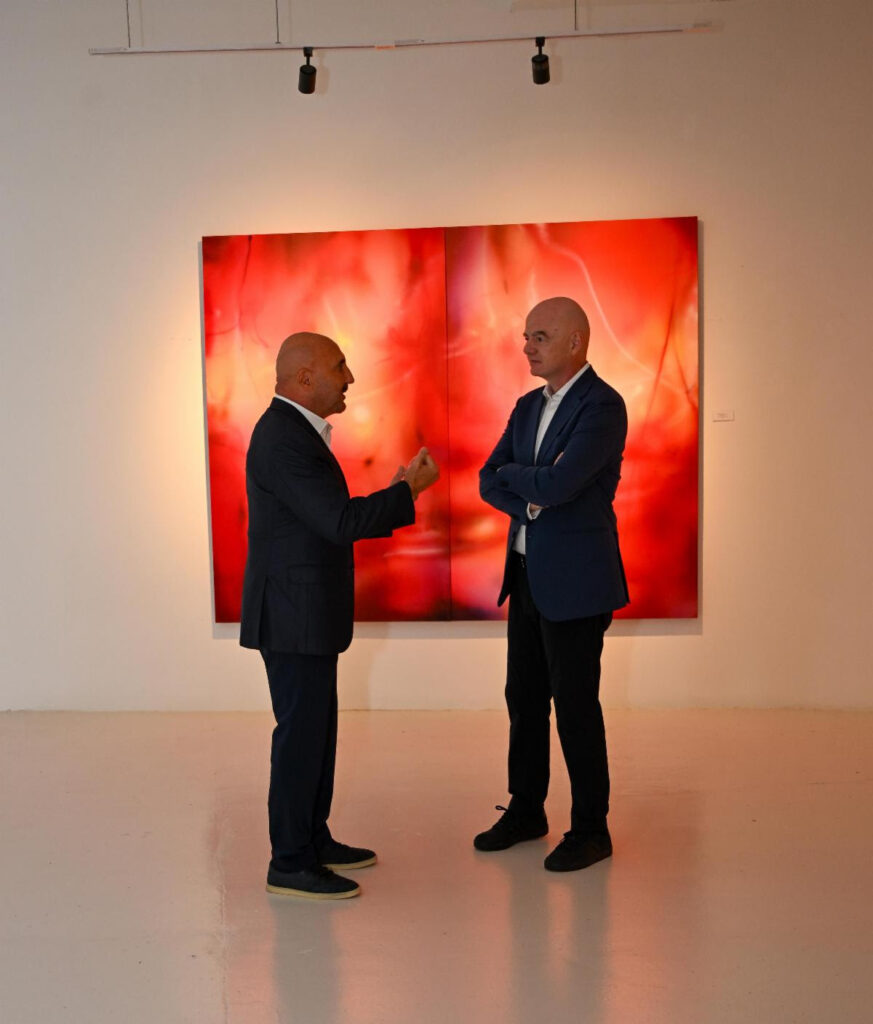
During the visit, Mr. Infantino had the opportunity to experience the gallery’s current exhibition by Rachel Valdés, as well as a curated selection of works from one of Miami’s leading destinations for Modern and Contemporary Art. The visit highlighted Gary Nader Art Centre’s extensive program, which includes museum-quality exhibitions, world-renowned masters, contemporary voices, and the world’s largest private collection of works by Fernando Botero.
The tour continued at Nader Sculpture Park, Gary Nader’s open-air cultural landmark in the Miami Design District, where monumental sculptures create a dialogue between art, architecture, urban life, and public space.
Gary Nader and FIFA President Gianni Infantino during the visit to Rachel Valdés’ current exhibition at Gary Nader Art Centre.
“This is a meaningful moment for Miami, for the arts, and for the universal language of culture. Welcoming FIFA President Gianni Infantino to Gary Nader Art Centre and Nader Sculpture Park; together with my dear brother Emilio Estefan, makes this announcement especially significant. Hosting the launch of a song connected to the FIFA World Cup 2026™ reflects exactly what we believe in: art, music, and public spaces as bridges between people, cities, and cultures.”
— Gary Nader, Founder of Gary Nader Art Centre & Nader Sculpture Park
Gary Nader welcomes FIFA President Gianni Infantino to Gary Nader Art Centre during a special visit highlighting the gallery’s Modern and Contemporary Art program.
The upcoming launch of “Love Always Wins” at Nader Sculpture Park will bring together the worlds of art, music, football, and Miami’s multicultural spirit in anticipation of the FIFA World Cup 2026™, which will be hosted across the United States, Mexico, and Canada.
Further details, including the official launch date and event information, will be announced soon.
ABOUT GARY NADER ART CENTRE
Founded by Gary Nader and headquartered in Miami’s vibrant Wynwood Arts District, is among the Americas’ preeminent and most regarded art galleries specializing in Latin American, Modern and Contemporary Masters. With over four decades of experience in the acquisition, exhibition, and scholarly promotion of major international artists, the gallery has mounted landmark exhibitions featuring the work some of he most important artists worldwide including Fernando Botero, Rufino Tamayo, Roberto Matta, Pablo Picasso, Matisse, Frank Stella, Diego Rivera, to name a few.
With a permanent inventory of over 2000 important works Gary Nader Art Centre maintains deep institutional relationships with major museums, auction houses, and private collections internationally, and is recognized as a primary authority on the work of Wifredo Lam.
The gallery is committed to the serious contextual and art-historical framing of the works it presents, and to the recognition of Latin America artistic traditions as central — not peripheral — to the history of modern and contemporary art worldwide.
ABOUT NADER SCULPTURE PARK
Nader Sculpture Park, located in the Miami Design District, is an open-air cultural destination dedicated to monumental sculpture and public engagement with art. Conceived by Gary Nader as an extension of his lifelong commitment to making art accessible, the park brings together major works by internationally celebrated artists in a setting that connects art, architecture, design, and the city.
Join us on February 28, 2026, 6—9 pm for Salon Together, a special exhibition and fundraiser made possible by the extraordinary generosity of artists who have shaped and been shaped by the organization in our 16-year history.
All works in the exhibition are fully donated and for sale, with 100% of proceeds directly supporting Dimensions Variable’s forthcoming publication—a long-term archival project developed over the past sixteen years. The publication will feature each participating artist, documenting their work and the sustained relationships that have defined Dimensions Variable’s experimental and community-centered mission.
The artists in Salon Together represent a living history of the organization. Many have been exhibited at Dimensions Variable, participated in its studio program, or contributed to its broader ecosystem through conversations, mentorship, and collaboration. This exhibition brings those artists together in a shared gesture of reciprocity: artists who have been supported by the organization now, in turn, support the creation of a publication that preserves and amplifies their work for the future.
Conceived as a collective gathering rather than a traditional benefit exhibition, Salon Together emphasizes togetherness, continuity, and gratitude. The title underscores the spirit of the project: artists standing alongside one another, and alongside Dimensions Variable, to ensure that a significant body of work, dialogue, and labor is thoughtfully documented and made public.
The resulting publication will serve as both an archive and a forward-looking resource — preserving the histories of artists and projects that might otherwise remain undocumented, while affirming the essential role of small and mid-sized nonprofit spaces in sustaining contemporary artistic practice.
Participating Artists
Participating artists include: Carrie Sieh, Charo Oquet, Francisco Masó, Onajide Shabaka, Yanira Collado, Margrethe Aanestad, Jamilah Sabur, Fabian Peña, Agustina Woodgate, Felice Grodin, Marisa Telleria, Marcos Valella, Jee Park, Clara Varas, Jennifer Printz, Alexis Martínez, Chris Byrd, Leyla Cárdenas, Nick Vaughan & Jake Margolin, Charles Koegel, Nellie Appleby, Liz Rodda, Jenene Nagy, Liene Bosquê, Robert Huff, Loretta Park, Vickie Pierre, Nicole Burko, Moira Holohan, Kerry Phillips, Karla Kantorovich, Ariel Orozco, Samantha Salzinger, Barron Sherer, Frances Trombly, Leyden Rodriguez-Casanova, Joyce Billet, Salua Ares, Devora Perez, Erin Parish, Karen Starosta-Gilinski, Alfredo Travieso, Claudia Vieira, Anna Biondo, and more.
Alma Allen: Representing US at Venice Biennale 2026
Matter, Silence, and the Politics of Form
The selection of Alma Allen as the United States representative at the Venice Biennale 2026 marks one of the most unexpected—and revealing—moments in recent American art. At once understated and controversial, Allen’s appointment exposes a fracture within contemporary discourse: between spectacle and stillness, between ideological urgency and material introspection.
A Sculptor Outside the System
Born in Utah and based in Tepoztlán, Mexico, Allen has long cultivated a practice that exists at the margins of institutional visibility. A self-taught artist, his work developed “independently of any recognized art movement,” grounded instead in an intuitive dialogue with materials such as stone, wood, and bronze.
This distance from the art world’s conventional circuits is precisely what makes his selection so charged. Unlike predecessors such as Simone Leigh or Jenny Holzer—whose practices engage explicitly with identity, politics, and language—Allen’s sculptures operate in a quieter register. They resist narrative. They resist declaration.
And yet, in that resistance lies their potency.
“Call Me the Breeze”: Elevation as Method
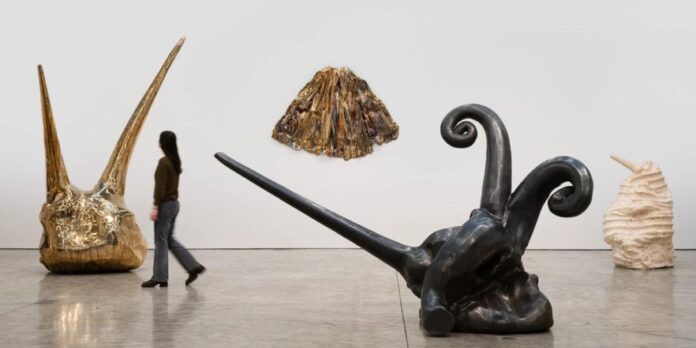
Allen’s pavilion, titled “Call Me the Breeze,” will present approximately 30 sculptures that explore what has been described as an “alchemical transformation of matter” and the concept of elevation.
But elevation here should not be misread as transcendence in the romantic sense. Rather, Allen’s forms—biomorphic, polished, often pierced or hollowed—suggest a continuous negotiation between weight and lightness, density and void. His sculptures do not ascend; they hover, as if caught in a moment of geological hesitation.
There is a profound temporality embedded in his work. Stone appears softened, almost eroded by an invisible time. Wood becomes a vessel rather than a surface. Bronze, traditionally monumental, is rendered intimate. Allen does not impose form onto matter; he coaxes form out of it.
A Controversial Appointment
The context of Allen’s selection is inseparable from its reception. The 2026 U.S. Pavilion emerged from an unusually opaque process, bypassing traditional institutional channels and instead involving the U.S. State Department and the newly formed American Arts Conservancy.
This departure from precedent—combined with Allen’s relatively low public profile—sparked skepticism across the art world. Critics questioned both the selection mechanism and the perceived “apolitical” nature of his work in a moment defined by global instability and cultural polarization.
Yet this critique may misunderstand the deeper stakes of Allen’s practice.
The Politics of Non-Declaration
To call Allen’s work apolitical is to overlook a more subtle proposition: that form itself can be a site of resistance. In an era saturated with images, language, and ideological positioning, Allen’s sculptures insist on something radically different—attention, slowness, and physical presence.
They do not tell us what to think. They ask us to feel how matter thinks.
In this sense, Allen’s work aligns with a lineage that includes Isamu Noguchi and Donald Judd, yet it diverges through its almost mystical sensibility. His objects seem less designed than discovered, as if unearthed from a future archaeology.
A Pavilion of Silence
What might it mean for the United States—at a moment of political intensity and global scrutiny—to present a pavilion grounded in silence, tactility, and ambiguity?
The answer may lie in the very discomfort Allen’s selection has produced. His work refuses to perform identity, refuses to illustrate ideology, refuses even to explain itself. In doing so, it challenges the expectation that national representation must be legible, declarative, or didactic.
Instead, Allen offers something rarer: an encounter.
Conclusion: Between Weight and Meaning
The Venice Biennale has often been described as the Olympics of the art world—a stage for spectacle, competition, and national branding.
Alma Allen’s pavilion may do something else entirely. It may slow the viewer down. It may redirect attention from message to material, from discourse to perception. And in that shift, it may reveal a different kind of American art—one not defined by proclamation, but by presence.
In an age of noise, Allen’s sculptures propose a radical idea: that meaning does not always need to be spoken.
Dimensiones Variables (DV) is pleased to announce Studio Focus, a new series dedicated to exploring the working practices, methodologies, and conceptual frameworks of Dimensions Variable artists. The first session will take place on May 3, 2026, at 3 pm, featuring the work and studio of Anna Biondo.
This session offers the unique opportunity to engage directly with Anna and to examine the ways in which her studio operates as both a site of creation and a point of intellectual inquiry. Participants will gain insight into her material techniques, processes, and the strategies through which her work negotiates contemporary artistic, cultural, and social concerns.
Anna Biondo
Anna Biondo (b. 1975, São Paulo, Brazil) lives and works between São Paulo and Miami. She holds a Bachelor’s degree in Drawing and Design from Faculdade de Belas Artes de São Paulo (2002) and a postgraduate degree in Visual Arts from Universidade Santa Marcelina (2004), where she studied under Leda Catunda. In 2022, she completed a postgraduate program in Analytical Psychology at the Freedom Institute and is currently pursuing advanced studies in mental health practices inspired by the work of Nise da Silveira.
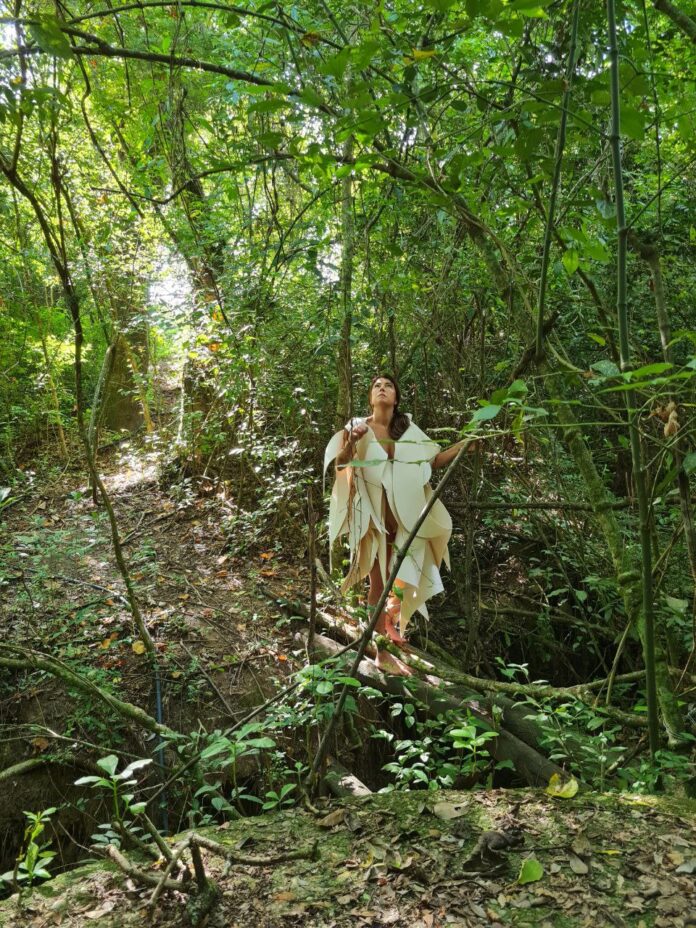
Her artistic practice investigates symbolism, affective experimentation, and relational processes through installations and textile-based works. Working with pure wool felt and recycled, between embroidery and cut-out forms, Biondo creates malleable structures that engage transformation, memory, and shared narratives.
From 2004 to 2007, she worked as a curatorial assistant at the Museu de Arte Moderna (MAM) São Paulo, collaborating on the curatorship and production of exhibitions. Since 2020, she has been Director of Special Projects at The55Project in Miami, where she coordinates artistic programs, residencies, workshops, and art fairs, fostering connections between Brazilian artists and the North American art scene. She was part of the Red Thread Studio collective for two years and is currently based at Dimensions Variable.
Selected exhibitions include Remorph: Unending (Doral Contemporary Art Museum), Visions from Inside the Walls (Coral Gables Museum), What Does Miami Mean to You? (Vizcaya Museum & Gardens), The Things We Carried (Emporium B Gallery, Miami), Cargo (Parque Lage, Rio de Janeiro), Just Breathe (The55Project, Miami Art Week), Lumen Art (Miami Art Week), among others.
El lenguaje silencioso:el simbolismo en el arte visual
El lenguaje silencioso: el simbolismo en el arte visual
Una guía para artistas que quieren leer y construir imágenes con mayor profundidad.
Antes de que existiera la escritura, antes de los alfabetos y los libros, los seres humanos ya tenían un idioma. No era hablado ni escrito: era visto. Las paredes de las cavernas, los muros de los templos, las superficies de la cerámica antigua están llenos de imágenes que no eran decoración, sino comunicación. Eran pensamiento hecho forma. Esa tradición nunca desapareció; simplemente aprendió a volverse más compleja, más íntima, más poderosa.
Para el artista visual, comprender el simbolismo no es un ejercicio académico. Es aprender a hablar con mayor precisión en el único idioma que domina por completo: el de las imágenes.
I · ¿Qué es un símbolo?
Un símbolo en el arte es cualquier elemento visual —un objeto, un color, un gesto, una figura— que carga un significado más allá de su apariencia literal. Una rosa no es solo una rosa: puede ser amor, belleza efímera, pasión o incluso muerte. Una calavera no anuncia solo la muerte física; en la tradición vanitas del Barroco, recuerda que el tiempo se agota y que ninguna gloria dura para siempre.
“Los símbolos no gritan ni argumentan ni convencen. Simplemente hablan a la parte de nosotros que ya comprende.”
Lo que hace al símbolo un instrumento extraordinario es que opera por debajo de la lógica. La mayoría de la información en el mundo moderno está diseñada para el intelecto: define, explica, categoriza. El símbolo trabaja de otra manera. No pide ser analizado antes de sentirse. Va directo a la intuición, directamente a la emoción. Por eso una imagen mitológica puede mover a alguien que no conoce el mito. Por eso el arte religioso conmueve incluso a quien no profesa esa fe.
Para el artista, esto tiene una implicación práctica crucial: puedes construir capas de significado en tu obra que el espectador percibirá sin necesariamente poder nombrarlas. El símbolo no necesita ser comprendido intelectualmente para ser sentido.
II · Un vocabulario visual universal
A lo largo de la historia del arte, ciertos símbolos han acumulado significados compartidos que trascienden culturas y épocas. Conocerlos es expandir el vocabulario de tu obra. No se trata de usarlos mecánicamente, sino de entender el peso que traen consigo y decidir conscientemente si ese peso sirve a lo que quieres decir.
Vanitas / Memento mori
Cráneos, velas apagadas, fruta en descomposición, relojes de arena. La brevedad de la vida.
Metamorfosis y alma
La mariposa: transformación, resurrección, esperanza. El alma liberada del cuerpo.
Agua y ríos
El paso del tiempo, el viaje de la vida, el cambio inevitable. A veces también lo inconsciente.
Flores y loto
El loto: iluminación y renacimiento (emerge del fango hacia la luz). El lirio: pureza divina.
Águila y poder
Fuerza, visión, autoridad. En muchas culturas, mensajero entre el mundo humano y lo divino.
Paloma y paz
Inocencia, paz, el espíritu divino. En el arte cristiano, símbolo del Espíritu Santo.
El color es también un sistema simbólico en sí mismo. El rojo comunica pasión, energía o peligro. El azul evoca calma, divinidad o melancolía. El oro habla de lo sagrado, lo eterno, lo que está fuera del tiempo ordinario. Incluso los gestos —una mano en oración, un dedo apuntando hacia arriba, los ojos cerrados o abiertos— dirigen la lectura emocional y espiritual de una imagen.
III · Una historia viva: los grandes momentos del simbolismo
Arte antiguo — Egipto, Grecia, Mesopotamia
Los símbolos eran lenguaje antes de que hubiera alfabeto. Comunicaban ideas filosóficas, religiosas e históricas que el habla cotidiana no podía contener. Un solo símbolo podía condensar lo que un párrafo no alcanzaba a decir.
Renacimiento y arte clásico — siglos XV–XVII
Los símbolos se disfrazaron de objetos cotidianos. Una flor sobre una mesa, una ventana al fondo, la posición de las manos en un retrato: todo estaba cargado de ideales humanistas o religiosos específicos que el espectador culto de la época sabía leer.
Movimiento Simbolista — finales del siglo XIX
Gustave Moreau, Odilon Redon y sus contemporáneos rechazaron el realismo para explorar el sueño, la mitología y el subconsciente. Afirmaron que el arte debía expresar la experiencia espiritual y emocional de la vida, no copiar su apariencia exterior.
Surrealismo — siglo XX
Salvador Dalí y sus contemporáneos llevaron el simbolismo al territorio de lo irracional y lo onírico. Las imágenes perturbadoras no eran accidentales: eran mapas del inconsciente, símbolos del mundo interior que la razón normalmente censura.
Arte contemporáneo — hoy
Los artistas actuales combinan símbolos universales con símbolos personales, creando lenguajes propios que hablan tanto de la experiencia íntima como de las tensiones sociales, políticas y culturales del mundo en que vivimos.
IV · El símbolo personal: tu propio vocabulario
Una de las grandes lecciones del arte contemporáneo es que el simbolismo no tiene que ser universal para ser poderoso. Cada artista puede —y quizás debe— construir su propio repertorio simbólico. Objetos que tienen resonancia biográfica, formas recurrentes que atraviesan tu obra, colores que para ti cargan un peso emocional específico: todos estos pueden convertirse en símbolos personales que, con el tiempo y la consistencia, se vuelven legibles para quienes siguen tu obra.
“En mis pinturas, a veces los símbolos son obvios y a veces muy sutiles, pero siempre están ahí para crear otra capa de significado debajo de lo que el ojo ve primero.”
Este gesto —incluir un símbolo personal de forma deliberada— transforma la imagen en un objeto estratificado. El espectador puede disfrutar la superficie: la composición, el color, la técnica. Pero si mira con mayor atención, descubrirá una segunda conversación ocurriendo en silencio dentro del cuadro.
V · Cómo trabajar con símbolos como artista
Hay tres formas de incorporar el pensamiento simbólico a tu práctica. La primera es la investigación: explorar los símbolos que han persistido a través de la historia, entender qué significados han acumulado y decidir si esos significados sirven a lo que necesitas decir. La segunda es la intuición: prestar atención a las imágenes que aparecen en tu trabajo de forma espontánea y preguntarte qué significan para ti, aunque al principio no sepas explicarlo. La tercera es la inversión: tomar un símbolo establecido y subvertir su significado, cargarlo con lo contrario de lo que suele representar o colocarlo en un contexto que lo resignifique completamente.
En los tres casos, lo que importa es la conciencia. Un símbolo usado sin intención es solo un objeto. Un símbolo elegido con deliberación es una palabra en el lenguaje silencioso de tu obra.
VI · Conclusión
Los seres humanos llevan miles de años comunicándose a través de imágenes simbólicas porque las palabras, solas, no son suficientes. Hay verdades —sobre la muerte, sobre el tiempo, sobre el amor, sobre lo sagrado— que solo pueden aproximarse mediante la imagen. El símbolo no explica esas verdades: las evoca. No las define: las convoca.
Como artista visual, estás trabajando en la tradición más antigua que la humanidad conoce. Cada vez que eliges un objeto, un color, una forma con intención, estás participando en una conversación que empezó en las paredes de una cueva y no ha terminado. Esa conversación es el arte.
La próxima vez que estés frente a un lienzo en blanco o en el proceso de tomar decisiones sobre tu obra, hazte esta pregunta: ¿qué está diciendo esta imagen por debajo de lo que muestra? La respuesta a esa pregunta es donde comienza el simbolismo.
What Schools Don’t Teach: Transforming Your Art Dream into a Professional Career (2026)
Art schools teach you how to see. They train your hand—painting, sculpture, textile, drawing—and situate your practice within art history. You learn references, materials, processes, and the language of critique.
But there is a fundamental gap.
What they rarely teach is how to exist as an artist within the real world.
The Educational Paradox: Skill vs. System
Over the last decades, art education has undergone a significant shift. Traditional skill-based training—drawing, material mastery, craft—has increasingly given way to conceptual thinking and critical theory. This transformation, often referred to as deskilling, emerged from late 20th-century movements where the idea became more important than execution.
While this has expanded the definition of art, it has also created a generation of artists who graduate with:
strong conceptual frameworks
but limited technical depth
and almost no understanding of the art industry
Simultaneously, the disappearance of resource-intensive programs—workshops, fabrication labs, technical training—has further reduced hands-on skill development. These programs are expensive, and institutions have shifted toward models that are more economically sustainable, but less materially rigorous.
The result is a contradiction:
Artists are taught how to think But not how to build a career
From Studio Practice to Professional Practice
To transform your artistic ambition into a sustainable career, you must move beyond the studio and begin to understand the art world as a system—a network of relationships, structures, and opportunities.
This is where most artists fail—not creatively, but strategically.
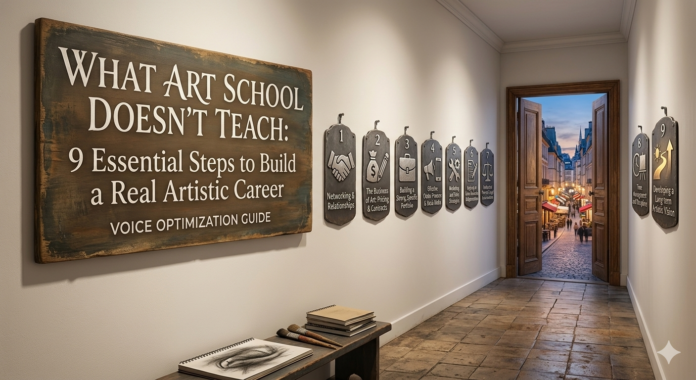
1. Build Relationships with the People Who Matter
The art world does not operate as a meritocracy alone. It operates through networks.
Collectors, curators, gallerists, advisors—these are not distant figures. They are part of an ecosystem that you must enter with intention.
Relationships are not transactional. They are built over time through:
consistency
clarity of work
presence
Your career is not only what you produce. It is who knows your work—and why it matters.
2. Gain a Deep Understanding of the Industry
There is no single “art world.” There are multiple sectors:
Commercial galleries
Nonprofit institutions
Art fairs
Public art commissions
Independent and alternative spaces
Each operates with different expectations, timelines, and values.
Without this understanding, artists:
apply to the wrong opportunities
misprice their work
or remain invisible despite strong practice
Clarity of context creates strategic movement.
3. Create a Visibility Plan That Works
Visibility is not accidental.
It is structured.
Most artists rely on:
sporadic exhibitions
inconsistent social media
passive waiting
This leads to frustration and invisibility.
A real visibility plan includes:
consistent output (not just production, but communication)
targeted platforms
alignment with curatorial contexts
documentation of work at a professional level
Visibility is not self-promotion. It is positioning.
4. Generate Sustainable Career Growth
The myth of the artist is still tied to instability:
no time
no money
no structure
This is not romantic. It is unsustainable.
A professional artist builds systems:
financial organization
time management
production cycles
strategic planning
Growth is not a moment. It is a structure that supports continuity.
5. You Don’t Have to Follow the Same Path
One of the biggest misconceptions is that success comes from:
showing in the same galleries
following the same artists
replicating the same trajectories
This is false.
Your career is not linear.
Opportunities already exist around you:
local networks
collectors outside major hubs
interdisciplinary collaborations
The key is learning how to expand what you already have.
6. End the Confusion: What to Focus on and When
Artists often feel overwhelmed because they try to do everything at once:
produce work
build visibility
apply to opportunities
network
Without structure, effort becomes scattered.
A step-by-step strategy allows you to:
focus on the right actions at the right time
create measurable progress
avoid burnout
Clarity replaces anxiety.
7. From Invisibility to Position
Many artists feel invisible not because their work lacks value, but because they lack:
context
positioning
understanding of the system
When you understand:
where you fit
who your audience is
what sector aligns with your work
You stop being invisible.
You become legible within the art world.
8. Reclaiming Time and Resources
A common condition among artists:
not enough time in the studio
not enough income from the work
This is not only a financial issue. It is a structural one.
By creating systems, you can:
protect studio time
generate income strategically
reduce instability
A career is not built on inspiration alone. It is built on organization.
9. Beyond School: A Necessary Expansion
Art school gives you tools—but incomplete ones.
To move forward, you must expand your education into:
strategy
industry knowledge
relationship-building
self-positioning
This is the missing curriculum.
Conclusion: From Practice to Career
The transition from student to professional artist is not about improving your technique.
It is about:
understanding the system
positioning your work within it
and building structures that sustain your practice over time
Because in the end, talent is not enough.
What defines a career is the ability to transform that talent into: visibility relationships opportunity continuity
Art Miami Magazine: From Vision to Strategy
At Art Miami Magazine, we extend beyond traditional art education. We provide artists with the strategic tools, industry insight, and professional guidance necessary to transform their artistic vision into a sustainable career.
Through structured methodologies, real-world knowledge, and direct access to industry perspectives, we help artists:
build meaningful relationships
understand the art ecosystem
create visibility with intention
and develop long-term growth strategies
Because your career should not be left to chance.
It should be built—step by step, with clarity and purpose.
Edouard Duval-Carrié Returns to Venice: History, Spirit, and the Politics of Visibility
There’s something quietly seismic about Edouard Duval-Carrié being selected to represent Haiti at the 61st Venice Biennale. Not because he’s new—he isn’t. Not because he’s emerging—he’s long established. But because his return to Venice, fifteen years after Haiti’s first official pavilion in 2011, feels less like participation and more like a recalibration.
Duval-Carrié has spent decades doing something the art world still struggles to fully absorb: making history visible without flattening it. His work doesn’t illustrate Haiti—it conjures it. Through resin, glass, and that unmistakable shimmer of glitter, his figures hover between presence and disappearance, as if caught mid-transformation. These are not images to look at. They are systems to enter.
The Venice Biennale, with its appetite for spectacle and national narratives, is not always kind to complexity. Yet Duval-Carrié’s practice thrives in precisely that tension. His guiding question—“What did Africa bring to the world?”—is not rhetorical. It is a provocation. It cuts through centuries of erasure and forces a reorientation of cultural memory.
What he brings to Venice is not just a body of work, but a worldview shaped by movement—Haiti, the Caribbean, North America, Europe—and by a sustained engagement with Haitian Vodou cosmology. In his visual language, lwa are not symbols; they are agents. History is not past; it is active, unstable, unresolved.
Back in Miami, in Little Haiti, a different kind of moment unfolds. In a rare, one-night studio preview organized with the Tout-Monde Art Foundation, the works that will not travel to Venice are given their own stage. This gesture matters. It resists the usual logic of the art world, where what leaves becomes important and what stays disappears. Here, the local community is not an afterthought—it is part of the work’s circulation.
A conversation with art historian Erica Moiah James frames this moment: not as a prelude, but as a narrative in itself. Because Duval-Carrié’s work has always been about storytelling—not the kind that resolves, but the kind that accumulates, layers, and insists.
Venice will see the official version. But the real story is larger than any pavilion.
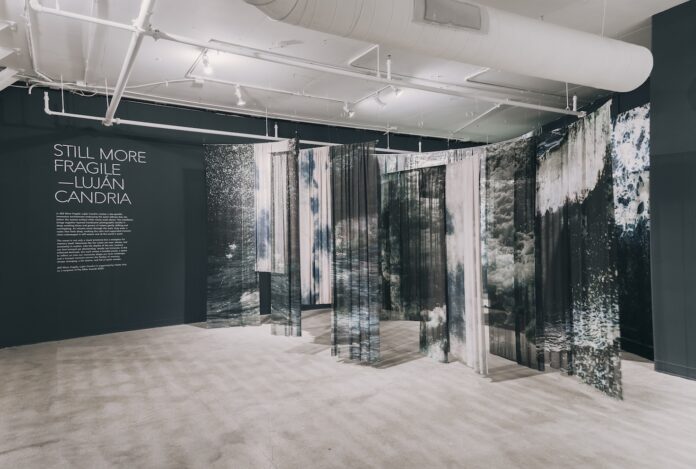
In Still More Fragile: Luján Candria - Faena Art Project Room
In Still More Fragile: Memory, Immersion, and the Unstable Image
In Still More Fragile, Luján Candria constructs a space that feels less like an artwork and more like a shift in perception—a quiet descent into a slower register where language begins to dissolve. What remains is not interpretation, but presence. You are not looking at the work; you are inside it.
Candria’s practice resists passive viewing. Layers drift, images refuse to settle, and the eye is forced to adjust. Seeing becomes physical—dependent on movement, proximity, and time. Nothing arrives fully formed.
Memory, here, is not something retrieved but something navigated. It behaves less like an archive and more like a landscape—unstable, layered, impossible to grasp from a single position. The ocean is not a metaphor so much as a structure: depth without clarity, movement without fixed meaning.
The work does not collapse into certainty. It holds its instability. Images shift. Meaning slips. What you see depends on how you move through it. This is not ambiguity as effect—it is ambiguity as condition.
Authorship loosens in the process. Memory is not owned; it is shaped—by time, by perception, by the present pressing against the past. Candria does not construct a narrative so much as create the conditions for one to emerge.
By the end, the distinction between landscape and interior life begins to erode. What appears external turns inward. What feels distant becomes intimate.
The work does not resolve. It lingers—somewhere between seeing and sensing, between memory and its disappearance.
AMM. In Still More Fragile, the viewer enters a suspended, almost pre-linguistic space beneath the surface. How do you understand this descent—as a phenomenological condition—and what kind of awareness becomes possible only in this state of immersion?
LC. I understand this descent as a shift in perception—from a more external way of seeing to a more embodied and internal experience. It’s less about going “beneath the surface” and more about entering a state where perception slows down and becomes less connected to language.
Rather than interpreting the work, the viewer inhabits it. It’s a space where boundaries soften, allowing for a more open and receptive way of paying attention.
For me, this immersion creates space for ambiguity, for silence, and for a kind of quiet recognition that cannot always be explained, but can be deeply felt.
AMM. The ocean in your work is not merely metaphor but a structure of thought. How do you conceive memory as a spatial system—one that can be navigated, inhabited, or even lost within—rather than simply recalled?
LC. I think of memory not as something linear or fixed, but as a kind of spatial field—something that can be entered, moved through, and experienced from multiple positions. In that sense, it’s closer to a landscape than to an archive.
The ocean becomes a way of thinking through this condition. It holds depth, movement, and opacity—there is no single point of access. Similarly, memory is not something we simply retrieve, but something we navigate. It shifts depending on where we stand, what we bring to it, and how we move within it.
In Still More Fragile, I try to create environments where this can be experienced. The viewer enters the image, moving through layers and fragments. This opens up new forms of perception, creating space for a different kind of engagement—one that is less about defining and more about experience.
AMM. Your installation destabilizes fixed perception through translucency, overlap, and movement. To what extent is the work proposing a critique of visual certainty, and how does it reposition the act of seeing as something unstable, contingent, and embodied?
LC. I don’t see the work as a critique of visual certainty, but as a reflection of how memory operates. Memory is never fixed or stable—it shifts, overlaps, and transforms over time. In that sense, the visual language of the installation—through translucency, layering, and movement—mirrors this condition.
The image is not presented as something definitive, but as something that is always in the process of becoming.
In this way, the act of seeing becomes unstable and embodied. Perception is shaped by movement, proximity, and time, rather than by a fixed point of view. The viewer does not observe from a distance, but navigates the work, and meaning emerges through that experience.
AMM. Your practice engages deeply with fragmentation, erasure, and recomposition of images. Do you see memory as an act of construction rather than retrieval—and if so, who or what is the “author” of that reconstruction?
LC. I understand memory as both an act of construction and a form of retrieval. It is not something we access intact, but something that is continuously shaped, reconfigured, and even partially invented over time. What we retrieve is always already transformed.
In that sense, there is no single author of memory. It emerges from an intersection between personal experience, time, and perception. What we remember is always influenced by our present condition—by what we feel, what we need, and how we position ourselves in relation to the past.
In my work, this understanding takes form through processes of fragmentation and recomposition.
AMM. In your work, the landscape seems to shift from an external environment to an internal condition. How do you negotiate the boundary between the seen world and the felt world, and where does identity situate itself within that threshold?
LC. I don’t see it as something that needs to be negotiated, but as a continuous condition. The boundary between the seen and the felt is constantly shifting.
Identity, for me, exists within that overlap. It is formed in relation to the landscape—through memory, experience, and a sense of belonging. The external and the internal are not separate, but intertwined.
The landscape is not only something we observe, but something we inhabit, carry, and continuously reconstruct.