Home Blog Page 157

Theo van Doesburg: La Vanguardia en la Intersección del Arte y la Filosofía

Theo van Doesburg
Theo van Doesburg

Theo van Doesburg: La Vanguardia en la Intersección del Arte y la Filosofía

Theo van Doesburg was a Dutch artist, who practiced painting, writing, poetry and architecture. He is best known as the founder and leader of De Stijl. He was married to artist, pianist and choreographer Nelly van Doesburg. Wikipedia

Born: August 30, 1883, Utrecht, Netherlands

Died: March 7, 1931 (age 47 years), Davos, Switzerland

Theo van Doesburg, figura clave en el movimiento De Stijl, desempeñó un papel fundamental en la difusión de ideas relacionadas con el constructivismo y el suprematismo en Europa. Inspirado por el trabajo de artistas como Kazimir Malévich y su búsqueda de la pureza abstracta, Van Doesburg abrazó la geometría y la abstracción como medios para alcanzar una expresión artística universal. Su revista “De Stijl” se convirtió en un crisol de ideas vanguardistas, donde no solo se exploraban las bases del neoplasticismo, sino también se debatían las conexiones entre el arte y la sociedad, anticipando temas centrales del constructivismo.

Aunque Van Doesburg compartió ciertas afinidades con el suprematismo y el constructivismo rusos, también se distinguió por su enfoque en la integración total de las artes y la arquitectura. Mientras que el suprematismo tendía hacia la abstracción pura y el constructivismo hacia la funcionalidad y la producción en masa, Van Doesburg abogaba por una síntesis más completa, donde el arte, la arquitectura y el diseño se fusionaran en una expresión coherente de la visión estética y social. Su legado influyó en movimientos posteriores como la Bauhaus, que adoptaron esta idea de la interdisciplinariedad como parte central de su filosofía creativa.

En el tumultuoso paisaje del arte del siglo XX, uno de los nombres que resuena con fuerza es el de Theo van Doesburg. Este holandés multifacético, nacido en 1883, se erigió como un titán en la vanguardia artística, contribuyendo no solo con su obra visual, sino también con sus ideas filosóficas que influyeron en movimientos artísticos como el De Stijl.

Van Doesburg, cuyo nombre original era Christian Emil Marie Küpper, cambió su nombre a un seudónimo que reflejaba su amor por la pintura y el diseño. Su trabajo abarcó diversas formas de arte, desde la pintura y la arquitectura hasta la poesía y el diseño gráfico. Pero fue su papel como líder intelectual y organizador que lo distinguió como una figura central en el panorama cultural de su tiempo.

El movimiento De Stijl, fundado por Van Doesburg en 1917 junto con artistas como Piet Mondrian, se destacó por su enfoque en la abstracción geométrica y la simplificación de formas y colores. Este movimiento buscaba la armonía universal a través de la reducción de la expresión artística a sus elementos básicos: líneas rectas, colores primarios y formas puras. Para Van Doesburg, el arte no era solo una cuestión de estética, sino una búsqueda de la verdad universal y la armonía cósmica.

Sin embargo, el legado de Van Doesburg trasciende su contribución artística. Su pensamiento filosófico, influenciado por movimientos como el neoplasticismo y el suprematismo, exploraba la relación entre el arte, la sociedad y la espiritualidad. Su revista, “De Stijl”, se convirtió en una plataforma para difundir estas ideas, sirviendo como un manifiesto para una nueva forma de ver y entender el arte y el mundo que lo rodeaba.

Pero el impacto de Van Doesburg no se limitó al ámbito artístico. Su visión de la interdisciplinariedad y la fusión de diferentes formas de arte y pensamiento prefiguró tendencias posteriores, desde el arte conceptual hasta la arquitectura moderna. Su experimentación con la teoría del color y la composición sentó las bases para desarrollos posteriores en el arte abstracto y la abstracción geométrica.

Además de su trabajo como artista y teórico, Van Doesburg fue un ferviente defensor del internacionalismo cultural, buscando trascender las fronteras nacionales y promover un diálogo global entre artistas y pensadores. Su influencia se extendió más allá de los límites de su país natal, llegando a impactar en movimientos artísticos en toda Europa y más allá.

En su corta pero intensa vida, Theo van Doesburg dejó un legado duradero que sigue resonando en el arte y la cultura contemporáneos. Su búsqueda de la armonía y la verdad a través del arte, su compromiso con la experimentación y la innovación, y su visión de un mundo unificado a través del intercambio cultural siguen inspirando a artistas y pensadores en todo el mundo. En la intersección del arte y la filosofía, Theo van Doesburg sigue siendo una figura ineludible, cuya influencia perdura en el tejido mismo de la creatividad humana.


El constructivismo y el suprematismo surgieron en paralelo en la Unión Soviética en 1915, aunque difieren significativamente en sus enfoques y objetivos artísticos. Mientras que el suprematismo desafía las convenciones artísticas tradicionales mediante la creación de imágenes visuales abstractas y geométricas, el constructivismo se centra en utilizar el arte como una herramienta para el beneficio colectivo de la sociedad, integrando la tecnología en su proceso creativo.

El movimiento De Stijl, fundado en los Países Bajos en 1917 por Theo van Doesburg, marcó una revolución en el arte y la arquitectura del siglo XX. Basado en el principio de la abstracción geométrica y la simplificación radical, De Stijl buscaba la armonía universal a través de la reducción de la expresión artística a sus elementos esenciales: líneas rectas, colores primarios y formas puras. Liderado por figuras como Piet Mondrian, el movimiento abogaba por una integración total de las artes, desde la pintura y la escultura hasta la arquitectura y el diseño, en una búsqueda de unidad estética y espiritual.

El legado de De Stijl trasciende el ámbito artístico, influyendo en la arquitectura moderna, el diseño gráfico y la teoría del color. Su enfoque en la simplicidad y la universalidad ha perdurado a lo largo del tiempo, inspirando a generaciones posteriores de artistas y diseñadores. A través de sus publicaciones y manifestos, De Stijl se convirtió en una plataforma para la difusión de ideas vanguardistas, promoviendo una visión utópica de un mundo transformado por el arte y el diseño.

El pensamiento filosófico de Theo van Doesburg estuvo intrínsecamente ligado a su trabajo artístico y su papel como líder del movimiento De Stijl. Van Doesburg abrazó una visión holística del arte, en la que buscaba trascender los límites convencionales del pensamiento estético para explorar la interconexión entre el arte, la sociedad y la espiritualidad.

En el corazón de su filosofía estaba la idea de que el arte no era simplemente una cuestión de expresión individual, sino una búsqueda de la verdad universal y la armonía cósmica. Inspirado por corrientes filosóficas como el neoplasticismo y el suprematismo, Van Doesburg creía en la capacidad del arte para comunicar conceptos abstractos y universales a través de la simplificación de formas y colores.

Para Van Doesburg, el arte no solo era una forma de expresión estética, sino también un medio para transformar la sociedad y la conciencia humana. Creía en la capacidad del arte para trascender las barreras culturales y lingüísticas, sirviendo como un lenguaje universal que podía unir a las personas más allá de las fronteras geográficas y políticas.

“De Stijl”

Su revista “De Stijl” se convirtió en un vehículo para la difusión de estas ideas filosóficas, sirviendo como un manifiesto para una nueva forma de ver y entender el arte y el mundo que lo rodeaba. A través de sus escritos y ensayos, Van Doesburg defendió una visión del arte como una fuerza transformadora y liberadora que tenía el poder de cambiar la forma en que percibimos y experimentamos la realidad. Su pensamiento filosófico influyó en la manera en que se concebía el arte en el siglo XX y sigue siendo relevante en el panorama cultural contemporáneo.

La revista “De Stijl” fue una publicación fundamental en la difusión y promoción del movimiento artístico del mismo nombre, De Stijl, fundado por Theo van Doesburg en los Países Bajos en 1917. Esta revista, que se publicó desde 1917 hasta 1932, sirvió como un crisol de ideas vanguardistas, reuniendo a artistas, arquitectos, diseñadores y teóricos comprometidos con los principios del neoplasticismo.

“De Stijl” no solo actuó como un órgano de difusión del movimiento, sino que también fue una plataforma para la discusión y el debate sobre las teorías estéticas y filosóficas que lo sustentaban. En sus páginas, los colaboradores y miembros del movimiento expresaban sus puntos de vista sobre temas como la abstracción geométrica, la integración de las artes y la relación entre el arte y la sociedad.

La revista presentaba obras de artistas prominentes como Piet Mondrian, Bart van der Leck, Gerrit Rietveld y, por supuesto, Theo van Doesburg, así como textos teóricos que explicaban los principios fundamentales del neoplasticismo. A través de sus ensayos, manifiestos y reseñas de exposiciones, “De Stijl” ayudó a definir y consolidar la identidad del movimiento, contribuyendo a su reconocimiento tanto en los Países Bajos como en el ámbito internacional.

La influencia de la revista “De Stijl” trascendió su período de publicación, dejando una marca indeleble en el arte, la arquitectura y el diseño del siglo XX. Su legado perdura en la actualidad, como testimonio del poder del arte para catalizar el cambio y la innovación en la sociedad.

Elementarismo Art Movement

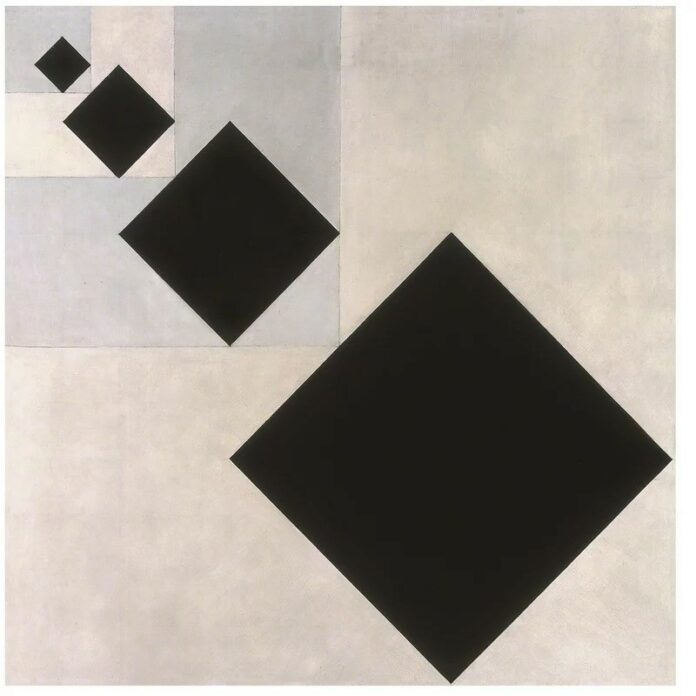
Elementarismo, un movimiento artístico iniciado en 1927 por Theo van Doesburg como reacción al Neoplasticismo, se presenta como una subcategoría de este último que enfatiza el arte geométrico con más energía y drama. El movimiento rechaza la noción de positivo y negativo, optando en cambio por utilizar la diagonal para construir. También rechaza el valor artificial del color a favor del contra-valor.

Van Doesburg introdujo las diagonales en sus pinturas en 1924, y denominó su nuevo enfoque “elementarismo”. En 1926, publicó un manifiesto explicándolo en De Stijl, anunciando la llegada del Elementarismo en los números de 1926-1927. El Elementarismo intenta modificar la naturaleza dogmática del Neoplasticismo al introducir la diagonal, que van Doesburg veía como una forma de dinamismo o “un estado de desarrollo continuo”. El Elementarismo se opone a la composición equilibrada del Neoplasticismo: una contra-composición no equilibrada como un fenómeno de tensión espacio-temporal del color, la línea o el plano, siempre en oposición a la estructura natural y arquitectónica. El Elementarismo excluye completamente la arquitectura como arte.

Related Movements & Topics

  • De Stijl
  • Constructivismo ruso
  • Neo-Plasticism
  • Concrete Art
  • Bauhaus
  • Suprematismo ruso
  • Elementarismo

Public Art

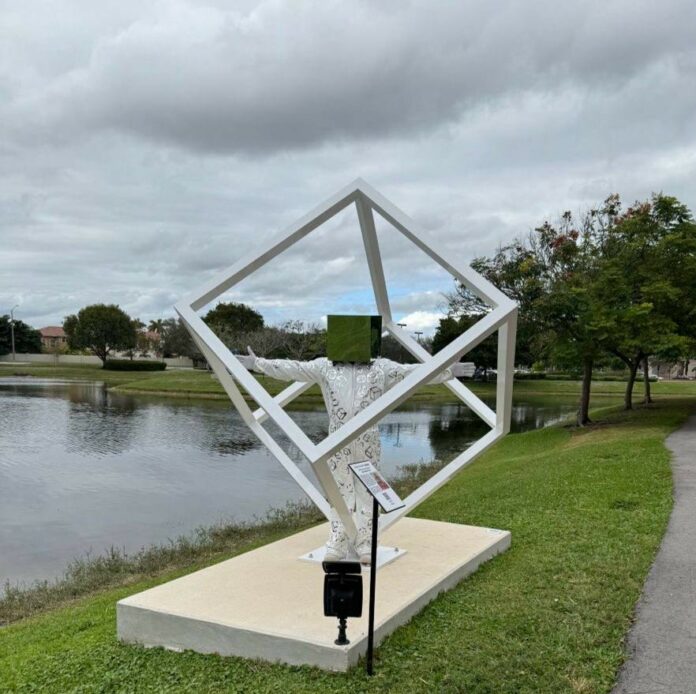
Public Art by Rafael Montilla, City of Miramar, FL

Art in public places

Public Art fosters cooperation and innovative artistic initiatives aimed at enhancing the aesthetic appeal of public areas.

What makes public art successful? Successful public art engages the community, reflects local culture and identity, and enhances the visual appeal and vibrancy of public spaces. It connects with people on an emotional level, sparking wonder, delight, or contemplation. Effective public art is site-specific, accessible, and adds functional or interactive elements that invite participation.

What are characteristics of public art? Key characteristics of public art include accessibility, community engagement, site-specificity, and a focus on placemaking. Public art is meant to be experienced by the general public in everyday settings, not confined to galleries. It often incorporates interactive elements, celebrates local history and culture, and transforms ordinary spaces into dynamic, engaging environments.

What is the positive impact of art? Art has tremendous power to enrich lives and communities. It can inspire creativity, foster empathy and social connection, preserve cultural heritage, and promote healing and well-being. Public art in particular beautifies shared spaces, attracts economic investment, and strengthens community pride and identity. The presence of art in public settings has been shown to reduce crime, improve mental health, and nurture a vibrant, thriving civic life.

What is the idea of public art? The core idea behind public art is to make art accessible to everyone, not just those who visit museums or galleries. Public art is integrated into the fabric of a community, transforming ordinary public spaces like plazas, parks, and streetscapes into lively, engaging environments. It is meant to be discovered serendipitously, sparking curiosity and wonder in passersby. The goal is to enhance the visual appeal and cultural vitality of shared spaces, fostering a sense of place and community identity.

What are the benefits of public art projects? Public art projects bring a host of benefits to communities. They can beautify public spaces, strengthen community identity and pride, attract economic investment, and enhance quality of life. Public art also promotes creative expression, builds civic engagement, and facilitates social connections. By making art accessible to all, public art projects nurture cultural participation and appreciation, with positive impacts on education, mental health, and community well-being.

How does public art benefit the economy? Public art has been shown to drive economic growth and revitalization in a number of ways. It can attract tourism, increase foot traffic and business activity, and spur real estate investment in an area. The presence of public art also enhances the overall visual appeal and “brand” of a city or neighborhood, making it a more desirable place to live, work, and visit. Additionally, the commissioning and installation of public artworks provides employment and economic opportunities for local artists and creative professionals. Overall, thoughtfully-integrated public art contributes significantly to a community’s economic vitality.

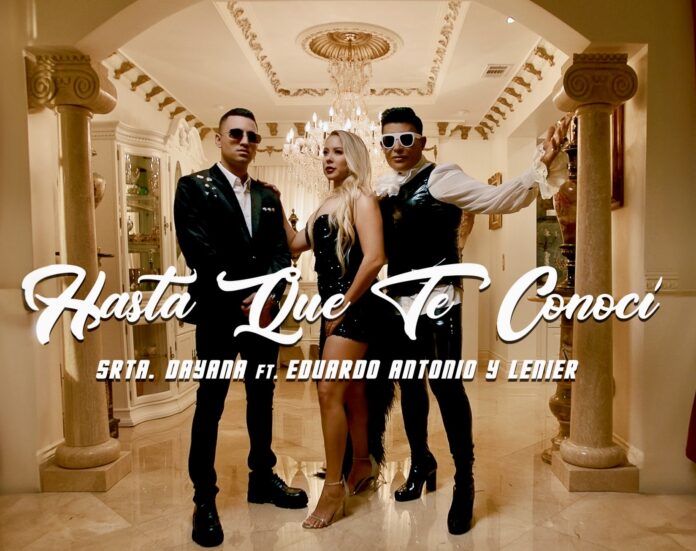
Srta. Dayana graba un tema de Juan Gabriel junto a Lenier y Eduardo Antonio

Dayana
Dayana

Srta. Dayana graba un tema de Juan Gabriel junto a Lenier y Eduardo Antonio

Srta. Dayana sorprende al mundo de la música con una espectacular versión de “Hasta que te conocí”, de Juan Gabriel, que interpreta junto a dos grandes amigos: Lenier y Eduardo Antonio. La famosa cantante y compositora cubana cuenta que este remix es producto de la admiración que siente por la obra de Juan Gabriel, y del afecto que la une a Lenier y Eduardo Antonio. “La idea surgió de casualidad en una ocasión en que nos reunimos los tres; de repente surgió la idea de hacer la grabación y todo fluyó de maravillas”, contó la artista. “Es una linda experiencia estar al lado de talentosos y carismáticos cantantes como Lenier y Eduardo Antonio”, agregó. Srta. Dayana asegura que esta versión de “Hasta que te conocí” fue hecha “con amor”. La producción musical corrió por cuenta de Frank Palacios (“Frank el que todo lo puede”) y Jordany Gonzalez Mora (J-Pro). El correspondiente videoclip fue realizado por Wilber Mateu. Dayana tiene otras exitosas colaboraciones en su haber, en especial las que hizo con Alvaro Torres, una versión de “Te va a doler”; con El Chacal, “Si piensas, si quieres”, que cuenta con ocho millones de visualizaciones en Youtube; y precisamente con Eduardo Antonio, con quien interpretó “Amor y guerra”. Dayana Chávez Victoria, conocida en el ámbito musical como “Srta. Dayana”, es una artista cubana que goza de gran popularidad y muy querida en la comunidad cubana y latina en general de Miami y Estados Unidos. En su juventud cursó estudios en la Escuela Nacional de Arte, en La Habana, donde se graduó de bailarina de Espectáculos Musicales. Se formó como cantante años más tarde, en academias de canto. Incursionó en sus inicios en varios géneros musicales como la música tradicional cubana y el pop, aunque más tarde definió su carrera más en el género urbano. 

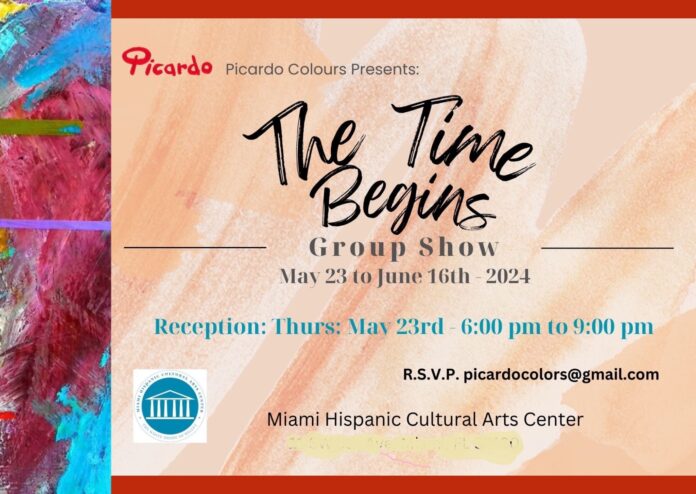
THE TIME BEGINS – Group Show

"The Time Begins": A Group Exhibition Exploring Time, Memory, and Perception

THE TIME BEGINS – Group Show

Picardo Colours LLC is thrilled to announce, “The Time Begins,” a vibrant group
show open to the public. Join us for an evening of artistic exploration, live
performances, and delightful refreshments.
The opening reception will take place on May 23rd from 6:00 pm to 9:00 pm at the
Miami Hispanic Cultural Center located at 111 SW 5th Ave, Miami, FL 33130. This
event promises to be an immersive experience, showcasing the diverse talents of
local and international artists.
We invite art enthusiasts and the community to join us for an unforgettable
celebration of creativity and culture, from captivating performances to thought-
provoking visual art, ‘The Time Begins’ promises to inspire and engage audiences
of all ages.
Don’t miss this opportunity to immerse yourself in a world of creativity and
expression. Admission is free, and all are welcome to attend. For more information,
please contact:
Picardo – Afro Caribbean Artist: – 616 881 5971 – [email protected]
About Miami Hispanic Cultural Center: The Miami Hispanic Cultural Center is
dedicated to promoting Hispanic heritage and artistic expression in the vibrant city
of Miami. Through exhibitions, performances, and educational programs, the
center fosters a deeper appreciation for Hispanic culture and its contributions to
the arts.
Please RSVP to confirm your attendance at the opening reception. *Note to Editors:
High-resolution images and additional press materials are available upon request

Las miradas del pensamiento de Alexander Martínez

Las miradas del pensamiento de Alexander Martínez

Las miradas del pensamiento de Alexander Martínez

Alexander Martínez es un artista visual venezolano residenciado en Nueva York, quien cuenta con una amplia trayectoria artística, la cual inicia con sus estudios académicos en 1988, año en el que comienza con los talleres libres de Dibujo y Pintura en la Escuela de Artes Visuales Cristóbal Rojas, en Caracas, institución de la que egresa en 1993 en la especialidad de Arte Puro. Desde entonces, Martínez ha realizado un gran número de exposiciones individuales y colectivas en diferentes museos y galerías de países como Venezuela, Bolivia, Colombia, Líbano, Canadá, Estados Unidos y Suiza. Su obra, además, forma parte de importantes colecciones públicas y privadas, tanto venezolanas como internacionales. 

Las miradas del pensamiento de Alexander Martínez

Continuando con su constante actividad expositiva, ahora tenemos la oportunidad de apreciar su producción más reciente en los espacios del William V. Musto Cultural Center, en Nueva Jersey, lugar en donde, desde el 13 de abril, presenta un grupo de 12 obras en las que trabaja la pintura, el dibujo y la instalación, cuya lectura está organizada bajo el título de Miradas del pensamiento

El proceso de conceptualización y ejecución de la obra de Martínez, responde a las experiencias que vive y percibe, con la totalidad de sus sentidos, de los acontecimientos que transcurren en la cotidianidad urbana y otros escenarios del mundo, vivencias que encauza hacia su universo interior, ámbito desde el que procesa y transmuta la realidad externa, despojándola de realismo, de sus rasgos objetivos, propios de la realidad real, para entregarnos un discurso visual contentivo de imágenes cargadas de subjetividad, de emociones y sentimientos, de inventiva e imaginación, producto de las miradas de su pensamiento interior.

En su búsqueda y formación como artista, Martínez ha estudiado movimientos tales como el expresionismo, el cubismo y el surrealismo, de quienes ha sabido aprovechar algunos principios estéticos, los cuales ha replanteado, reinterpretado y aplicado en su discurso visual, según sus intereses artísticos, aunque lo expresionista ha sido un componente preponderante en casi toda su producción. Sus obras transmiten emociones y sentimientos marcados por la angustia existencial, la soledad, la enajenación, el exilio y las pasiones humanas.  

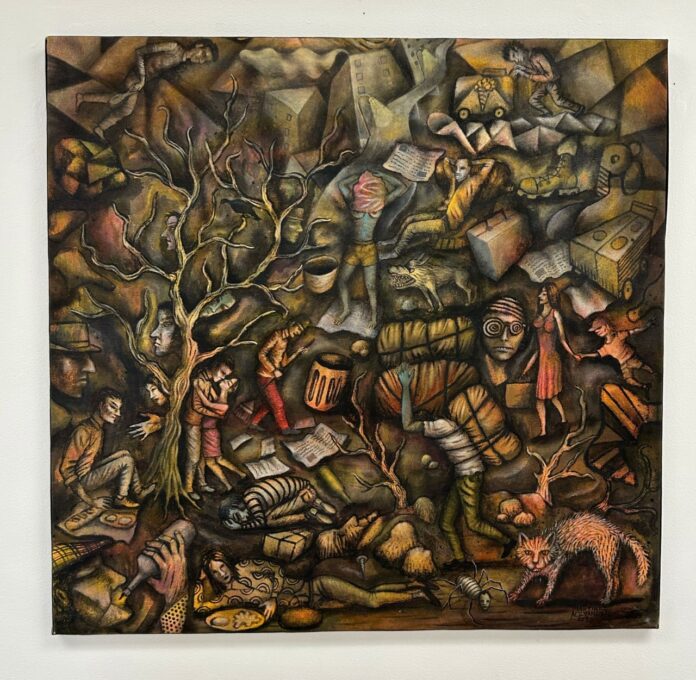
En sus composiciones observamos figuras, rostros y formas exageradas, distorsionadas, grotescas, retorcidas, mordaces, fragmentadas, aspectos que él subraya mediante el tratamiento de la línea irregular, sinuosa, de la mancha gestual, espontánea. Otras características en su obra son lo abigarrado, lo laberíntico, lo caótico, dispuestos en toda la superficie del soporte en el que se despliegan detalles de acontecimientos urbanos y de otros territorios del mundo, orientados de manera simultánea, entretejida, yuxtapuesta y/o superpuesta. 

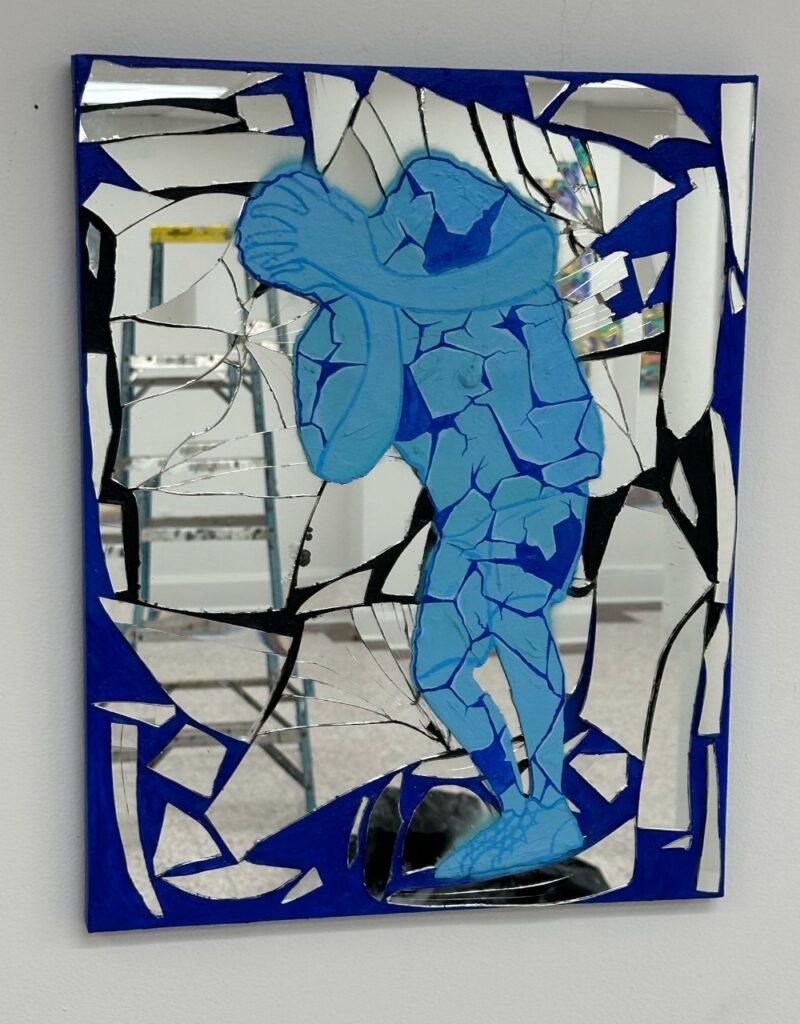
Vale acotar que en esta exposición nos encontramos con propuestas visuales en las que Martínez incorpora elementos extrapictóricos, objetos encontrados, como pedazos de vidrio, por ejemplo, material que agrega en algunas de sus composiciones para aludir a la ira, en las que, aparte de la figura representada, se refleja la imagen del espectador de manera fragmentada, interesante este efecto que induce a la reflexión, además. Otra obra atractiva es la instalación con luz, en la que el artista hace uso de materiales aprovechables, que reincorpora en ella para crear una metáfora visual con la que se propone hacer una ofrenda al agua, recurso vital que se agota por el acelerado crecimiento demográfico y el cambio climático, propuesta que, de igual modo, nos ilumina, nos llama a la reflexión.

«Para ver claro, basta con cambiar la dirección de la mirada», como dice el escritor francés Antoine de Saint-Exupery. Efectivamente, eso es lo que hace Alexander Martínez después de ver y vivir la cotidianidad urbana y de otros ámbitos del mundo: dirigir la mirada de su pensamiento hacia su mundo interior, para luego entregarnos un repertorio de imágenes transfiguradas, con el objeto de activar nuestro pensamiento reflexivo y crítico.  

José Gregorio Noroño

Curador y crítico de arte

“unCLASSICAL: Miami Vibes,”

Soleil River Nation i

MIAMI MUSIC PROJECT PREPARES ALL-STAR CONCERT FEATURING GRAMMY NOMINATED SIMONE TORRES, UNIVISION MULTIMEDIA TALENT VICKY VAN EERDEWIJK, AND TRAVEL TV PERSONALITY AUGUSTO VALVERDE

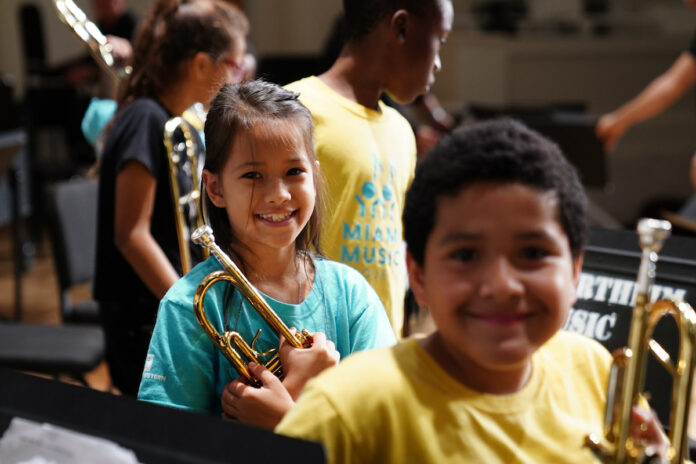
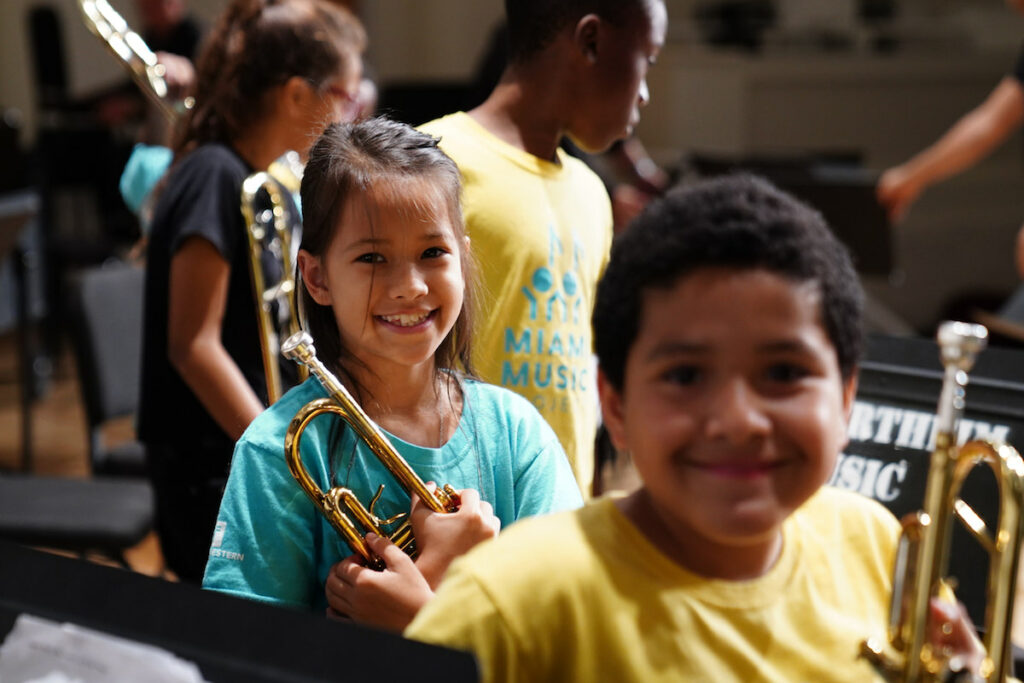
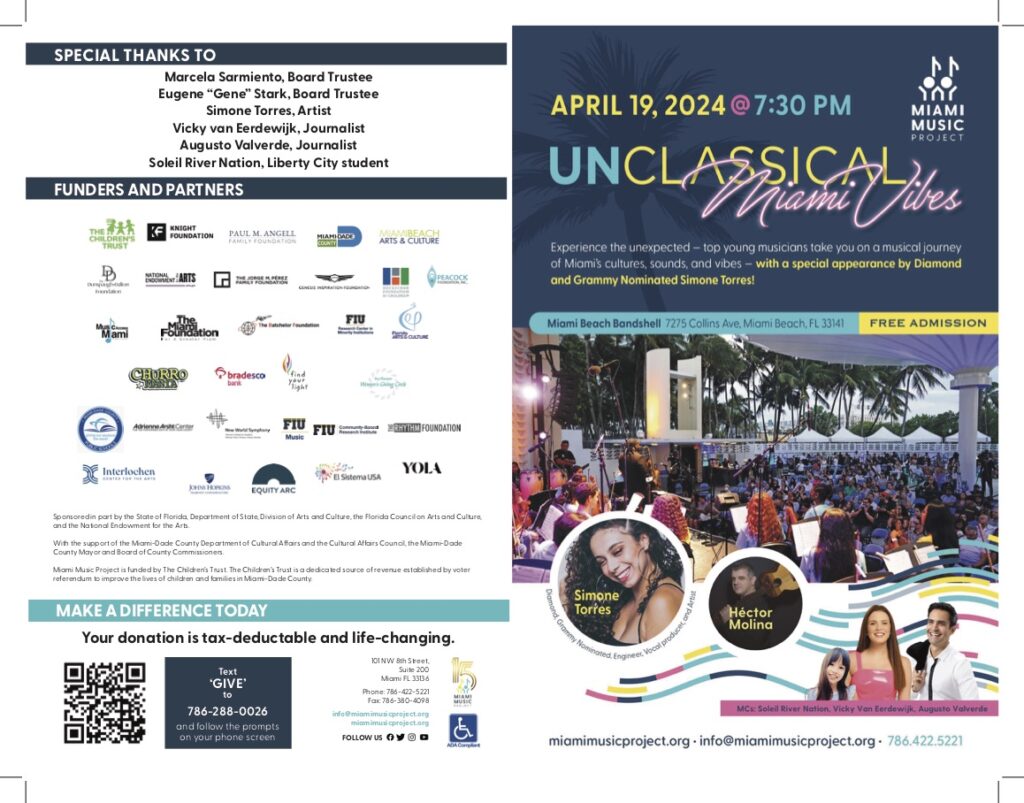
Miami Music Project proudly announces “unCLASSICAL: Miami Vibes,” a cultural event celebrating Miami life and diverse culture on Friday, April 19, at 7:30 p.m. at the iconic Miami Beach Bandshell, located at 7275 Collins Ave, Miami Beach, FL 33141. This year, the Miami Music Project has upscaled its celebrity collaborations, featuring Grammy-nominated artist Simone Torres and award-winning media personalities Vicky van Eerdewijk and Augusto Valverde as Masters of Ceremony. The concert aims to welcome the public to celebrate the Miami community at large, as well as push the boundaries of Miami Music Project children’s imaginaries, boosting their sense of belonging and potential for achievement. In the words of President Anna Klimala: 

“The Miami Music Project carefully curates concert venues that help Miami’s youth feel they can achieve their dreams. The Miami Beach Bandshell, in particular, is an iconic landmark and a crucial piece of Miami’s social infrastructure. Reaching that stage resignifies Miami youth’s bond to its culture since they are no longer just born into it but also aware that they can contribute to it and shape it actively. The additional exposure to renowned artists and media professionals shows students what happens when a young promise becomes fulfilled.”

Simone Torres is a Diamond, Latin Grammy-nominated engineer, vocal producer, and artist from New York. She has worked with artists such as Becky G, Chlöe Bailey, Normani, Anitta, Cardi B, Camila Cabello, Monsta X, Jessie J, Billy Porter, The Backstreet Boys, Dua Lipa, and more. Some of her most notable vocal productions include Becky G’s “Coming Your Way” and “La Nena,” Normani’s “Motivation,” and Engineering Cardi B’s “I Like It” and “Be Careful.” In 2023, she was honored by the Latin Recording Academy as one of their Leading Ladies of Entertainment. This year marks Simone’s debut as a solo artist, premiering her first single, “Bent,” in February. Her music is a blend of Soul and Rnb, among other influences. 

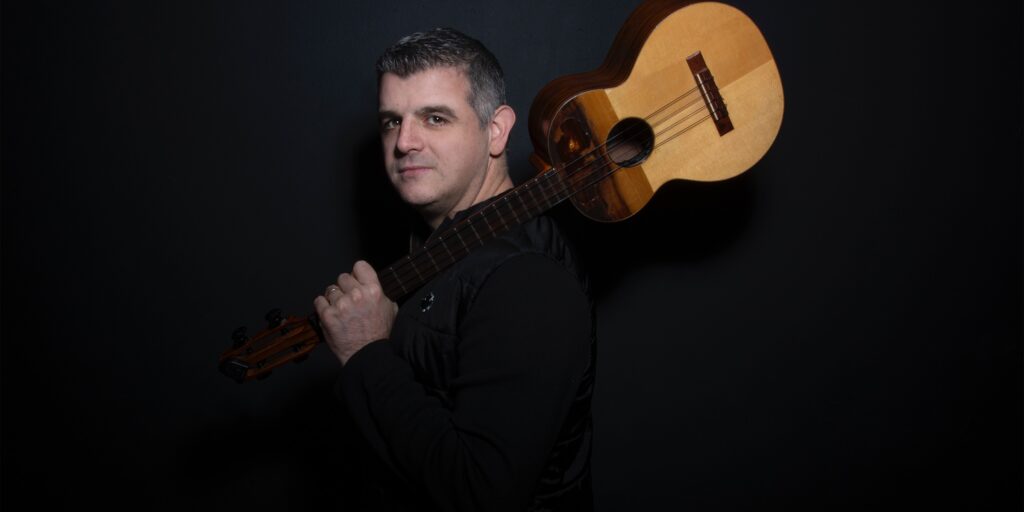
Venezuelan composer, cuatro, and guitar player Hector Molina is known for his participation in the “C4 Trío” (2005) along with Jorge Glem, Edward Ramirez, and Rodner Padilla. With C4 Trío, he has recorded six albums and a DVD. He has been nominated five times for the Latin Grammys and has won two: in 2014 as “Best Recording Engineering for an Album” for the album “De Repente” and in 2019 as “Best Folkloric Album” for “Tiempo al Tiempo.” Also, with “C4 Trío,” he has been nominated twice for the Grammy Awards, in 2018 with the album “Pa Fuera” and in 2020 with “Tiempo al Tiempo.” With “C4 Trío,” he maintains an intense concert schedule in the most important theaters and festivals in North, Central, South America, and Europe. In 2018, Héctor released his first solo album called “Giros,” in collaboration with some of the most renowned Venezuelan musicians and where he showcased more of his role as a composer.

Vicky Van Eerdewijk, an on-air talent for Univision, co-hosts the morning radio show El Flow in Miami, Houston, Dallas, Chicago, Phoenix, and San Franciso and, in the evenings, reports for the network show Primer Impacto. She also conducts artist interviews, presents Uforia live concerts, and covers Univision’s top award shows and red carpets. 

Born in Miami, Augusto Valverde is an actor, executive producer, and creator of the Travel TV Show Global Child: Travel & Purpose, aired on Peacock, VIZIO, and 15 other platforms, including major airlines worldwide. He founded SWAY Magazine and served as its chief editor. He also worked as an event promoter for Telemundo. He hosted “La Tijera” on Telefutura. As an actor, Augusto received training in California under Howard Fine, practicing improv at the renowned Groundlings. He holds a certificate in Feature Film writing from UCLA. 

Soleil River Nation is a 10-year-old student at the Miami Music Project, studying trumpet at Liberty City. Originally from Manila, Philippines, she has resided in Miami Beach, FL, since 2022. In 2023, Soleil River Nation earned the Miami Music Project “Student of the Year” award. In 2024, Soleil initiated her solo career as a child vocalist, releasing her debut single, “Small Girl in a Big World.”

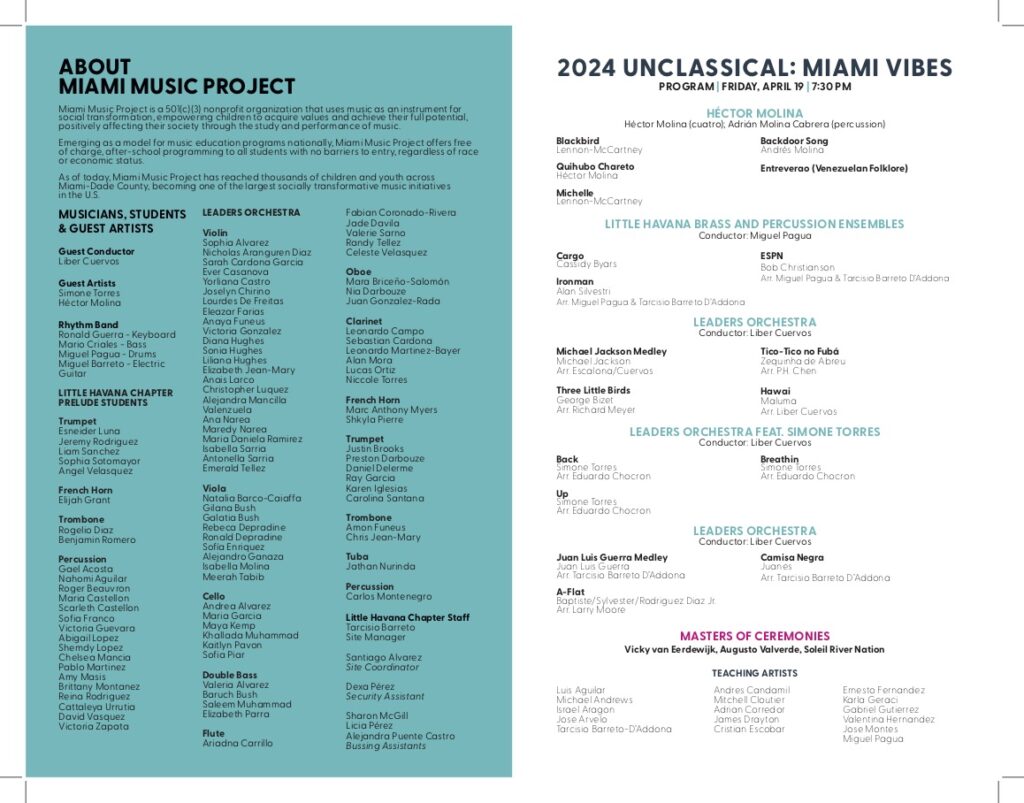
The Little Havana Chapter Prelude Students and Leaders’ Orchestra will perform arrangements of works by Simone Torres, Maluma, Juanes, Juan Luis Guerra, Marc Anthony, Kool & the Gang, and others at the concert. Young performers will be joined by guest artists Simone Torres and Héctor Molina, and the Rhythm Band composed of Ronald Guerra, Mario Criales, Miguel Pagua, Miguel Barreto, and Edival Daniz, under musical conductor Liber Cuervos. The concert is open to the public and free of charge. 

About Miami Music Project

Miami Music Project is a 501(c)(3) nonprofit organization that uses music as an instrument for social transformation, empowering children to acquire values and achieve their full potential, positively affecting their society through the study and performance of music. Miami Music Project’s vision is to create opportunity and access through music for those most in need, improve the quality of life for children today, and ultimately transform their lives, the lives of their families, and their communities. Emerging as a model for music education programs nationally, Miami Music Project offers free-of-charge, after-school programming to all students with no barriers to entry, regardless of race or economic status. As of today, the Miami Music Project has reached over 30,000 children and youth across Miami-Dade County, becoming one of the largest socially transformative music initiatives in the US. Miami Music Project’s programming is inspired by the El Sistema phenomenon – a new model for social change and a visionary global movement that transforms the lives of children through music.

El pianista argentino Horacio Lavandera se presentará en Miami el 7 de mayo

Horacio Lavandera
Horacio Lavandera

El pianista argentino Horacio Lavandera se presentará en Miami el 7 de mayo

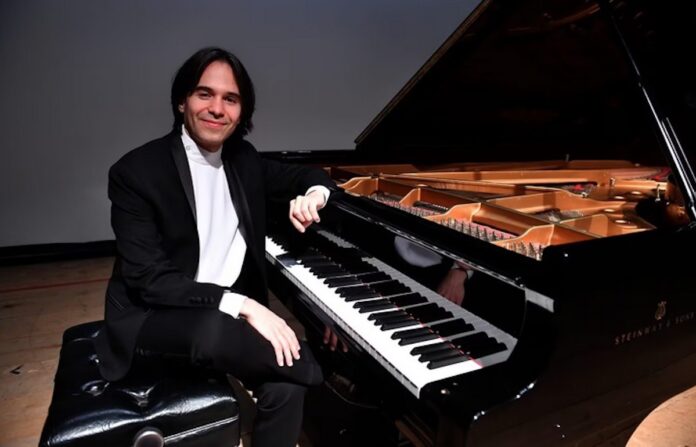
El pianista de música clásica argentino Horacio Lavandera actuará por primera vez en Miami, como parte de una gira a piano solo por Estados Unidos que también lo llevará a tocar en el mítico Carnegie Hall, de Nueva York. El virtuoso instrumentista sudamericano estará el martes 7 de mayo, a las 8 pm, en la sala Newman Recital Hall, de la Universidad de Miami, en Coral Gables. Los boletos para esa función ya están a la venta en www.passline.com Tanto en Miami como en el Carnegie Hall y en Minnesota -estado en el que tendrá dos funciones-, Lavandera ejecutará un repertorio ecléctico con obras de Mozart, Beethoven y Mendelssohn, así como del estadounidense George Gershwin y del compositor contemporáneo argentino y maestro bandoneonista Dino Saluzzi. “Estoy muy entusiasmado ante esta serie de presentaciones porque, como verán, voy a interpretar a grandes autores de la música clásica alemana, pero también a dos compositores paradigmáticos de Argentina y de Estados Unidos como son Saluzzi y Gershwin”, manifestó el joven maestro, que también es productor y director. En consonancia, el pianista prosiguió: “Mi idea es conectar a Argentina y Estados Unidos a través de mi piano, instrumento cuya presencia en el desarrollo cultural de ambas sociedades fue fundamental”. A propósito de anteriores presentaciones en suelo estadounidense, la prensa especializada local lo ha elogiado. “Así como Wynton Marsalis representa el jazz en Estados Unidos, Lavandera representa la música clásica en Argentina”, escribió Keith Widyolar, de New York Latin Culture Magazine. El USA Tour de Lavandera tiene el siguiente itinerario: viernes 3 de mayo, Co-Cathedral de St. John the Evangelist, en Rochester (Minnesota); domingo 5 de mayo, St. Martin’s Lutheran Church and School, de Winona (Minnesota); martes 7 de mayo, Newman Recital Hall, de Miami; y viernes 10 de mayo, Carnegie Hall.

Celines Toribio, “La Novia del Atlántico”Celines Toribio

Celines Toribio debuta como directora de cine con “La Novia Del Atlántico”

La reconocida actriz y comunicadora Celines Toribio debuta como directora de cine con la película “La Novia del Atlántico”.

El actor español Iván Sánchez y Celines Toribio junto a Sandy Hernández y Cheddy García se encuentran grabando en República Dominicana una historia que celebra la fuerza y superación de las mujeres.

La vibrante costa de República Dominicana sirve como el escenario perfecto para el rodaje de “La Novia del Atlántico“, la película dirigida por la talentosa actriz y comunicadora Celines Toribio, quien por primera vez hace su incursión como directora de cine, con una narrativa conmovedora que celebra la fuerza y la resiliencia de las mujeres. Esta película no solo marca su debut como directora, sino que también representa un poderoso mensaje de apoyo con las mujeres.

La película, cuyo guión aborda temas como la superación personal, la solidaridad femenina y la lucha contra los estereotipos sociales, sigue la historia de tres mujeres en una isla caribeña que unen fuerzas para rescatar a una de ellas atrapada en una relación destructiva, y para lograrlo cuentan con un hombre extranjero quien representa la unión de ideales y géneros.

“La Novia del Atlántico” es protagonizada por el reconocido actor español Iván Sánchez, Celines Toribio, Sandy Hernández y Cheddy García quienes se encuentran grabando en República Dominicana, dan vida a los personajes principales, aportando su talento y experiencia a esta historia inspiradora sobre coraje y superación.

Le doy gracias a Dios de que tal y como lo soñé hace años, me concediera el deseo de que mi primera dirección en cine, sea una película que celebra la fuerza de las mujeres. Representa un poderoso mensaje de apoyo y solidaridad con ellas como lo he hecho a lo largo de mis 30 años en los medios. Esta historia la hacemos con mucho respeto para todas las mujeres de mi país y el mundo” afirmó Celines.

Este proyecto cuenta con un equipo 90% femenino, marcando un hito en la industria cinematográfica. La película se convierte en un símbolo de comunicación y solidaridad femenina, un paso crucial hacia el empoderamiento de sus protagonistas. “Que mejor manera que contar esta valiente historia que con una óptica femenina, no solo delante de las cámaras sino detrás. Me acompaña un equipo extraordinario, quienes captan muy bien el mensaje que queremos transmitir con este filme. Esta es una película hecha por mujeres y de mujeres” comentó la cineasta.

La Novia del Atlántico” no solo es un tributo a la valentía individual, sino también un recordatorio del poder de la unión en la lucha contra la adversidad.

Frederick Harris, MIT

Frederick Harris, MIT

Frederick Harris,Jr.
Director,Senior Lecturer
Performance
MUSIC

MIT

Every time we gather to make music we have the opportunity to connect and grow. We expand our humanity by expressing our feelings through sound, silence, and space.” 

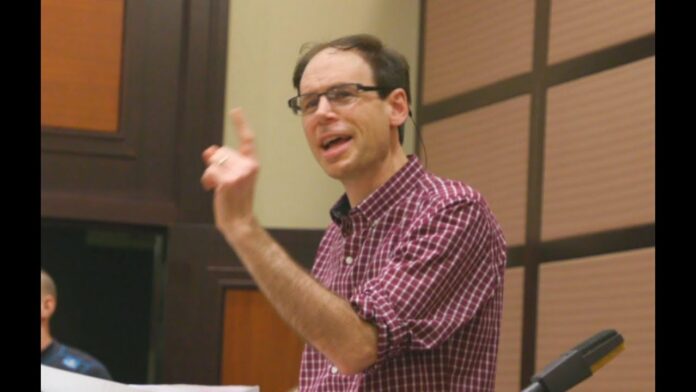
Dr. Frederick Harris, Jr. is the Director of Wind and Jazz Ensembles at MIT, where he serves as Music Director of the MIT Wind Ensemble, MIT Festival Jazz Ensemble, and Jazz Coordinator, overseeing jazz chamber music programs including three combos, MIT Vocal Jazz Ensemble, and the Emerson Jazz Scholars Program. Harris is also the creator and director of It Must Be Now!, a project creating music and visual art on themes of racial justice. He is also leading a project combing Brazilian music and environmental research, focused on the Amazon rainforest.

Harris has been highly active with public school students and music educators throughout his career, leading seminars, guest conducting, and coordinating enrichment events at MIT and beyond. Nominated by his students, Harris is a 2013 and 2019 recipient of the James A. and Ruth Levitan Award for Excellence in Teaching in the School of Humanities, Arts, and Social Sciences at MIT.

He is the author of Conducting with Feeling and Seeking the Infinite: The Musical Life of Stanisław Skrowaczewski, and currently he is writing a biography of Herb Pomeroy. He has published articles/book chapters related to conducting, jazz, and wind ensemble performance.

He and the MIT Wind Ensemble have been featured on NPR and PBS in the 2014 Emmy-winning documentary Awakening: Evoking the Arab Spring through Music, with music by Jamshied Sharifi. Harris and his students also are featured in the 2018 Emmy-winning documentary Imagination Off The Charts: Jacob Collier Comes to MIT, and the Emmy-nominated documentary The Great Clarinet Summit.

He is a strong advocate for the creation and performance of new music, having commissioned and/or premiered 105 works for wind, jazz, and mixed ensembles, recently leading pieces by John Harbison,Jamshied Sharifi, Chick Corea, Don Byron, Jacob Collier, and Miguel Zenón. Renowned artists with whom MITWE and MIT FJE have worked include Kenneth Amis, Frank Battisti, Ran Blake, Don Byron, Peter Child, Jacob Collier, Chris Cheek, Anat Cohen, Michael Colgrass, Chick Corea, Braxton Cook, Terri Lyne Carrington, Dominique Eade, George Garzone, John Harbison, Mark Harvey, Sean Jones, Guillermo Klein, Joe Lovano, Stephen Massey, Bill McHenry, Herb Pomeroy, Gunther Schuller, George Schuller, Jamshied Sharifi, Luciana Souza, Judi Silvano, Magali Souriau, Stever Turre, Kenny Werner, Warren Wolf, Miguel Zenón, and Evan Ziporyn.

The joint MIT Wind Ensemble and MIT Festival Jazz Ensemble recording Infinite Windson Sunnyside Records, was awarded the highest rating by Down beat magazine (5 stars), and was chosen as one of Down beat magazine’s “Best Albums of 2015: Masterpieces.” Both of these honors are firsts in MIT’s history. It is extremely rare that student ensembles are mentioned in Down beat’s highly selective “best of the year” list. The Boston Globe called Infinite Winds “one of the most compelling CDs of the year.” Other recordings by the MIT Wind Ensemble include Waking Winds(2004), published by Innova Recordings of the American Composers, and Solo Eclipse(2008), published by Albany Records. Both CDs feature premiere recordings by composers Schuller, Child, Ziporyn, Klein, and Amis. Dr. Harris conducted Kenny Werner’s No Beginning, No End(2010)—originally premiered by MITWE—in New York City for Half Note Records.

Throughout its 22-year history, MITWE has collaborated with elementary, middle and high school students throughout Massachusetts. It has collaborated extensively with many of MIT’s ensembles and faculty members. In March of 2019, MITWE embarked on its first tour, spending a week in the Dominican Republic, presenting four concerts,including a performance with clarinetist Anat Cohen, many STEM presentations for middle, high school and college students, and leading music workshops. In January of 2019 the MIT Festival Jazz Ensemble participated in a cultural exchange, touring Puerto Rico with Miguel Zenón, presenting concerts in various venues and also STEM workshops in middle and high schools.

Harris has served as acting music director of the MIT Symphony Orchestra, assistant conductor of the Boston University Tanglewood Institute Young Artists Wind Ensemble, music director of the Summer Music Festival at the South Shore Conservatory, conductor of the Concerto Grosso Orchestra at the University of Minnesota, and he has guest conducted the New Hampshire Philharmonic and the Chamber Music Society of Minnesota, and for numerous wind and jazz festivals for the Massachusetts, New Hampshire, and Maine Music Educators Association.

He also has appeared on Minnesota Public Radio’s All Things Considered and other MPR programs. In 2015 he produced and premiered a 30-minute documentary film Seeking the Infinite: Stanislaw Skrowaczewski—A Life in Music, at Orchestra Hall, Minneapolis, Minnesota. Over 600 people viewed the film and it was reviewed as “essentially viewing” by Minnesota Public Radio. Dr. Harris organized a commission consortium involving three composers and 40 universities/schools honoring the 85th birthday of legendary wind conductor Frank Battisti. The project is sponsored by the American Composers Forum. He has lectured on music in Canada and at many New England universities, as well as for the Minnesota Orchestra and the Deutsche Radio Philharmonie Saarbrücken.

Harris has performed as a drummer with the Aardvark Jazz Orchestra, John Harbison, the Boston Pops, Kenny Werner,and Grammy-winning jazz saxophonist Joe Lovano. He studied jazz drums with Alan Dawson and classical percussion with Arthur Press, former principal percussionist with the Boston Symphony Orchestra. As a classical percussionist he has performed with wind ensembles, orchestras, and chamber ensembles throughout New England.

His conducting teachers included Stephen Massey, Frank Battisti, Gunther Schuller, Stanisław Skrowaczewski, and Craig Kirchhoff. His degrees are from New England Conservatory, Boston Conservatory, and the University of Minnesota.

Harris was awarded the 2010 Paul Smith Hall of Fame Award from the Massachusetts Instrumental and Choral Conductors Association. The award is presented annually “to a Massachusetts music conductor who is a musical and personal inspiration to students, the community, and other professional conductors.

Education

B.M. in Music Education/Percussion, Boston Conservatory; M.M. in Conducting, New England Conservatory; Ph.D. in Music Education/Conducting, University of Minnesota. Principal teachers: Frank Battisti, Gunther Schuller, Stanisław Skrowaczewski, Alan Dawson, and Arthur Press.

Bio

Dr. Frederick Harris Jr. has been highly active with public school students and music educators throughout his career, leading seminars, guest conducting, and coordinating enrichment events. He is the author of Conducting with Feeling, and Seeking the Infinite: The Musical Life of Stanisław Skrowaczewski. He currently serves as Music Director of the MIT Wind Ensemble and MIT Festival Jazz Ensemble, and as MIT’s Jazz Performance Studies Coordinator. He and the MIT Wind Ensemble have been featured on NPR, PBS, and in two New England Emmy-winning documentaries. Dr. Harris has commissioned and premiered over 120 works by composers such as Don Byron, Chick Corea, John Harbison, Jamshied Sharifi, and Miguel Zenón. His ensembles have collaborated with leading artists such as Terri Lyne Carrington, Anat Cohen, Jacob Collier, Sean Jones, Guillermo Klein, and Luciana Souza. He has also performed as a jazz drummer with Joe Lovano, Kenny Werner, and the Boston Pops. 

Dr. Harris is the creator and director of It Must Be Now!, an initiative at MIT focused on advancing social justice actions through music and media, and Hearing Amazônia–The Responsibility of Existence, an MIT project combining Brazilian music influenced by the natural world and sustainability solutions, drawing attention to the urgency of the climate crisis.

Louis M. Glackens: Pure Imagination

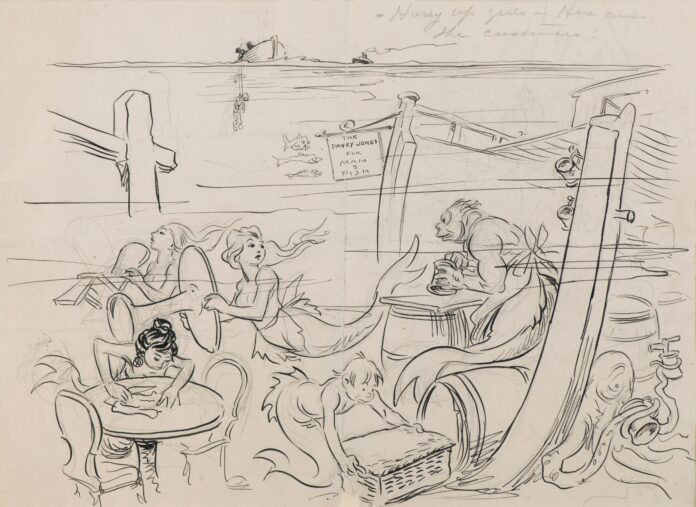
Louis Glackens, Hurry up Girls - Here comes the customers , n.d. Pencil, pen and ink on paper, NSU Art Museum Fort Lauderdale, William Glackens Collection, 92.132

NSU Art Museum Fort Lauderdale Announces New Exhibition: Louis M. Glackens: Pure Imagination On view from April 14 to March 30, 2025, the show glances into the life and
work of artist Louis M. Glackens
.

Beginning April 14th, NSU Art Museum Fort Lauderdale will present Louis M. Glackens: Pure Imagination, an insider’s look into the life and work of artist Louis M. Glackens (b.1866, Philadelphia, PA, d. 1933, Jersey City, NJ). Louis Glackens was a trailblazing figure who became one of the first illustrators of animated cartoons from 1915-1920, creating characters for production houses such as Bray and Pathé Studios. His fantastical depictions of mermaids, anthropomorphic beasts and pie-faced grown-ups carved a path for what would become the wonderful world of Walt Disney. Regrettably, Louis Glackens was out of step with the fashion of his time and bore the curse of the avant-garde. As such, his vast contribution to the history of cartoons has remained largely unexplored. Louis M. Glackens: Pure Imagination is sponsored by The Sansom Foundation, Inc.

Until now, he has been relegated aside within the narrative of his younger brother, Ashcan School artist William J. Glackens. While both brothers “drew in the cradle,” a compulsion that stayed with them throughout their lives, it seems that Louis Glackens had the misfortune of being “born too soon.”

Like his brother William, Louis Glackens had a discerning eye through which he observed the human condition. However, while his brother was rooted in the realism of the Ashcan School, Louis Glackens chose to deliver his take on reality through a more fable-like world, in which the absurdity of life was captured through an economy of line and an abundance of wit.

For over 20 years, Louis Glackens served as a staff artist for the weekly magazine Puck, the first widely disseminated political humor periodical in the United States. The artist was prolific in creating his satirical scenes, doused in acerbic wit, combining his childlike fantasies with a hearty dose of jaded cynicism.

A Puck magazine cover from April 1912 is illustrative of this attitude. Set within a quaint, pastoral scene is a little cottage with a charming front yard, tended to by a matronly woman wearing a striped frilly dress and sunbonnet. Upon closer inspection, it appears that the woman has a hook mustache and looks an awful lot like the 27th President William Howard Taft. The President is wielding a watering can, emblazoned with the word “PATRONAGE”, which he pours over a bed of flowers, blossoming with the heads of gentlemen in top hats. This rare breed of flower is called, “DELEGATES: HARDY QUADRENNIAL”. Below the cartoon is a caption reading, “THE FLOWERS THAT BLOOM IN SPRING, TRA-LA!”, a satirical nod to Gilbert & Sullivan’s operetta, The Mikado (1885). Glackens’ commentary on Taft’s ill-fated run for re-election and his quid-pro-quo exchange with future President Harding and his cronies reads like a New Yorker cartoon of now. The image is rendered with the masterly draftsmanship that Louis and William both inherited “from an untraceable source,” according to William’s son, Ira Glackens. Their distinct ability to conjure a scene brimming with vitality unites this unlikely pair, complicating the narrative of what constituted realism and social critique in the Progressive Era.

Over 100 years after the folding of Puck magazine in 1918, and the consequent diminishing of Louis Glackens’ career, we may come to appreciate the artist’s uncanny ability to convey the sentiments of his time with the brevity and grace of a great comic artist.

Curated by the Museum’s Bryant-Taylor Curator, Ariella Wolens, Louis M. Glackens: Pure Imagination seizes the opportunity to reevaluate Louis Glackens’ cultural contributions through the gift of hindsight and wealth of illustrations generously gifted to the Museum and sponsored by The Sansom Foundation, Inc.

Situated midway between Miami and Palm Beach, NSU Art Museum is located in the heart of Downtown Fort Lauderdale. The Museum is a premier destination for exhibitions and programs encompassing all facets of civilization’s visual history and is widely known for its significant collection of Latin American art, contemporary art with an emphasis on art by Black, Latin American and women artists, as well as works by American artist William Glackens and the European CoBrA group of artists. For more information, please visit https://nsuartmuseum.org.

About NSU Art Museum

Founded in 1958, NSU Art Museum Fort Lauderdale is a premier destination for exhibitions and programs encompassing many facets of civilization’s visual history. Located midway between Miami and Palm Beach in downtown Fort Lauderdale’s arts and entertainment district, the Museum’s 83,000 square-foot building, which opened in 1986, was designed by architect Edward Larrabee Barnes and contains over 25,000 square feet of exhibition space, the 256 -seat Horvitz auditorium, a museum store and café. In 2008, the Museum became part of Nova Southeastern University (NSU), one of the largest private research universities in the United States. NSU Art Museum is known for its significant collection of Latin American art, contemporary art with an emphasis on art by Black, Latinx and women artists, African art that spans the 19th to the 21st-century, as well as works by American artist William Glackens, and the European CoBrA group of artists. Two scholarly research centers complement the collections: The Dr. Stanley and Pearl Goodman Latin American Art Study Center and the William J. Glackens Study Center.

Major support for NSU Art Museum Fort Lauderdale is provided by the David and Francie Horvitz Family Foundation Endowment, the City of Fort Lauderdale, Wege Foundation, Community Foundation of Broward, Lillian S. Wells Foundation, the Broward County Cultural Division, the Cultural Council, the Broward County Board of County Commissioners, the State of Florida through the Division of Arts and Culture and the National Endowment for the Arts.

Page 157 of 277
1 155 156 157 158 159 277