The Johnnypump and the Stop and Search:
Jean-Michel Basquiat, Banksy, and the Enduring Politics of the Street
An Essay Inspired by Richard J. Powell’s Talk at the Hirshhorn Museum and Sculpture Garden
Presented in Tandem with Basquiat × Banksy (September 29, 2024 – October 26, 2025) Organized by Betsy Johnson, Assistant Curator, Hirshhorn Museum and Sculpture Garden Part of the Hirshhorn’s 50th-Anniversary Season
Prologue: Two Paintings, One Wall, One Argument
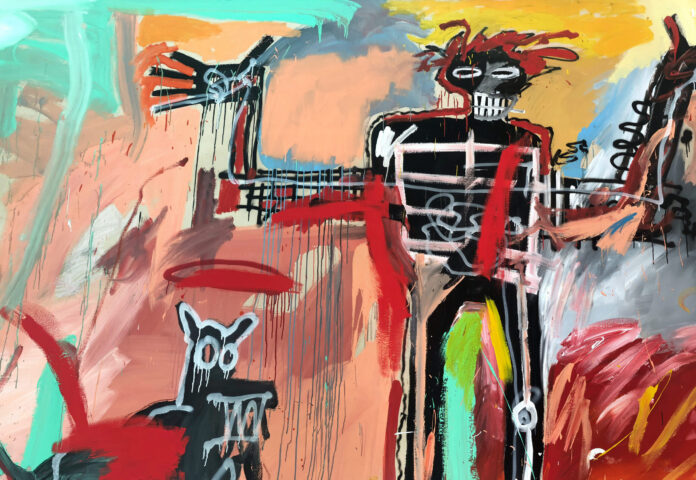
When the Hirshhorn Museum and Sculpture Garden — the Smithsonian’s national museum of modern and contemporary art, situated with particular authority on the National Mall in Washington, D.C. — chose to mark its fiftieth anniversary by placing two paintings in conversation, the choice was itself a critical act. On one side: Jean-Michel Basquiat’s Boy and Dog in a Johnnypump (1982), a monumental canvas nearly fourteen feet wide and eight feet high, executed in acrylic, crayon, and spray paint, in which a skeletal Black boy and his equally skeletal dog are rendered in the midst of an open fire hydrant’s spray. On the other: Banksy’s Banksquiat. Boy and Dog in Stop and Search (2018), a work on birch wood panel in which the same two figures from Basquiat’s painting are now being frisked by stenciled officers of London’s Metropolitan Police, their joyful raised hands reframed in an instant as the universal gesture of surrender.
For Richard J. Powell — the Distinguished John Spencer Bassett Professor of Art and Art History at Duke University, one of the foremost authorities on African American and African diasporic visual culture, and the scholar invited by the Hirshhorn to deliver the major public lecture accompanying this exhibition on October 10, 2024 — this pairing is not simply a curatorial conceit. It is a crystallization of the argument that has animated his scholarly career across more than three decades: that the art of the Black Atlantic diaspora, from the street to the canvas to the museum wall, operates within a continuous set of cultural, political, and aesthetic negotiations that mainstream art history has persistently failed to read with sufficient rigor or sufficient care.
This essay follows in Powell’s intellectual wake, using the Basquiat × Banksy exhibition as its primary occasion and its two central paintings as its central texts.
I. 1982: The Zenith of a Landmark Year
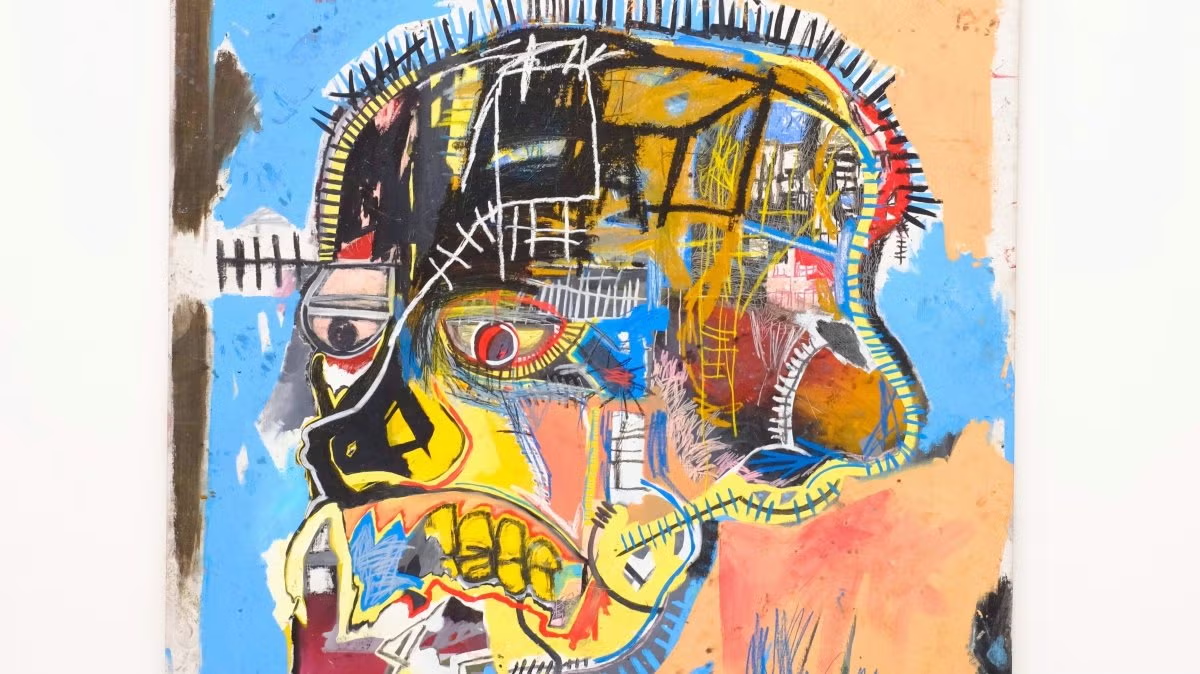
Basquiat himself said it plainly: looking back on 1982 from an interview with The New York Times in 1985, he observed that he had made the best paintings he had ever made during that period. The historical record supports the self-assessment. The year 1982 is widely recognized as Basquiat’s most artistically concentrated and most critically significant, a year in which the translation from street to studio — from SAMO© on the walls of SoHo and the Lower East Side to paintings that commanded galleries from New York to Modena to Los Angeles — was fully and irreversibly accomplished. It is the year that produced the skull painting Untitled (1982), which would later sell for $110.5 million, and it is the year that produced Boy and Dog in a Johnnypump, which sold for over $100 million in 2020.
But these auction figures, arresting as they are, tell us almost nothing about the painting itself. Boy and Dog in a Johnnypump is, on its surface, a scene of childhood: a boy and his dog playing in the spray of an open fire hydrant on a New York City summer day. “Johnny pump” is New York vernacular for a fire hydrant opened in summer for children to cool off in the heat — a genuinely democratic urban pleasure, free, improvisational, communal, available to whoever happened to live on the block. The scene is, in that sense, an idyll.
But Basquiat paints it with the formal vocabulary of his full Neo-Expressionist power: skeletal figures rendered with jagged, rapid brushstrokes, the boy’s three-pointed hair already gesturing toward the recurring crown motif that runs through his entire body of work. The figures are placed at the center of a polychromatic field — warm oranges and reds suggesting summer heat, the colors of a Pan-African tricolor investing the background with a political resonance that the surface innocence of the scene might otherwise obscure. The skeletal rendering of the Black figure does not suggest death or danger. It does something more complex: it simultaneously evokes the anatomical drawings of Gray’s Anatomy that captivated Basquiat since childhood and asserts a kind of structural clarity, a refusal of sentimentality, an insistence that the Black body be seen for what it is — sovereign, present, fully itself — without the mediating softness of idealization.
In this, as Powell’s framework helps us understand, Basquiat is working within a tradition of representing Black figures not as victims or exotica but as what the poet Robert Farris Thompson called “epic heroes,” kings in ordinary circumstances, crowned — if only by three-pointed hair — even in the simple act of playing in a hydrant’s spray.
II. From Graffiti to Gallery: The Street Art Lineage
To place Boy and Dog in a Johnnypump in the Hirshhorn is to enact the very argument the painting implicitly makes. Basquiat came out of the street. His earliest significant practice, beginning in the late 1970s, was as a graffiti artist and street poet under the tag SAMO©, a collaboration with Al Diaz that produced enigmatic, aphoristic messages on the walls of SoHo, the Lower East Side, and beyond. SAMO© was never merely decorative vandalism: it was a critical practice, a form of public poetry that used the most democratic possible medium — the city’s own exterior surfaces — to deliver philosophical and political observations to whoever happened to pass by.
The move from that practice to the canvas was not, Powell would insist, a rupture or a conversion experience. It was a continuous extension of the same impulse: to make marks on surfaces that communicate with maximum directness, that refuse the gatekeeping protocols of official culture, that assert the legitimacy of voices and forms that the mainstream art world has historically ignored or suppressed. When Basquiat began exhibiting at galleries — the Fun Gallery in the East Village in 1982, the Annina Nosei Gallery, the Larry Gagosian Gallery in Los Angeles — he brought the energy of the street with him. The paintings were never entirely domesticated by the white cube. They retained the explosive, improvisational force of the wall, the door, the found surface.
It is this lineage that connects Basquiat to Banksy — and that makes the Hirshhorn’s exhibition, organized by curator Betsy Johnson, not merely an exercise in comparative aesthetics but a genuine inquiry into the social and institutional meanings of street art’s journey into the museum. As Hirshhorn Director Melissa Chiu has observed, positioning Basquiat with Banksy “brings into focus elements of Basquiat’s legacy, notably the movement of street art tropes into museums through his studio practice.” Both artists began on walls. Both became internationally celebrated. Both have seen their work command extraordinary prices at auction. And both have been, in their different ways, artists whose primary subject is the relationship between power and the powerless, authority and insurgency, the official and the illicit.
III. Banksy Reads Basquiat: The Critical Transformation
On the night of September 16–17, 2017, in the early hours before dawn, Banksy made his way to the Barbican Centre in central London and stenciled a new image onto its exterior wall. His timing was deliberate: Basquiat: Boom for Real — the first major retrospective of Basquiat’s work in the United Kingdom since his death — was opening at the Barbican that week. Banksy announced the new work on Instagram with characteristic wit: “Major new Basquiat show opens at the Barbican — a place that is normally very keen to clean any graffiti from its walls.” The image he left on the wall — and later translated, in 2018, into the panel work Banksquiat. Boy and Dog in Stop and Search that now hangs across from the Basquiat at the Hirshhorn — showed the two skeletal figures from Boy and Dog in a Johnnypump being frisked by officers of the Metropolitan Police.
The formal operation Banksy performs on Basquiat’s painting is precise and devastating. He retains the figures — the boy and the dog, rendered in a faithful echo of Basquiat’s gestural, painterly style — but strips away Basquiat’s warm polychromatic background, leaving the figures against a largely monochromatic field. The boy’s raised hands, which in the original might be read as the exuberant gesture of a child playing in water, are now unmistakably the hands of someone complying with a police command — the “hands up, don’t shoot” gesture that has become the universal visual language of unarmed Black people confronting armed state authority. The Barbican’s light stone walls provide their own ironically charged backdrop: as Zora Neale Hurston once wrote, “I feel most colored when I am thrown against a sharp white background.”
The transformation is a form of art-historical commentary as much as political commentary. Banksy is arguing that the politics were always there in Basquiat’s painting — that the “urban idyll” was always a conditional idyll, available to the Black boy in the hydrant spray only until the moment when authority decided to intervene. The johnnypump becomes a stop and search. The summer afternoon becomes a confrontation. The joy is revealed to have been, all along, precarious.
What Banksy adds that was not explicit in Basquiat’s original is the police — the direct embodiment of the structural violence that threatened Basquiat throughout his own life, from his years on the streets of New York to his documented experience of racial profiling, to the death of his contemporary Michael Stewart at the hands of the New York City Transit Police in 1983. In Defacement (The Death of Michael Stewart) — painted directly onto the wall of Keith Haring’s studio in the immediate aftermath of Stewart’s death — Basquiat made that violence explicit and personal. In Boy and Dog in a Johnnypump, the violence is structural and latent, present in the social conditions that produced the scene even if not visible within it. Banksy makes the latent manifest, the structural literal, the implicit viscerally direct.
IV. Homage, Appropriation, and the Ethics of Citation
The relationship between Banksy’s work and Basquiat’s raises questions that Powell, as a scholar with deep expertise in both African American art and the politics of representation, is uniquely positioned to address. The Hirshhorn’s exhibition stages the encounter between them under the rubric of “homage and appropriation” — two terms that exist in productive tension with each other and that the work itself refuses to allow us to separate too cleanly.
Banksy is a white British artist of anonymous identity. Basquiat was a Black American artist of Haitian and Puerto Rican descent. When Banksy appropriates Basquiat’s figures and recontextualizes them as the subjects of a police stop-and-search, he is simultaneously honoring Basquiat’s legacy and performing an act of citation that has to be read carefully, particularly given the history of white artists and institutions appropriating Black creative work without adequate acknowledgment or compensation. To his credit, Banksy is explicit in naming his debt: the work’s title, Banksquiat, incorporates Basquiat’s name into his own authorial signature, and the ironic description of the piece as “an (unofficial) collaboration with the new Basquiat show” acknowledges the transatlantic, transgenerational nature of the artistic conversation.
The question of what Banksy adds to Basquiat — what his act of citation produces that was not already available in the original — is ultimately the question that the Hirshhorn exhibition asks its visitors to answer for themselves. Powell’s contribution, in his lecture accompanying the exhibition, is to provide the art-historical framework within which that question can be posed most rigorously: the tradition of African American and diasporic art that Basquiat inherited and transformed, the social conditions that made his practice both necessary and dangerous, the legacy that now continues to inspire artists across the globe — including an anonymous British street artist who paid tribute not by producing a pallid imitation but by producing a genuinely new work, one that uses Basquiat’s own visual language to say something that Basquiat, working in 1982, was perhaps not yet saying explicitly.
V. The Museum as Site: Institutional Stakes at the Hirshhorn
The fact that Basquiat × Banksy is on view at the Hirshhorn — presented as part of the museum’s fiftieth-anniversary season, marking it as the first time works by either artist have been exhibited at the nation’s museum of modern and contemporary art — is itself a statement of institutional reckoning. The Hirshhorn’s acknowledgment that it had not previously exhibited Basquiat is, in retrospect, a striking admission: one of the most significant American artists of the twentieth century, dead for more than three decades, was reaching the Smithsonian’s modern and contemporary museum for the first time through a loan of a single painting organized around his relationship to a British street artist.
This is not merely a logistical curiosity. It reflects the larger institutional history of American museums’ fraught and belated relationship with African American art — a history that Powell has documented and analyzed across his career. As Betsy Johnson’s curatorial vision for the exhibition recognizes, what the pairing of Basquiat and Banksy illuminates is precisely this institutional dynamic: the way in which the movement of street art into the museum is always a negotiation between the subversive energies that produced it and the legitimizing apparatus that displays it.
Basquiat experienced this negotiation in his own lifetime with acute discomfort. He was celebrated by the art market and by blue-chip galleries, but he was also subjected to the commodification of his practice and the exoticization of his person. He was the young Black artist who emerged from the streets and was welcomed into the gallery — and who understood, with painful clarity, the difference between being welcomed and being absorbed, between recognition and appropriation, between fame and dignity. The crown he wore in his own self-portraits — that three-pointed mark of sovereignty — was as much a defiant assertion against a market and an institution that he knew might consume him as it was a celebration of Black creativity.
To see Boy and Dog in a Johnnypump in the Hirshhorn, finally, forty-two years after it was painted, is to feel the full weight of that delay.
VI. Legacy Alive: Basquiat’s Continuing Resonance
Richard J. Powell has described Basquiat as one of the most significant artists of the twentieth century whose work remains a pivotal source of inspiration for artists today. The evidence for the second half of that observation is everywhere: in the work of painters, graffiti artists, installation artists, musicians, and filmmakers across the globe who cite Basquiat as formative to their own development; in the influence his visual language has had on the street art tradition from which Banksy himself emerged; in the continued scholarly and curatorial attention that his work attracts from every major art institution in the world; and in the sustained auction market that has made his paintings among the most expensive ever created by an American artist.
But Powell’s more significant contribution is the insistence on the first half of the observation: that Basquiat was not simply a wildly talented individual who made striking paintings, but one of the most significant artists of the twentieth century — a claim that rests on a rigorous understanding of the cultural and historical context in which he worked and the transformations his practice effected on the visual language of late modernity. His fusion of graffiti and Neo-Expressionism, his integration of writing and painting, his deployment of sign and symbol in the service of a counter-history of Black achievement and Black suffering, his polychromatic intensity drawn from both Caribbean muralism and commercial print culture, his sustained engagement with the body as both anatomical fact and political site — these constitute not the eccentric output of an outsider prodigy but the achieved expression of an artist who knew exactly what he was doing and why.
The small works on paper and wood from the collection of Larry Warsh — made between 1979 and 1985 and included in the Hirshhorn exhibition — provide crucial evidence for this claim. They demonstrate, as the Hirshhorn notes, Basquiat’s deep familiarity with art history, his disciplined use of language, and the systematic development of his signature motifs. The crowns and skulls that appear across his career are not accidental or arbitrary; they are elements of a carefully constructed visual vocabulary, deployed with the precision and intentionality of a painter who had studied the history of art with genuine seriousness and was fully conscious of the tradition within which he was working — and the tradition against which he was pushing back.
Epilogue: What the Johnnypump Holds
A fire hydrant opened in summer is a democratic miracle: it belongs to the street, to whoever lives on that block, to the children who play in it without permission or purchase. It is, in the vocabulary of urban life, a site of unclaimed pleasure, temporary freedom, the small sovereignty of the ordinary. Basquiat painted it in 1982 as exactly that — a moment of Black childhood delight, given epic scale and chromatic force by an artist who understood that the ordinary is never merely ordinary, that the boy in the hydrant’s spray is a king in his own right, that dignity does not require a gallery or an auction house or a fiftieth-anniversary exhibition at the Smithsonian to exist.
Banksy, thirty-six years later, reminded us of what that dignity is always up against. He did not contradict Basquiat’s painting; he completed it — or rather, he revealed that it had always already contained within it the conditions of its own undoing, that the joy is real and the threat is real and the two have always coexisted in the same body, on the same street, in the same country.
Richard J. Powell — who has spent his career insisting on the rigor, the complexity, and the historical depth of African American and diasporic visual culture — brings to both paintings the scholarly apparatus they deserve: an apparatus rooted not in the mythology of the overnight sensation or the market’s verdict, but in the long, unfinished, trans-Atlantic history of which both Basquiat and his inheritors are a part. To encounter Basquiat × Banksy at the Hirshhorn is, through Powell’s lens, not merely to attend an exhibition. It is to participate in a reckoning with that history — with what it has cost, what it has produced, and what it continues to demand of us as viewers, as scholars, and as citizens.
This essay was written in dialogue with Richard J. Powell’s lecture delivered at the Hirshhorn Museum and Sculpture Garden on October 10, 2024, and with the exhibition Basquiat × Banksy (September 29, 2024 – October 26, 2025), organized by Betsy Johnson, Assistant Curator, made possible with generous support from Kenneth C. Griffin and Griffin Catalyst, and presented as part of the Hirshhorn’s 50th-anniversary season. It draws additionally on Powell’s Black Art: A Cultural History (Thames & Hudson, 1997, 2002, 2021) and on the published record of Basquiat’s life and work.