Beyond the Visible:
A History of
Abstract Painting
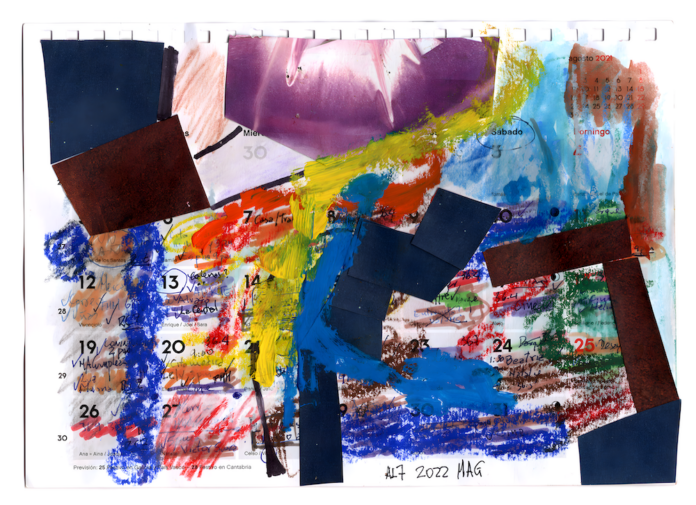
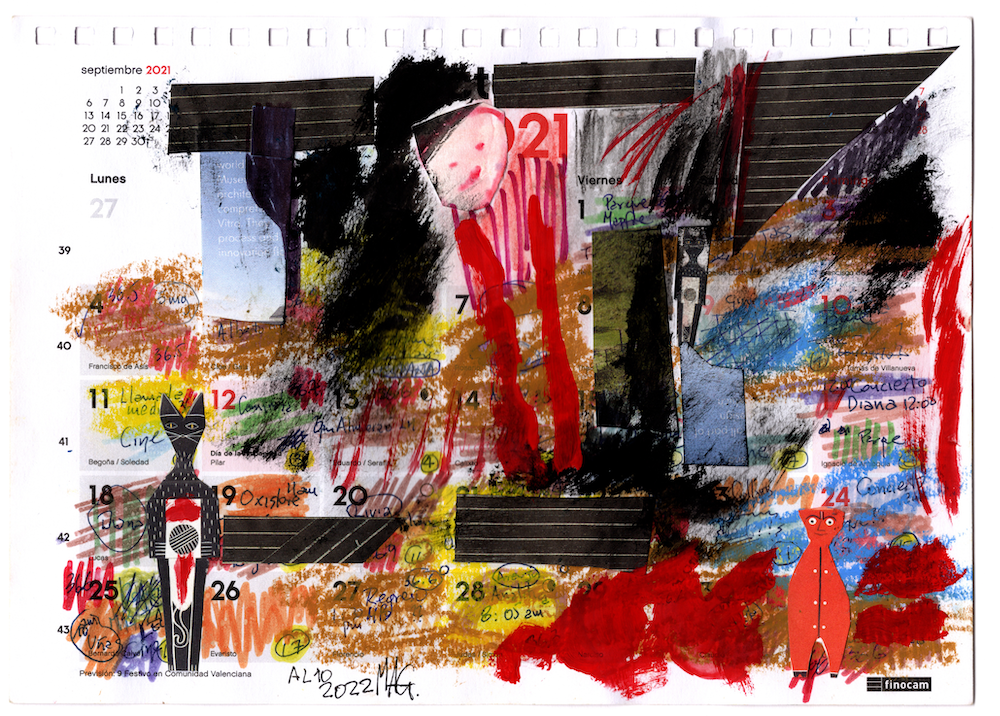
From Hilma af Klint’s spirit-guided canvases to Pollock’s dripped galaxies, abstract painting is the most radical act in the history of Western art — a sustained refusal to depict, and a wager that pure form can carry the full weight of human experience.
Every painting makes a choice about the world. The representational painter chooses to mirror it; the abstract painter chooses to abandon that mirror entirely, or to shatter it into something unrecognizable and perhaps more true. This second choice — which is really a bet, a philosophical wager on the capacity of color, line, and form to carry meaning without the crutch of resemblance — is the defining act of modern art. It altered, irreversibly, what a painting is permitted to be.
Abstract art did not arrive fully formed. It was the result of a century of accumulated pressure: the camera liberating painting from its documentary function; non-Western visual cultures destabilizing European conventions; the explosion of modern physics, psychology, and theosophy reorganizing humanity’s sense of what was real and what was hidden. By the early twentieth century, the conditions were in place for a rupture. The only question was who would make it — and when.
I. The Hidden Founder: Hilma af Klint
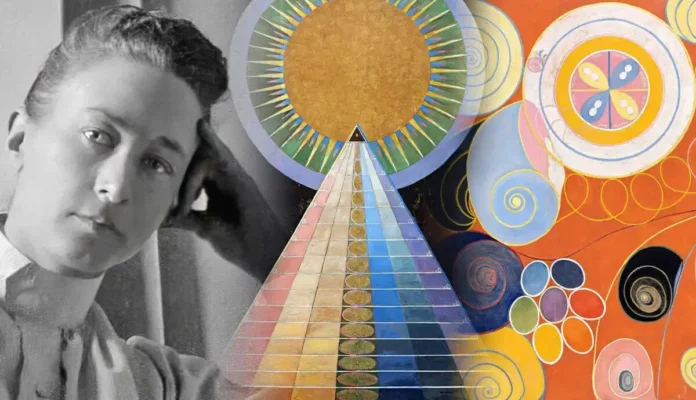
The official history of abstraction has been systematically wrong. For decades it named Wassily Kandinsky as the originator, citing his first non-objective compositions from around 1911. af Klint What Kandinsky did not know is that a Swedish painter by the name of Hilma af Klint had created her first abstract painting in her Stockholm studio in 1906, five years before him. She did not know it either. They worked in complete mutual ignorance, like two trains on the same tracks — Klint arriving before Kandinsky.
Born in 1862, af Klint was a trained portraitist and landscape painter who had become drawn, alongside four other women artists she called “The Five,” to theosophy and the possibility of communicating with forces beyond ordinary perception. Her Paintings for the Temple, which she began in 1906, were painted directly through her, without preliminary drawings and with great force — she had no idea what the paintings were supposed to depict, yet she worked swiftly and surely, without changing a single brushstroke. The resulting works — spiraling, biomorphic, geometrically ordered — are today recognized as the earliest sustained body of abstract painting in Western art history.
“Hilma af Klint worked with non-figurative forms years before her male peers Wassily Kandinsky, Piet Mondrian and Kazimir Malevich were credited with inventing abstract art.”
— Smithsonian Magazine
Believing her art carried spiritual messages that would benefit humankind, af Klint stipulated in her will that her paintings remain out of sight for twenty years following her death — convinced her contemporaries were not yet equipped to understand them. When the boxes were finally opened at the end of the 1960s and her work slowly entered public consciousness through the 1980s, it forced a complete rewriting of the founding myth. Hilma af Klint created abstract paintings as early as 1906, predating other artists’ first forays into abstraction; her paintings feature nonrepresentational geometric and organic forms. She is now the hidden mother of the movement — hidden by patriarchal art history, and by her own prophetic doubt that the world was ready.
II. Kandinsky and the Grammar of Feeling
Kandinsky Wassily Kandinsky (1866–1944) arrived at abstraction through a different portal: synesthesia and music. Trained in law before dedicating himself to painting, Kandinsky developed the conviction that color and form could produce emotional and even auditory sensations independent of any depicted subject. His 1911 treatise Concerning the Spiritual in Art is the founding theoretical document of abstraction — a systematic argument that the purely visual could speak the language of the soul.
Where af Klint’s abstraction was channeled and spiritual in an almost literal sense, Kandinsky’s was philosophical and worked toward by intellectual effort. His compositions of the early 1910s — cascading color masses, angular forms in tension, loosely related to landscape and horsemen — gave way, after his years at the Bauhaus, to harder-edged geometric work. The New York Times described his practice as exhibiting a rigorous focus on logic, utility and simplicity, but this misses the core of it: Kandinsky was after emotional resonance, and he believed that geometry, used rightly, could carry it.
III. The Order of Pure Form: Suprematism, Constructivism, De Stijl
While Kandinsky worked from feeling outward toward form, another lineage of abstractionists worked from form inward toward philosophy. Kazimir Malevich’s Suprematism, inaugurated by the notorious Black Square (c. 1915), proposed that geometric abstraction represented a higher order of reality — the supremacy of pure feeling over the contingencies of the visible world. A black rectangle on a white ground was not reduction but elevation: the elimination of everything unnecessary until only the essential remained.
Constructivism Constructivism was an early twentieth-century art movement founded in 1915 by Vladimir Tatlin and Alexander Rodchenko. Abstract and austere, constructivist art aimed to reflect modern industrial society and urban space, rejecting decorative stylization in favour of the industrial assemblage of materials. Where Malevich sought the spiritual, the Constructivists sought the social: art as instrument of the revolutionary new order, geometric abstraction as the visual language of a collective modernity. Their grid-structures, photomontages, and agitational graphics extended abstract principles into every domain of material culture.
De Stijl In the Netherlands, Piet Mondrian and Theo van Doesburg arrived at a different but related purity. De Stijl was an innovative visual language marked by abstraction and universality, reducing the visual to the essential using only vertical and horizontal lines and primary colors. Mondrian called his system Neoplasticism. He saw the grid as an embodiment of universal forces: vertical lines carrying the energy of the sun’s rays, horizontal lines relating to the earth’s movement. By simplifying his visual vocabulary to straight lines, primary colors, and rectangular shapes, Mondrian sought a streamlined “language” of art — four elements he thought were part of a universal language that would promote universal harmony.
IV. Marlow Moss: The Double Line and the Erased Name
Moss Any honest account of abstract painting’s development must contend with the systematic erasure of its women. Marlow Moss (1889–1958) is perhaps the most egregious example. Moss was the first British Constructivist artist, working in both painting and sculpture, and she had a documented, verifiable influence on the very master whose work most defines the Neoplasticist canon.
Moss moved to Paris in the late 1920s to apprentice herself to Fernand Léger, although it was her encounter with Piet Mondrian, around 1928, that would define her approach to abstraction for the rest of her career. What followed was a relationship of genuine intellectual exchange — and one in which the established account has been quietly, persistently unjust to Moss. Her thinking was that the then customary single-line grid of Neo-Plasticism split a composition up, rendered it static, and prevented it from visually expanding outwards. Mondrian was impressed enough that in 1931 he nominated Moss for founding membership of the new Association Abstraction-Création, and began to experiment with the double-line himself.
“Moss devised the double line as an innovation to the Neo-Plasticist grid. Mondrian would later use the parallel lines himself — without referring to Moss’s authorship.”
— Von Bartha Gallery
The war was devastating for Moss’s legacy. At the beginning of World War II, Moss fled France and went to Cornwall in the UK, but a 1944 bombardment destroyed all of her works stored in Gauciel — the output of a highly creative two decades in Paris, narrowly escaped on a boat to England. What survives is extraordinary: tight, luminous compositions of double lines and white grounds that vibrate with contained energy. Her work is held in the collections of MoMA, the Tate, and the Centre Pompidou — and her name is still largely unknown.
V. The American Rupture: Abstract Expressionism
The next great transformation came from an unexpected quarter. Abstract Expressionism Abstract expressionism in the United States emerged as a distinct art movement in the aftermath of World War II and gained mainstream acceptance in the 1950s. It was the first specifically American movement to achieve international influence and put New York City at the center of the Western art world, a role formerly filled by Paris.
All the artists of the movement were committed to art as expressions of the self, born out of profound emotion and universal themes, and most were shaped by the legacy of Surrealism — a movement they translated into a new style fitted to the post-war mood of anxiety and trauma. The Surrealist technique of automatism — allowing the hand to move without conscious control, mining the unconscious — became central to their method. Pollock dripped. De Kooning slashed. Kline made gestures that looked like architecture being torn down.
Pollock Jackson Pollock’s drip paintings of the late 1940s represent the most extreme gesture of liberation in Western art history. In 1947, Pollock developed a radical new technique, pouring and dripping thinned paint onto raw canvas laid on the ground — the paintings were entirely nonobjective; in their subject matter, scale, and technique, the works were shocking to many viewers. What Pollock discovered was that the act of painting — its physical drama, the evidence of the body moving through space and time — could be the subject of the work. The canvas became, as Harold Rosenberg memorably framed it, an arena of action rather than a surface for representation.
Rothko Mark Rothko arrived at a very different but equally radical conclusion. Where Pollock’s canvases are electric with event, Rothko’s large-scale color fields are conspicuously still — hovering rectangles of luminous color that seem to absorb light rather than reflect it. For Rothko, his glowing soft-edged rectangles of luminescent color were meant to provoke a quasi-religious experience in viewers, even eliciting tears. “I paint big to be intimate,” he said: the notion is toward the personal rather than the grandiose. His Orange, Red, Yellow (1961) is one of the most powerful emotional instruments ever constructed in paint.
VI. The Branching Tree: Abstract Painting’s Descendants
Abstract painting did not reach an endpoint. It branched, and its branches continue to grow. The following movements all emerged from, or are in direct dialogue with, the abstract tradition:
1910s–30s
Suprematism
Malevich’s geometric purity; the supremacy of pure feeling above representation. The Black Square as both painting and manifesto.
1915–30s
Constructivism
Soviet-born movement fusing abstraction with industrial production, politics, and social transformation. Tatlin, Rodchenko, El Lissitzky.
1917–31
De Stijl / Neoplasticism
Mondrian’s grid of primary colors and right angles as a universal visual language. A utopian geometry seeking cosmic harmony.
1919–33
Bauhaus
The great German school synthesizing abstract art with craft and design. Where Constructivism met everyday life. Klee, Albers, Kandinsky as professors.
1940s–50s
Abstract Expressionism
The New York School’s explosion of gesture, scale, and unconscious mark-making. Pollock, de Kooning, Rothko, Krasner, Kline, Mitchell.
1950s–60s
Color Field Painting
Large flat planes of pure color as meditative and emotional fields. Rothko, Newman, Frankenthaler, Louis, Noland.
1950s–60s
Action Painting / Tachisme
The physical act as subject; Europe’s parallel to American gesture painting. Paint applied spontaneously, impulsively, as existential testimony.
1950s–60s
Lyrical Abstraction
Emotive, fluid painting balancing spontaneity with compositional control. Frankenthaler’s soak-stain technique; Sam Francis; Joan Mitchell.
1960s
Minimalism
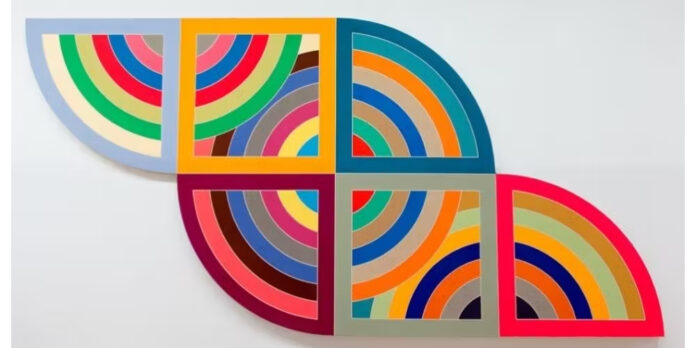
The reduction of abstraction to its irreducible elements: Frank Stella’s shaped canvases, Ad Reinhardt’s near-black monochromes, Donald Judd’s industrial forms.
1960s
Hard-Edge Painting
Crisp, flat, geometric fields with sharp transitions. Ellsworth Kelly, Al Held, Kenneth Noland. The human hand made deliberately invisible.
1960s
Op Art
Optical illusions and perceptual instability as artistic subject. Bridget Riley, Victor Vasarely. The viewer’s eye becomes the medium.
1960s–70s
Conceptual Abstraction
When the idea supersedes the object entirely. Art as proposition. The painting as documentation of a thought rather than its resolution.
1970s–80s
Neo-Expressionism
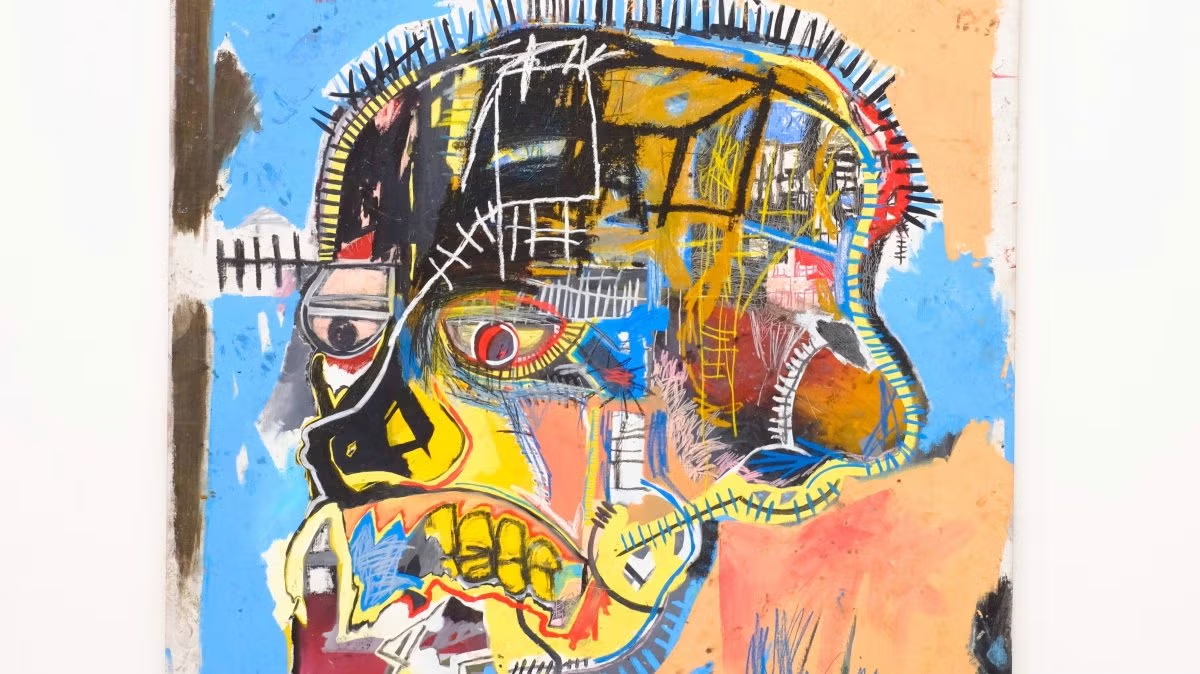
A return of raw gesture, figuration, and emotional urgency in reaction to Minimalism. Basquiat, Kiefer, Baselitz, Schnabel.
1980s–now
Post-Painterly Abstraction
Cool, detached, process-based painting moving beyond expressionism. Richter’s squeegee paintings; Julie Mehretu’s layered cartographies of event.
Contemporary Abstraction
No single center remains. Digital tools, global perspectives, feminist and postcolonial revisionism have opened abstraction to an unprecedented plurality of voices and methods.
Digital & Generative Abstraction
Algorithms, AI, and code as co-authors of abstract form. The question of authorship and intention reopened for a new century.
VII. What Abstract Painting Asks of Us
Abstract painting is frequently accused of hermeticism — of being art for initiates, art that excludes. The accusation is almost always made by those who have not stood long enough in front of a Rothko or a Frankenthaler or a Mondrian to let the work do its work. Abstract painting does not exclude; it demands. It asks the viewer to abandon the habit of identification — the comfortable procedure of recognizing chair, face, landscape — and to be present, instead, to sensation, to color relationship, to spatial tension, to the emotional pressure a composition can exert before the naming-mind has had time to intercede.
This is, in fact, a more intimate demand than representation makes. Representation allows the viewer to stand at a safe distance from the image, processing it through the familiar machinery of recognition. Abstraction offers no such distance. The viewer stands before pure address.
Abstract art mainly focuses on the content of an artwork rather than its subject — through forms and colors it gives out different degrees of a particular emotion or idea, experienced by feelings and mind, not by recognition of images.
— On the definition of abstract painting
The century-long project of abstract painting has produced some of the most powerful objects Western culture has made. It has also produced a great deal of noise — work that mistakes absence of skill for absence of ego, or confuses visual poverty with spiritual depth. But the tradition at its best, from af Klint’s spiraling cosmologies to Rothko’s luminous fields to Julie Mehretu’s vast palimpsests of history and event, constitutes an argument that painting — freed from the obligation to describe the world — can, paradoxically, show us something truer about experience than any description could achieve.
The abstract painting does not show us what the world looks like. It shows us what it feels like to be in it — which is, in the end, the older and deeper task of art.
Source:
Hilma af Klint
- Tate Etc. – “The First Abstract Artist? (And It’s Not Kandinsky)” → tate.org.uk
- Smithsonian Magazine – “A Swirl of Intrigue Surrounds Hilma af Klint’s Newfound Status as an Icon of Abstract Art” → smithsonianmag.com
- Artsy – “How the Swedish Mystic Hilma af Klint Invented Abstract Art” → artsy.net
- DailyArt Magazine – “Hilma af Klint: Pioneer of Abstract Art” → dailyartmagazine.com
- The Collector – “Hilma af Klint: 7 Facts About the Pioneer of Abstract Art” → thecollector.com
Wassily Kandinsky / Abstracción temprana
- Contemporary Art Issue – “Abstract Art Explained: Ultimate FAQ on Abstraction” → contemporaryartissue.com
- Artyfactory – “Modern Art Timeline Part 1” → artyfactory.com
Constructivismo / De Stijl / Suprematismo
- Wikipedia – “Constructivism (art)” → en.wikipedia.org/wiki/Constructivism_(art)
- Wikipedia – “Abstract Expressionism” → en.wikipedia.org/wiki/Abstract_expressionism
- Study.com – “Abstract Art Styles: Definition, List & Examples” → study.com
- Artlex – “19 Types of Abstract Art: Characteristics and Artists” → artlex.com
Abstract Expressionism
- The Metropolitan Museum of Art – “Abstract Expressionism” (essay) → metmuseum.org
- Britannica – “Abstract Expressionism” → britannica.com
- Tate – “Abstract Expressionism” (art term) → tate.org.uk
- The Art Story – “Abstract Expressionism Movement Overview” → theartstory.org
Marlow Moss
- Art UK – “Queering Constructivism: The Legacy of Marlow Moss” → artuk.org
- Ideelart – “A Long-Overdue Artist Spotlight on Marlow Moss” → ideelart.com
- Wikipedia – “Marlow Moss” → en.wikipedia.org/wiki/Marlow_Moss
- Tate – “Marlow Moss 1889–1958” → tate.org.uk
- Von Bartha Gallery – “Marlow Moss, Who?” → vonbartha.com
- Sotheby’s – “Marlow Moss: Artist Biography” → sothebys.com
- The Mayor Gallery – “Marlow Moss” → mayorgallery.com
- AWARE Women Artists – “Marlow Moss” → awarewomenartists.com