
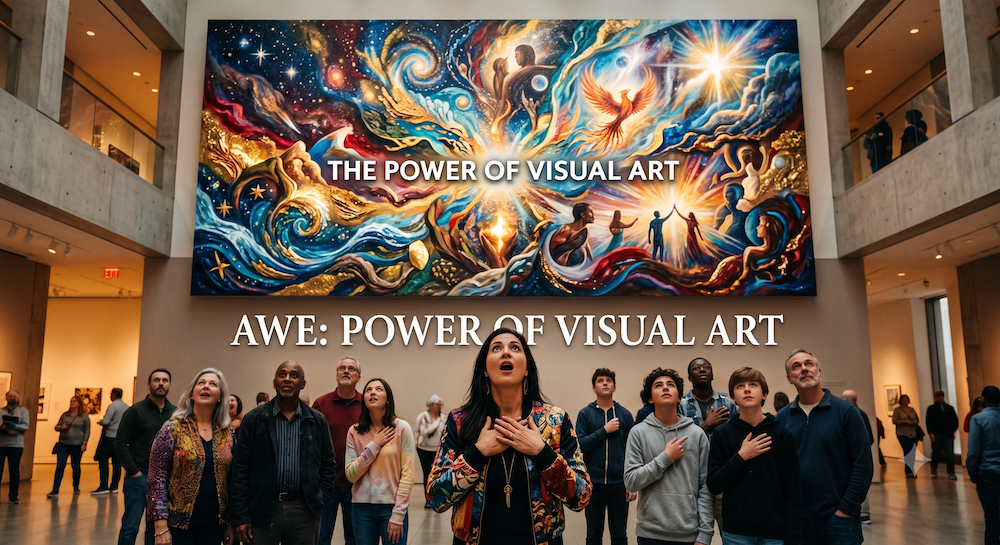
Give Me Some Awe: Creativity, Perceptual Vastness, and the Transformative Power of Visual Art
There are works of art that we admire, works that we understand, and works that we enjoy. And then there are encounters that temporarily exceed us.
We stand before an image, an installation, an immense architectural space, an unexpected combination of materials, a field of color, an impossible perspective, or an idea whose implications seem larger than our capacity to contain them. For a moment, our ordinary categories become inadequate. We know that we are looking at something, yet what we already know is insufficient to explain what we are experiencing.
Psychology has a name for this condition: awe.
Awe is not simply beauty, pleasure, surprise, admiration, or excitement. In the influential psychological model developed by Dacher Keltner and Jonathan Haidt, awe emerges from the convergence of two central appraisals: perceived vastness and a need for accommodation. Vastness does not have to mean physical enormity. It can also be conceptual, intellectual, social, temporal, spiritual, or perceptual. Accommodation occurs when an experience cannot easily be assimilated into the mental structures we already possess, forcing those structures to adjust.
This distinction is crucial for understanding the relationship between awe and visual art.
A great work of art does not always confirm what we already know about the world. Sometimes it does precisely the opposite: it makes our existing understanding temporarily insufficient.
That insufficiency may be one of the most fertile territories of creativity.
The Mind Meets Something Larger Than Itself
Human perception is not a passive recording system. We continuously interpret reality through previous knowledge, memories, expectations, categories, cultural conventions, and internal models. We do not simply see; we anticipate what the world should be and organize new information accordingly.
Most experiences can be incorporated relatively easily into these structures.
Awe begins when this process becomes difficult.
Keltner and Haidt describe the prototypical awe experience as one in which something is perceived as vast and existing mental structures become inadequate. The mind must therefore attempt accommodation: rather than merely fitting the experience into an old category, it may have to modify the category itself.
Michelle Shiota, Dacher Keltner, and Amanda Mossman subsequently examined this model empirically. Their studies characterized awe as particularly information-oriented and stimulus-focused. People experiencing awe directed attention outward, toward the extraordinary stimulus, rather than primarily toward themselves. They also found an association between dispositional awe and a lower need for cognitive closure—the desire to reach definite answers quickly and avoid ambiguity.
That finding has profound implications for creativity.
Creative thought frequently requires remaining inside uncertainty long enough for alternative possibilities to emerge. The artist cannot always know what the work means before making it. Nor can every encounter with art be immediately resolved into a familiar category.
Awe interrupts premature certainty.
It says, psychologically:
Your current explanation is not enough. Look again.
Awe and the Creative Mind
The connection between awe and creativity is not merely philosophical speculation.
Alice Chirico, Vlad Petre Glăveanu, Pietro Cipresso, Giuseppe Riva, and Andrea Gaggioli experimentally investigated whether inducing awe could affect creative thinking. Participants watched emotion-inducing videos and subsequently completed verbal tasks derived from the Torrance Tests of Creative Thinking. Awe influenced several dimensions of creativity, including fluency, flexibility, and elaboration, compared with a neutral condition.
The study does not demonstrate that awe automatically produces artistic genius, nor that every awe experience results in a masterpiece. Creativity is far too complex for such a claim.
What it does provide is experimental evidence for something conceptually important: a temporary state of awe can alter cognitive processes involved in creative thinking.
Why might this happen?
One compelling possibility lies precisely in accommodation.
If creativity involves producing relationships, possibilities, interpretations, or solutions that are not already obvious, then a psychological state that destabilizes established mental structures could provide fertile conditions for creative reorganization.
The creative process can therefore be understood not only as the production of novelty but as a negotiation between what the mind already knows and what it can no longer explain with what it knows.
Awe lives at that threshold.
It appears when perception encounters more information, complexity, meaning, magnitude, mystery, or possibility than its existing architecture comfortably accommodates.
The artist’s question then becomes:
What happens if I do not immediately reduce the unknown to something familiar?
Art Does Not Need to Be Beautiful to Produce Awe
This distinction becomes particularly important in contemporary and conceptual art.
If awe depended exclusively on conventional beauty, its relevance to art would be considerably narrower. But the psychological definition emphasizes vastness and accommodation, not beauty alone. Keltner and Haidt explicitly described beauty as one possible feature that can modify the character of awe, alongside threat, exceptional ability, virtue, and supernatural interpretation.
A work can therefore produce awe without being conventionally beautiful.
It might instead confront the viewer with the incomprehensible scale of geological time, mortality, technological power, ecological interdependence, human violence, infinity, consciousness, or the cosmos.
This is particularly relevant to conceptual art because conceptual vastness can be as psychologically disruptive as physical vastness.
A tiny object can contain an enormous idea.
A nearly empty room can reorganize one’s perception of space.
A simple geometric structure can prompt questions about infinity, order, containment, human scale, or our position within a larger system.
The perceptual dimensions of the object may be modest while the mental space opened by the work becomes enormous.
In this sense, visual art does not merely represent awe-inspiring things.
Art can construct the conditions under which awe becomes possible.
Beyond Beauty: The Emotional Complexity of Visual Art
Contemporary empirical research also supports the idea that our responses to art cannot be compressed into the simple opposition of “beautiful” and “ugly.”
In a large-scale study mapping emotional responses to visual artworks, Eftychia Stamkou and colleagues identified a multidimensional landscape of aesthetic experiences. Responses to visual art were organized across numerous emotional categories and gradients rather than along a single scale of liking or beauty. Awe forms part of this much richer emotional vocabulary through which people encounter visual images.
Likewise, research by Yagmur Ozbay, Suzanne Oosterwijk, and Eftychia Stamkou directly compared engagement with paintings and visually matched non-art photographs. Their experiments examined experiences including awe, being moved, reflection, and social cognition, demonstrating why aesthetic engagement must be studied as something substantially richer than simple visual pleasantness.
The implication for artists is significant.
Perhaps the strongest artwork is not always the work that gives the spectator the fastest pleasure.
Sometimes the more consequential work is the one that produces a productive inadequacy:
I do not entirely understand this.
I have never seen something organized this way.
I know what these materials are, but I do not know what they have become.
I recognize the object but no longer recognize the world around it in quite the same way.
That gap between recognition and comprehension can become psychologically generative.
The Small Self
Awe also changes the scale at which we perceive ourselves.
Research repeatedly describes a phenomenon known as the small self: during powerful experiences of awe, the individual may experience the self as relatively smaller in relation to something greater.
This should not automatically be interpreted as humiliation, worthlessness, or self-erasure. Rather, attention temporarily shifts away from the self as the dominant center of experience.
Piff and colleagues demonstrated across several studies that awe could decrease self-focus and promote prosocial tendencies. In one field experiment, simply standing among towering trees influenced subsequent helping behavior relative to a control condition. Their analyses suggested that the experience of a smaller self partially mediated awe’s relationship with prosocial behavior.
Bai and colleagues later investigated the phenomenon across six studies and more than two thousand participants, including participants from different cultural contexts. Their findings again connected awe with a diminished sense of individual self and greater orientation toward collective engagement, while also identifying meaningful cultural differences in how the small self was experienced.
The relevance to art is considerable.
Much ordinary perception begins implicitly with:
What does this mean for me?
Awe can introduce another possibility:
What am I in relation to this?
The difference is subtle but profound.
The artwork ceases to be merely an object available for consumption by the viewer. Instead, the viewer becomes one element within a larger perceptual or conceptual field.
This is the territory where aesthetics begins to approach philosophy.
When the Ego Becomes Quieter
Neuroscientific research offers a tentative biological parallel to this phenomenology.
In an fMRI experiment, Michiel van Elk and colleagues compared participants viewing awe-inducing, positive, and neutral audiovisual material. They reported reduced activity in components of the default mode network during awe, a network strongly implicated in self-referential processing. The authors interpreted their findings as consistent with the subjective reduction in self-focused processing reported in psychological research on awe.
This finding should be interpreted cautiously. Awe does not simply “switch off the ego,” and no single brain network can be equated with something as philosophically complicated as the self.
Nevertheless, the convergence is compelling.
Psychologically, awe redirects attention away from the individual self.
Phenomenologically, people report feeling smaller in relation to something larger.
Neurally, at least some experimental work identifies reduced engagement of systems involved in self-referential processing.
Together, these findings suggest that one of awe’s defining movements may be a temporary decentering of the self.
And decentering may be extraordinarily important for creativity.
To create something genuinely unfamiliar, the artist sometimes has to stop demanding that reality obey the categories through which he or she already understands it.
Awe and the Sublime: Related, but Not Identical
Art history and philosophy encountered these questions long before contemporary psychology gave them experimental terminology.
The philosophical tradition of the sublime, particularly in Edmund Burke and Immanuel Kant, explored experiences of magnitude, power, infinity, obscurity, danger, and perceptual or imaginative excess. The sublime described encounters in which ordinary measures of comprehension seemed inadequate.
There is an obvious family resemblance between the sublime and psychological awe.
But they should not simply be treated as synonyms.
The sublime is a historically developed aesthetic and philosophical category. Awe, as studied in contemporary psychology, is an empirically investigated emotion characterized through measurable appraisals, behaviors, self-reports, and physiological or neural correlates.
Their intersection is nevertheless intellectually productive.
Both ask what happens when human perception encounters something that exceeds its ordinary measure.
This is why awe offers an unusually powerful bridge between aesthetics, psychology, philosophy, and contemporary art.
Creativity Begins Where the Model Fails
We often describe creativity as the capacity to “think outside the box.” The expression has become so familiar that it almost means nothing.
Awe suggests a more precise formulation.
Creativity may sometimes begin when the box itself becomes inadequate.
The mind encounters something it cannot assimilate.
Expectation fails.
Scale changes.
Categories destabilize.
Attention moves outward.
Certainty becomes temporarily unavailable.
And rather than immediately retreating to the familiar, the creative mind remains in contact with the discrepancy.
This is accommodation as creative possibility.
The artist does not necessarily resolve the mystery. The artist can give it form.
That form may be monumental or microscopic, figurative or abstract, material or digital, spectacular or almost invisible. What matters is not sheer size but the relationship between the work and the spectator’s capacity to assimilate it.
Awe appears when the work somehow communicates:
There is more here than your present model can contain.
Give Me Some Awe
Perhaps this is one of visual art’s most important functions in an age saturated with images.
Contemporary culture supplies an extraordinary quantity of visual information, but quantity is not the same as perceptual transformation.
We scroll.
We identify.
We categorize.
We like.
We dislike.
We move on.
Awe interrupts that economy of instantaneous recognition.
It demands accommodation.
The truly awe-producing artwork does not simply ask, “Do you like me?”
It asks something more unsettling:
“Is your existing way of seeing sufficient?”
And sometimes the answer is no.
That “no” should not be considered a failure of perception.
It can be the beginning of perception.
It can be the instant in which the known loses its monopoly over possibility.
For the spectator, awe can transform looking from recognition into discovery.
For the artist, it can transform uncertainty from an obstacle into material.
And for creativity, perhaps this is the essential territory: the moment when our mental models encounter something larger than themselves and, rather than turning away, begin to change.
Give me some awe.
Not merely something enormous.
Not merely something beautiful.
Give me something that makes what I thought I knew temporarily insufficient.
Give me an image that changes the scale of my questions.
Give me a work that makes the self smaller and reality larger.
Give me something I cannot completely accommodate without becoming, intellectually or perceptually, slightly different from the person who first encountered it.
That is where awe approaches the deepest promise of visual art:
not simply to show us another image of the world, but to enlarge the mind with which we see it.
Academic References
Bai, Y., Maruskin, L. A., Chen, S., Gordon, A. M., Stellar, J. E., McNeil, G. D., Peng, K., & Keltner, D. (2017). Awe, the diminished self, and collective engagement: Universals and cultural variations in the small self. Journal of Personality and Social Psychology, 113(2), 185–209. DOI: 10.1037/pspa0000087.
Chirico, A., Glăveanu, V. P., Cipresso, P., Riva, G., & Gaggioli, A. (2018). Awe enhances creative thinking: An experimental study. Creativity Research Journal, 30(2), 123–131. DOI: 10.1080/10400419.2018.1446491.
Keltner, D., & Haidt, J. (2003). Approaching awe, a moral, spiritual, and aesthetic emotion. Cognition and Emotion, 17(2), 297–314. DOI: 10.1080/02699930302297.
Ozbay, Y., Oosterwijk, S., & Stamkou, E. (2024). Beyond beauty: Does visual art facilitate social cognitive skills? PLOS ONE, 19(10), e0308392. DOI: 10.1371/journal.pone.0308392.
Piff, P. K., Dietze, P., Feinberg, M., Stancato, D. M., & Keltner, D. (2015). Awe, the small self, and prosocial behavior. Journal of Personality and Social Psychology, 108(6), 883–899.
Rudd, M., Vohs, K. D., & Aaker, J. (2012). Awe expands people’s perception of time, alters decision making, and enhances well-being. Psychological Science, 23(10), 1130–1136.
Shiota, M. N., Keltner, D., & Mossman, A. (2007). The nature of awe: Elicitors, appraisals, and effects on self-concept. Cognition and Emotion, 21(5), 944–963. DOI: 10.1080/02699930600923668.
Stamkou, E., Keltner, D., Corona, R., Aksoy, E., & Cowen, A. S. (2024). Emotional palette: A computational mapping of aesthetic experiences evoked by visual art. Scientific Reports, 14, 19932. DOI: 10.1038/s41598-024-69686-9.
van Elk, M., Arciniegas Gomez, M. A., van der Zwaag, W., van Schie, H. T., & Sauter, D. (2019). The neural correlates of the awe experience: Reduced default mode network activity during feelings of awe. Human Brain Mapping, 40(12), 3561–3574. DOI: 10.1002/hbm.24616.