Miami Beach Negotiates Art Basel’s Future: Money, Exclusivity, and Cultural Power Beyond 2026
This article is based on a DPA news report published by Yahoo on August 2, 2026. The central information comes from that report, which in turn cites public records obtained by the Miami Herald. Additional context was drawn from official sources published by the City of Miami Beach, Art Basel, and MCH Group.
Every December, Miami Beach becomes more than a coastal destination: it turns into one of the most closely watched centers of the international art market. Since arriving in 2002, Art Basel Miami Beach has served as the principal anchor around which a vast constellation of fairs, museum exhibitions, private events, commercial activations, and independent projects has developed.
However, the fair’s continued presence beyond 2026 still depends on a complex negotiation. Art Basel Miami Beach is scheduled to take place at the Miami Beach Convention Center from December 4 through 6, 2026, but a long-term agreement with the city had not yet been secured when Yahoo and DPA published their report. (artbasel.com)
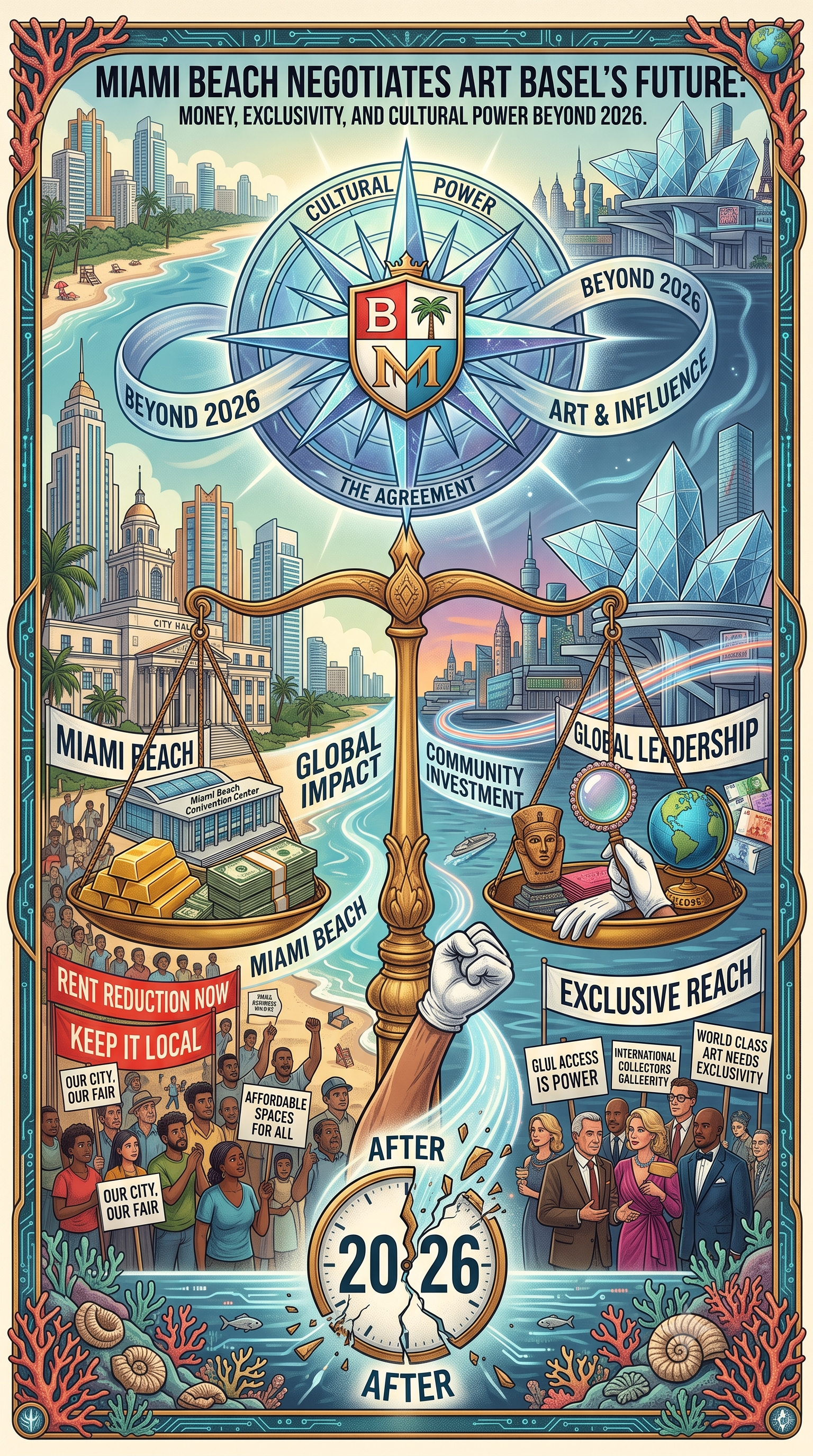
What is being negotiated is not simply how much an art fair should pay to occupy a convention center. At stake are the economic value of the Art Basel brand, the use of public resources, the cultural autonomy of Miami Beach, and the ability of an international company to influence the broader Miami Art Week ecosystem.
A Substantial Reduction in Rent
According to the report published by Yahoo, Art Basel is expected to pay the city nearly $1 million in 2026 for exclusive use of the Miami Beach Convention Center. That fee—formally described as a license fee—has reportedly increased by approximately a quarter of a million dollars over the past five years because of inflation-based adjustments.
During negotiations for a new agreement, Miami Beach officials initially proposed a base rent of $500,000 and later reduced the offer to $400,000. The city would also be willing to absorb approximately $300,000 in police and fire-service expenses that Art Basel previously covered.
In return, Miami Beach is asking the fair to contribute $100,000 toward transportation systems provided during the week, including free trolley and water-taxi services.
The length of the proposed agreement represents another point of difference. Art Basel is reportedly seeking a five-year commitment, while the city would prefer to secure the fair for ten years. According to municipal calculations cited in the report, a ten-year agreement beginning with rent of approximately $450,000 could save Art Basel around $9 million compared with the current payment structure.
The existing agreement originated in 2017, when Miami Beach announced a long-term relationship granting Art Basel exclusive use of the convention center. At the time, the city estimated that the fair generated between $400 million and $500 million in related economic activity. (docmgmt.miamibeachfl.gov)
Following the cancellation of the 2020 edition because of the pandemic, the city substantially reduced the 2021 fee and extended the agreement through 2026. The arrangement also allowed annual increases tied to inflation and granted Art Basel a right of first refusal for the Convention Center in 2027 and 2028 under similar financial terms.
Public Subsidy or Strategic Investment?
A reduction of nearly half the rent, combined with the city’s assumption of security-related costs, could reasonably be interpreted as an indirect public incentive.
That does not necessarily mean the city would be making a poor investment. According to figures attributed to Art Basel in the Yahoo and DPA report, the previous edition welcomed approximately 80,000 visitors and generated an estimated $570 million in economic impact across Miami-Dade County.
Hotels, restaurants, transportation providers, art installers, security companies, galleries, museums, printers, designers, media outlets, and many temporary workers depend in part on the activity generated during that week.
However, “economic impact” should not automatically be confused with direct revenue received by the municipal government. A responsible evaluation would need to consider how much Miami Beach actually collects, how much it spends on security, cleaning, transportation, and administration, which businesses receive the greatest benefits, and which costs are carried by residents and workers.
The public question should not be limited to how much the city is willing to pay to prevent Art Basel from leaving. It should also ask what cultural, social, and economic commitments Miami Beach would receive in exchange.
A significant reduction could be connected, for example, to public programming, opportunities for local artists, participation by community institutions, investment in transportation, environmental measures, improved labor conditions, and a more visible relationship with Miami’s cultural production.
The Most Delicate Negotiation: Control of Miami Art Week
The most troubling aspect of the report is not necessarily the proposed reduction in rent, but Art Basel’s requests concerning other fairs.
Art Basel is reportedly seeking a right of first refusal over the Ocean Drive sites currently occupied by Untitled Art and SCOPE should either organization vacate its location. The fair has also asked Miami Beach to establish an expanded exclusivity zone intended to prevent new competing art events from being introduced in the city.
The request comes at a time when Miami Beach has already authorized negotiations for a long-term agreement with Untitled Art in the Lummus Park area, between 10th and 12½ Streets, and instructed the administration to explore a similar agreement with SCOPE. (miamibeachagenda.com)
A fundamental distinction must be made here: Art Basel Miami Beach and Miami Art Week are not the same thing.
Art Basel is the principal fair and the international anchor of the week. Miami Art Week, by contrast, is a decentralized ecosystem consisting of numerous fairs, museums, galleries, foundations, artist studios, private collections, independent organizations, universities, artists, and cultural communities.
Its vitality depends precisely on that multiplicity.
Untitled, SCOPE, NADA, Art Miami, CONTEXT, Design Miami, Pinta, and other projects are not merely peripheral extensions of Art Basel. Each serves different galleries, audiences, geographic regions, price levels, and curatorial models. Their coexistence has helped transform the week into something far larger than a single commercial fair.
Allowing a private company excessive influence over which new art events may take place in the city could weaken that diversity. It could also restrict competition, raise barriers to entry, and permit an international brand to function, in practice, as the regulator of a cultural phenomenon that belongs to the entire community.
A Relationship of Mutual Dependence
Art Basel needs Miami as much as Miami needs Art Basel.
South Florida has given the fair a strategic position between North America, Latin America, the Caribbean, and Europe. Art Basel has benefited from the region’s cultural diversity, climate, hospitality industry, private collections, and ability to bring together art, luxury, design, architecture, fashion, gastronomy, and entertainment.
Miami, in turn, gained an international platform that accelerated the growth of its museums, galleries, collections, cultural districts, and art-related real-estate market.
This is not the story of an institution arriving in a culturally empty city. The particular identity of Art Basel Miami Beach was also created by the collectors, artists, curators, institutions, and communities that already existed or developed around it.
For that reason, the implicit possibility that the fair could leave should not force the city into a negotiation based entirely on fear. The objective should be to preserve a mutually beneficial partnership without surrendering control of the city’s cultural ecosystem.
Art Basel Is No Longer Dependent on a Single Geography
The negotiations are taking place while Art Basel continues to expand internationally. In February 2026, it inaugurated its fifth fair in Doha, featuring 87 galleries from 31 countries and territories. The inaugural edition of Art Basel Qatar welcomed more than 17,000 visitors, in addition to thousands who attended public projects presented elsewhere in the city. (artbasel.com)
This expansion demonstrates that Art Basel operates as a global corporate platform capable of developing new geographic and financial partnerships.
Its parent company, MCH Group, is publicly traded in Switzerland. At the end of 2025, Lupa Investment Holdings controlled 41.94 percent of its shares, while the Canton of Basel-Stadt owned 37.52 percent. (mch-group.com)
This context does not diminish the fair’s cultural value, but it requires the negotiation to be viewed clearly: Miami Beach is not dealing only with an arts organization, but with an international company that manages brands, markets, audiences, and strategic assets.
The Danger of Confusing a Brand with a Culture
Art Basel has been decisive in Miami’s cultural transformation. Denying that would be unreasonable. Yet it would be equally mistaken to claim that the city’s entire contemporary-art culture depends on the fair’s presence.
Culturally mature cities do not surrender their complete identity to a single brand. They build infrastructures capable of enduring even when sponsors, fairs, economic trends, or corporate priorities change.
Miami Beach should work to retain Art Basel, but it should also strengthen what makes the city indispensable to the fair:
its diverse artists;
its connections with Latin America and the Caribbean;
its museums and collections;
its independent galleries;
its cultural publications;
its universities;
its public projects;
and the plurality of Miami Art Week.
The strongest defense against the fair’s possible departure is not to concede every request, but to build an ecosystem so resilient that no single organization can claim to be its only source of legitimacy.
An Opportunity to Redefine the Agreement
The negotiations offer an opportunity to create something more ambitious than a rental contract.
A new agreement could recognize Art Basel as a strategic cultural partner while also protecting the autonomy of other fairs. It could provide financial stability without granting an exclusivity arrangement capable of preventing new projects from emerging. It could also establish measurable commitments to Miami’s local artistic community.
The city has legitimate reasons to offer competitive conditions. Art Basel has legitimate reasons to seek financial predictability. What must not be lost is the principle that public spaces and public resources should generate public benefits.
Keeping the fair in Miami Beach is important. Preserving the cultural diversity that developed around it is even more important.
Conclusion
The negotiations between Art Basel and Miami Beach reveal a broader transformation in the art world: major fairs are no longer simply temporary marketplaces. They are platforms capable of influencing urban policy, transportation systems, public-space use, and cultural hierarchies.
Miami Beach must avoid two extremes. The first would be to underestimate Art Basel’s impact and allow a relationship built over more than two decades to weaken. The second would be to accept conditions that effectively turn a single company into the gatekeeper of all artistic activity in the city.
Art Basel is December’s principal anchor, but Miami Art Week belongs to a much broader ecosystem.
The best agreement will not be the one that merely keeps the fair in Florida. It will be the one that ensures its continued presence while protecting competition, diversity, local cultural production, and the artistic freedom that helped make Miami one of the most dynamic art centers in the Americas.
News credit: DPA via Yahoo, August 2, 2026. The original reporting was based on public records obtained by the Miami Herald. Additional context was drawn from official records published by the City of Miami Beach, Art Basel, and MCH Group.