Dmitri Wright: Painting, Contemplation, and Transcendence
In this conversation with Art Miami Magazine, artist and educator Dmitri Wright reflects on painting as an experience of observation, gratitude, and inner transformation. Through what he calls “Transcendent Impressionism,” Wright understands the landscape not merely as a visible subject, but as a living expression of order, beauty, and meaning—one capable of connecting the viewer with a deeper spiritual dimension.
The interview explores his balance between academic discipline and intuition, expressed through his metaphor of “The Gypsy and the Accountant,” as well as the influence of Johann Sebastian Bach and Thelonious Monk on the rhythm and construction of his paintings. Wright also discusses how travel, memory, and cultural experience enrich his visual language, while considering the legacy of American Impressionism, the rise of artificial intelligence, and the artist’s responsibility to preserve human experience, transmit knowledge, and inspire future generations.
AMM. You define the artist as someone who seeks “the good, the beautiful, and the true” with joy and gratitude. How does this philosophy translate into the specific decisions you make before the canvas, particularly in your choice of landscape, color, and atmosphere?
DW. The good, the beautiful, and the true are not simply artistic ideals; they are transcendent realities that focus my attention on creation itself. They remind me that painting is more than making an image—it is participating in the wonder of creation with joy and gratitude.
This understanding calls me to paint proactively rather than reactively. Rather than merely responding to external appearances or contemporary trends, I seek to discover and reveal what is already present within the landscape. Nature becomes my first teacher. The Impressionist tradition invites me through the sensations of light, atmosphere, season, and the fleeting moments of the day. Post-Impressionism broadens those possibilities by allowing imagination, expressive color, abstraction, and personal interpretation to deepen what is seen.
What I call Transcendent Impressionism seeks to go one step further. It asks not only, “What do I see?” but “What does creation reveal about its Creator?” The landscape is more than scenery; it is a living expression of order, beauty, and meaning. To paint truthfully is to conform oneself to reality rather than impose oneself upon it. To paint beautifully is to participate in the creative process itself. And to paint the good is to affirm that creation is a gift worthy of our attention, stewardship, and wonder.
We have been given the extraordinary privilege of being creative within creation. Through the creative process we bring forth something new while continually rediscovering timeless virtues in fresh and unexpected ways. Every painting becomes an act of gratitude—a conversation between observation, imagination, and contemplation.
This philosophy shapes every decision I make before the canvas. I choose landscapes that invite contemplation rather than spectacle, colors that convey emotional and spiritual resonance rather than mere description, and atmosphere as the invisible bridge between the visible world and the mystery that lies beyond it. My hope is that the viewer does not simply see a place, but experiences a moment of quiet recognition—a glimpse of something enduring that awakens both memory and wonder.
That is why I often say, “I paint from the inside out. I paint the prayer that paints me.” Whether I am standing before the landscape with my easel or working quietly in the studio, that inward disposition guides every decision of color, atmosphere, composition, and brushstroke. It is also the source of the joy and gratitude I experience each time I pain.
AMM. Your painting method combines academic training, Impressionism, Expressionism, and moments of abstraction. How do you preserve the structure of classical drawing while allowing intuition, gesture, and emotion to transform representation?
DW. Art is a paradox. It requires both freedom and control. Every artist, according to his or her temperament, must discover the proper balance between improvisation and discipline in order to communicate authentically the hope that is within them. Freedom without form becomes chaos; control without imagination becomes lifeless. The creative life flourishes in the dynamic tension between the two.
Over the years I have developed a teaching metaphor I call “The Gypsy and the Accountant.” They represent the two indispensable partners in the creative process. The Accountant is reason; the Gypsy is poetry. The Accountant seeks order through composition, perspective, proportion, anatomy, value relationships, and the countless structural decisions that give a painting integrity. The Gypsy brings intuition, improvisation, gesture, risk, surprise, emotion, and imagination.
For me, these two do not compete—they marry one another. Science and poetry tango. I often think of Yeats’ question, “How can we know the dancer from the dance?” At its best, painting reaches that same unity, where structure and spontaneity become one living expression. Eventually, you can no longer separate discipline from intuition, or craftsmanship from inspiration. They have become one.
My own temperament probably leans about twenty-five percent Accountant and seventy-five percent Gypsy. I front-load the process with the Accountant. I make thumbnail sketches, value studies, compositional drawings, wash drawings, and enough preliminary work to understand my subject from the inside out. Once that foundation is secure, I gladly surrender more and more to the Gypsy, allowing intuition, gesture, and the unexpected to breathe life into the painting.
The process reminds me of the performing arts: rehearsal, rehearsal, dress rehearsal, and finally the performance itself. Classical drawing provides the rehearsal. It prepares the artist so thoroughly that, when the moment arrives, freedom can emerge with confidence rather than uncertainty. Technique becomes the servant of expression instead of its master.
This is why I continue to value classical drawing so deeply. A drawing can often capture the spirit of a subject more profoundly than a photograph because it records not merely what the eye sees, but what the heart understands. It distinguishes between simple infatuation with appearances and genuine love of the subject’s essence.
For that reason I encourage every artist to keep an artist’s journal. It is the place where words become sketches, sketches become ideas, and ideas become paintings. It is where one’s artistic DNA begins to reveal itself. There, science and poetry meet each day, and once again, they tango. It is also where I learn, again and again, to paint from the inside out.
AMM. You compare the movement of your brushstrokes to musical counterpoint and speak of creating “jazz-like notes” through color. How does music influence the rhythm, energy, and visual construction of your paintings?
DW. Music has always been one of the hidden architects of my paintings. I often compare my brushwork to musical counterpoint because a painting, like a great composition, requires both harmony and independence. Every brushstroke has its own voice, yet it must contribute to the larger whole.
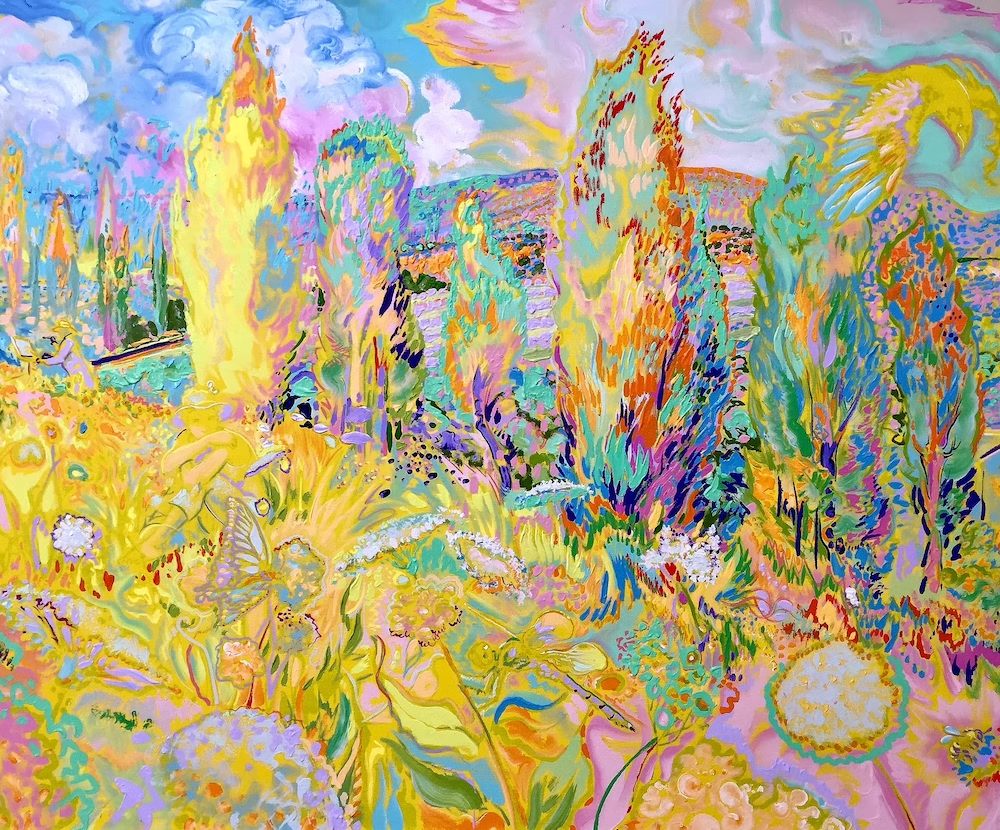
I think of my brushstrokes as belonging to two families. The first are illustrative brushstrokes. They follow the melody of the drawing and the underlying design, describing form, light, atmosphere, and structure. The second are abstract brushstrokes. They possess a certain independence, almost a life of their own. They shape rhythm, create visual surprises, and sometimes simply exist as something mysterious and beautiful beyond explanation. Together they create a visual music.
I often say that Impressionism is Jazzical. That may not be a dictionary word, but it perfectly describes what I mean. Impressionism shares the structure of classical music while embracing the freedom and improvisation of jazz. It is independence and harmony existing together.
Two composers have deeply influenced my imagination. Johann Sebastian Bach is my Accountant. His fugues reveal extraordinary order, logic, and architecture. Thelonious Monk is my Gypsy. His unexpected rhythms, daring harmonies, and playful improvisations remind me that surprise is often where beauty lives. Sometimes I listen to both while painting in the studio, and when I paint en plein air I hear their music echoed in birdsong, moving water, the wind through the trees, and the changing rhythms of light itself. Nature becomes the orchestra.
There comes a moment in every successful painting when something remarkable happens. Preparation gives way to freedom. The rhythm of the brush begins to carry me. I can see it, I can feel it, and then something quietly changes. The painting begins to paint the painter.
That is the great mystery of the creative process. We begin by shaping the painting, but if we remain humble and attentive, the painting begins to shape us. It teaches patience, gratitude, courage, and wonder. The Accountant and the Gypsy are no longer debating; they are completely lost in the dance. The artist is no longer merely making a painting, but participating in something larger than oneself. That, for me, is the heart of Transcendent Impressionism.
Perhaps that is why poetry often accompanies my painting. One of my recent verses expresses this progression:
Color and light are one and the same,
The natural Impressionist eye-brain.
Stage two:
Post-Impressionist from the very start,
Deconstructed through the expressive eye-heart.
Stage three:
Paint the prayer that paints you—
Transcendent Impressionism,
The soul renewed.
AMM. Your travels through France, Italy, New England, the Caribbean, Latin America, and China have significantly expanded your palette and your perception of nature. Which landscapes or cultural experiences produced the most profound transformations in your pictorial language?
DW. There is no single place I can point to and say, “That landscape transformed me.” My artistic language is the result of an accumulation of places, people, cultures, and experiences that have gradually become woven together over a lifetime. Every journey has left its mark, and together they have become part of my visual vocabulary.
When I was a young artist, I had very little money. The landscapes immediately around me became my teachers because they were all I could afford. Looking back, I see that limitation as a gift. It taught me that inspiration is not found by traveling farther, but by seeing more deeply.
As my career developed, new doors opened. Graduating first in my class at the Academy, receiving international scholarships, studying at the Ivy League level, and eventually becoming a professional painter and teacher gave me opportunities to experience France, Italy, New England, the Caribbean, Latin America, China, and many other remarkable places. With each journey my world became larger, but the lesson remained the same: the extraordinary is always hidden within the ordinary for those who have eyes to see it.
A bishop once shared a thought with me that has remained close to my heart: “God loves you just the way you are, but too much to leave you where you are.” That wisdom beautifully describes my artistic journey. Every place I have visited has invited me to become someone a little different from the person who arrived. I learned to love each place for what it offered at that particular moment, and just as importantly, to love the people who gave each place its unique character.
For me, Impressionism has never been limited to the visual experience alone. It embraces the totality of the moment. A landscape is not simply what I see; it is the atmosphere I breathe, the language I hear, the conversations I share, the food and wine around the table, the music drifting through the streets, and the emotional memory those experiences create. All of these impressions become part of the painting long before the first brushstroke touches the canvas.
I remember painting along the Mediterranean in Cap d’Antibes, where I found myself less interested in the glamorous surroundings than in the extraordinary quality of the light. In Italy, while teaching, I became fascinated by the ancient olive trees—their sculptural forms, their quiet dignity, and the timeless landscapes they inhabited. Those moments continue to find their way into my paintings years later.
More recently, while teaching in the mountains of North Carolina, I found myself captivated by the drifting fog, the rain, sudden shafts of sunlight cascading across the hills, and the winding mountain roads that revealed new compositions around every bend. Those experiences are already finding their way into the next generation of my paintings.
That is why I do not simply paint what I see. I paint what I have lived. Every place leaves its echo. Every culture adds another voice. Every season contributes another layer. The artist’s palette is not filled only with pigments, but with memories, gratitude, and lived experience. Over time those layers become richer, more harmonious, and perhaps even more operatic. They become part of the prayer that continues to paint the painter, from the inside out.
AMM. As an heir to a lineage connected to William Merritt Chase, Charles W. Hawthorne, and the tradition of American Impressionism, you speak of both preserving and advancing that legacy. What aspects of Impressionism should be preserved in the twenty-first century, and what elements must be transformed to respond to our technological and globalized era?
DW. As an heir to a lineage connected to William Merritt Chase, Charles W. Hawthorne, and the tradition of American Impressionism, you speak of both preserving and advancing that legacy. What aspects of Impressionism should be preserved in the twenty-first century, and what elements must be transformed to respond to our technological and globalized era?
Today we find ourselves living through another profound transformation. Artificial intelligence, globalization, and accelerating technologies are changing not only how images are made, but how we think, communicate, and even understand ourselves. I do not see these changes as enemies of art. Every generation has faced its own technological revolution. The real question is not whether technology will advance—it certainly will—but whether humanity will advance with it.
That question has led me to what I call Transcendent Impressionism. If Natural Impressionism taught us to see the world, and Post-Impressionism taught us to express the inner life, then Transcendent Impressionism invites us to rediscover the soul. It asks us to slow down, to cultivate our own artistic DNA, and to become fully human, fully alive, and fully present within creation.
Artificial intelligence can generate astonishing images, but it cannot live a human life. It cannot stand in silent wonder before a sunrise, hear birdsong drifting across a quiet field, share bread and wine with friends, or be transformed by gratitude, suffering, forgiveness, and love. Those experiences remain the sacred inheritance of the human artist. Our task is not simply to make pictures, but to reveal the soul that no machine can replicate.
Painting is not merely the making of beautiful pictures. It is the transformation of the painter through participation in God’s ongoing work of creation. Every authentic work of art begins with the world before us, passes through the soul within us, and returns as a gift to the world around us.
Ultimately, I believe every artist must live, move, and have his or her being in the One who gave us life. For me, that source is Jesus Christ. It is through Him that creativity becomes more than self-expression; it becomes participation in creation itself. When we paint from that place, we do more than preserve a tradition—we allow it to continue growing, bearing fruit for generations yet to come.
Perhaps these thoughts are best expressed through two short poems that continue to guide my own journey:
Do I paint the light,
or does the light paint me?
I think the latter.
Now I’m free.
The unconsumed Burning Bush
sets our hearts afire;
rapture in this sacred muse,
dove of peace inspire.
In closing, I have been reminded recently of how deeply connected we are to those who came before us. I had the great honor of serving as curator for the exhibition Then and Now in Connecticut, where I was privileged to exhibit alongside many of my artistic teachers. Among them was the work of Charles W. Hawthorne, whose name was spoken with such reverence and affection by my own teacher, Samuel Brecher, during my years at the Academy.
As a young student, I could never have imagined that one day my paintings would hang alongside Hawthorne’s. It was a profoundly humbling experience and a reminder that every generation receives a gift from those who have gone before.
We are standing on the shoulders of giants.
The artist’s calling is to receive that inheritance with gratitude, deepen it through faithful work, and pass it on with generosity. Art is a great relay race. Each generation carries the baton for only a little while. We learn from those who came before us, we add our own voice, and then we entrust the tradition to those who follow.
If my work has any lasting significance, I hope it is found not only in the paintings I leave behind, but in the artists I have encouraged, the students I have mentored, and the lives I have inspired to see more deeply, love more fully, and create more courageously.
So let us receive this remarkable inheritance with gratitude. Let us paint with humility, courage, and wonder. Let us pass the baton with love, joy, and peace, holding the standard high for those who will one day stand where we now stand.
For painting is not merely the making of beautiful pictures. It is the transformation of the painter through participation in God’s ongoing work of creation.