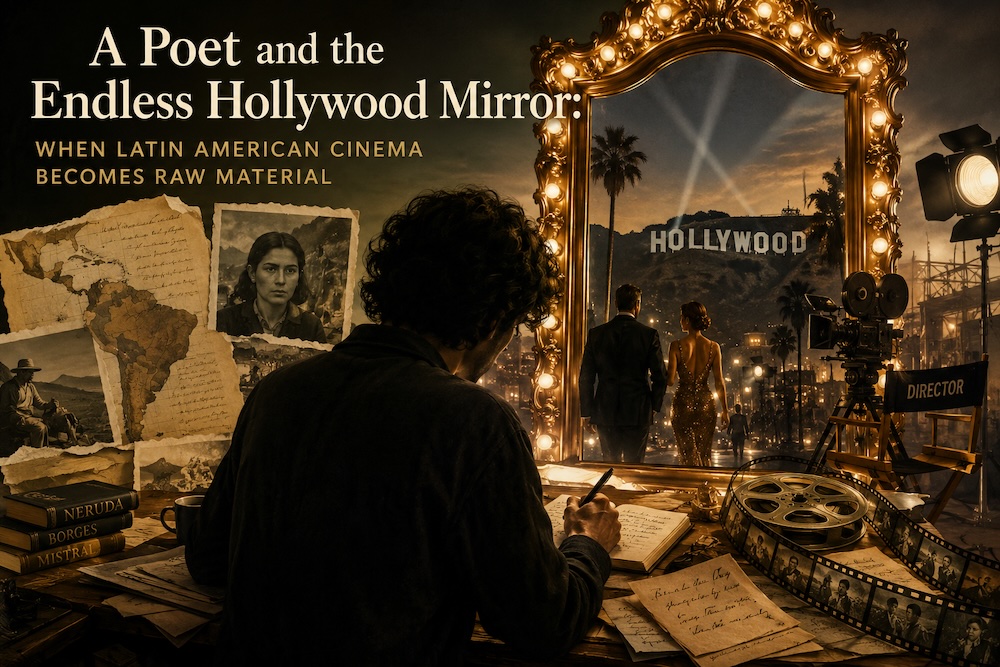
A Poet and the Endless Hollywood Mirror: When Latin American Cinema Becomes Raw Material
Hollywood Remake
By Rafael Montilla
The announcement that Simón Mesa Soto’s acclaimed Colombian film A Poet (Un poeta, 2025) will receive an American remake has ignited a familiar debate across the international film community. The controversy is not merely about one film. It touches a deeper question that has accompanied global cinema for decades: Why does Hollywood so often feel compelled to retell stories that have already been told—sometimes brilliantly—in other languages?
Mesa Soto’s original film emerged as one of the most celebrated Latin American productions of recent years. Premiering at the Cannes Film Festival in 2025, where it received major recognition, A Poet quickly established itself as a poignant reflection on artistic failure, ambition, and redemption. Its success led to international distribution and critical acclaim well beyond Colombia.
Yet only a year later, an American adaptation is already in development. Directed by Nathan Silver and produced by Saïd Ben Saïd, the project has provoked criticism from audiences who question whether such a recent and culturally specific work requires reinterpretation for English-speaking viewers.
To be fair, remakes are not inherently problematic. Cinema has always been a conversation across borders. Stories migrate, transform, and acquire new meanings. Simón Mesa Soto himself has defended the adaptation, arguing that the sale of remake rights helps sustain independent filmmakers and finance future projects. From an economic perspective, his position is entirely understandable.
The concern lies elsewhere.
For many cinephiles, the issue is not that Hollywood remakes foreign films, but that the remakes frequently overshadow the originals. Audiences often encounter the American version first and remain unaware that the story originated elsewhere. This dynamic has affected numerous international works whose artistic achievements become secondary to the visibility of their English-language adaptations.
A notable example is The Secret in Their Eyes (El secreto de sus ojos), Juan José Campanella’s Argentine masterpiece, winner of the Academy Award for Best Foreign Language Film in 2010. In 2015, Hollywood released Secret in Their Eyes, starring Julia Roberts, Nicole Kidman, and Chiwetel Ejiofor. While heavily marketed, the remake received mixed reviews and was frequently criticized for failing to capture the emotional and political complexity of the original. Critics noted that much of what made the Argentine film exceptional was lost in translation.
Another example is CODA (2021), winner of the Academy Award for Best Picture. Many viewers were unaware that it was a remake of the French film La Famille Bélier (2014). While CODA successfully reimagined the story and achieved enormous acclaim, public discussion often centered on the remake itself rather than its source material.
The pattern extends beyond Latin America. International cinema frequently serves as a testing ground for narratives that are later reformulated for American audiences. The remake industry operates under the assumption that many viewers prefer stories delivered through familiar cultural codes and in English. Whether this assumption remains valid in an era of streaming platforms, subtitles, and global audiences is increasingly open to question.
Today, viewers can access Colombian, Argentine, Korean, French, and Iranian cinema with unprecedented ease. The old argument that foreign-language films are inaccessible feels less convincing than ever. Contemporary audiences have shown a growing willingness to engage directly with original works rather than mediated versions.
Perhaps the debate surrounding A Poet signals a broader cultural shift. The resistance to the remake is not necessarily resistance to adaptation itself; it is a defense of cultural specificity and artistic authorship. It reflects a desire to preserve the integrity of works that emerge from particular histories, languages, and social realities.
Hollywood will undoubtedly continue remaking international films. The practice is as old as the industry itself. But the conversation surrounding A Poet reminds us that audiences are becoming more attentive to origins. They want to know where stories come from. They want to recognize the artists who first imagined them.
And perhaps that is the most important outcome of this controversy: not the remake itself, but the renewed attention being given to the remarkable original film that inspired it.