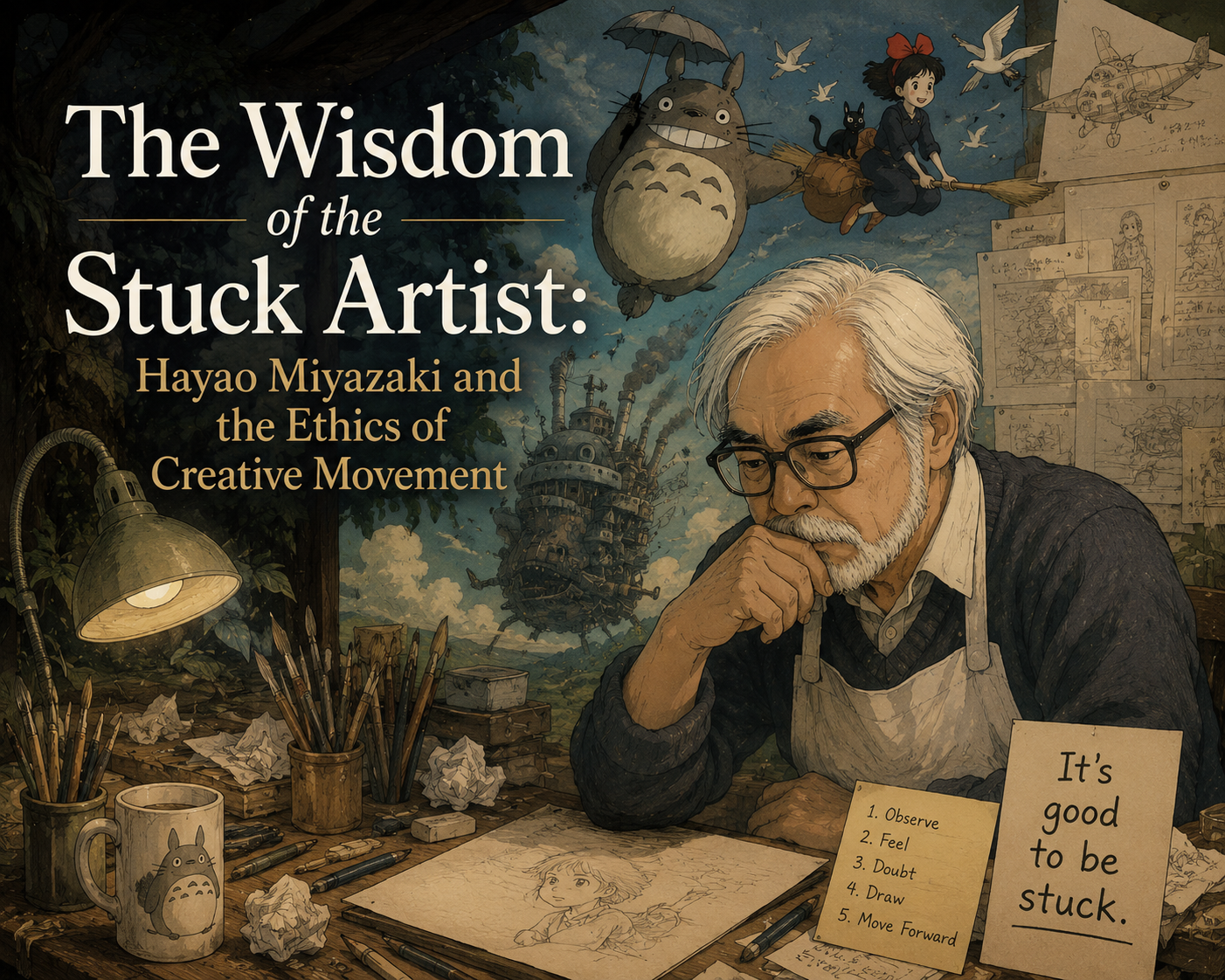
The Wisdom of the Stuck Artist: Hayao Miyazaki and the Ethics of Creative Movement
One of the greatest myths surrounding artistic creation is the belief that masterpieces emerge fully formed — complete visions descending upon the artist with clarity and certainty. For many visual artists, this illusion becomes psychologically devastating. The studio fills with unfinished sketches, fragmented concepts, disconnected images, abandoned canvases, and silent notebooks. Ideas accumulate, yet nothing materializes. The artist waits for the “perfect” concept, the complete narrative, the fully resolved vision before beginning. But that moment rarely arrives.
This condition — creative paralysis — is not the absence of talent. It is often the consequence of excessive self-consciousness and the fear of imperfection. The contemporary visual artist exists within a culture obsessed with finished products, visibility, and immediate coherence. In this environment, uncertainty becomes intolerable. Yet the history of art repeatedly demonstrates that creation rarely begins with certainty; it begins with fragments.
Hayao Miyazaki’s creative process offers a profound lesson for artists trapped within stagnation. Contrary to traditional expectations of narrative structure or conceptual planning, Miyazaki often begins not with a script or a complete story, but with isolated images — intuitive visual fragments without explanation or conclusion.
This gesture contains enormous philosophical significance for visual practice.
Miyazaki understands that the image itself thinks. The drawing is not the final result of thought; it is the mechanism through which thought emerges. Instead of waiting for complete understanding, he externalizes fragments immediately. A single sketch, an unfinished atmosphere, a loose gesture on paper becomes enough to initiate movement.
For the stuck visual artist, this represents a radical shift in consciousness. The problem is not the absence of ideas. The problem is the interruption of creative flow. Creativity behaves less like an object and more like energy — something that must circulate continuously or risk stagnation. The artist who endlessly stores concepts internally without materializing them creates psychological congestion. The imagination becomes overburdened by unrealized potential.
Miyazaki’s method proposes something deceptively simple yet profoundly transformative: stop waiting for completeness. Begin with the fragment.
A color combination.
A shape.
A texture.
A memory.
A body in motion.
A dream.
A visual tension that cannot yet be explained.
The act of externalizing incomplete thoughts restores circulation between imagination and matter. Once the hand begins moving, consciousness reorganizes itself around action rather than doubt. This is why many artists rediscover vitality not through inspiration, but through process itself.
Importantly, not every fragment must become a finished artwork. Contemporary culture often pressures artists to monetize, exhibit, or finalize every creative impulse. Yet many sketches, studies, collages, photographs, textile experiments, or sculptural fragments exist simply to clear psychic space for future work. They are not failures; they are pathways.
Miyazaki’s philosophy also dismantles the scarcity mindset that paralyzes many artists. Creative ideas are not finite resources that must be protected until the “right moment.” They are regenerative. The more the artist creates, the more creation becomes possible.
This principle aligns deeply with the history of artistic production. Picasso produced thousands of drawings. Louise Bourgeois filled notebooks obsessively. Cy Twombly embraced fragments and gestural incompletion. Agnes Martin understood repetition itself as meditation. Artistic wisdom does not emerge from perfection, but from sustained movement.
For the contemporary visual artist, the lesson is clear: creation must remain alive. The sketchbook, the studio wall, the unfinished material experiment — these are not secondary spaces. They are laboratories of consciousness where the work slowly reveals itself.
The artist does not need total clarity to begin. The image arrives before language. The gesture arrives before certainty. Often, the work already exists somewhere beneath consciousness, waiting only for the courage of movement to bring it into form.
The way out of creative paralysis is not through waiting.
It is through making.