Beatriz González: Between the Underdeveloped and the Eternal. The Art, Politics, and Memory.
There are artists whose work is inseparable from the land that produced them — artists whose canvases are, in a very literal sense, made of history. Beatriz González (Bucaramanga, November 16, 1932 – Bogotá, January 9, 2026) was one of these artists. Across more than six decades of relentless production, she transformed Colombian popular culture, political violence, and the fraught reception of European canonical art into a singular visual language that refuses easy classification. To write about González is to write, simultaneously, about the condition of being Colombian in the twentieth and early twenty-first centuries: about La Violencia, about the absurdities of power, about the anonymous dead, and about the stubborn persistence of beauty in the midst of catastrophe.
As a Colombian art historian and curator, I find myself in the peculiar position of writing about an artist who is, to me, both object of study and intimate interlocutor. González was not merely a major figure in the Latin American art canon; she was la maestra — a teacher in the broadest possible sense — whose critical intelligence shaped the very institutions and discourses through which Colombian art is understood today. Her death in January 2026 brought an outpouring of mourning that cut across class lines and cultural boundaries, a recognition that an irreplaceable consciousness had left the world.
I. Formation and Context: Colombia as Curriculum
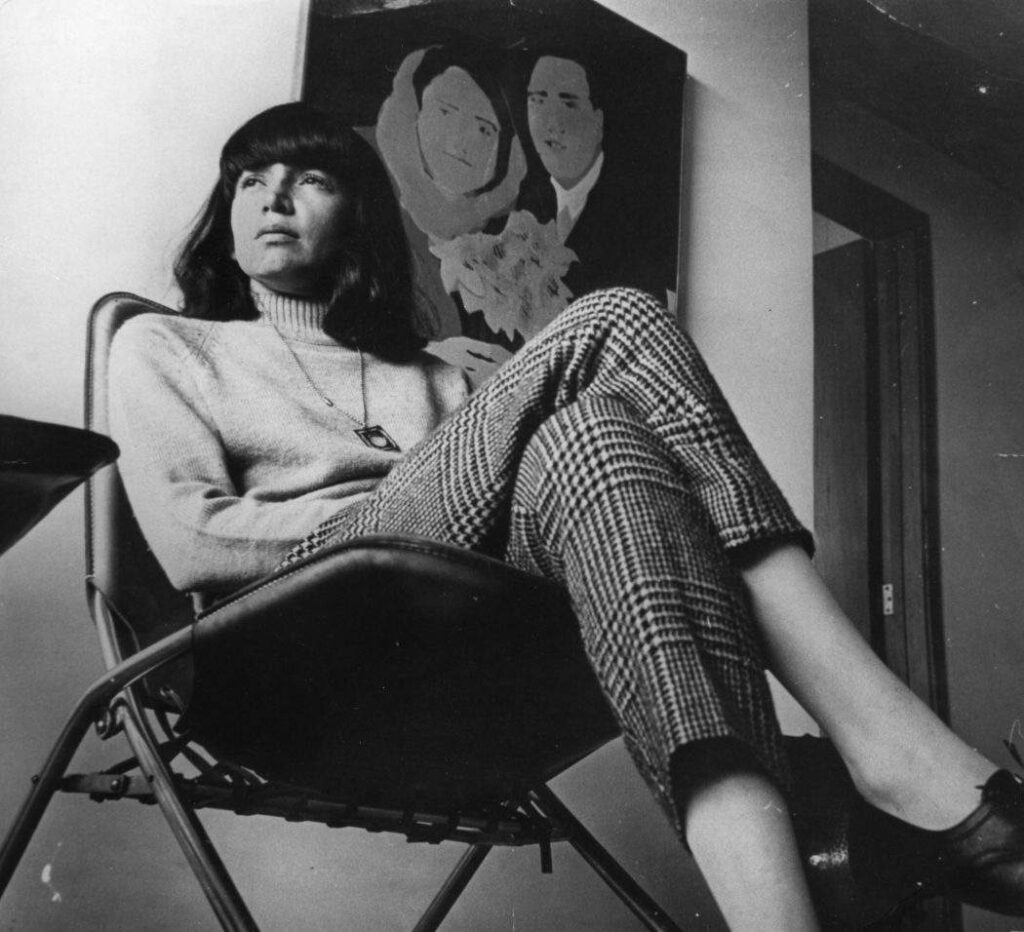
González came of age during one of the most traumatic periods in Colombian history. Born in Bucaramanga in 1932, she spent her formative years under the long shadow of La Violencia (1948–1958), the catastrophic civil conflict between Liberal and Conservative factions that claimed the lives of an estimated 200,000 Colombians. This historical wound would prove to be a permanent substrate of her artistic imagination — not as mere biographical backdrop, but as an epistemological condition that shaped how she understood images, power, and representation.
After briefly enrolling in architecture — a discipline whose structural logic would later inform her installations and furniture works — González transferred to the fine arts program at the Universidad de los Andes in Bogotá, graduating in 1962. There, she encountered two decisive intellectual forces: the Argentine art critic and historian Marta Traba, and the Spanish painter Joan Antonio Roda. Traba, in particular, was a towering presence in the formation of a Colombian modernism; she was combative, exacting, and deeply committed to the idea that Latin American art needed to define its own terms rather than simply follow metropolitan dictates (Ponce de León, 1988). It was Traba who, when González’s landmark painting Los suicidas del Sisga (1965) was initially rejected by the jury of the Salón de Artistas Colombianos as a “bad Botero,” intervened to demand its reconsideration. The painting not only gained acceptance but won González a special prize, launching her public career. The debt to Traba was both institutional and deeply personal — as González later acknowledged, it was Traba who first created conceptual and institutional space for women artists in the Colombian scene.
González later extended her training with printmaking studies at the Rijksakademie van Beeldende Kunsten in Amsterdam, an experience that reinforced her interest in reproducibility, seriality, and the mechanical circulation of images — themes that would animate her entire oeuvre.
II. “The Joy of the Underdeveloped”: Pop Art and Its Discontents
González’s relationship to Pop Art is perhaps the most theoretically productive tension in her work, and one she herself reflected on with characteristic precision and wit. She has been widely catalogued as one of Latin America’s leading Pop artists — her works appeared in the landmark Tate Modern exhibition The World Goes Pop (2015), and critical literature frequently situates her alongside Andy Warhol and Roy Lichtenstein as a practitioner of appropriation and mass-media imagery. Yet González consistently resisted this label, and her resistance is not mere modesty or provincial defensiveness; it is a substantive theoretical position.
“I’ve always considered myself more of a painter,” she told ArtReview in 2016, “and within this remit I painted the joy of the underdeveloped. For me the type of art that I was doing could only circulate internationally as a curiosity. Mine was a provincial type of art without horizons, confronting the everyday: art is international.” This self-description as painter of “the underdeveloped” is not self-deprecation — it is a semiotic and political declaration. Where North American Pop Art engaged with the surfaces of consumer culture and the glamour of commodity fetishism, González was interested in something altogether different: the way in which masterpieces of the Western canon — Vermeer, Manet, Velázquez, Leonardo — were received, distorted, and resignified in the periphery.
This theory was formalized in her presentation at the 1978 Venice Biennale, where she spoke of “the transformations that the work of art endures in underdeveloped countries.” As she explained: Vermeer’s Woman with a Pearl Necklace circulates in Colombia in a pamphlet about sexual education; Leonardo’s Last Supper is hung in homes as a talisman against thieves. The iconic becomes kitsch, the sacred becomes utilitarian, and the aura of the masterpiece is dispersed into the noise of everyday life. For González, this was not a tragedy to be lamented but a productive condition to be painted — with flat, saturated colors that deliberately evoked the cheap reproduction and the handmade sign. Scholar Ana María Reyes, in her important doctoral dissertation “Art at the Limits of Modernization: The Artistic Production of Beatriz González during the National Front in Colombia” (University of Chicago, 2011), frames this practice as a critique of the conditions of cultural modernization in Cold War Colombia, arguing that González’s paintings interrogate the very logic of taste that Western aesthetic discourse sought to impose on peripheral societies.
III. The Suicides of Sisga and the Ethics of the Image
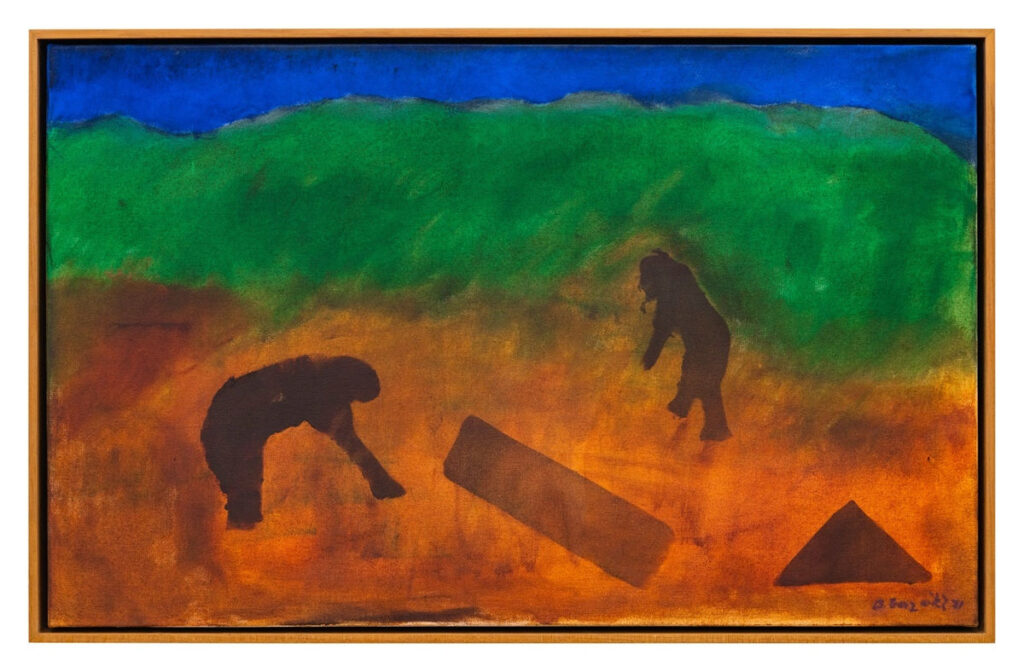
No single work more clearly marks González’s artistic turning point than Los suicidas del Sisga (1965), a series of three paintings based on a newspaper photograph published in El Tiempo. The photograph depicted a young couple — a man and woman — who had thrown themselves from the Sisga Dam on the outskirts of Bogotá, having arranged for a professional photographer to document their final moments before what the man, in a state of mystical obsession, called a sacrifice to preserve the purity of their love.
González’s transformation of this newspaper image into a series of paintings is a decisive act of mediation. The painting does not sensationalize; it does not exploit. Instead, it abstracts the image, flattening it into zones of vivid color, removing the naturalism that would make it documentary, and in doing so asks fundamental questions about the status of photography as witness and painting as monument. As González herself articulated when asked what painting does that photography cannot: “Photography takes the place of the model in academia. I think that photography’s particularity lies in its ephemeral quality, while the essence of painting lies in its endurance.” In this distinction lies an entire theory of art history: the newspaper photograph is disposable, consumed and discarded in the flow of daily information; the painting, however crude or popular its register, insists on duration, on memory, on being seen again.
The critical literature on this series has been rich and growing. Carolina Ponce de León, in her foundational 1988 monograph on González, identified the driving force of the artist’s practice as its “ethical dimension” — a commitment not to political propaganda but to a deeper engagement with the moral texture of Colombian life (Ponce de León, 1988; ICAA Documents Project). This ethics of the image, as I would call it, means that González never simply appropriates: she transforms, she mourns, she insists on the humanity of the photographed subject even as she denies the photograph its claim to realism.
IV. Furniture, Power, and Satire: The Political Works
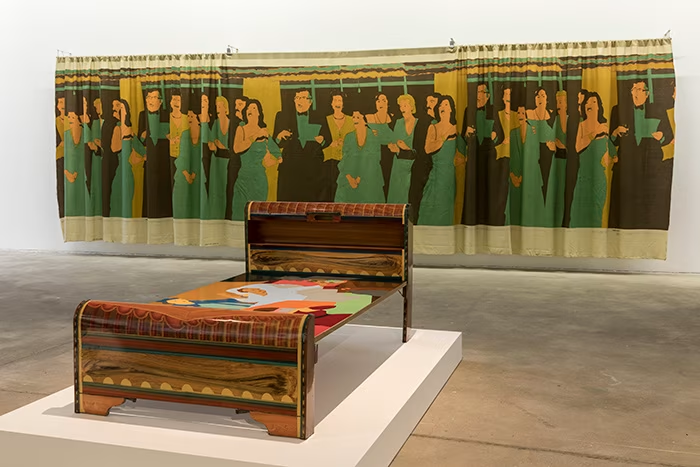
One of the most formally inventive episodes in González’s career began with an accidental discovery in a hardware store in the 1970s: store-bought furniture — cribs, beds, curtains, tables — as pictorial support. González began painting directly on found domestic objects, typically middle-class furniture that she found on the streets of Bogotá, incorporating images from her canonical series of political figures, Renaissance reproductions, and tabloid imagery. Marta Traba wrote compellingly about these furniture works in her 1977 text Los muebles de Beatriz González, arguing that they occupied a unique position between fine art and the decorative arts, between the prestigious and the popular.
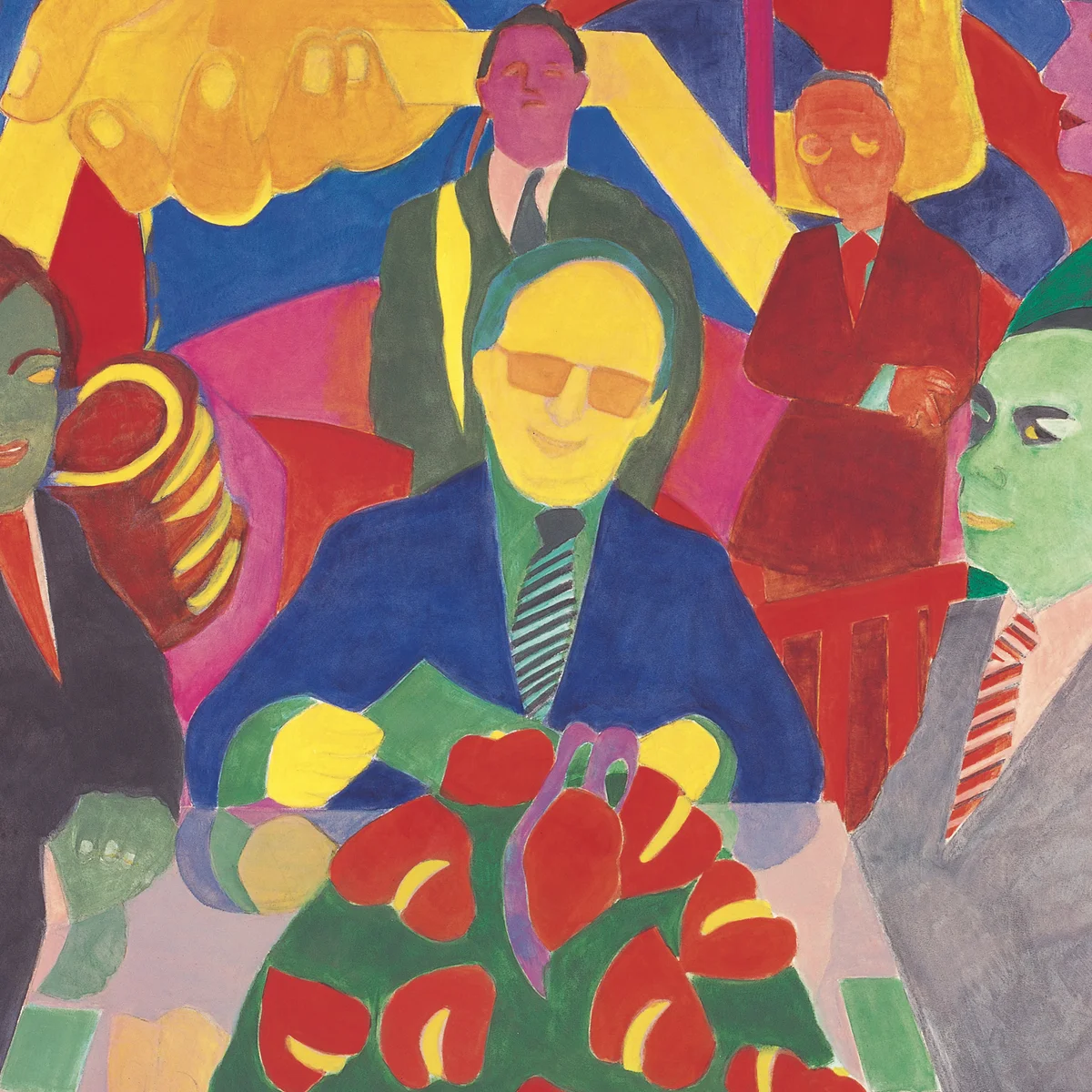
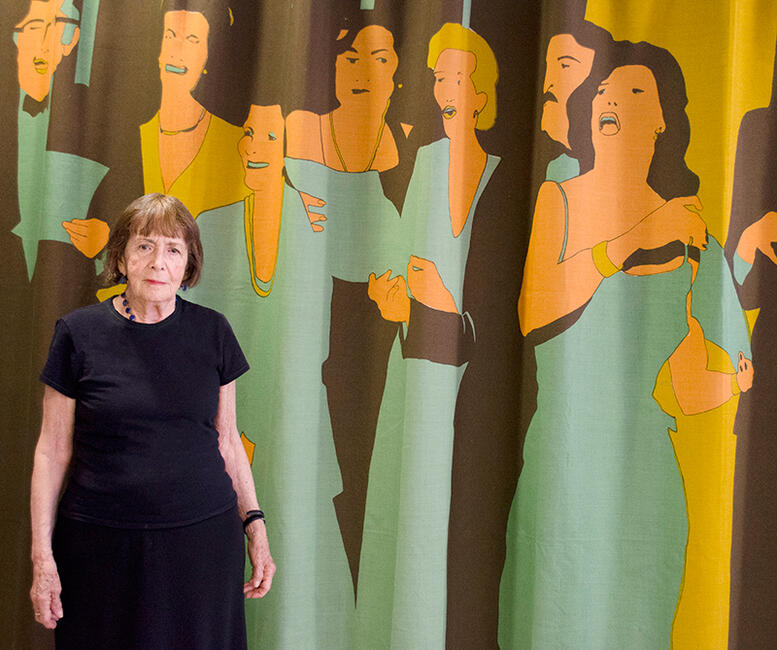
The political dimension of González’s work intensified from the 1980s onward, as Colombia descended further into cycles of narco-violence, guerrilla warfare, and state repression. Works such as Señor Presidente, qué honor estar con usted en este momento histórico (1986) — later the title of her major retrospective exhibition at El Museo del Barrio in New York in 1998 — deployed González’s signature flat figures and mordant irony to dissect the theater of political power. In the monumental undulating curtains titled Interior Decoration (1981), she repeatedly depicted a press photograph of President Julio César Turbay Ayala singing at a party; the flatness of the rendering, as ArtReview noted, sarcastically evokes the president’s ineffectiveness amid the growing violence of his era.
González was careful to distinguish her practice from political art in the propagandistic sense. “It’s been a critique of power that has impregnated my work,” she told ArtReview. “For that same reason, I don’t think of it as ‘political’; it just has a commitment to ethics.” This distinction is important: her satirical images of presidents and generals do not advocate for a particular political program; they inhabit a more unsettling register, one of absurdity, of the grotesque, of laughter that catches in the throat.
V. Auras Anónimas: Mourning as Monument
If any single work encapsulates the full reach of González’s ambition, it is Auras Anónimas (Anonymous Auras, 2007–2009), the monumental installation she created for the columbariums of the Central Cemetery in Bogotá. The work was born of both civic urgency and artistic vision: since 2003, González had been fighting to save the columbariums — six buildings constructed in 1943 to house the bodies of the poorest inhabitants of the city — from demolition. The columbariums had accumulated anonymous victims of Colombia’s decades of armed conflict, bodies laid in niches that were then left empty when no one came to claim them.
González created eight distinct silhouettes of cargueros — the porters who carry the dead in popular Colombian funerary tradition, a figure drawn directly from photojournalistic images of the violence — and reproduced them across 8,957 silk-screen prints installed over every tombstone in the columbarium walls. The image was haunting in its simplicity: figures bent under the weight of the dead, repeated thousands of times, a visual dirge for the anonymous casualties of a conflict that had no definitive beginning and no clear end.
The work transformed the columbariums into a site of collective mourning and public memory — and González’s persistence in defending the space against demolition eventually bore institutional fruit: the columbariums were declared a National Heritage site in 2019, the same year that saw González’s first career retrospective in the United States at the Pérez Art Museum Miami. The recognition was global: in 2024, Auras Anónimas was awarded the Regional Grant Award at the International Award for Public Art in Shanghai, with the jury praising its capacity to transform a forgotten space into a living monument to memory and healing.
Auras Anónimas represents a profound culmination of González’s lifelong engagement with the image as ethical act. The work draws together her sustained interest in photojournalism as source material, her commitment to seriality and repetition as structural principles, and her conviction — articulated most clearly in her later interviews — that art can perform a social function that history and politics alone cannot achieve. “Art says things that history cannot,” she stated succinctly, a position that in this context takes on the force of a manifesto.
VI. Curator, Critic, Educator: The Institutional González
Any account of González that confines itself to her paintings and installations risks underselling the full scope of her contribution to Colombian cultural life. Like her mentor Marta Traba, González understood that the conditions of art production and reception are themselves political — that you cannot make meaningful work in a vacuum of institutional indifference, and that part of the artist’s responsibility is to build the infrastructure through which art can be seen, debated, and remembered.
González coordinated the educational program at the Museo de Arte Moderno de Bogotá between 1978 and 1983, and served as chief curator of the Museo Nacional de Colombia from 1989 to 2003 — a tenure of fourteen years during which she undertook a systematic review and reinterpretation of Colombian art history. She published critical monographs on fellow artists, including the painter Luis Caballero (1943–1995), and participated in major international biennials: the 11th Bienal de São Paulo (1971), the 38th Venice Biennale (1976), the 8th Berlin Biennale (2014), and Documenta 14 in Kassel (2017). Her presence in these venues was not merely representative; she carried with her a coherent theoretical position about the specific conditions of artistic production in the so-called “underdeveloped” world, a position she articulated in catalogues, lectures, and interviews with unfailing rigor and wit.
VII. Legacy and Global Reception
The international reception of González’s work has accelerated dramatically in the years since her retrospective at the Pérez Art Museum Miami (2019), which presented nearly 150 works spanning six decades. This was followed by a major touring retrospective that passed through the Museo Nacional Centro de Arte Reina Sofía in Madrid (2018), and culminated — posthumously — in the grand retrospective at the Barbican Centre in London, which opened in February 2026, just weeks after her death. The Barbican described the exhibition as her “largest-ever exhibition in Europe,” and the critical response confirmed what Latin American art historians had long argued: that González belonged not in a regional category but in the first rank of twentieth-century artistic intelligence.
Her works now reside in the permanent collections of the Museum of Modern Art in New York, the Tate Modern in London, the Museum of Fine Arts in Houston, the Museo Nacional de Colombia, and the Casa de las Américas in Havana, among many others. The critical literature has grown accordingly: Teresa Eckmann’s analysis of González’s work in the context of Cold War aesthetics, published in conjunction with the 2019 retrospective catalogue, placed her firmly within the political and intellectual struggles of the postwar period; while Reyes’s doctoral dissertation (2011) remains the most rigorous academic treatment of her early work in its Colombian historical context.
Conclusion: “Art Says What History Cannot”
To stand before a Beatriz González is to inhabit a double consciousness: you are looking at Colombia, and you are looking at art history, and you are being asked — quietly, insistently, sometimes with devastating irony — to consider what happens when the second encounters the first. The bright colors of the underdeveloped, as she called them: those are not naïveté, not folk simplicity, not the primitiveness that European modernism always wanted to project onto its peripheries. They are a knowing, theoretically sophisticated response to the condition of being at the edge of a world system that sends its masterpieces as reproductions and its politics as violence.
González was, in the end, a singularity — an artist who was also an art historian who was also a curator who was also a public intellectual, and who understood all of these roles as aspects of a single ethical commitment: to make visible what Colombia’s violence, its politics, and its cultural dependency on the metropolitan center had made invisible. The cargueros of Auras Anónimas carry not only the unnamed dead of the armed conflict; they carry the weight of González’s entire life’s work. It is a weight that, as the Barbican retrospective and a world still grappling with its implications confirm, is far from exhausted.
References and Sources
Ariza, Carolina. “Beatriz González: From the Dismantling of Universal Iconography to Provincial Singularity.” Interview. AWARE: Archives of Women Artists, Research and Exhibitions, January 24, 2017. https://awarewomenartists.com/en/magazine/beatriz-gonzalez-du-demontage-de-liconographie-universelle-a-la-singularite-provinciale/
AWARE: Archives of Women Artists, Research and Exhibitions. “Beatriz González.” Artist entry. https://awarewomenartists.com/en/artiste/beatriz-gonzalez/ (last updated 2024).
Barbican Centre. “Beatriz González: Retrospective.” Exhibition press release. London: Barbican Centre, 2026. https://www.barbican.org.uk/our-story/press-room/beatriz-gonzalez
Casas Riegner Gallery. “Beatriz González Has Been Awarded the International Award for Public Art 2024 in China for Her Work ‘Auras Anónimas.'” Press release. Bogotá, 2024. https://www.casasriegner.com/blog-en_ca/beatriz-gonz%C3%A1lez-honored-with-the-2024-international-award-for-public-art-in-china
Eckmann, Teresa. Review of Ana María Reyes, The Politics of Taste: Beatriz González and Cold War Aesthetics, and exhibition Beatriz González: A Retrospective. Cited in Academia.edu: “Context, Cursilería, and Sorrow: Beatriz González.” https://www.academia.edu/44172354/Context_Cursiler%C3%ADa_and_Sorrow_Beatriz_Gonz%C3%A1lez
Hammer Museum / UCLA. “Beatriz González.” In Radical Women: Latin American Art, 1960–1985, Digital Archive. Los Angeles: Hammer Museum, 2019. https://hammer.ucla.edu/radical-women/artists/beatriz-gonzalez
Institute for Public Art. “Auras Anónimas (Anonymous Auras).” Case study by Laura Zarta. https://www.instituteforpublicart.org/case-studies/auras-anonimas-anonymous-auras/
International Council for Latin American Art (ICAA) / Museum of Fine Arts Houston. “Beatriz González in Situ.” ICAA Documents Project. https://icaa.mfah.org/s/en/item/1088587
Ponce de León, Carolina, ed. Beatriz González: What an Honor to Be with You at This Historic Moment: Works, 1965–1997. New York: El Museo del Barrio, 1998.
Ponce de León, Carolina. Beatriz González [monograph, first retrospective]. Bogotá, 1988. [Cited in ICAA Documents Project]
Rappolt, Mark. “The Interview: Beatriz González.” ArtReview, 2016 (reprinted February 19, 2026). https://artreview.com/the-interview-beatriz-gonzalez-mark-rappolt/
Reyes, Ana María. “Art at the Limits of Modernization: The Artistic Production of Beatriz González during the National Front in Colombia.” PhD dissertation, University of Chicago, 2011.
Sierra Maya, Alberto. Beatriz González: La comedia y la tragedia. Retrospectiva, 1948–2010. Medellín: Museo de Arte Moderno, 2011.
Tate Modern. “Who Is Beatriz González?” Artist profile with interview, 2015. https://www.tate.org.uk/art/artists/beatriz-gonzalez-11980/who-is-beatriz-gonzalez
Traba, Marta. Los muebles de Beatriz González. Bogotá: Museo de Arte Moderno, 1977.
Universes Art. “Beatriz González – In Memoriam.” 2026. https://universes.art/en/magazine/articles/2026/beatriz-gonzalez-in-memoriam
Villegas Jiménez, Benjamín. Beatriz González. Bogotá: Villegas Editores, 2005.
Wikipedia. “Beatriz González.” Last modified January 2026. https://en.wikipedia.org/wiki/Beatriz_Gonz%C3%A1lez