Edouard Duval-Carrié Returns to Venice: History, Spirit, and the Politics of Visibility
There’s something quietly seismic about Edouard Duval-Carrié being selected to represent Haiti at the 61st Venice Biennale. Not because he’s new—he isn’t. Not because he’s emerging—he’s long established. But because his return to Venice, fifteen years after Haiti’s first official pavilion in 2011, feels less like participation and more like a recalibration.
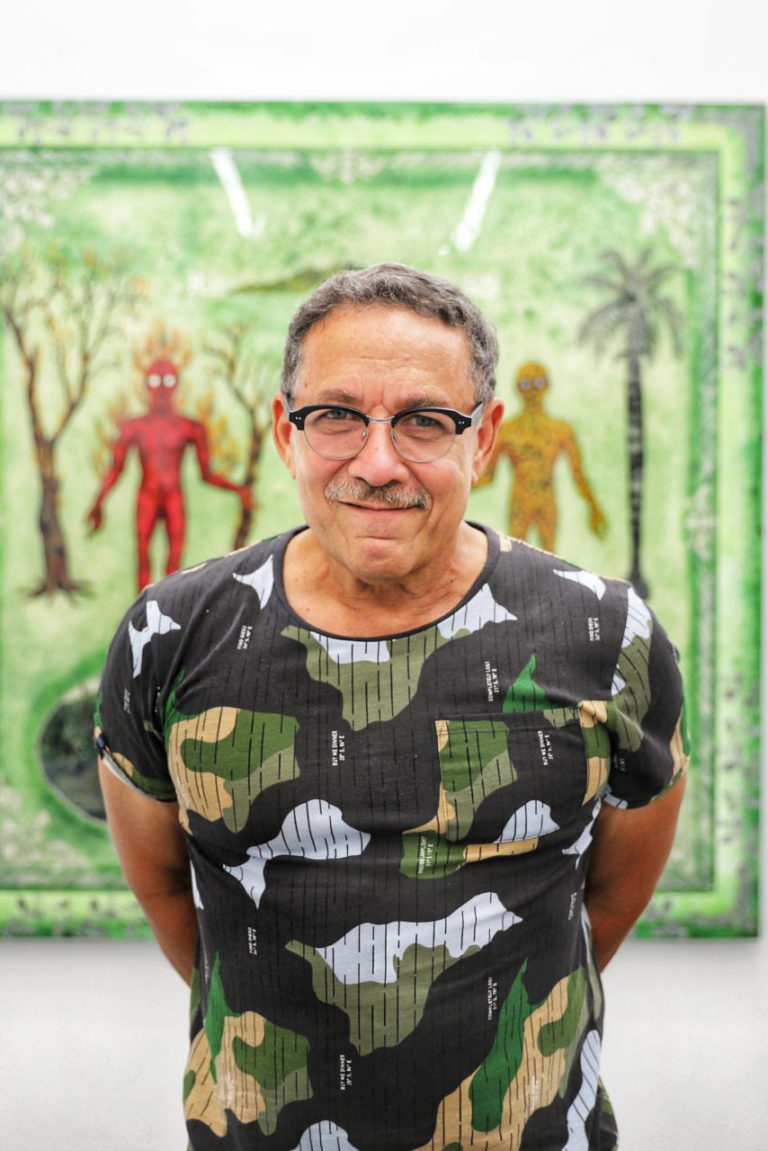
Duval-Carrié has spent decades doing something the art world still struggles to fully absorb: making history visible without flattening it. His work doesn’t illustrate Haiti—it conjures it. Through resin, glass, and that unmistakable shimmer of glitter, his figures hover between presence and disappearance, as if caught mid-transformation. These are not images to look at. They are systems to enter.
The Venice Biennale, with its appetite for spectacle and national narratives, is not always kind to complexity. Yet Duval-Carrié’s practice thrives in precisely that tension. His guiding question—“What did Africa bring to the world?”—is not rhetorical. It is a provocation. It cuts through centuries of erasure and forces a reorientation of cultural memory.
What he brings to Venice is not just a body of work, but a worldview shaped by movement—Haiti, the Caribbean, North America, Europe—and by a sustained engagement with Haitian Vodou cosmology. In his visual language, lwa are not symbols; they are agents. History is not past; it is active, unstable, unresolved.
Back in Miami, in Little Haiti, a different kind of moment unfolds. In a rare, one-night studio preview organized with the Tout-Monde Art Foundation, the works that will not travel to Venice are given their own stage. This gesture matters. It resists the usual logic of the art world, where what leaves becomes important and what stays disappears. Here, the local community is not an afterthought—it is part of the work’s circulation.
A conversation with art historian Erica Moiah James frames this moment: not as a prelude, but as a narrative in itself. Because Duval-Carrié’s work has always been about storytelling—not the kind that resolves, but the kind that accumulates, layers, and insists.
Venice will see the official version.
But the real story is larger than any pavilion.