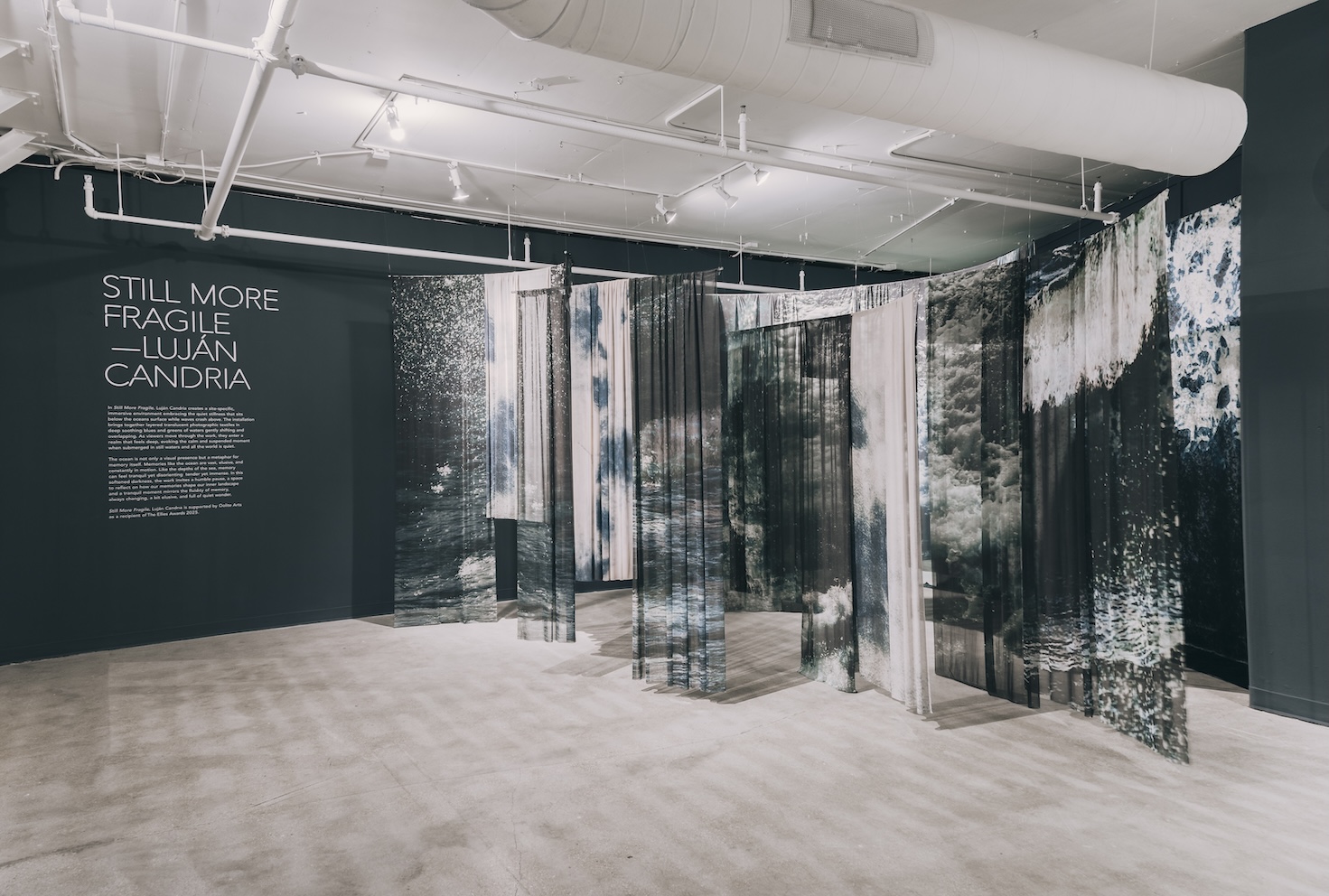
In Still More Fragile: Memory, Immersion, and the Unstable Image
In Still More Fragile, Luján Candria constructs a space that feels less like an artwork and more like a shift in perception—a quiet descent into a slower register where language begins to dissolve. What remains is not interpretation, but presence. You are not looking at the work; you are inside it.
Candria’s practice resists passive viewing. Layers drift, images refuse to settle, and the eye is forced to adjust. Seeing becomes physical—dependent on movement, proximity, and time. Nothing arrives fully formed.
Memory, here, is not something retrieved but something navigated. It behaves less like an archive and more like a landscape—unstable, layered, impossible to grasp from a single position. The ocean is not a metaphor so much as a structure: depth without clarity, movement without fixed meaning.
The work does not collapse into certainty. It holds its instability. Images shift. Meaning slips. What you see depends on how you move through it. This is not ambiguity as effect—it is ambiguity as condition.
Authorship loosens in the process. Memory is not owned; it is shaped—by time, by perception, by the present pressing against the past. Candria does not construct a narrative so much as create the conditions for one to emerge.
By the end, the distinction between landscape and interior life begins to erode. What appears external turns inward. What feels distant becomes intimate.
The work does not resolve.
It lingers—somewhere between seeing and sensing, between memory and its disappearance.
AMM. In Still More Fragile, the viewer enters a suspended, almost pre-linguistic space beneath the surface. How do you understand this descent—as a phenomenological condition—and what kind of awareness becomes possible only in this state of immersion?
LC. I understand this descent as a shift in perception—from a more external way of seeing to a more embodied and internal experience. It’s less about going “beneath the surface” and more about entering a state where perception slows down and becomes less connected to language.
Rather than interpreting the work, the viewer inhabits it. It’s a space where boundaries soften, allowing for a more open and receptive way of paying attention.
For me, this immersion creates space for ambiguity, for silence, and for a kind of quiet recognition that cannot always be explained, but can be deeply felt.
AMM. The ocean in your work is not merely metaphor but a structure of thought. How do you conceive memory as a spatial system—one that can be navigated, inhabited, or even lost within—rather than simply recalled?
LC. I think of memory not as something linear or fixed, but as a kind of spatial field—something that can be entered, moved through, and experienced from multiple positions. In that sense, it’s closer to a landscape than to an archive.
The ocean becomes a way of thinking through this condition. It holds depth, movement, and opacity—there is no single point of access. Similarly, memory is not something we simply retrieve, but something we navigate. It shifts depending on where we stand, what we bring to it, and how we move within it.
In Still More Fragile, I try to create environments where this can be experienced. The viewer enters the image, moving through layers and fragments. This opens up new forms of perception, creating space for a different kind of engagement—one that is less about defining and more about experience.
AMM. Your installation destabilizes fixed perception through translucency, overlap, and movement. To what extent is the work proposing a critique of visual certainty, and how does it reposition the act of seeing as something unstable, contingent, and embodied?
LC. I don’t see the work as a critique of visual certainty, but as a reflection of how memory operates. Memory is never fixed or stable—it shifts, overlaps, and transforms over time. In that sense, the visual language of the installation—through translucency, layering, and movement—mirrors this condition.
The image is not presented as something definitive, but as something that is always in the process of becoming.
In this way, the act of seeing becomes unstable and embodied. Perception is shaped by movement, proximity, and time, rather than by a fixed point of view. The viewer does not observe from a distance, but navigates the work, and meaning emerges through that experience.
AMM. Your practice engages deeply with fragmentation, erasure, and recomposition of images. Do you see memory as an act of construction rather than retrieval—and if so, who or what is the “author” of that reconstruction?
LC. I understand memory as both an act of construction and a form of retrieval. It is not something we access intact, but something that is continuously shaped, reconfigured, and even partially invented over time. What we retrieve is always already transformed.
In that sense, there is no single author of memory. It emerges from an intersection between personal experience, time, and perception. What we remember is always influenced by our present condition—by what we feel, what we need, and how we position ourselves in relation to the past.
In my work, this understanding takes form through processes of fragmentation and recomposition.
AMM. In your work, the landscape seems to shift from an external environment to an internal condition. How do you negotiate the boundary between the seen world and the felt world, and where does identity situate itself within that threshold?
LC. I don’t see it as something that needs to be negotiated, but as a continuous condition. The boundary between the seen and the felt is constantly shifting.
Identity, for me, exists within that overlap. It is formed in relation to the landscape—through memory, experience, and a sense of belonging. The external and the internal are not separate, but intertwined.
The landscape is not only something we observe, but something we inhabit, carry, and continuously reconstruct.