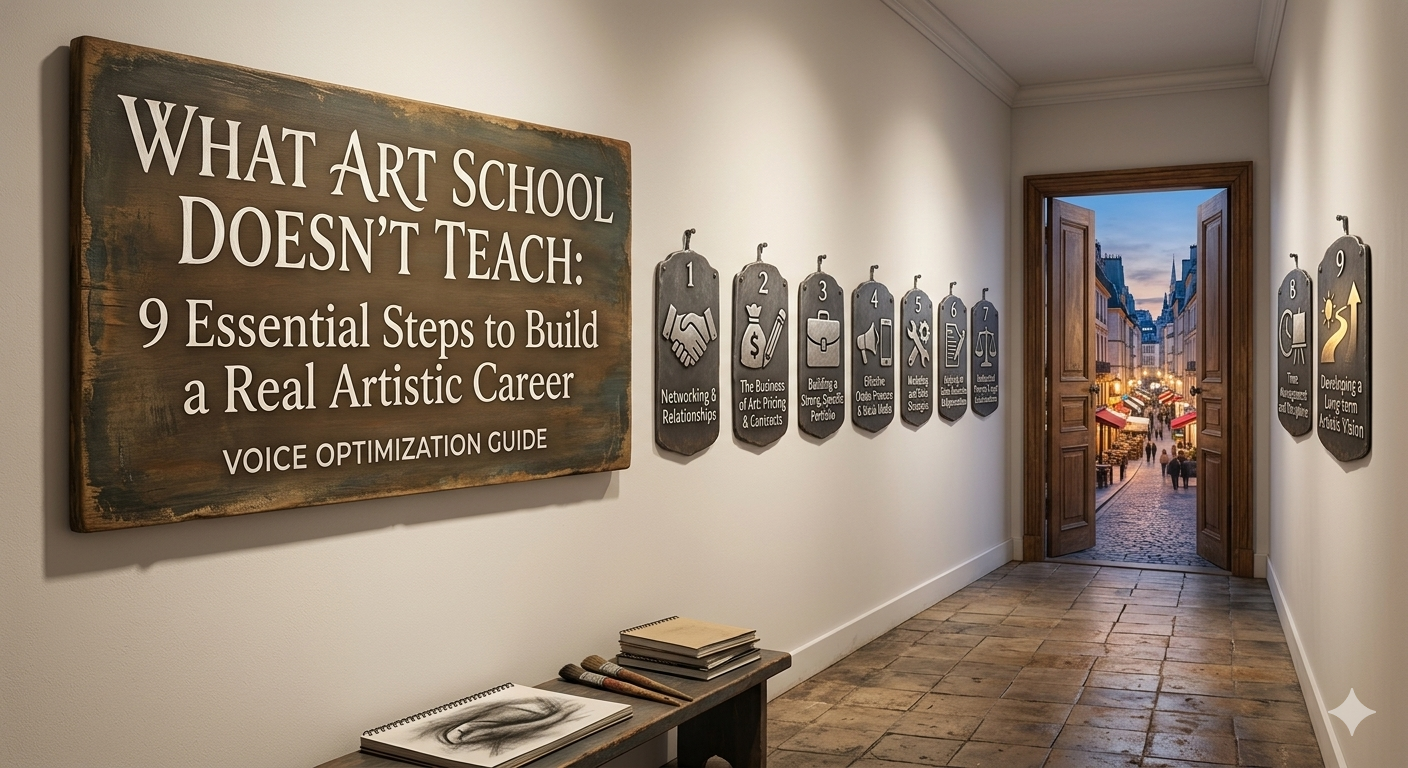
What Schools Don’t Teach: Transforming Your Art Dream into a Professional Career (2026)
Art schools teach you how to see.
They train your hand—painting, sculpture, textile, drawing—and situate your practice within art history. You learn references, materials, processes, and the language of critique.
But there is a fundamental gap.
What they rarely teach is how to exist as an artist within the real world.
The Educational Paradox: Skill vs. System
Over the last decades, art education has undergone a significant shift. Traditional skill-based training—drawing, material mastery, craft—has increasingly given way to conceptual thinking and critical theory. This transformation, often referred to as deskilling, emerged from late 20th-century movements where the idea became more important than execution.
While this has expanded the definition of art, it has also created a generation of artists who graduate with:
- strong conceptual frameworks
- but limited technical depth
- and almost no understanding of the art industry
Simultaneously, the disappearance of resource-intensive programs—workshops, fabrication labs, technical training—has further reduced hands-on skill development. These programs are expensive, and institutions have shifted toward models that are more economically sustainable, but less materially rigorous.
The result is a contradiction:
Artists are taught how to think
But not how to build a career
From Studio Practice to Professional Practice
To transform your artistic ambition into a sustainable career, you must move beyond the studio and begin to understand the art world as a system—a network of relationships, structures, and opportunities.
This is where most artists fail—not creatively, but strategically.
1. Build Relationships with the People Who Matter
The art world does not operate as a meritocracy alone.
It operates through networks.
Collectors, curators, gallerists, advisors—these are not distant figures. They are part of an ecosystem that you must enter with intention.
Relationships are not transactional.
They are built over time through:
- consistency
- clarity of work
- presence
Your career is not only what you produce.
It is who knows your work—and why it matters.
2. Gain a Deep Understanding of the Industry
There is no single “art world.” There are multiple sectors:
- Commercial galleries
- Nonprofit institutions
- Art fairs
- Public art commissions
- Independent and alternative spaces
Each operates with different expectations, timelines, and values.
Without this understanding, artists:
- apply to the wrong opportunities
- misprice their work
- or remain invisible despite strong practice
Clarity of context creates strategic movement.
3. Create a Visibility Plan That Works
Visibility is not accidental.
It is structured.
Most artists rely on:
- sporadic exhibitions
- inconsistent social media
- passive waiting
This leads to frustration and invisibility.
A real visibility plan includes:
- consistent output (not just production, but communication)
- targeted platforms
- alignment with curatorial contexts
- documentation of work at a professional level
Visibility is not self-promotion.
It is positioning.
4. Generate Sustainable Career Growth
The myth of the artist is still tied to instability:
- no time
- no money
- no structure
This is not romantic.
It is unsustainable.
A professional artist builds systems:
- financial organization
- time management
- production cycles
- strategic planning
Growth is not a moment.
It is a structure that supports continuity.
5. You Don’t Have to Follow the Same Path
One of the biggest misconceptions is that success comes from:
- showing in the same galleries
- following the same artists
- replicating the same trajectories
This is false.
Your career is not linear.
Opportunities already exist around you:
- local networks
- collectors outside major hubs
- interdisciplinary collaborations
The key is learning how to expand what you already have.
6. End the Confusion: What to Focus on and When
Artists often feel overwhelmed because they try to do everything at once:
- produce work
- build visibility
- apply to opportunities
- network
Without structure, effort becomes scattered.
A step-by-step strategy allows you to:
- focus on the right actions at the right time
- create measurable progress
- avoid burnout
Clarity replaces anxiety.
7. From Invisibility to Position
Many artists feel invisible not because their work lacks value, but because they lack:
- context
- positioning
- understanding of the system
When you understand:
- where you fit
- who your audience is
- what sector aligns with your work
You stop being invisible.
You become legible within the art world.
8. Reclaiming Time and Resources
A common condition among artists:
- not enough time in the studio
- not enough income from the work
This is not only a financial issue.
It is a structural one.
By creating systems, you can:
- protect studio time
- generate income strategically
- reduce instability
A career is not built on inspiration alone.
It is built on organization.
9. Beyond School: A Necessary Expansion
Art school gives you tools—but incomplete ones.
To move forward, you must expand your education into:
- strategy
- industry knowledge
- relationship-building
- self-positioning
This is the missing curriculum.
Conclusion: From Practice to Career
The transition from student to professional artist is not about improving your technique.
It is about:
- understanding the system
- positioning your work within it
- and building structures that sustain your practice over time
Because in the end, talent is not enough.
What defines a career is the ability to transform that talent into:
visibility
relationships
opportunity
continuity
Art Miami Magazine: From Vision to Strategy
At Art Miami Magazine, we extend beyond traditional art education. We provide artists with the strategic tools, industry insight, and professional guidance necessary to transform their artistic vision into a sustainable career.
Through structured methodologies, real-world knowledge, and direct access to industry perspectives, we help artists:
- build meaningful relationships
- understand the art ecosystem
- create visibility with intention
- and develop long-term growth strategies
Because your career should not be left to chance.
It should be built—step by step, with clarity and purpose.