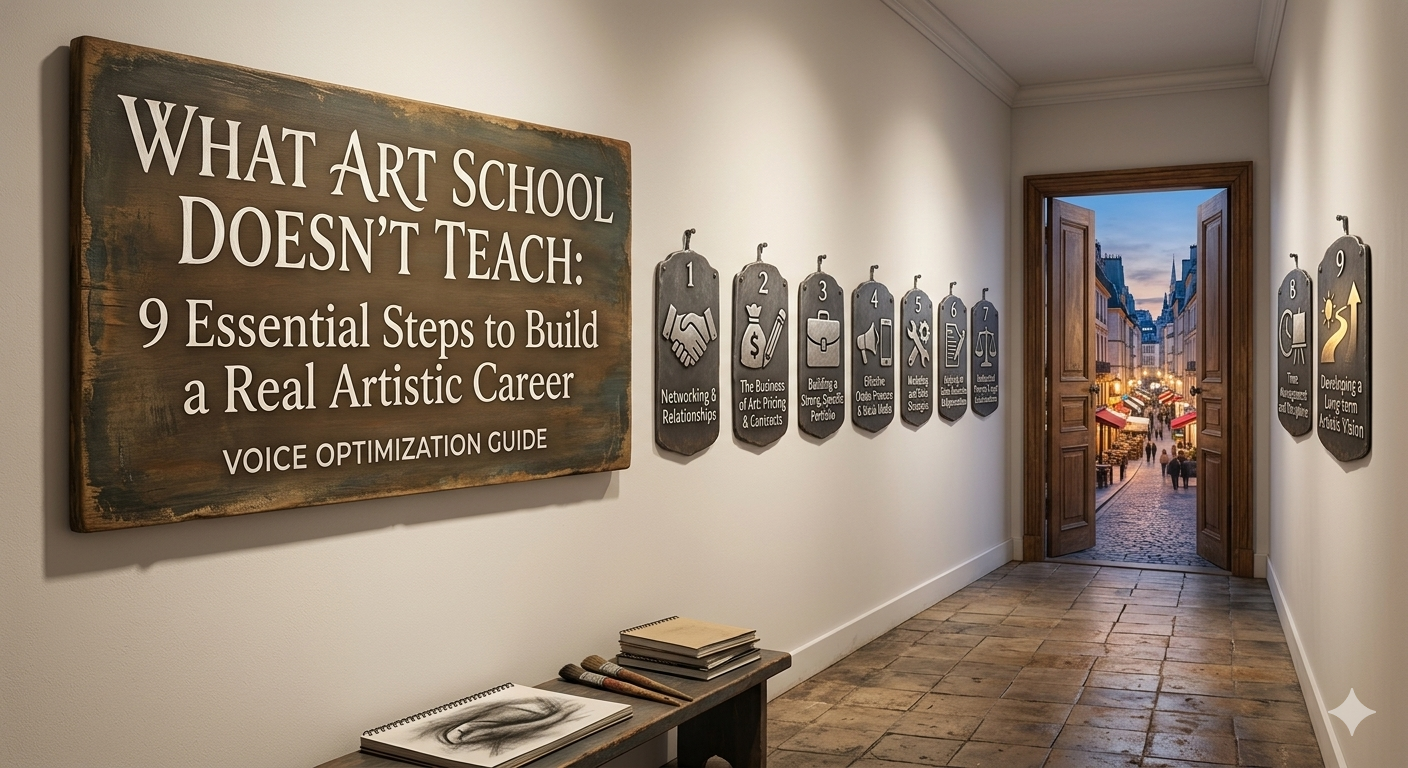
What Art School Doesn’t Teach: 9 Essential Steps to Build a Real Artistic Career
Graduation is often mistaken for arrival. In reality, it is a point of departure—one that reveals a fundamental gap between academic formation and professional reality. Art school refines perception, technique, and critical language, yet it rarely equips artists with the structural tools required to navigate the art world as a system.
What follows is not a motivational guide, but a strategic framework—one that allows you to locate yourself within the ecosystem of art, define your position, and move forward with clarity and intention.
1. Define Your Artistic Identity
Before entering the market, you must understand your own work.
Not stylistically, but conceptually:
- What are you investigating?
- What tension drives your practice?
- Why does your work need to exist?
Your identity is not your medium.
It is your position.
2. Identify Your Career Level
Most artists fail not because of lack of talent, but because of misalignment.
You must determine where you stand:
- Emerging → developing visibility
- Mid-career → building structure and audience
- Established → consolidating influence and legacy
Each level requires different strategies.
Confusion here leads to stagnation.
3. Build an Emergence Strategy (Early Career)
If you are starting:
- Identify your first audience (not “everyone”)
- Protect studio time as a non-negotiable
- Begin showing work—even in small, imperfect contexts
Visibility is not vanity.
It is existence within the system.
4. Plan Your Expansion (Mid-Career)
Growth requires structure:
- Refine your narrative
- Strengthen your digital and physical presence
- Align your work with curatorial contexts
At this stage, your task is not to produce more—
but to position better.
5. Master Elevation (Established Artists)
If you are already visible:
- Curate your opportunities
- Deepen relationships with collectors and institutions
- Focus on long-term impact rather than constant output
Maturity in an artist is measured by precision, not volume.
6. Identify Your Industry Sector
Art is not a single market.
You must locate where your work belongs:
- Commercial (galleries, collectors)
- Retail (design-driven, accessible art)
- Nonprofit (institutions, grants, residencies)
- Public art (commissions, urban interventions)
Clarity here transforms effort into opportunity.
7. Create Your Strategic Roadmap
Without structure, intention dissolves.
Define:
- Short-term goals (3–6 months)
- Mid-term goals (1–2 years)
- Long-term direction
Translate them into specific, actionable steps.
A plan is not a vision—it is a sequence.
8. Execute with Discipline
Ideas do not build careers—execution does.
Develop:
- A weekly system of action
- A checklist tied to your roadmap
- A rhythm that sustains productivity
Consistency is the invisible force behind visibility.
9. Build a Life Around Your Practice
No career survives instability.
- Organize your finances
- Create a daily structure
- Seek mentorship and critical feedback
- Continue learning beyond formal education
An artist’s career is not separate from life.
It is an extension of how that life is structured.
Final: From Artist to Position
What art school rarely teaches is that talent is only one variable within a larger system. To build a career, you must understand that system—its sectors, its rhythms, and its expectations.
The transition from student to professional artist is not about doing more work.
It is about thinking differently about your work.
Because in the end, a career is not something you wait for.
It is something you construct.
If you’re ready to elevate your career as a visual artist, Art Miami Magazine can support you with experienced professionals and the right tools to help you move forward with clarity and strategy. Our goal is to help you build visibility, strengthen your positioning, and take concrete steps toward achieving your artistic vision.