During Bakehouse Art Complex’s annual fundraiser, the Miami-based conceptual artist transformed a one-night exhibition into a provocative performance examining desire, trust, identity, and the hidden mechanisms of the art market.
The most intriguing thing about a secret may not be what it conceals, but how badly someone wants to discover it.
At Studio 45 in Miami, on November 6, 2026, artist Katelyn Kopenhaver transformed this simple observation into an ingenious artistic experiment. Presented during Bakehouse Art Complex’s annual fundraiser, The Price List consisted of ten sealed envelopes containing fragments of the artist’s personal and professional life.
Their contents remained undisclosed until acquisition. Instead of conventional monetary prices, prospective collectors were asked to exchange something of themselves, completing an action the artist determined.
By the evening’s end, every envelope had found a buyer.
“I sold all of the envelopes. I sold them relatively fast,” Kopenhaver recalled afterward, describing an experience that exceeded her expectations.
But the sales were only one element of a remarkably sophisticated performance. What unfolded around those transactions revealed the exhibition’s deeper examination of social behavior, perception, and the commercial art world’s extraordinary influence.
The Artist Becomes Her Own Gallerist
Perhaps the most fascinating aspect of The Price List was Kopenhaver’s decision to assume the role of the very person representing her work.
Rather than introducing herself as the artist, she performed as her own gallerist, presenting Katelyn Kopenhaver as someone whose work she was promoting.
The distinction was subtle, but its implications were profound.
Some visitors knew her personally and played along. Others didn’t know her and asked whether Kopenhaver was present.
She responded like a gallery representative, offering information about the artist, fielding questions, and occasionally suggesting she could pass along a message.
Her demeanor shifted accordingly: friendly yet professionally detached, sometimes deliberately reserved.
Kopenhaver discovered that occupying this position let her ask questions and direct interactions in ways that might have felt different if she had presented herself simply as the artist.
The performance exposed the invisible hierarchies that influence how people respond to authority within cultural institutions.
A gallerist is often perceived as possessing expertise, access, and the power to determine artistic value. The artist, meanwhile, is often positioned as someone seeking representation and recognition.
Kopenhaver collapsed these roles.
By simultaneously creating, representing, and selling her own work, she became both the subject and the architect of the transaction.
The resulting confusion was intentional.
Some visitors eventually discovered her identity, occasionally looking her up before recognizing the elaborate performance unfolding around them.
According to Kopenhaver, learning the truth only heightened their appreciation of the work.
The artist described the experience as distinctly “Warholian,” reflecting the complex relationship between artistic identity, self-promotion, and the mechanisms of celebrity and commerce.
When Desire Becomes Contagious
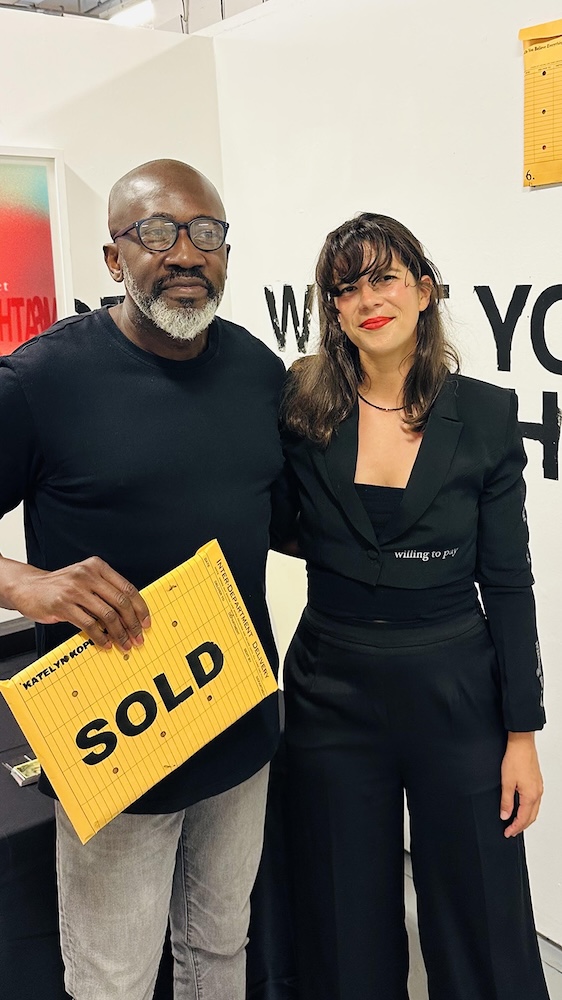
Kopenhaver’s investigation extended beyond individual transactions into the psychology of collecting.
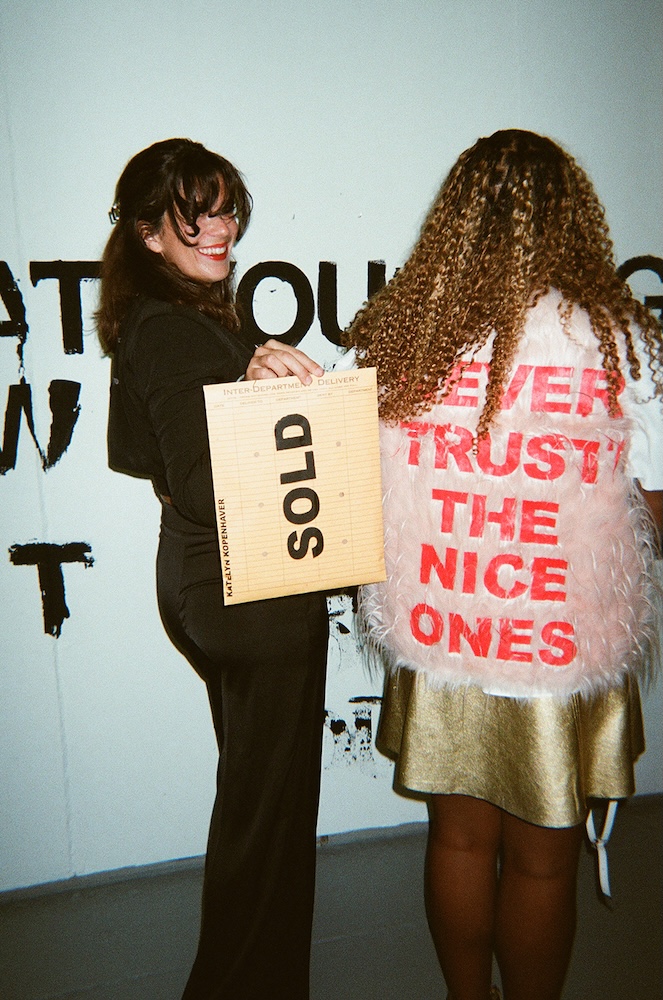
After someone acquired an envelope, she screen-printed “SOLD” across its surface.
The collector was then instructed to carry the envelope facing outward.
This seemingly modest gesture transformed a private acquisition into a public announcement.
As visitors moved through the event displaying their purchases, others began asking where the envelopes had come from. Curiosity spread. More people wanted to participate.
Kopenhaver observed a familiar phenomenon within collecting culture: an object’s desirability can increase when others appear to want or possess it.
The envelopes became symbols of exclusivity without revealing anything about their contents.
Their value was generated partly through mystery and partly through the social interactions surrounding them.
The artist was not simply observing consumer behavior. She had constructed the circumstances through which it unfolded.
Her performance became an intricate choreography of anticipation, curiosity, acquisition, and recognition.
The exchanges also involved visitors from different corners of the art world, including collectors, curators, and individuals affiliated with museum boards.
Each transaction reinforced the exhibition’s central proposition: value is not inherent in an object alone. It is also produced through relationships, expectations, and belief systems.
In an unexpected extension of the evening’s commercial energy, Kopenhaver even sold two of her blazers.
The incident offered a humorous reminder that desire and intrigue can easily move beyond the objects originally presented for sale.
The Visual Language of Power
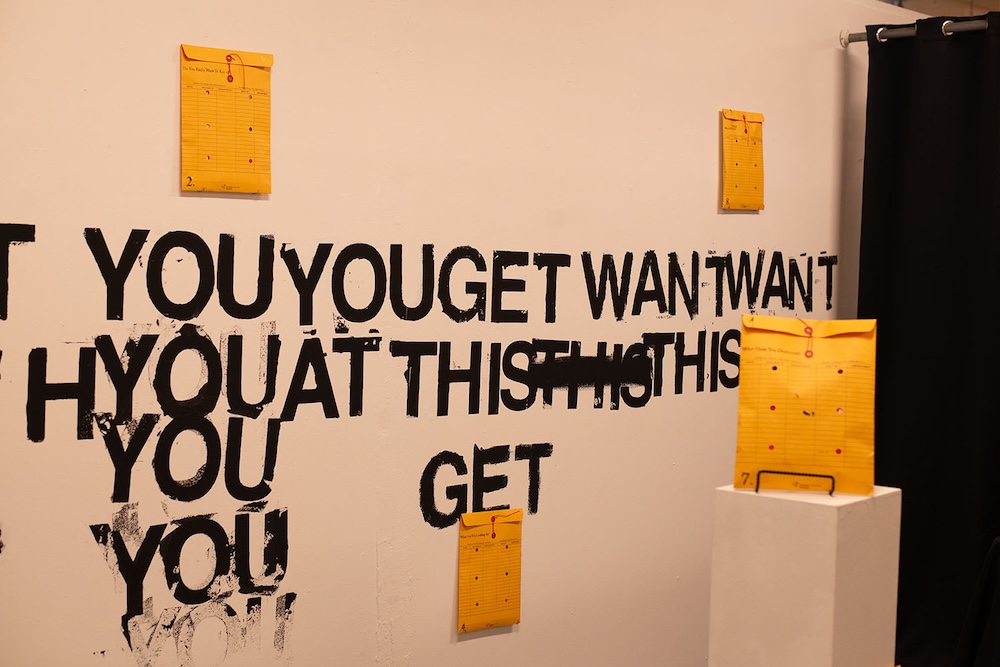
The installation itself was as conceptually considered as the performance.
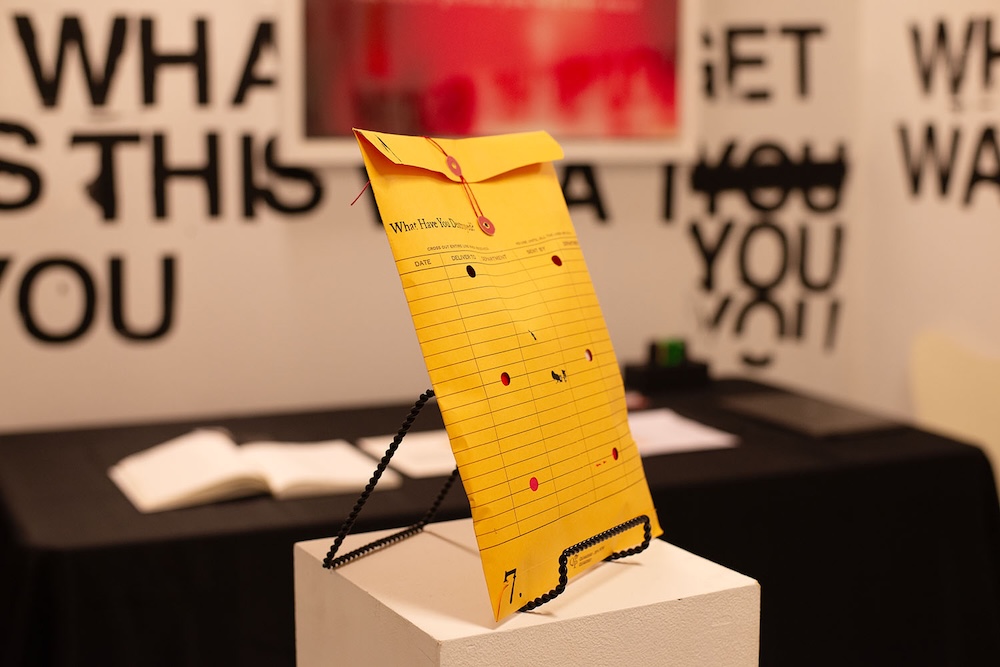
Across the white gallery walls, oversized black typography fragmented and repeated words associated with wanting, acquiring, and possessing. This visual element originated in Kopenhaver’s earlier performance, This Is What You Want This Is What You Get, presented in March 2026.
The letters appeared interrupted, layered, and partially erased, creating a visually compelling tension between communication and confusion.
Familiar phrases lost their certainty.
Golden-yellow envelopes, resembling institutional correspondence, punctuated the walls and occupied a white pedestal.
Their bureaucratic appearance suggested confidentiality, regulation, and official authority—precisely the kinds of systems Kopenhaver wants to question.
Printed questions such as “Do You Believe Everything You Read?” and “Do You Really Want to Know?” challenged the viewer’s assumptions about knowledge and disclosure.
The prices attached to these envelopes were equally revealing. One required a collector to take Kopenhaver to breakfast on Miami Beach, submitting preferred dates to the gallerist before receiving the artwork. Another asked the collector to empty everything from their bag onto a table for three minutes while the gallerist photographed its contents. A third demanded something more intimate: sharing a personal detail they would not ordinarily disclose, recorded as a voice memo on the gallerist’s phone.
These exchanges transformed the act of collecting into an exercise in vulnerability, trust, and personal negotiation, where the value of an artwork could be measured through time, exposure, or confession rather than money.
Elsewhere, a framed image displaying the words “the nicest person you will ever meet” introduced another playful ambiguity concerning identity and self-presentation.
Taken together, these elements created an installation in which everyday materials acquired psychological significance.
Kopenhaver understands that the familiar can be profoundly unsettling when its ordinary function is disrupted.
An envelope becomes an instrument of negotiation. Typography becomes an assertion of authority. The gallerist becomes a fictional identity. The collector becomes an active participant.
Nothing is quite what it initially appears to be.
The Intelligence of Play
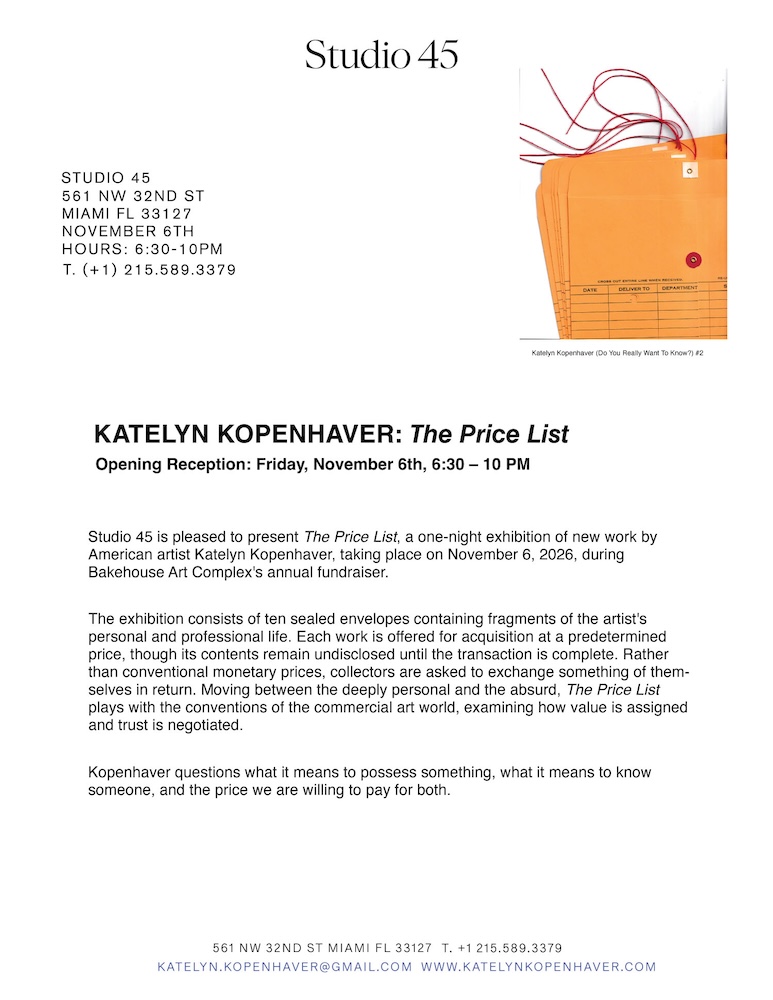
What makes Kopenhaver’s work particularly distinctive is that its intellectual ambition never eliminates humor.
The exhibition addressed serious questions about trust, ownership, power, and vulnerability, yet the atmosphere surrounding the transactions remained playful.
Some requested actions carried genuine emotional weight, while others added to the experience’s unexpected theatricality.
This balance matters.
Conceptual art can sometimes create distance between an artist’s ideas and the audience. Kopenhaver works in the opposite direction, inviting visitors into situations where their own reactions become part of the artwork.
Born in 1992, the Miami-based interdisciplinary artist received her BFA in Photography from the School of Visual Arts in 2016. Her practice encompasses public intervention, performance, photography, and text, frequently examining how familiar systems influence perception and behavior.
A recipient of the 2021 NYSCA/NYFA Artist Fellowship and the 2024 Miami Individual Artists Grant, she has continued to develop a practice that moves between institutional critique and direct audience engagement.
Her work has appeared in The New York Times, New York Magazine, The Brooklyn Rail, and Der Greif, including an issue curated by Hank Willis Thomas.
As a resident artist at Bakehouse Art Complex, she is part of a Miami creative community that supports experimentation beyond conventional gallery formats.
The Price of Participation
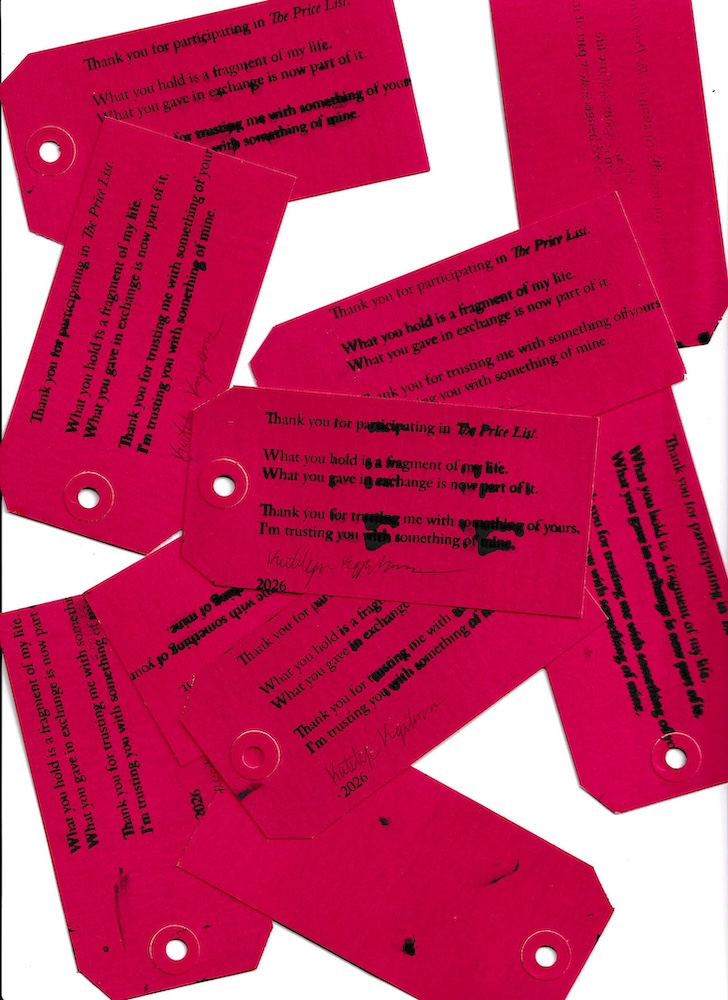
Presenting The Price List during Bakehouse’s annual fundraiser introduced an especially meaningful context.
An event dedicated to supporting artists became the setting for an artwork investigating the conventions of buying, selling, and assigning value.
Kopenhaver did not reject the commercial art world; she transformed its mechanisms into her artistic materials.
The work demonstrated how authority can be performed, how desire can circulate through social relationships, and how the promise of access can become a commodity.
Yet beneath its humor and ingenuity was a more intimate proposition.
Every collector had to decide whether obtaining a fragment of another person’s life was worth revealing or giving something of their own.
The exchange required participation, not passive appreciation.
By the end of the evening, all ten envelopes had been acquired, but The Price List’s true significance extended far beyond its commercial success.
Kopenhaver had created a temporary social experiment in which the artwork existed simultaneously as an object, a transaction, a performance, and a relationship.
Her achievement was not merely convincing people to purchase something they could not see. It was revealing how much of what we call value depends on what—and whom—we choose to believe.
The Price List was presented November 6, 2026, at Studio 45, 561 NW 32nd Street, Miami, during Bakehouse Art Complex’s annual fundraiser.
For more information, visit katelynkopenhaver.com.