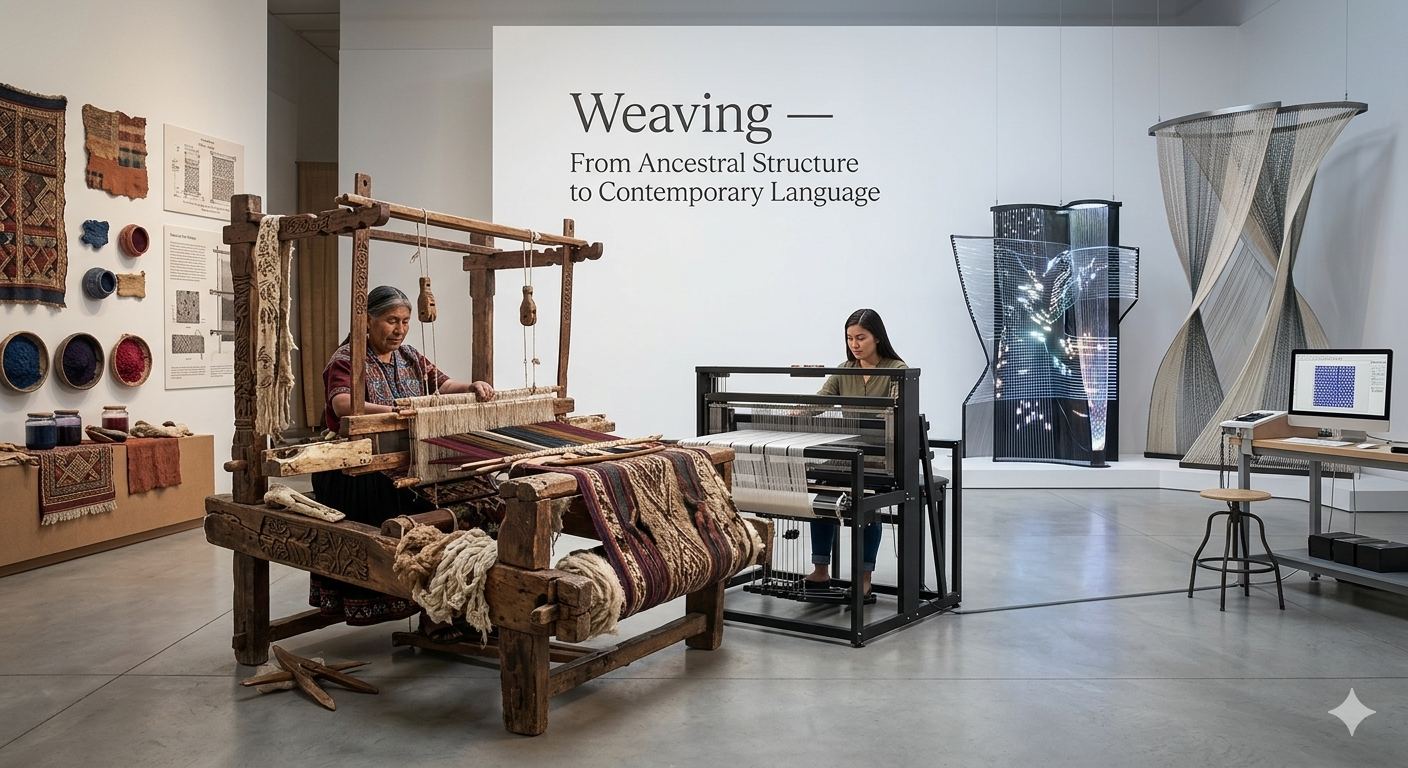
Weaving — From Ancestral Structure to Contemporary Language
Weaving is among the oldest artistic and technological practices of humanity—a foundational gesture through which civilizations constructed not only textiles, but systems of meaning. Defined by the interlacing of warp and weft, weaving operates at the intersection of structure, rhythm, and time. From ancestral looms to contemporary installations, it has evolved from necessity into a critical language of contemporary art.
The Ancestral Grid: Weaving as Origin
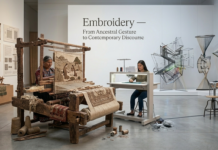
Long before painting or sculpture assumed their canonical status, weaving functioned as a primary cultural expression. Across Indigenous, African, Asian, and pre-Columbian traditions, textiles encoded cosmologies, hierarchies, and identities. The loom itself—horizontal or vertical—was not merely a tool, but a cosmological device, organizing the world into tension (warp) and passage (weft).
The distinction between warp and weft is both technical and symbolic:
- Warp threads: strong, stable, held under tension—structure, continuity, order
- Weft threads: flexible, moving across—variation, narrative, intervention
This binary underpins not only textile production but a broader philosophical model: structure versus agency, system versus improvisation.
Material Intelligence
The intelligence of weaving lies in its materials. Traditionally:
- Cotton offers absorbency and clarity—ideal for functional textiles
- Wool introduces warmth, elasticity, and mass—suited for blankets and rugs
- Linen and silk bring luminosity and tension—refined, almost architectural qualities
Contemporary practice expands this palette to include bamboo, Tencel, synthetic fibers, and even paper, each introducing new behaviors of light, gravity, and fragility.
Even the technical language of yarn—fractions such as 8/2 or 16/2—reveals a system of measurement distinct from other textile traditions, emphasizing structure over softness, precision over volume.
Modernism and the Rewriting of Weaving
The 20th century marked a critical shift. With the Bauhaus, weaving entered modernist discourse not as craft but as design, abstraction, and architecture. Figures such as Anni Albers redefined the medium, treating the woven surface as a site of experimentation with pattern, perception, and industrial logic.
Yet even then, weaving remained marginal within art history—its association with the feminine and the functional limiting its institutional recognition.
Contemporary Weaving: Beyond the Loom
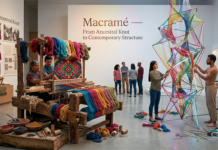
In contemporary art, weaving has fully entered the expanded field. It is no longer confined to textile production but has become a method of thinking and constructing space.
Artists today:
- deconstruct the loom
- suspend warp threads in architectural environments
- fragment woven surfaces into sculptural forms
- integrate unconventional materials—plastic, metal, found objects
Weaving becomes less about fabric and more about systems, networks, and interconnection.
Paper Weaving and Fragility
One of the most compelling contemporary developments is paper weaving. By replacing fiber with paper, artists introduce a material that is:
- fragile
- archival
- historically loaded (linked to text, image, and documentation)
Paper weaving collapses distinctions between drawing, collage, and textile. It transforms the act of weaving into a gesture of reconstruction—cutting, reordering, and reassembling visual information.
Here, the grid is no longer neutral. It becomes a site of disruption, where images are fragmented and reconfigured, echoing the instability of contemporary visual culture.
Weaving as Metaphor in the 21st Century
In 2026, weaving resonates far beyond material practice. It has become a central metaphor for contemporary life:
- social networks as woven systems
- identities as interlaced narratives
- histories as layered and entangled
From a curatorial perspective, weaving aligns with a broader shift toward practices that emphasize process, interdependence, and relationality. It resists singular authorship, foregrounding instead the logic of connection.
Labor, Time, and Resistance
Weaving remains inherently slow. Each intersection of thread marks a moment of labor, a unit of time embedded in the object. In an era defined by speed and immateriality, this slowness becomes a form of resistance.
The woven object carries:
- duration
- repetition
- care
It asks the viewer to engage differently—to read not only the image, but the time it contains.
Conclusion: The Persistence of Structure
What makes weaving enduring is its dual nature: it is both primitive and contemporary, functional and conceptual, material and metaphorical.
From ancestral looms to paper-based installations, weaving continues to evolve while maintaining its essential logic—the crossing of threads, the negotiation of tension, the creation of structure through relation.
In this sense, weaving is not simply a technique.
It is a model for understanding the world—one in which everything exists through connection, and meaning emerges not from isolated elements, but from the spaces where they intersect.