The Ephemeral Permanence of Water – Eugenia Vargas Pereira’s AGUAS at Art Palm Beach 2026
In the cacophony of an art fair, where the visual noise often leans towards the commercial and the spectacle, finding a moment of genuine, meditative introspection is rare. Yet, at the 2026 edition of Art Palm Beach, within the curated section of DIVERSEartPB, Chilean artist Eugenia Vargas Pereira offered precisely that—a sanctuary of shadow and light titled AGUAS. Curated by the astute Marisa Caichiolo, this immersive installation stood as a poignant testament to the fragility of our ecological tether.
Having followed Vargas Pereira’s trajectory—an artist who has consistently interrogated the boundaries of the body, the landscape, and the ephemeral nature of performance—AGUAS feels like a maturation of her ecological consciousness. It is a work that moves beyond the mere representation of nature to enact a ritual of restoration.
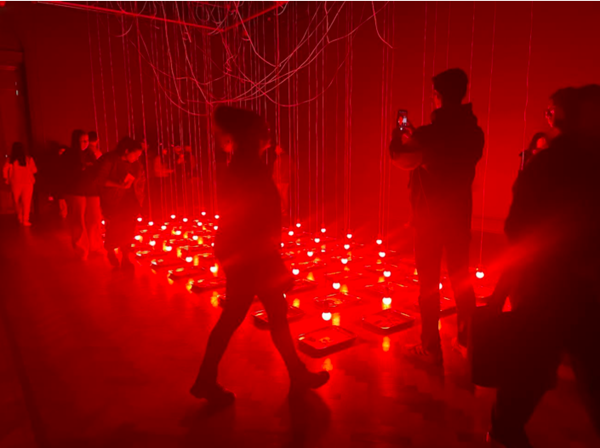
The installation’s physical presence was commanding yet delicate. Stepping into the space, one was immediately transported into the belly of a large-scale analog darkroom. The lighting, a dim constellation of amber and red bulbs suspended from the ceiling, created a visceral, womb-like atmosphere. The white electrical cables, cascading from a tangled mass overhead, suggested a nervous system or perhaps the complex, unseen root networks that bind our ecosystem together. This “intricate network” served as a visual metaphor for the interdependence that the piece seeks to highlight.
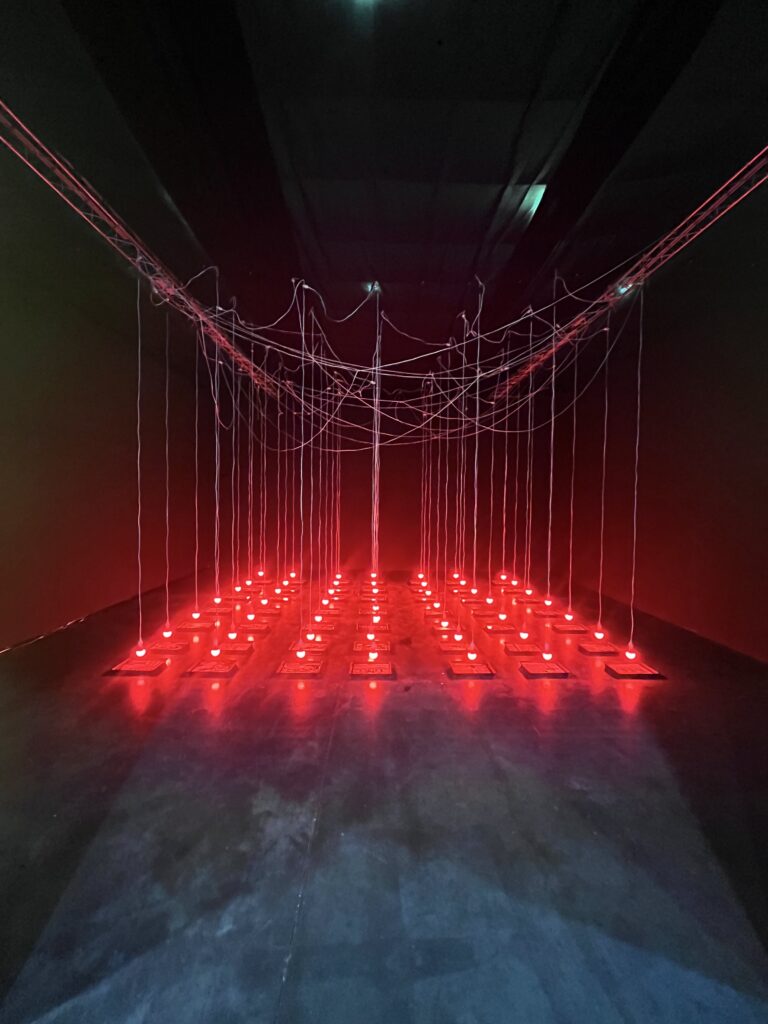
Beneath this canopy lay 55 developing trays, the tools of a fading analog trade repurposed here as vessels of memory. Submerged in water within these trays were photographs—images of men and women interacting with rivers. But the brilliance of AGUAS lay in its participatory element. In a profound gesture of “collaborative care,” volunteers and visitors were invited to place their own selfies into the trays.
As an art critic, I was struck by the conceptual layering of this act. The darkroom is traditionally a place of fixing an image, of making the transient permanent. Here, Vargas Pereira inverts this logic. The images in the water are subject to the slow violence of the elements; they emerge and fade, mirroring the “tragic and relentless transformation of the natural world.” The viewer becomes a “visual narrator,” witnessing their own image—their own ego—dissolve into the fluid medium that sustains all life. It is a humbling reminder that we are not observers of nature, but permeable parts of it.
The connection to the Casablanca Biennial 2026 adds another layer of geopolitical urgency to the work. By linking the waters of the Americas with those of North Africa, Vargas Pereira suggests that the crisis of water—and the ritual of cleansing—is a universal narrative, transcending borders.
AGUAS is not merely an installation; it is a “meditation on environmental degradation” that refuses to succumb to despair. Instead, it offers a “quiet potential.” In the dimly lit room, surrounded by the smell of water and the ghostly glow of red lights, the community participation became a form of collective resistance. It reminded us that while our connection to the natural world is fragile, it is also the only thing that creates a true “unity of being”—a concept I often return to in my own philosophical inquiries.
Eugenia Vargas Pereira has created a space where aesthetic expression dissolves into ethical action. AGUAS was, without a doubt, one of the most powerful and necessary works of Art Palm Beach 2026.