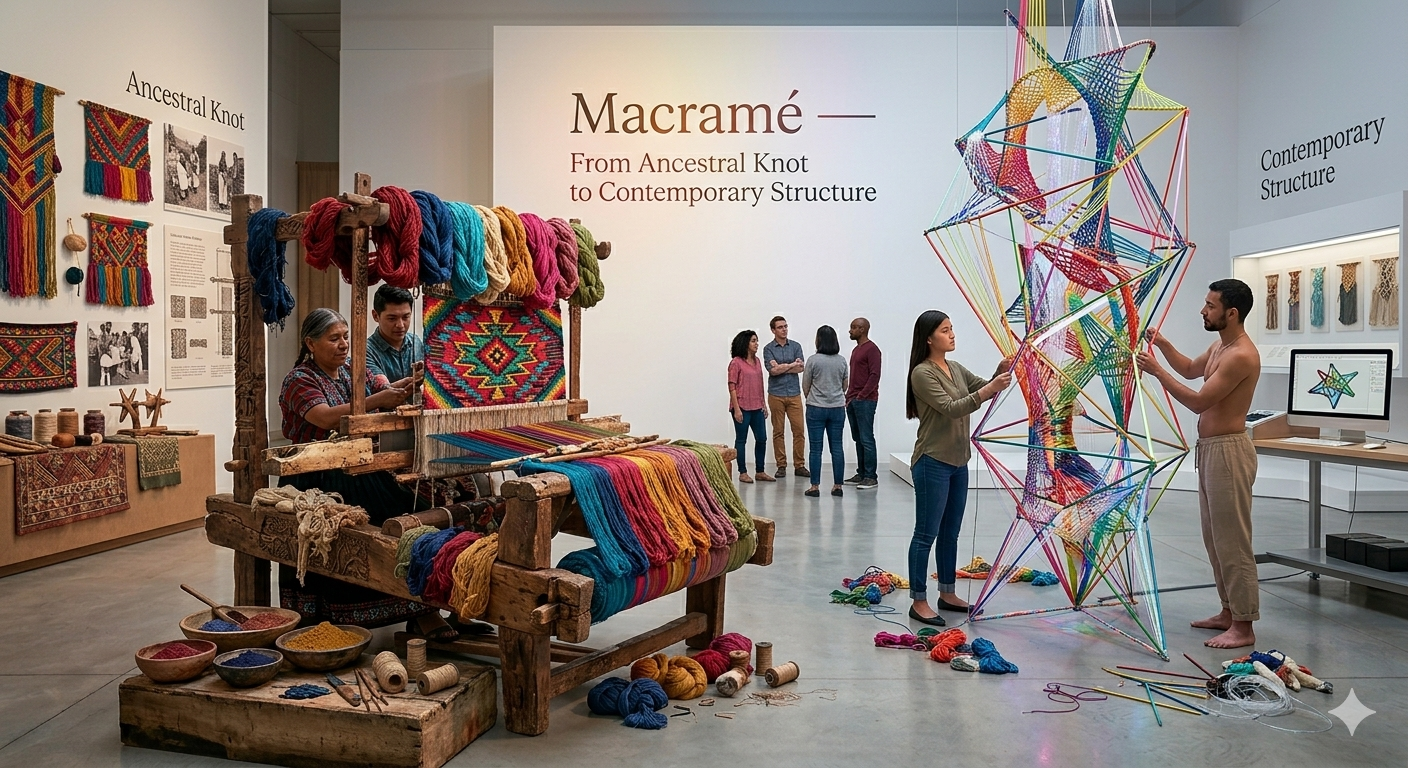
Macramé — From Ancestral Knot to Contemporary Structure
Macramé, the art of constructing textiles through knots rather than weaving or knitting, occupies a singular position within the history of fiber practices. Defined by the manipulation of cord through tension, repetition, and pattern, it is at once primitive and sophisticated, rooted in ancestral techniques yet fully aligned with contemporary sculptural thinking.
The Ancestral Knot: Origins and Transmission
The origins of macramé precede its name. Archaeological and historical evidence traces knot-based textile decoration back to ancient civilizations such as the Babylonians and Assyrians, where braided and fringed elements adorned garments and ceremonial objects.
What we recognize as macramé today likely emerged in the 13th century among Arab weavers, who developed decorative knotting techniques to finish the loose ends of woven fabrics—transforming necessity into ornament. The very word is believed to derive from the Arabic migramah, meaning “fringe” or “ornamental veil.”
From the Islamic world, the technique traveled through Spain and Italy into Europe, carried by trade routes and cultural exchange. By the 17th and 19th centuries, macramé had become a refined decorative practice within European domestic interiors, appearing in textiles, lace, and ornamental furnishings.
Simultaneously, sailors played a crucial role in its dissemination, producing knotted objects aboard ships—belts, hammocks, and decorative items—embedding macramé within a global vernacular of labor and mobility.
Structure Without Loom: A Different Textile Logic
Unlike weaving, macramé does not rely on a loom. Its fundamental unit is the knot, constructed through the direct manipulation of cord by hand. This absence of machinery is not a limitation but a conceptual distinction:
- no fixed warp and weft
- no predetermined grid
- structure emerges through sequential decisions and tension
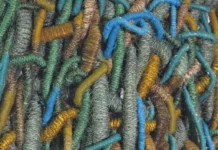
The most common knots—square knots, half-hitches, spiral knots—form a modular system capable of generating both flat patterns and volumetric structures.
In this sense, macramé is closer to drawing in space than to traditional textile construction. Each knot is a point of intersection, a moment of decision, accumulating into a larger structural logic.
Decline and Revival: The 20th Century
Macramé’s history is cyclical. After periods of prominence in Europe, it receded before experiencing a major revival in the 1960s and 1970s. This resurgence was driven by countercultural movements and, crucially, by feminist artists who challenged the hierarchy between fine art and craft.
During this period, macramé moved beyond decoration into artistic experimentation:
- wall hangings became sculptural
- knots became compositional elements
- materials expanded beyond traditional fibers
This moment marked the integration of macramé into the broader field of fiber art, where knotting joined weaving, braiding, and coiling as legitimate artistic strategies.
Contemporary Macramé: From Craft to Sculpture
In contemporary art, macramé has undergone a profound transformation. No longer confined to domestic objects, it now operates as a spatial and conceptual medium.
Artists today use macramé to:
- construct large-scale installations suspended in space
- explore tension, gravity, and structural balance
- integrate unconventional materials—metal, plastic, industrial rope
- create immersive environments that engage the viewer physically
The knot becomes a unit of architecture, capable of generating complex, three-dimensional forms without rigid frameworks.
Material, Labor, and Time
Macramé foregrounds the relationship between hand, material, and duration. Each knot is tied individually, embedding time into the structure. This repetitive labor transforms the work into a record of process—a visible accumulation of gestures.
From a museological perspective, this aligns macramé with contemporary concerns around:
- labor and visibility
- the value of the handmade
- resistance to industrial and digital production
Its tactile nature invites a sensory engagement that contrasts sharply with the immateriality of much contemporary culture.
Macramé as Contemporary Metaphor
In the 21st century, macramé resonates beyond its material form. It functions as a metaphor for:
- networks and connectivity
- systems built through interdependence
- the tension between order and improvisation
Each knot is both independent and relational—holding its place within a larger structure while depending on others for stability.
Conclusion: The Persistence of the Knot
Macramé endures because it is fundamentally about connection. From ancient fringes to contemporary installations, it transforms simple gestures into complex systems.
What once secured the edges of fabric now constructs entire environments. What began as utility has become language, structure, and thought.
In 2026, macramé is no longer a nostalgic craft. It is a living, evolving practice—one that reveals how the simplest act, the tying of a knot, can still articulate some of the most sophisticated ideas in contemporary art.