Katelyn Kopenhaver: Language, Memory, and the Fragile Construction of Truth
In Katelyn Kopenhaver’s work, language does not function merely as a vehicle for communication, but as a territory of tension, doubt, and resistance. Her phrases, interventions, and strategies question the ways in which we construct meaning, recognize truth, and accept the narratives that organize everyday life. Through ambiguity, repetition, concealment, and humor, Kopenhaver shifts the viewer from a passive position and turns them into an active participant in interpretation. Her practice moves between conceptual art, institutional critique, the psychology of perception, and cultural memory. Yet perhaps most significant is her willingness to include herself within the very systems she examines. For Kopenhaver, art functions as testimony: a way of keeping suppressed histories, unresolved events, and uncomfortable realities visible in the face of forgetting. In this conversation, the artist reflects on truth, power, autonomy, memory, and transformation, revealing a practice that offers no definitive answers, but rather questions that continue to resonate long after one has left the work.
AMM. In your work, words do more than communicate: they provoke, question, and activate thought. How do you choose a word or phrase, and what qualities must it possess to become a conceptual proposition capable of generating multiplinterpretations for the viewer?
KK. Sometimes the words choose me. Other times I have a lot of words or thoughts floating around and I jot them down. I could probably be more organized — I have a whiteboard, multiple notebooks, and a running Illustrator file that feels endless.
I’m drawn to words/phrases that contain an element of tension, irony or contradiction, where the meaning can shift depending on who is reading it or where / when they encounter it. Context is important, and so is humor and timing. Certain phrases come to mind because of what I’m feeling or going through at the time. I’m constantly, or at least trying to be, paying attention to what’s going on inside of me and outside of me, and asking myself: is this idea reactionary or timeless? What’s the medium for this message, and how does that add to the conceptual nature of the work? I find myself asking all sorts of questions and try to look at language from multiple points of view.
I avoid language that gives the viewer an easy answer, where they read it and go, “Okay, got it.” But I can’t be too vague either, there has to be something to hold onto. There’s usually a dose of skepticism in there too, and a phrase has to possess some flexibility. I don’t like things that are too easy, soothing, cute or cliché. With that said, tenderness is an important part of me. I can come across as acerbic, and I am, when necessary, but softness is also important. I think that’s a good thing for me to remember and to keep present in the work.
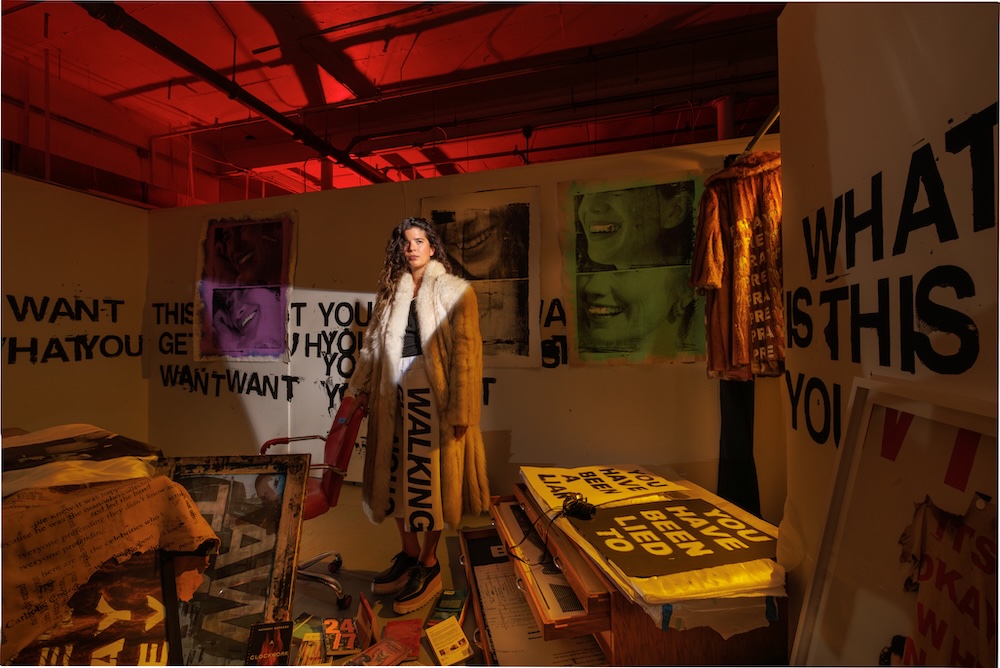
My work IT’S OKAY WHEN BILL DOE$ IT is a good example of a phrase that does this. Who is Bill? What did Bill do? Why is it okay when he does it? Is she talking about a person? Money?
Something seemingly specific becomes very open and layered, and now the viewer has some thinking to do. I like that.
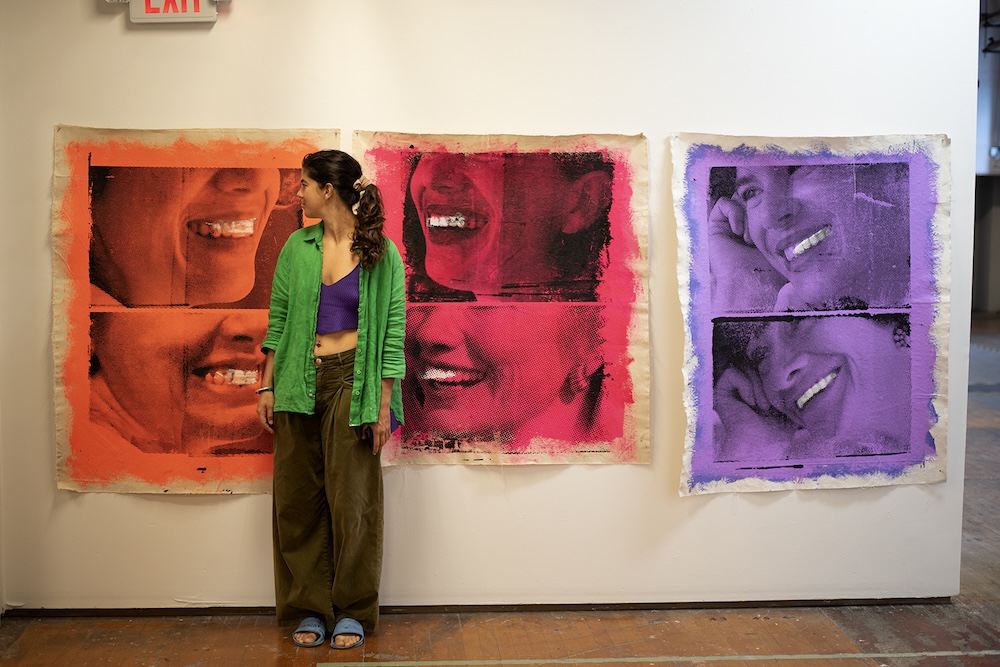
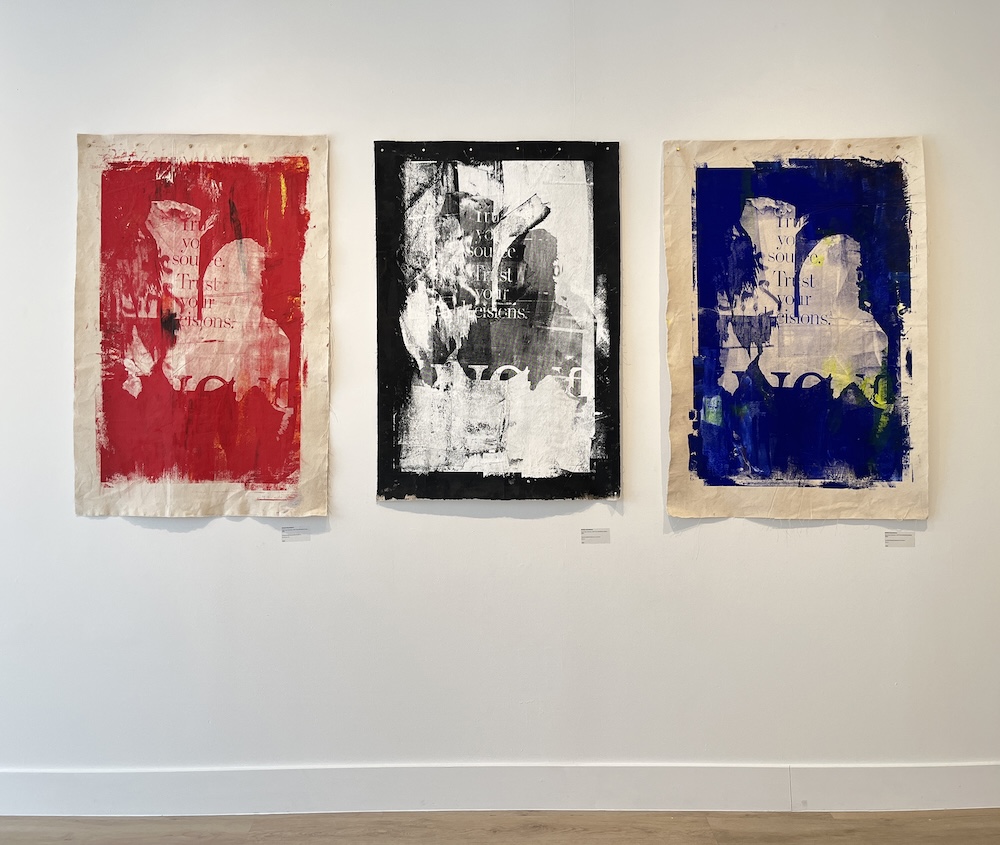
AMM. In the three versions of Trust Your Sources, Trust Your Decisions, color, fragmentation, and concealment alter the way we encounter the same phrase. How do these visual decisions relate to our ability to recognize truth and make autonomous choices within systems that shape our perception?
The phrase remains the same, but the way you encounter it changes. Certain words become more visible, while others recede or disappear. Color can make something feel urgent or trustworthy, fragmentation can make you work harder to understand what you’re seeing, and to
conceal is also to reveal, by making an obstacle to understanding the viewer is activated, they’re thinking, they’re a participant, not a passive observer. Our perception is constantly being shaped by outside forces, which inevitably affects how we make meaning.
That’s part of what interests me about these three works. News has increasingly become entertainment, language is adjusted for particular audiences, and things are repeated and repeated and repeated. There’s that idea that if you repeat something enough times, eventually it starts to feel true. I look at patterns, repetition, what is being pushed and what is being incentivized. Who gains from these things? Who is writing the script? Sometimes you start to see the connections only when you zoom way out.
Making an autonomous choice requires questioning our own choices and thoughts, and interrupting a habit or routine. Do I like this because I was told to? I’m also part of the systems I critique and analyze. I’ll start scrolling Instagram and tell myself to stop; yet in the same breath, post about what I’m doing, because apparently that’s how people “know” what you’re up to. As soon as we’re born we’re inundated with images, personas, belief systems. Are we capable of original thought? We are, but it’s especially difficult today as we’re constantly bombarded by media competing for attention; pushing identities, ideologies, and choices on us through manipulative advertising/advanced methods of psychological coercion. It takes a lot of self-awareness and clear-headedness — difficult, but possible. We have to look inward, and trust ourselves. I question my own perception and performance all the time. Looking from another perspective is vital; otherwise, we risk seeking out external validation for what we already believe, thus not evolving. We’re in control of our thoughts… or we can be, if we protect them.
AMM. Your work often engages with truths that culture may conceal, manipulate, or choose to forget. Do you understand truth as an objective reality that can be discovered, or as something shaped by consciousness, experience, and one’s position in the world?
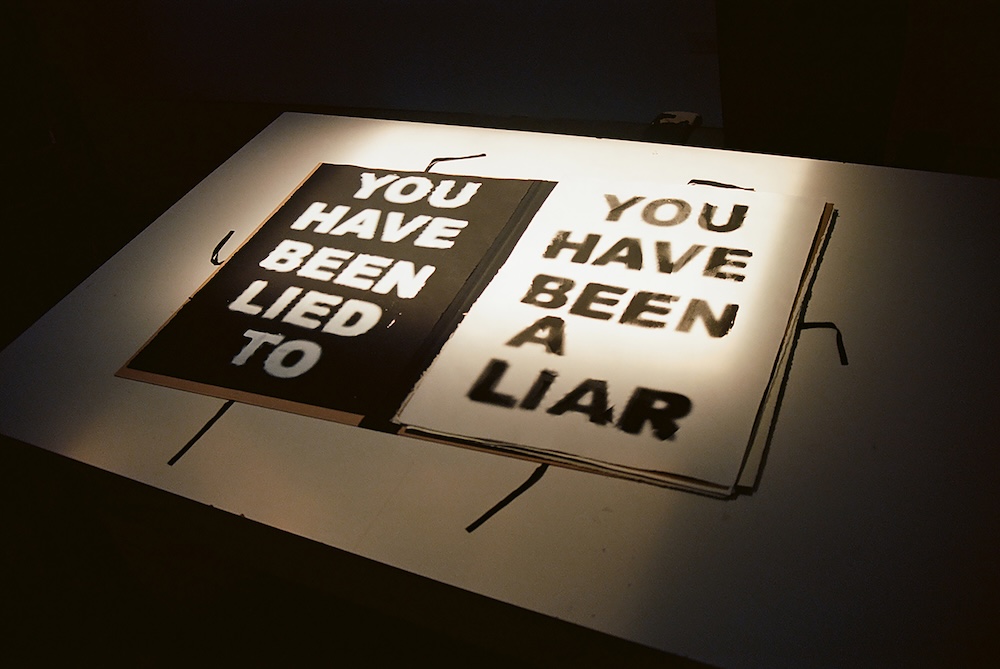
Oh boy. It’s both and neither. We’re living in a time where no one trusts anyone or anything, so how do we get a sense of what’s real? Our sense of truth and justice and reality that we plug into subconsciously every day has been diluted. The only way is to look inward, and retain a sense of human connection and hope.
I sometimes have issues with the phrase “my truth,” because it can get murky. People have experiences in the world, and those experiences are real, but they’re also viewed through a biased lens, they’re subjective – and that’s the nature of being human. There is also objective Truth, absolutes that exist independently of whether we recognize, agree with, or how we feel about them. Where it gets complicated is our access to those Truths: how what we see as real is constantly being manipulated and twisted. Someone else can look at the same event and understand it completely differently. But that difference in perception doesn’t necessarily make both interpretations true. A false belief can also become part of our social reality and have very real consequences. I think about Animal Farm. The pigs change the rules, but the other animals don’t fully recognize it. They trust their leaders, conditioned to accept the reality handed to them.
The facts haven’t changed; their ability to recognize them has. (That’s scary) Power, experience, belief, motive, memory, language all shape what we are capable of seeing.
And rightly so! Life is complex, and people are complicated. No one makes all the right choices all the time, or has all the right beliefs or knows everything, that’s – again – part of being human.
Especially me, right now, with this answer, ha. It’s simply impossible. Consensus doesn’t necessarily make something true either. Just because an “expert” or someone we admire or canonize says something does not make it so. People can also break out of one belief system only to replace it with another. All we can do is take it a step further… beyond the headline, the label, and take time to listen to ourselves and others on a deeper level. That’s where the truth lies.
AMM. After completing a work, what kind of transformation do you hope it might produce—in you as an artist, in the viewer’s consciousness, or in the social reality you are questioning?
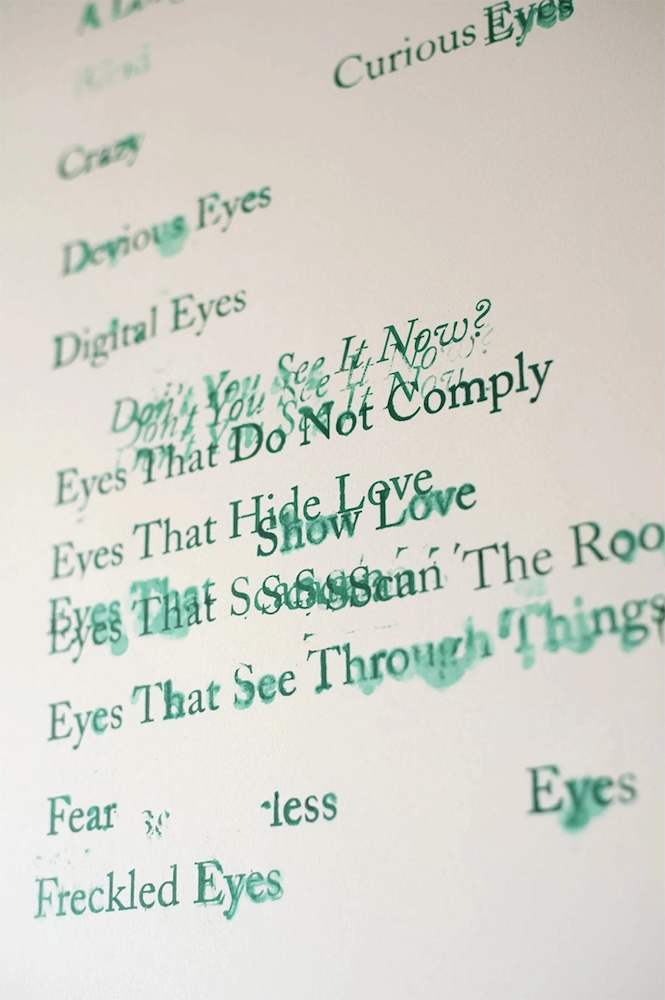
I’m trying to show you what’s already there: to plant a seed, hold up a mirror, offer a vantage point you didn’t see but now cannot unsee. Underneath the work, I am always asking: what shaped your understanding of what’s true, and have you ever questioned it? This may be delayed, and sometimes my work relies on that lag between awareness and recognition. I’m willing to let the work “fail” in the moment. The aesthetic brings you in, and maybe you don’t get it at first, but then you see something on your walk, and your mind comes back to what you saw. I want the work to constantly transform me. Sometimes that transformation is physical. I feel it in my hands, the soreness after a performance screen printing on a wall. Other times one idea leads to another, or making something reveals a question I didn’t know I had. I learn I like this, I don’t like this, or learn a new skill.
When the work enters public space, that transformation can move outward. I’ve repurposed abandoned mattresses in Central Park into missing-person posters, and used MoMA’s restroom as a message board to expose the actions of museum trustees. Those interventions temporarily shift the purpose and meaning of the spaces they occupy. Transformation can also be very small. Instructions for Commuters is a sixteen-step performance video of what I’d do if I were being abducted by a cab driver. Years later, a woman came up to me and said,
“Did you make that? It’s stayed with me for years, I think about it often.” The same thing happens when someone wears one of my messages on their clothing and carries it out into the world. I don’t expect a work to completely change someone’s consciousness, but if it stays with them, resurfaces later, or snaps them out of their day-to-day autopilot, that feels like a transformation to me.
AMM. Your practice brings hidden histories and unresolved events back into the present. Do you see art as a way of awakening consciousness, preserving memory, demanding accountability, or contributing to the healing of what has not yet found justice or closure?
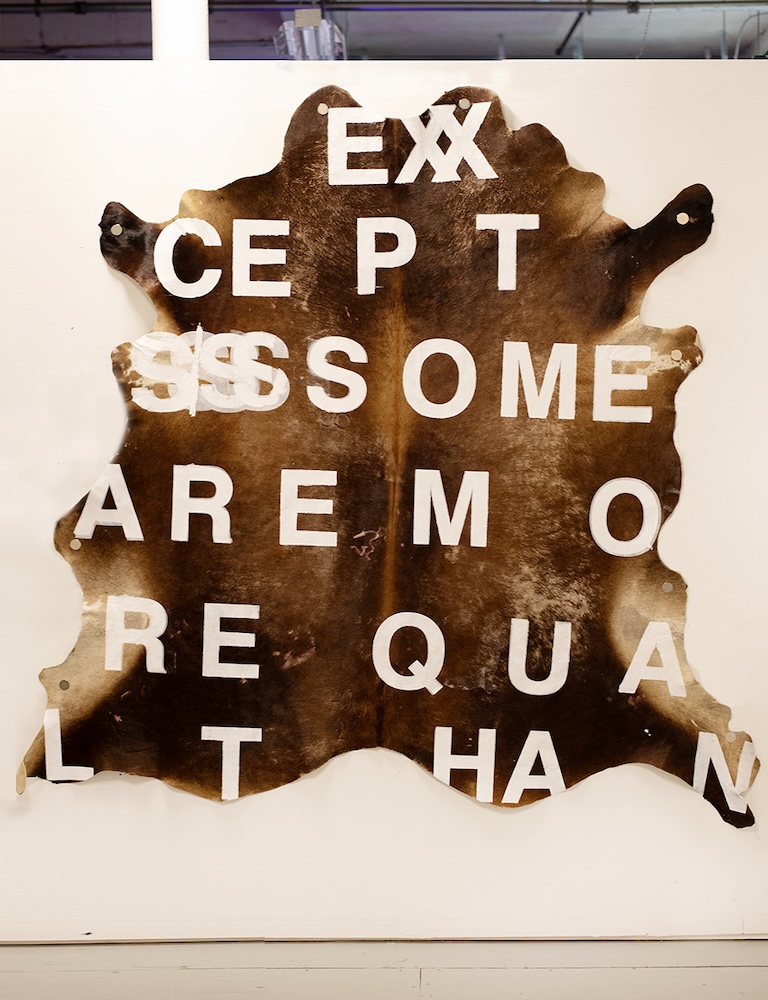
All four. I see most of my work as a form of testimony. Of proof. As a way to index reality and/or myself. We suppress a lot, we hide a lot, and so much gets written over — whether deliberately (usually deliberately) or simply through time.
I’m interested in bringing some of those things back into view and insisting that they remain part of the record. Art can preserve what happened, but it can also ask us to look at it again from the present. I don’t know that art alone can provide justice or closure, but it can deny disappearance. It can keep something visible long enough for us to reckon with it.
For Inquiries:
Stanek Gallery Miami
Stanekgallery.com
8375 NE 2nd Ave.
Miami, FL 33138
(305) 713-9454
[email protected]
Photo credit: Pedro Wazzan of Katelyn Kopenhaver at Bakehouse Art Complex, Studio 45