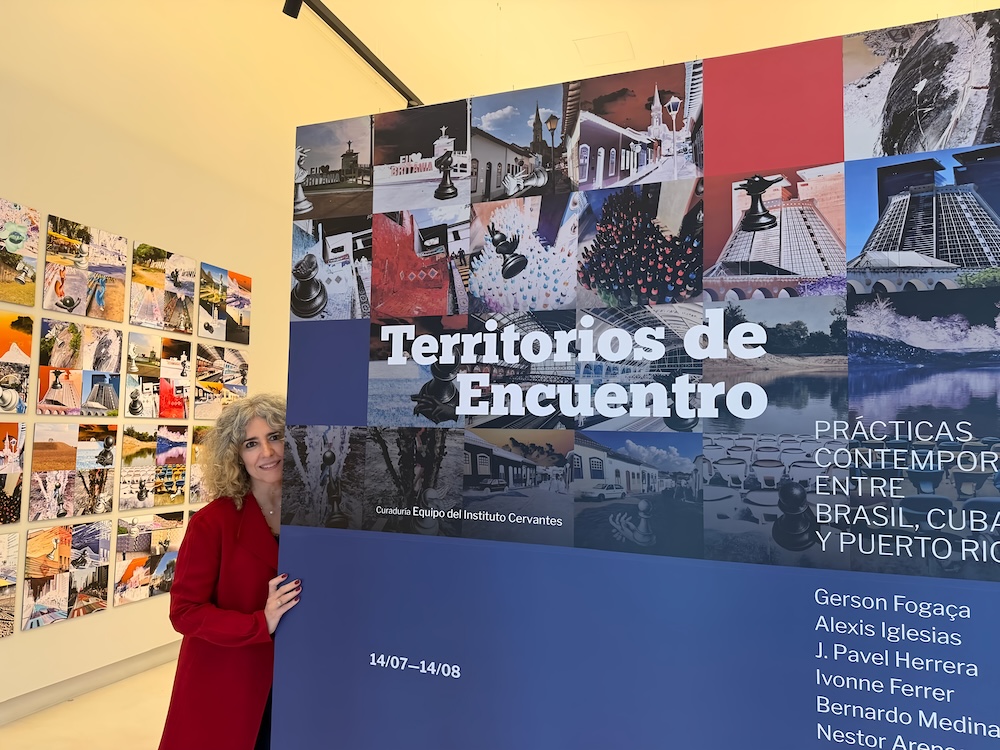
In Ivonne Ferrer’s work, cartography ceases to be a tool for describing external territories and becomes a way of exploring memory, identity, displacement, and personal transformation. Drawing from her participation in Territorios de Encuentro at the Instituto Cervantes in São Paulo, this conversation delves into concepts such as the in-between, fragmentation, migration, wounds, and reconstruction. Her practice reveals an identity in motion: an inner cartography that is never fully finished.
AMM. In an exhibition built precisely around the idea of “territories of encounter,” what did you discover about your own work when you saw it in dialogue with the practices of other artists from Brazil, Cuba, and Puerto Rico?
Ivonne Ferrer. I think one of the most interesting things was discovering that, although our experiences and visual languages are different, there are concerns that run through all of us in very similar ways. Memory, displacement, identity, territory, and the need to belong emerged from different perspectives, yet they found points of connection.
Seeing my work within that dialogue made me understand even more clearly that many of the questions I ask myself from a personal experience—shaped by Cuba, migration, and by having lived in different places—are not exclusively mine. They are part of much broader, shared experiences.
For me, that was precisely the most beautiful aspect of the exhibition: realizing that encounter does not erase differences. On the contrary, it makes them visible and allows new connections to emerge from those very differences.
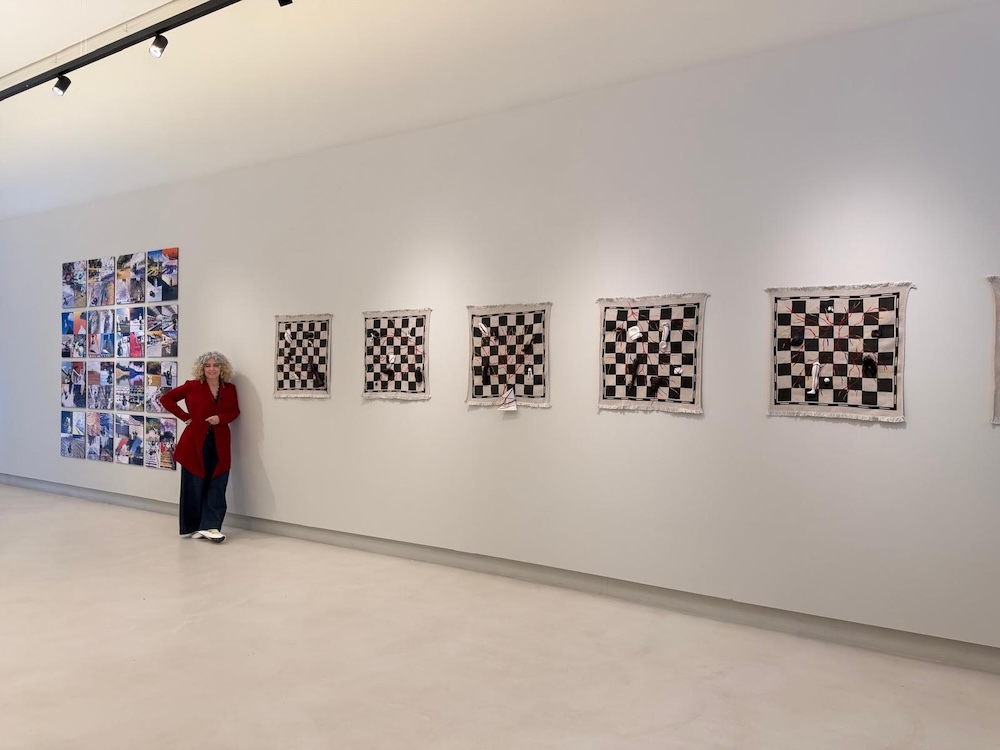
AMM. In your concept of the “in-between,” there appears a territory situated between who we once were and who we are still becoming. After having lived between Cuba, Spain, and the United States, what does inhabiting that intermediate space mean to you, both personally and artistically?
For me, the in-between is not merely a geographic space. Above all, it is an emotional state and a way of understanding who I am. When you have lived in different countries, you discover that you never completely leave behind the places that came before, but neither do you remain exactly the same person you were while living in them.
IF. Cuba remains within me, just as Spain and the United States do, along with all the experiences accumulated throughout those displacements. Over time, I have come to understand that I do not need to choose one place and exclude the others. My identity has been constructed precisely through this overlapping.
Artistically, something similar happens. My work inhabits that intermediate space between memory and the present, belonging and displacement, what remains and what transforms. For that reason, the in-between—which at one point may have felt like uncertainty or uprootedness—eventually became, for me, a territory of creation and also of freedom.
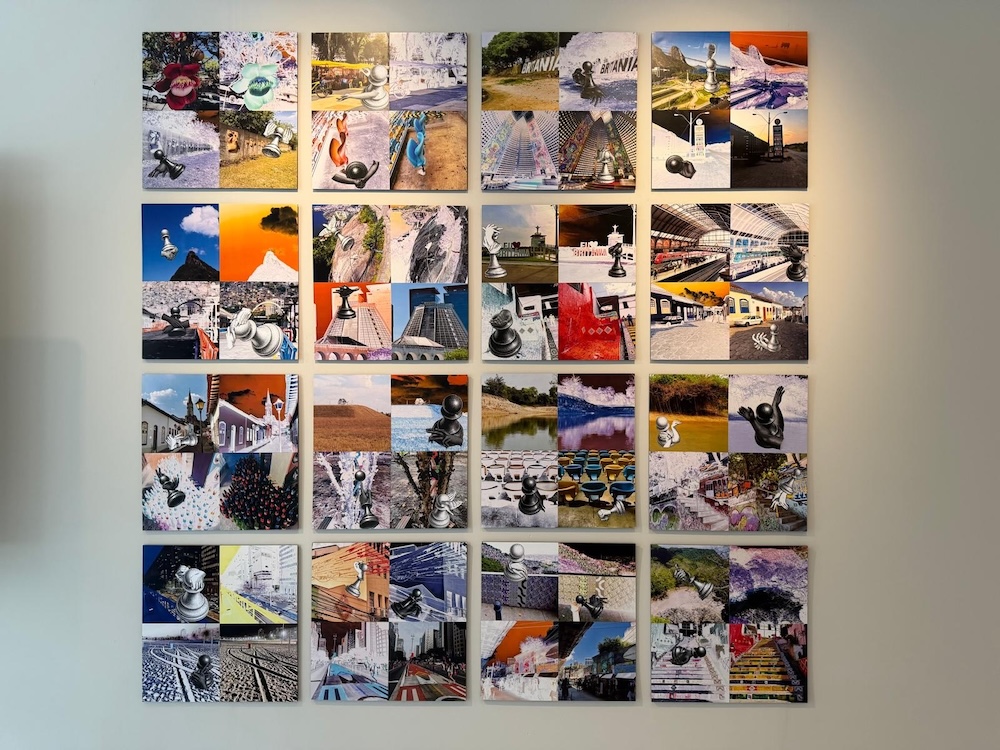
AMM. Chess appears in your work as a metaphor for decisions, movements, and consequences. If existence were a chessboard, to what extent are we truly the ones deciding our moves, and to what extent are we pieces conditioned by history, family, politics, or the circumstances that surround us?
That contradiction is precisely what interests me about chess. We believe that we are moving the pieces, but very often we are also the pieces.
There are decisions we make freely that can completely alter the course of our lives, but we never begin the game from zero. We enter it with a history, a family, a place of birth, a political and social situation, and a series of circumstances that we did not choose.
IF. I was born in Cuba, for example. I did not choose that starting point, just as I did not choose many of the historical circumstances that shaped my generation. But I have had to decide what to do in response to them: when to move, what to preserve, what to leave behind, and how to rebuild myself.
That is why the chessboard functions for me as a metaphor for existence. We do not completely control the game, but neither are we entirely passive pieces. Between what conditions us and what we choose lies a small territory of freedom. And perhaps that is where we truly construct our lives.
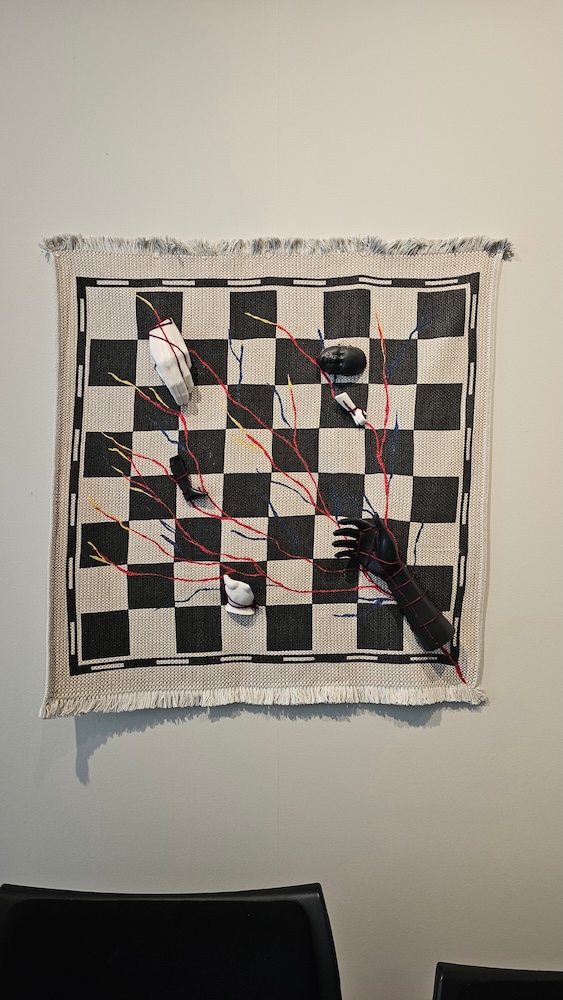
AMM. In Cartografía del Juego Interior, the red thread connects the fragments, but in doing so, it also passes through them. There is something deeply paradoxical there: what connects can also wound. Do wounds, losses, and ruptures ultimately become part of the architecture of our identity as well?
IF. Yes, absolutely. It was very important to me that the thread not simply surround the fragments, but actually pass through them. Because the experiences that truly transform us do not pass around us; they pass through us.
The red thread can represent connection, memory, affection, inheritance, but it can also represent a wound. And very often those things are inseparable. What connects us to a person, a family, a country, or a history can also be what causes us pain.
I do not believe that losses or ruptures ever completely disappear. Over time, they become incorporated into our identity. Not necessarily as something negative, but as part of the structure that sustains and transforms us.
That is why I am interested in this contradiction: the same thread that passes through and can wound is also the thread that stitches, connects, and reconstructs. The scar does not erase the wound; it demonstrates that something happened and that, somehow, we continued.
AMM. Your figures appear fragmented, and yet those fragments seem to construct a whole. Do we need to feel complete in order to know who we are, or is our identity precisely constituted by fragments, contradictions, and transformations that never fully resolve?
IF. I do not believe very much in the idea of a completely finished identity. We are an accumulation of fragments: memories, people, places, losses, affections, decisions, and contradictions. Some parts remain, others disappear, and still others change meaning over time.
That is why the fragment appears so frequently in my work. I do not necessarily understand it as something broken or incomplete. A fragment can contain an entire story, and when it enters into relation with others, it can construct a different kind of wholeness.
Perhaps being complete does not mean being closed or perfectly assembled. For me, it has more to do with accepting that we are all of those parts, including those that may seem contradictory.
My work speaks extensively about this identity in motion. I am not interested in arriving at a definitive image of the human being, because I believe we are continually constructing ourselves. We are, in a way, a cartography that is never finished being drawn.
Contact:
Ivonneferrerartist.com
@ivonneferrerart