From Gerswin to Groove: in Conversation with Conductor Andrew Grams
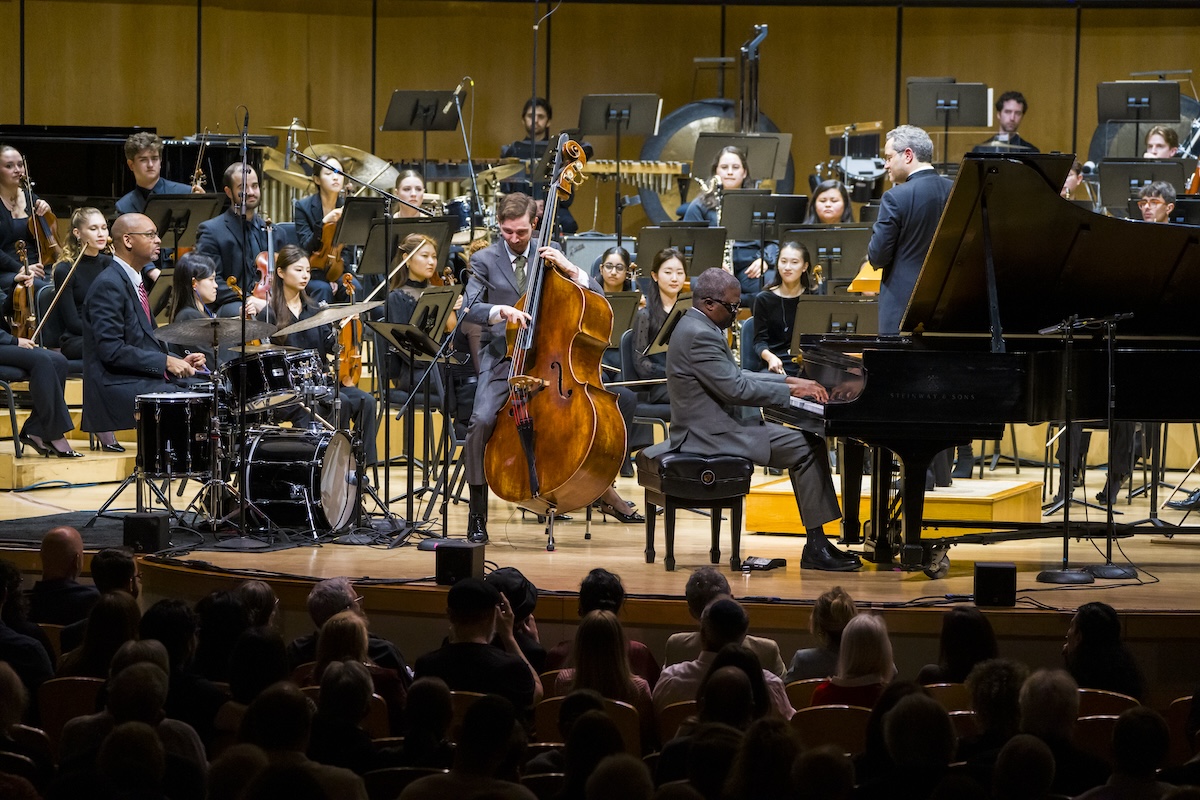
New World Symphony with Andrew Grams and Marcus Roberts Trio Rhapsody in Blue
Written By Olga Garcia-Mayoral
Saturday, January 10, 2026, 8:00 PM • Knight Concert Hall, Adrienne Arsht Center
By the time the clarinet smears its famous blue note across the Knight Concert Hall, the evening’s premise is already humming: jazz and classical aren’t opposites—they’re dance partners. “People love to think jazz and classical are diametrically opposed,” conductor Andrew Grams told me at 12:30 p.m., hours before the downbeat. “That’s not the case at all. This program shows how those two styles coexist—very, very well—right next to each other.”
The New World Symphony begins 2026 with American classics that actually behave like conversations. Tonight’s opener, Ellington & Strayhorn’s Nutcracker Suite (in a symphonic arrangement by Jeff Tyzik), sets the table: Tchaikovsky’s melodies everyone knows, re-harmonized, re-grooved, and re-voiced in swing. From there, the orchestra and the Marcus Roberts Trio—pianist Marcus Roberts, bassist Rodney Jordan, and drummer Jason Marsalis—plunge into Gershwin’s Rhapsody in Blue, Milhaud’s La création du monde, Ellington’s Black, Brown and Beige, and James P. Johnson’s Victory Stride. The arc isn’t just stylistic; it’s historical—a panorama of American sound shaped by Black music and refracted through the symphonic lens.
A “hybrid” Rhapsody—and an elastic pulse
Which Rhapsody will we hear? “We’re using the orchestral version,” Grams says, “but with Marcus and his jazz bass and drum kit in the mix, it feels closer to the original jazz-band energy.” That choice matters less than the method: Roberts famously treats the cadenzas and connective tissue as living space. “He’ll play some of what Gershwin wrote, then go somewhere else, the trio joins him, and we come back to the orchestra,” Grams explains. “He’s given us signs—a landing on E-major 7 here, three big deflect chords there—so after the trio’s improvisation, I know exactly when to bring the orchestra back in.”
The effect should feel organic, not patched. It also honors the piece’s origin as an encounter rather than a museum piece. “Everything you love about Rhapsody in Blue will be there,” Grams says, “with some extra jazz included.”
Teaching swing to symphonic athletes
If you know New World Symphony, you know the Fellows—22 to 30, glaringly capable, voracious for repertoire—can pivot stylistically. Even so, Grams says this program asks for a complete recalibration of touch and time. “In classical music, we coach blend, patience, and listening to the sound,” he notes. “Jazz is the flip side: the front of the note, commitment to tempo, and a willingness to ride the groove.”
Tyzik’s orchestration of Ellington & Strayhorn’s Nutcracker helps. “He notates the feel in ways classically trained players can read,” Grams says. But the conductor’s work is still granular: ghost notes, back-phrasing within sections, vibrato choices that read “American,” percussion and low-brass that thrum on top of the beat rather than behind it. “I describe the sound I’m after, they play, and then I say, ‘Yes—now add this,’” he says. “Rehearsal is trial and error—and they’re doing extremely well.”
Milhaud hears Harlem—without pastiche
One of the night’s most illuminating bridges is Milhaud’s La création du monde (1923), a ballet score born from the composer’s immersion in Harlem clubs. “Milhaud wrote to a classical form, then altered rhythms and harmonies to make it more jazzy,” Grams says. “We move through sections that tell an ancient African creation story, but the players must still play jazz—within that classical structure.” The orchestra becomes a translator: the bass lines need earth; the saxophone needs speech; percussion needs swing without becoming a drum set. When it clicks, the piece reads as dialogue, not cosplay.
Ellington’s epic—and a different kind of “program.”
Ellington’s Black, Brown and Beige is a landmark: a symphonic-scale narration of Black American history, premiered at Carnegie Hall in 1943. Many conductors would underline the storyline; Grams resists map-making. “I’m not trying to assign characters or chapters,” he says. “What I want the public to hear is Ellington’s grand symphonic scale—from a jazz composer working beyond three- to five-minute songs—and to let the melodies and feelings speak. If the music washes over them, they’ll take from it what they need.”
That shift—from prescriptive program to felt argument—is smart. It trusts the audience and honors Ellington’s reach: the piece doesn’t need a dotted line; it requires the sonic room to unfold.
Stride to the finish line
If there’s a fitness test on the stand, it’s the closer: James P. Johnson’s Victory Stride. “This is where everything I’ve asked for all night gets turned up to eleven,” Grams laughs. “It’s fast, it’s athletic, and nobody can lag or drag. You anticipate; you go; you pound everything out.” In other words: the orchestra channels the engine room of the stride piano—left-hand locomotion transposed to basses, tuba, and low brass; right-hand sparkle distributed to winds and strings—until the hall feels like a jubilant downtown block.
Balances in a bright room
Knight Concert Hall is clear and present; add a trio, and you can swamp details or lose the piano’s inner life. Grams’s rule of thumb is surprisingly direct: “When the trio joins us, we play louder.” There are also sequences where the orchestra plays on its own. “It’s nice to have both—moments of conversation and moments of symphonic space,” he says. Expect clarinet and saxophone colors to sit forward; tuttis to lift rather than thicken; and in Rhapsody’s perorations, a thrilling conversation rather than a shoot-out.
What this night means—for the Fellows, and for Miami
Grams has a long history with NWS—Brahms and Mahler one week, Stravinsky with Miami City Ballet the next, a Mary Lou Williams retrospective another season. He loves what the institution asks of its young artists. “The Fellows always respond to whatever the challenge is,” he says. “It’s great for them—gaining skills and styles they’ll need to become successful professionals. And it’s great for Miami to have access to such a wide variety of music.”
That civic dimension is embedded in the repertoire itself. Nutcracker in a tuxedo of swing, French modernism listening to Harlem, Ellington’s epic insisting on scale, Johnson’s victory lap—this is American music reminding a city of its layered DNA.
Listening tips, from the podium
Grams refuses to micromanage the audience’s ear, but he offers a path in. “I love starting with the Tchaikovsky–Ellington because everyone recognizes those melodies—just newly dressed,” he says. “In Rhapsody, let the trio’s flair surprise you; notice how the orchestra catches them on those cues. In Création, listen for the classical skeleton moving under a jazz surface. In Black, Brown and Beige, let the feeling lead. And in Victory Stride, hold on.”
Most of all, he hopes people leave elated by what they’ve witnessed. “Enjoy these young people doing this,” Grams says. “It’s a great exploration of what jazz is—and how it relates to what we call classical music.
Tonight, that exploration is a lived thing: clarinets falling into blue, brass leaning forward, a trio that can reroute a river mid-phrase, an orchestra that can pivot on a dime. If Gershwin opened a door a century ago, Andrew Grams and the Marcus Roberts Trio are stepping through it at speed—inviting Miami to follow, to listen, and to feel the floor move.