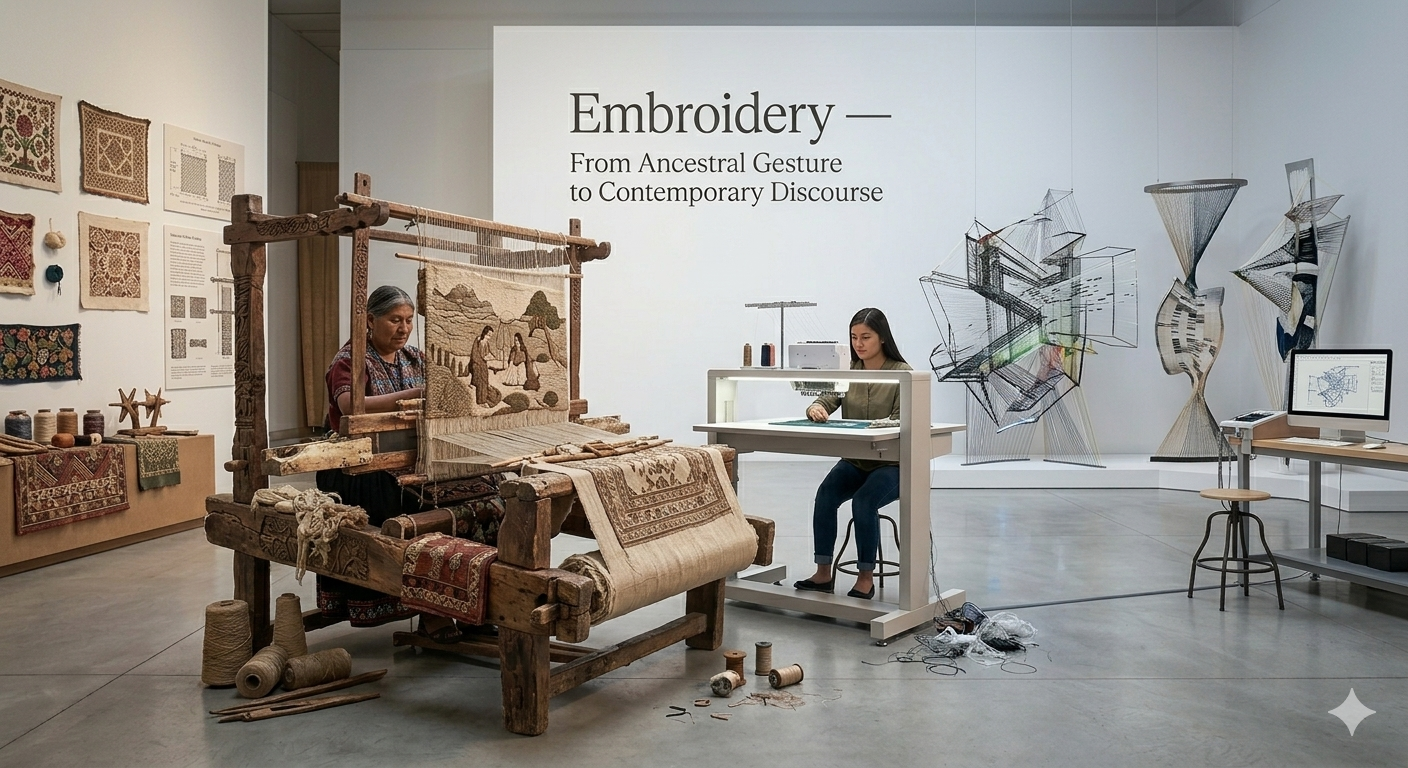
Embroidery — From Ancestral Gesture to Contemporary Discourse
Embroidery, the act of inscribing thread into fabric with needle and hand, is one of the most enduring artistic practices in human history. At once intimate and expansive, it has traversed centuries as a medium of decoration, storytelling, identity, and resistance. From ancestral textiles to contemporary conceptual works, embroidery has evolved from a domestic craft into a critical language within contemporary art.
The Ancestral Mark: Embroidery as Memory
Historically, embroidery functioned as a cultural archive. Across civilizations—whether in Central Asia, the Middle East, Europe, Africa, or the Americas—embroidered textiles encoded systems of belief, social status, and communal memory.
Unlike weaving, which constructs the fabric itself, embroidery operates on the surface, intervening after the fact. This distinction is crucial: embroidery is inherently additive and narrative. It marks, embellishes, and transforms an existing ground, much like writing on a page.
Each stitch—whether ceremonial or utilitarian—carried meaning:
- patterns signified lineage or region
- motifs conveyed myth or spirituality
- technique reflected labor, gender roles, and social structures
Embroidery was not merely decoration; it was a language stitched into cloth.
The Grammar of Stitch
Even in its most basic forms, embroidery is structured through a limited but powerful vocabulary of stitches:
- Running stitch: a linear, rhythmic mark—suggestive of movement and continuity
- Backstitch: precise and controlled—used for clarity, outline, and definition
- Satin stitch: dense and luminous—transforming line into surface
- French knots: punctuations of texture—small accumulations of presence
These foundational gestures form a grammar of mark-making, comparable to drawing or writing. In contemporary practice, artists often return to these elementary stitches, not as craft exercises, but as conceptual tools.
From Domestic Craft to Artistic Medium
For centuries, embroidery was confined to the domestic sphere, frequently associated with femininity and undervalued within dominant art historical narratives. The 20th century began to unsettle this hierarchy, as artists and theorists questioned the boundaries between fine art and craft.
Embroidery emerged as a site of reclamation and critique:
- reclaiming overlooked labor
- challenging gendered divisions of artistic practice
- asserting the intellectual and aesthetic complexity of textile work
This shift parallels broader museological revisions, where institutions increasingly recognize embroidery as part of the expanded field of contemporary art.
Contemporary Embroidery: Surface as Concept
In contemporary practice, embroidery is no longer limited to ornament or representation. It has become a conceptual intervention into surface, image, and meaning.
Artists today:
- embroider over photographs and printed images, disrupting visual certainty
- use text and language, transforming thread into a form of writing
- incorporate unconventional materials—plastic, metal, found fabrics
- expand embroidery into installation, sculpture, and performance
The stitched mark becomes both material and metaphor—a trace of time, labor, and intention.
Embroidery and the Politics of the Hand
Embroidery’s slow, repetitive process foregrounds time and embodiment. Each stitch records a gesture, a moment of attention. In an age dominated by digital production, this slowness acquires political significance.
Embroidery resists:
- speed
- mass production
- immateriality
Instead, it insists on:
- presence
- care
- duration
From a curatorial perspective, this positions embroidery within a broader discourse of labor and visibility, where the handmade becomes a form of critical resistance.
Beyond Fabric: Expansion and Experimentation
Contemporary embroidery often transcends its traditional support. It appears on:
- paper
- industrial materials
- architectural surfaces
In some cases, embroidery becomes spatial—threads extending into the environment, dissolving the boundary between surface and space. This expansion aligns embroidery with sculpture and installation, reinforcing its role as a multidimensional practice.
Embroidery as Writing, Embroidery as Thought
Perhaps the most compelling aspect of embroidery today is its proximity to language. The act of stitching resembles writing—line by line, mark by mark. Yet unlike ink, thread introduces:
- texture
- resistance
- physical depth
Embroidery becomes a form of thinking through the hand, where ideas are not simply represented but materially constructed.
Final thoughts: The Persistence of the Mark
Embroidery endures because it operates at the intersection of intimacy and structure, tradition and innovation, surface and depth.
From ancestral garments to contemporary installations, it continues to evolve while retaining its essential gesture: the puncture of fabric, the passage of thread, the accumulation of meaning.
In 2026, embroidery is no longer peripheral. It is a central medium through which artists explore identity, memory, and the conditions of making itself.
What appears delicate is, in fact, profoundly resilient—
a quiet but persistent assertion that even the smallest mark can carry the weight of history, labor, and imagination.