
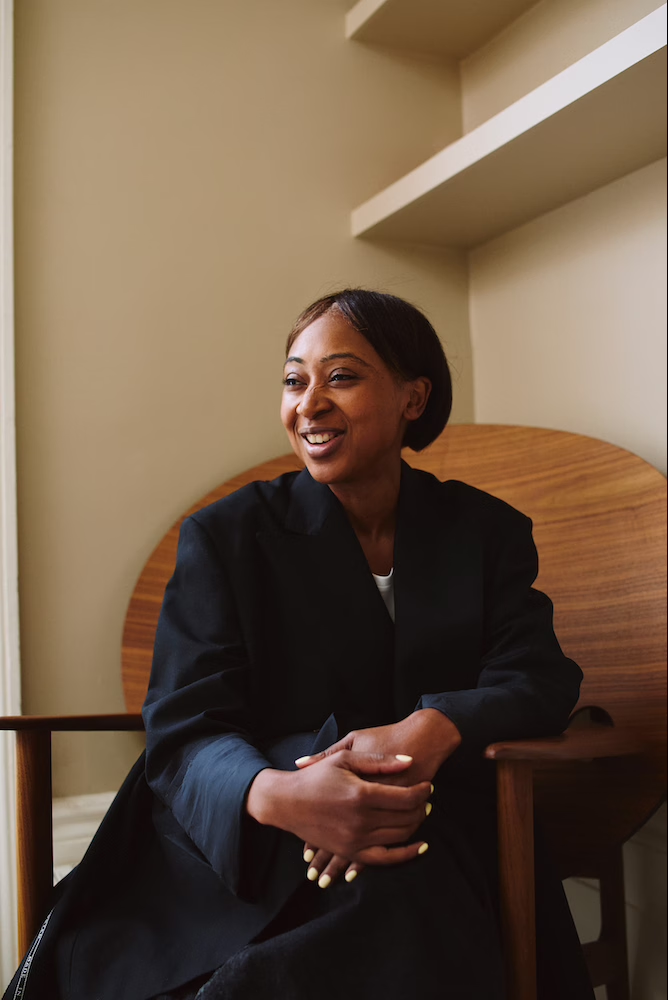
Design Miami’s 2026 curatorial director brings to the fair a conviction that has shaped her entire practice: that what we fail to see in an object is often what matters most.
Every object conceals as much as it shows. A chair offers its form to the eye but withholds the hands that shaped it, the material histories it carries, and the cultural memory sedimented in its making. For the 22nd edition of Design Miami, curatorial director Charlene Prempeh has made this tension the subject of the fair itself. Her theme, Unveiling, proposes that collectible design is not merely something to be acquired or admired, but something to be read.
“Unveiling speaks to Design Miami’s role as a site of discovery and exploration,” Prempeh states, “where the ideas, craftsmanship, and cultural narratives embedded within objects are revealed.” The formulation is deceptively simple. To unveil is not to invent meaning but to recover it, to remove what obscures an object’s full significance and return it to view.
It is a gesture that runs through Prempeh’s work. A London-based writer, curator, and founder of the creative studio A Vibe Called Tech, which has collaborated with Gucci and Frieze, she is the author of Now You See Me: An Introduction to 100 Years of Black Design. The book began with a single omission: Ann Lowe, the designer of Jacqueline Kennedy’s wedding gown, whose name went unmentioned in the press coverage of the time. From that erasure, Prempeh constructed a broader inquiry into the Black creatives whom design history had not simply overlooked but excluded. She sought, in her words, “narratives that illuminated issues that are still relevant now,” and described the book not as a final account but as “a starting point for discovery.”
That phrase could serve as an epigraph for Unveiling. Prempeh’s curatorial method is less concerned with pronouncement than with opening. “At its core, I suppose curation is an act of selecting and organising,” she has said, with characteristic modesty. Yet selection is never neutral: it determines what becomes visible and what remains in shadow. Her current exhibition at London’s Design Museum, The Nue Black Aesthetic, gathers more than 100 objects by 16 contemporary Black designers and insists that Black design is not a single category but a field of distinct histories and geographies. “I want the visitors to leave with curiosity,” she has explained.
Curiosity is precisely what Unveiling asks of Design Miami’s audience. Across partner presentations and gallery booths, historical and contemporary design meet in a shared inquiry into material, craft, and memory. Glass is traced back to sand and silica; archives are opened to the public; the maker’s hand is recognized not as mere technique but as a form of cultural authorship.
In the context of Miami Art Week, where spectacle often competes with substance, Prempeh’s proposal carries a quiet radicalism. It asks visitors to slow down, to look past the polish of the finished object, and to ask what, and whom, it holds. In her hands, unveiling becomes both an aesthetic and an ethical act: a way of seeing more fully, and of granting visibility where it has long been withheld.
Design Miami 2026
📍 Miami Beach Convention Center, Convention Center Drive & 19th Street, Miami Beach
🗓️ December 1–6, 2026
Las citas de Prempeh provienen de entrevistas publicadas en Cultured y Wallpaper*. La de Unveiling es la que tú me diste. No encontré una entrevista en la que hable a fondo del tema de Design Miami, así que la conexión entre su libro y Unveiling es una interpretación crítica mía, no una declaración suya.
Un dato para revisar: según Dezeen, la feria abre al público del 2 al 6 de diciembre, con un preview de prensa el 1 de diciembre. Tu artículo anterior dice del 1 al 6, porque el 1 de diciembre hay previews para miembros y coleccionistas. Ambos son correctos, pero usa la misma forma en los dos artículos.
Fuentes:
- Dezeen: Design Miami 2026
- Cultured: Charlene Prempeh on Black design and Now You See Me
- Wallpaper*: ‘The Nue Black Aesthetic’ maps the diasporic voices shaping design today
- Dezeen: “Technology’s been coming for black people since the beginning” says Charlene Prempeh
- Dezeen: Now You See Me, Charlene Prempeh’s book on Black designers