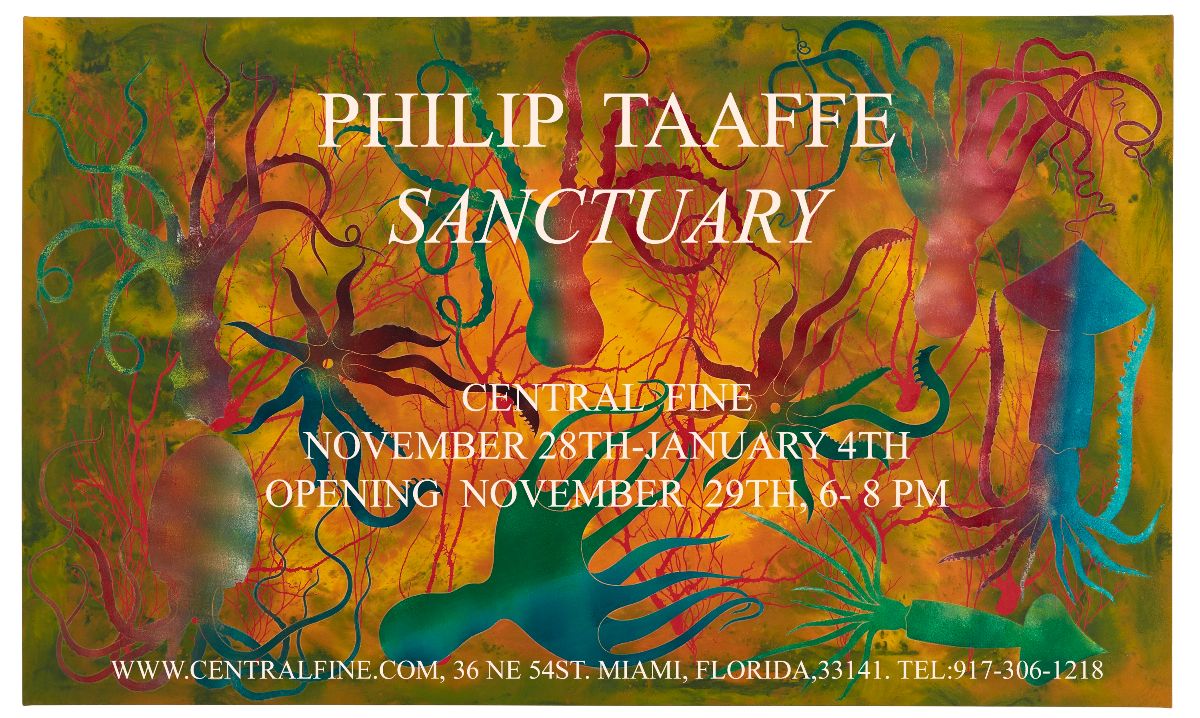
CENTRAL FINE presents Philip Taaffe’s first solo exhibition in Miami since 1993, exploring cultural memory, natural history, ornament, transformation, and the persistence of life through painting.
Opening Reception: Sunday, November 29, 2026 | 6–8 PM
Exhibition Dates: November 29, 2026 – January 4, 2027
Location: CENTRAL FINE, Miami
Exhibition Overview
CENTRAL FINE is pleased to announce Sanctuary, a solo exhibition of works by Philip Taaffe. This will be his first solo exhibition in Miami following his 1993 presentation at the Center for Fine Arts, which was curated by Louis Grachos.
Philip Taaffe’s paintings draw on an encyclopedic range of sources, spanning art history, natural history, visual culture, and ornamental traditions. Through the collection, translation, and recombination of these references, he creates complex pictorial environments in which diverse cultural histories and natural forms converge.
His practice approaches image-making as a form of visual anthropology, examining how visual languages carry knowledge, memory, and cultural meaning. Ornament serves as both a formal vocabulary and a means of connecting traditions across time and geography.
Eros and Thanatos: Life, Transformation, and the Natural World
The works evoke ancient places, forbidden zones, and sanctuaries, reflecting on the precariousness of existence and the search for beauty within threatened natural and cultural environments.
At their core is what Taaffe describes as the triumph of Eros over Thanatos: the persistence of life, desire, and transformation in the face of extinction and loss.
This tension is particularly evident in Painted Ossuary, which draws upon 120-year-old photographic documentation of Congolese fauna. Through his engagement with this archival material, Taaffe seeks to rescue otherwise obscured histories, transforming images of mortality into renewed pictorial life.
Thorn Heads, whose title evokes Graham Sutherland’s thorn imagery, similarly explores the relationship between vulnerability and resilience, while the extraordinary forms of cephalopods suggest alternative modes of intelligence, adaptation, and existence.
Cephalopods, Jean Painlevé, and Alternative Forms of Intelligence
The cephalopod painting included in the show pays homage to Jean Painlevé, the French photographer and filmmaker whose underwater studies were screened in surrealist salons in Paris in the 1930s.
His early innovations in underwater filmmaking, exemplified in 1928’s The Octopus, expanded the possibilities of observing marine life.
Drawing upon William James’s description of the octopus as possessing a “flexible intensity of life,” and Peter Godfrey-Smith’s conception of its body as one of “pure possibility,” Taaffe considers the remarkable adaptability of these creatures.
Their chromatophores, which allow them to change color in response to their environments, become suggestive of transformation, responsiveness, and the fluid boundaries between organisms and their surroundings.
Hic Sunt Dracones: Identity, Cultural Categories, and the Unknown
The painting Hic Sunt Dracones offers a compelling framework for approaching Taaffe’s practice.
Its title simultaneously evokes the unknown and uncharted, while also recalling James Baldwin’s 1985 essay Here Be Dragons, in which the writer examines the cultural constructions of race, sexuality, and identity.
Although distinct in their approaches, Taaffe and Baldwin’s practices both invite a reconsideration of inherited categories and the conventions through which meaning is established.
They similarly unsettle fixed interpretations, bringing disparate references into unexpected relationships and opening new possibilities for perception.
Painting as Accumulation, Transformation, and Visual Memory
These conceptual concerns are inseparable from Taaffe’s distinctive working methods.
His paintings evolve from an initial gestural staining, or from specific painted and stamped impressions, which establish a generative subtext for subsequent layers of collaged and superimposed imagery.
Painted Ossuary originates in relief plates developed from collages, impressed onto canvas before further stretching, staining, and painting.
Hic Sunt Dracones weaves fragments and traces into a unified composition, while lithographic ink and oil paint enrich passages.
In Windmill Cursive, the artist undertakes a sustained meditation on transparency, gradually building a scrolling pictorial field through successive layers of translucent medium.
Across these processes, each gesture preserves a record of the painting’s evolution.
Robert Hobbs on Palimpsest and Cultural Memory
As art historian Robert Hobbs recently noted in private correspondence with the artist:
“Looking again at your Palimpsest, I am struck by the coexistence of vivid, sharply articulated signs and pale, nearly disappearing contours. Birdlike forms, elongated emblems, and looping chains occupy overlapping registers of visibility. To my eye, these relationships make the painting feel like a field of recollection: certain images declare themselves, while others persist as intimations. The painting allows signs to appear as survivals, carrying associations that exceed our ability to fully identify or translate them. Its palimpsest effect gives cultural memory a visible structure, allowing different times to remain active together.”
Balancing intricacy with vulnerability, Taaffe’s paintings function as visual archives and imagined places of refuge.
They offer spaces for reflection and renewed attention to the world, where beauty becomes a means of confronting uncertainty rather than escaping it.
Painting emerges as an act of faith: a diaristic record of collecting, looking, and making connections, through which the possibility of hope persists.
About Philip Taaffe
Philip Taaffe was born in Elizabeth, New Jersey, in 1955 and studied at Cooper Union in New York.
His first solo exhibition was held in New York in 1982.
Taaffe has traveled extensively throughout the Middle East, India, South America, and Morocco. He also lived and worked in Naples, Italy, from 1988 to 1991.
His work has been included in numerous major museum exhibitions, including the Carnegie International, two Sydney Biennials, and three Whitney Biennials.
Taaffe’s works are held in important public collections, including:
- Museum of Modern Art (MoMA), New York
- Philadelphia Museum of Art
- Whitney Museum of American Art, New York
- Museo Nacional Centro de Arte Reina Sofía, Madrid
Exhibition Information
Exhibition: Philip Taaffe: Sanctuary
Opening Reception: Sunday, November 29, 2026, 6–8 PM
Exhibition Dates: November 29, 2026 – January 4, 2027
Gallery: CENTRAL FINE
Address: 36 NE 54th Street, Miami, FL 33137
Website: https://www.centralfine.com