
Home Blog Page 17

PALM BEACH SHOW: EXCLUSIVE PRESENTATIONS FOR 2026

PALM BEACH SHOW 2026

PALM BEACH SHOW ANNOUNCES CURATED GUIDED TOURS AND EXCLUSIVE PRESENTATIONS FOR 2026

February 12-17, 22026 | Presidents’ Day Weekend | Palm Beach Convention Center

Palm Beach Show Group is pleased to announce a dynamic lineup of curated guided tours and exclusive presentations as part of the 2026 Palm Beach Show programming. Designed to enrich the visitor experience, this year’s offerings invite attendees to engage with expert insights, immersive discussions, and intimate explorations of art, design, jewelry, and collecting.

The 2026 Palm Beach Show opens with its Opening Preview Party on Thursday, February 12, offering guests an elegant first look at the fair. From Friday, February 13 through Tuesday, February 17, attendees may participate in a series of curated guided tours and special presentations held directly on the show floor at the Palm Beach County Convention Center. The full schedule is available online.

Curated Guided Tours

Each guided tour provides an intimate look into exceptional collections and creative perspectives. Tour themes include:

  • The Art of Adornment
  • Collecting the Extraordinary
  • Art Within Reach
  • Jewels Through Time
  • The Now Movement
  • Masters of Time
  • Curator’s Choice

Tours are led by knowledgeable guides and limited to 15 guests per session, offering rare access to gallery insights and collecting expertise.

Exclusive Presentation

In addition to the guided tours, the Palm Beach Show will feature an exclusive presentation by Fred Savage, founder of Timepiece Grading Specialists (TGS), on Saturday, February 14, from 4:00–5:00 pm. Savage will share his personal journey into watch collecting and discuss how TGS is helping to transform transparency and confidence in the pre-owned watch market.

“We are delighted to offer a multi-layered program that brings deeper understanding and appreciation to the works on display,” said Scott Diament, President and CEO of the Palm Beach Show Group. “These guided tours and presentations enhance the collecting experience and provide meaningful engagement for both seasoned collectors and new enthusiasts.”

Advance purchase and registration are required for curated tours and the exclusive presentation. Visitors are encouraged to explore the complete 2026 programming schedule and reserve their spots online.

For full details and the complete schedule, visit:
https://www.palmbeachshow.com/2026-palm-beach-show-programming/


About the 2026 Palm Beach Show

Opening Night Preview Party
Thursday, February 12, 2026 | 2:00–9:00 pm

  • Exclusive Preview — 2:00 pm Entry (Invitation or $200 Multi-Day Ticket per person)
  • VVIP Preview — 4:00 pm Entry (Invitation or $100 Multi-Day Ticket per person)
  • VIP Preview — 6:00 pm Entry (Invitation or $50 Multi-Day Ticket per person)

General Show Days
(Invitation or $30 Multi-Day General Admission Ticket per person)

  • Friday, February 13 | 11:00 am – 6:00 pm
  • Saturday, February 14 | 11:00 am – 6:00 pm
  • Sunday, February 15 | 11:00 am – 6:00 pm
  • Monday, February 16 | 11:00 am – 6:00 pm
  • Tuesday, February 17 | 11:00 am – 6:00 pm

Location
Palm Beach County Convention Center
650 Okeechobee Boulevard
West Palm Beach, FL 33401

Admission

  • $50–$200 for Opening Night Preview tickets
  • $30 for General Admission tickets
    (All purchased tickets are valid for all General Show Days)

For More Information
Call 561.822.5440 or visit www.PalmBeachShow.com

Exhibitors | Palm Beach Show 2026

Aaron Faber Gallery — New York, NY | Booth 906
ABA Gallery — New York, NY | Booth 1111
Alexander Laut — New York, NY | Booth 225
Allegro Studio Art — West Bloomfield, MI | Booth 431
Andrew Ford Fine Art — Sarasota, FL | Booth 640
Anna Paola Cibin — Venice, Italy | Booth 632
Anne Howard Gallery — Dublin, NH | Booth 405
Antico Contempo — New York, NY | Booth 432
Arader Galleries — Philadelphia, PA | Booth 703
Art New Line — Lake Worth, FL | Booth 1204
Artnew Gallery JD — Sant Julià de Lòria, Andorra | Booth 904

Benchmark of Palm Beach — Palm Beach, FL | Booth 502
Berengo Studio — Murano–Venice, Italy | Booth 226
Beto Oliveros Studio — New York, NY | Booth 910
Betsy Frank Gallery — Miramar, FL | Booth 431A
Boccara Gallery — New York, NY | Booth 1110
Butchoff Antiques — London, United Kingdom | Booth 406 / 507

Callaghans of Shrewsbury — Shrewsbury, United Kingdom | Booth 1100
Camilla Dietz Bergeron — New York, NY | Booth 533
Cavalier Gallery — Palm Beach, FL | Booth 418 / 521
Charamonde Jewelers — Palm Beach, FL | Booth 701
CHARLES OUDIN Paris — Paris, France | Booth 400 / 501
CICADA — New York, NY | Booth 219
Classic Antiques — Chicago, IL | Booth 1019
Corey Friedman Fine Jewels — New York, NY | Booth 319

Daniels Antiques — Fort Lauderdale, FL & Aspen, CO | Booth 732
Daphne Alazraki Fine Art — New York, NY | Booth 200 & 1101
Darnley Fine Art — London, United Kingdom | Booth 115 / 115A
David Brooker Fine Art — Woodbury, CT | Booth 1002
David Harber — Aston Upthorpe, Oxfordshire, UK | Booth 124
Dinan & Chighine — London, United Kingdom | Booth 413

Fazzino Art by Amazing Animation — Lake Worth Beach, FL | Booth 321
FerriFirenze — Florence, Italy | Booth 112
Ford Art & Antiques — Sarasota, FL | Booth 644
Frederic Got — Paris, France | Booth 830

Galerie Fledermaus — Palm Beach, FL | Booth 601
Galerie STP — Greifswald, Germany | Booth 729
Gallery Je’ — Stuart, FL | Booth 1022
Gallery Josée Nadeau — Montréal / Palm Beach, FL | Booth 135 & 143
Gladwell & Patterson — London, United Kingdom | Booth 800 / 901
Glen Leroux Gallery — Westport, CT | Booth 1008
Greenwich Bazaar — New York, NY | Booth 1016
Greg Pepin Silver Denmark — Hellerup, Denmark | Booth 1114
Guarisco Gallery — McLean, VA | Booth 724

Hakimian Gem Company — Chicago, IL | Booth 924
Heera Moti Fine Gems & Jewelry — New York, NY | Booth 1025
Imperial Fine Books & Oriental Art — New York, NY | Booth 713
Itay Noy Timepieces — Old Jaffa, Tel Aviv, Israel | Booth 429

J. S. Fearnley — Atlanta, GA | Booth 300
J. Ruel Martin Gallery of Wood Sculptures — Acworth, GA | Booth 1207
Janice Paull Antiques & Design — New Castle, DE | Booth 1013
Janina Fine Art — Madrid, Spain | Booth 933
Jardin Jewels — New York, NY | Booth 118
Jimmy & Kathy Gallery — Flushing, NY | Booth 1012
JM Insurance Agency Partners — Neenah, WI | Booth 329

Kodner Galleries — Dania Beach, FL | Booth 330
Kofski’s — West Palm Beach, FL | Booth 424 / 525

L.E. Gallery — Brussels, Belgium | Booth 117
Lawrence Steigrad Fine Arts — New York, NY | Booth 600
Leighton Fine Art — Marlow, United Kingdom | Booth 919
Lester Lampert Fine Jewelry — Chicago, IL | Booth 129
Lueur Jewelry — New York, NY | Booth 218
Lydia Courteille — Paris, France | Booth 106

M.S. Rau — New Orleans, LA | Booths 606 / 707 & 700 / 801
Maison Palm Beach / Mark Lukas Fine Art — Palm Beach, FL | Booth 1010
Market Gallery of Palm Beach — Lake Worth, FL | Booth 1038
Martinez Art Gallery — Southampton, NY | Booth 1030
Masterworks Fine Art Gallery — Palo Alto, CA | Booth 206 / 307
MASTOUR Est. 1890 — New York, NY | Booth 1200
Mazal Diamonds — Boca Raton, FL | Booth 123
Michael S. Haber — Wynnewood, PA | Booth 417
Mikaël Dan — Paris, France | Booth 630
Miseno — Naples, Italy | Booth 324
Modern Fine Art — New York, NY | Booth 412 / 515

Nelson Rarities — Falmouth, ME | Booth 1000
Nicolas Auvray Gallery — New York, NY | Booth 306

Palm Beach Art, Antique & Design Showroom — Lake Worth Beach, FL | Booth 132 / 233
Palm Beach Estate Empire — Weston, FL | Booth 1211
Pampillonia Jewelers — Bethesda, MD | Booth 209
Pascoe Gallery — Miami, FL | Booth 428 / 529
Pash Art Studio — New York, NY | Booth 319A
Pavel Novak Glass — Collingswood, NJ | Booth 425
Pearl Masters USA — New York, NY | Booth 301
Persian Galleries — Brentwood, TN | Booth 1213
Premier Rare Coins — West Palm Beach, FL | Booth 715
Prochazka Glass — Prague, Czech Republic | Booth 731

Provident Fine Art — Palm Beach, FL | Booth 614 / 721
Provident Jewelry — Florida (Multiple Locations) | Booth 624 / 725
Provident Realty of South Florida — West Palm Beach, FL | Booth 1039

Rebecca Koven — New York, NY | Booth 419
Rehs Contemporary Galleries — New York, NY | Booth 506 / 607
Rehs Diamonds — New York, NY | Booth 504 / 605
Renssen Art Gallery — Amsterdam, Netherlands | Booth 833
RIZLANE — Granby, Canada | Booth 133
Robert Fontaine Gallery — Miami Beach, FL | Booth 310
Robert Simon Fine Art — New York, NY | Booth 1112
Roberto Freitas American Antiques & Decorative Arts — Stonington, CT | Booth 401
Rosaria Varra Fine Jewelry — Miami, FL | Booth 1009
Rosior — Lisbon & Porto, Portugal | Booth 718 / 817
Ruchi New York — New York, NY | Booth 212 / 313

S. Georgios Inc. — Astoria, NY | Booth 234
Scarselli Diamonds — New York, NY | Booth 612
Schillay Fine Art — New York, NY | Booth 203
Shaw Jewelry / Hughes Bosca — Northeast Harbor, ME | Booth 322
SICIS Jewels — Milan, Italy | Booth 824 / 925
SmithDavidson Gallery — Amsterdam, Netherlands | Booth 516 / 617
Steidel Contemporary — Lake Worth Beach, FL | Booth 438 / 539
Steven Neckman, Inc. — Miami, FL | Booth 312

Takat — New York, NY | Booth 900 / 1001
The Back Vault — New York, NY | Booth 816
The Jade Gallery — Starke, FL | Booth 1018
The MK Artem House — Coral Gables, FL | Booth 331
The Parker Gallery — Hampshire, United Kingdom | Booth 201
Toulouse Antique Gallery — Los Angeles, CA | Booth 812 / 913
Traum Safe — New York, NY | Booth 916
Treasure Fine Jewelry — Miami, FL | Booth 1034
Trissi Corporation — Scarsdale, NY | Booth 125

Urban Larsson — Amsterdam, Netherlands | Booth 831
VANT Jewellery — London, United Kingdom | Booth 409
Vendome Collection — San Antonio, TX | Booth 918
Viggi — Palm Beach, FL | Booth 412 / 515
VK Gallery — Amsterdam, Netherlands | Booth 832

Willow Gallery — St. James’s, London, United Kingdom | Booth 100
Winick-Runsdorf-Dauria — New York, NY | Booth 1045
Winsor Birch — Marlborough, United Kingdom | Booth 1005
Worldwide Investments — Bal Harbour, FL | Booth 213

Yafa Signed Jewels — Palm Beach, FL | Booth 712 / 813
Yossi Shua — Jerusalem, Israel | Booth 433
Yvel — Palm Beach, FL | Booth 538 / 639
Zdzisław Beksiński

Zdzisław Beksiński
Zdzisław Beksiński

Zdzisław Beksiński: Architecture of Ruin and the Refusal of Meaning

Zdzisław Beksiński (1929-2005) was a Polish painter, photographer, and sculptor whose work defied conventional interpretation by refusing titles and explicit meaning. His statement “I don’t want to say or convey anything. I just paint what comes to my mind” represents not evasion but a radical aesthetic position: the image exists as experience, not message. This essay examines Beksiński’s oeuvre through documented analysis from established institutions, focusing on his architectural training, photographic experimentation, and the development of what he termed his “fantastic period”—work that transformed dystopian surrealism into a visual language of universal unease.

Biographical Context: Poland 1929-2005

Born on February 24, 1929, in Sanok, southern Poland, Beksiński’s formative years coincided with World War II. He survived the war and continued creating provocative work during Communist times in Poland, when many art forms faced government censure. While biographical determinism can oversimplify artistic output, the historical context remains significant: Beksiński emerged from a Europe that had witnessed industrial-scale destruction, yet he consistently rejected interpretations that reduced his work to trauma illustration or political commentary.

In 1947, Beksiński began studying architecture at Kraków Polytechnic, completing his MSc degree in 1952. This educational foundation proved crucial. Unlike painters trained in academic traditions of representation, Beksiński learned to conceive space structurally—understanding volume, perspective, and the relationship between bodies and built environments. Upon returning to Sanok in 1955, he worked as a construction site supervisor but found the position unfulfilling.

The Photographic Foundation: 1950s

Beksiński began working as a photographer in the 1950s, holding a solo exhibition at the Photographic Society in Gliwice in 1958. His photographic work, now housed at the National Museum in Wrocław, represents one of the most significant achievements of Polish photography in the 20th century. These images—depicting wrinkled surfaces, desolate landscapes, bandaged faces, and decaying materials—established his aesthetic vocabulary.

In 1958, Beksiński wrote “Crisis in Photography and the Prospects of Overcoming It,” published in the journal Periodical Photography, which became one of the most important theoretical writings on photography produced in Poland during the 20th century. His photographic practice challenged aesthetic conventions and anticipated conceptual art, body art, and photo-media developments.

By the early 1960s, Beksiński abandoned photography, disappointed by the limited possibilities of altering captured images. Painting and drawing offered the freedom to manipulate reality beyond photographic constraints—to create what he described as “photographing dreams.”

1964: The Warsaw Exhibition and Critical Recognition

The turning point in Beksiński’s career occurred in 1964 when critic Janusz Bogucki organized an exhibition in Warsaw that became his first major success—all paintings sold. This success came without titles, without artist statements, without the explanatory apparatus typically demanded of contemporary art. In a cultural environment where socialist realism had dominated, Beksiński’s refusal to make his work “useful” or explicable constituted quiet resistance.

He soon became a leading figure in contemporary Polish art, not through manifestos or group affiliations but through the unsettling power of images that demanded engagement without offering resolution.

The “Fantastic Period”: Late 1960s to Mid-1980s

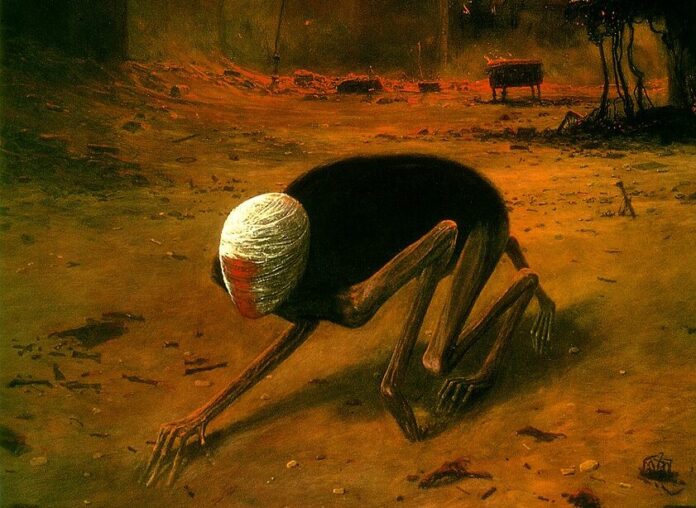
In the late 1960s, Beksiński entered what he called his “fantastic period,” which lasted until the mid-1980s—his most celebrated phase, during which he created disturbing images of gloomy, nightmarish environments featuring death, decay, skeleton-filled landscapes, deformed figures, and deserts.

His famous declaration captures his methodology: “I wish to paint in such a manner as if I were photographing dreams”. The photographic metaphor is significant—it suggests documentation rather than invention, objectivity applied to the oneiric. His architectural training manifested in precise perspectival construction, measured diagonals, and volumetric exactitude applied to impossible spaces.

Beginning around 1970, Beksiński painted in oils on masonite, and his ability to manipulate light effects quickly became a hallmark of his work, comparable to the renowned abilities of J.M.W. Turner. Yet where Turner’s light suggested transcendence, Beksiński’s illumination is clinical, exposing rather than redeeming.

Importantly, despite the grim subject matter, Beksiński claimed some works were misunderstood—he considered them optimistic or even humorous. This statement confounds easy readings. The artist’s subjective experience diverged from viewer reception, further emphasizing his position that meaning resides in encounter, not authorial intent.

The Radical Act: Refusing Titles

Beksiński was adamant that he did not know the meaning of his artworks and was uninterested in possible interpretations; consistent with this position, he refused to provide titles for any drawings or paintings. Every work remains “Untitled.”

This decision exceeds aesthetic preference. Titles direct interpretation, create narrative frames, anchor images in conceptual schemas. By withholding them, Beksiński forced viewers into direct phenomenological engagement. The work could not be reduced to “The Horror of War” or “Meditation on Mortality”—it remained stubbornly itself, demanding that viewers confront their own responses without interpretive guidance.

As he stated, “I cannot conceive of a sensible statement on painting,” and he was especially dismissive of those seeking simple answers to what his work meant. This dismissal was not arrogance but epistemological rigor: visual experience precedes and exceeds verbal translation.

Technique and Material Practice

Beksiński’s paintings were mainly created using oil paint on hardboard panels that he personally prepared, though he also experimented with acrylics. He abhorred silence and always listened to classical music while painting, though he also appreciated rock music. He credited music as his main source of inspiration, claiming not to be influenced by literature, cinema, or other artists’ work, and almost never visited museums or exhibitions.

This methodological isolation meant his visual language developed independently. He created not in dialogue with art historical movements but in response to internal necessity and musical structure.

Later Developments: The “Gothic Period” and Digital Work

Beksiński’s art in the late 1980s and early 1990s focused on monumental, sculpture-like images rendered in restricted, often subdued color palettes, including a series of crosses. He described this later phase as his “gothic period,” characterized by deformed heads and less dreamlike figures displaying specific plastic harmony.

In the later part of the 1990s, he became interested in computers, the Internet, digital photography, and photo manipulation—media he focused on until his death. While many artists his age rejected digital tools, Beksiński embraced them, extending his vision into new technical possibilities. His digital works maintained his aesthetic concerns while demonstrating formal adaptability.

Before relocating, Beksiński burned a selection of works in his own backyard without documentation, claiming some were “too personal” while others were unsatisfactory—he didn’t want people to see them. This destruction suggests he maintained strict standards for what entered public circulation, exercising posthumous control through pre-emptive erasure.

Life in Warsaw and Personal Tragedy

In 1977, Beksiński moved to Warsaw with his wife Zofia and their son Tomasz. Although his art was often grim, he himself was known as a pleasant person who enjoyed conversation and had a keen sense of humor—modest, somewhat shy, avoiding public events including his own exhibition openings.

He had obsessive-compulsive disorder, which made him reluctant to travel; he referred to his condition as “neurotic diarrhea”. This clinical detail humanizes the artist while explaining his reclusive working method—isolation was not romantic pose but psychological necessity.

Beksiński’s wife Zofia died in 1998; a year later, on Christmas Eve 1999, his son Tomasz died by suicide by drug overdose. Beksiński discovered his son’s body. On February 21, 2005, Beksiński was murdered in his Warsaw apartment by Robert Kupiec, the teenage son of his longtime caretaker, reportedly because Beksiński refused to lend him money. Robert was sentenced to 25 years in prison; his cousin Łukasz received five years.

The violence that ended Beksiński’s life was not metaphorical or aesthetic but banal—a refusal to lend money, a sudden attack. Unlike his paintings, which transform suffering into carefully constructed images, his death had no formal coherence.

Institutional Recognition and Legacy

The town of Sanok houses a museum dedicated to Beksiński; the Historical Museum in Sanok possesses the world’s largest collection of his work, with approximately 600 pieces. A museum housing 50 paintings and 120 drawings from the Piotr Dmochowski collection—the largest private collection of Beksiński’s art—opened in 2006 at the City Art Gallery of Częstochowa. On May 18, 2012, with participation from Minister of Regional Development Elżbieta Bieńkowska, the ceremonial opening of The New Gallery of Zdzisław Beksiński took place in the rebuilt wing of Sanok Castle.

During his lifetime, Beksiński received various accolades including the Award of the Minister of Culture and Art in 1980 and the Award of the Polish Culture Foundation in 1992. His work has been exhibited in numerous galleries and museums across Poland and internationally.

Film director Guillermo del Toro credits Beksiński’s influence on Pan’s Labyrinth, which won del Toro an Oscar in 2006. According to del Toro, “In the medieval tradition, Beksinski seems to believe art to be a forewarning about the fragility of the flesh—whatever pleasures we know are doomed to perish—thus, his paintings manage to evoke at once the process of decay and the ongoing struggle for life”.

Beksiński and his family are portrayed in the 2016 drama film The Last Family directed by Jan P. Matuszyński, with Andrzej Seweryn playing Beksiński.

Critical and Academic Reception

Academic analysis has attempted various interpretive frameworks, including psychoanalytic approaches examining Beksiński’s “fantastic period” paintings as expressions of early childhood experience. However, such readings exist in tension with the artist’s explicit rejection of interpretive closure.

Beksiński’s work has been studied in academic circles for its striking visuals, rich symbolism, and connection to Polish history and culture. Some scholars contextualize his imagery within Poland’s traumatic 20th-century history—World War II, communist repression—while others focus on formal analysis, compositional strategies, and his manipulation of light and space.

The challenge for critics remains Beksiński’s own position: he produced images of extraordinary power while insisting they meant nothing beyond themselves. This creates interpretive paradox—work that seems laden with meaning but whose creator denies semantic content.

Conclusion: The Function of Discomfort

Beksiński’s significance extends beyond dystopian surrealism as genre. His work performs a specific cultural function: it refuses consolation. In an era saturated with images designed for rapid consumption and emotional management, his paintings demand sustained attention. They cannot be scrolled past, reduced to captions, or domesticated through explanation.

His architectural training produced images of spatial logic applied to impossible scenarios—ruins that were never buildings, figures that were never fully human, light sources that illuminate without warmth. The precision of execution intensifies rather than diminishes horror: these are not chaotic nightmares but methodically constructed visions.

By refusing titles and interpretations, Beksiński insisted that art’s primary function is not communication of predetermined meaning but creation of phenomenological encounter. The viewer stands before the work without mediation, forced to acknowledge their own response—discomfort, fascination, revulsion, recognition.

The world’s largest exhibition of Beksiński’s work at the Historical Museum in Sanok presents approximately 600 pieces, documenting his artistic evolution across photography, painting, sculpture, and digital media. This institutional preservation ensures continued engagement with work that refuses to become comfortable, familiar, or fully explained.

Beksiński created images of ruin—architectural, corporeal, civilizational. Yet the ruins are not memorials to specific catastrophes but structural conditions. His work suggests that decay, deformation, and death are not aberrations but fundamental aspects of existence that polite culture works to obscure. His painting’s function, then, is not to explain these conditions but to make them visible—to hold them before the viewer until recognition occurs.

The discomfort his work generates is not incidental but essential. It marks the distance between aesthetic experience and intellectual containment, between what can be shown and what can be said. In this gap, Beksiński’s untitled works continue to operate—not as messages but as encounters that remain stubbornly, productively, irresolvable.


References

All factual claims in this essay are supported by the following authoritative sources:

  • Historical Museum in Sanok (official institutional repository housing the world’s largest Beksiński collection)
  • Wikipedia entries on Zdzisław Beksiński (citing multiple scholarly sources)
  • DailyArt Magazine art historical analysis
  • National Museum in Wrocław (repository of Beksiński’s photographic work)
  • Academic papers including Beata Sokołowska-Smyl’s “Zdzisław Beksiński’s Paintings of the ‘Fantastic Period’ as an Expression of Early Childhood Experience” (2014)
  • Morpheus Gallery biographical documentation
  • Sanok Historical Museum official documentation
  • WikiArt scholarly database
  • Culture.pl (Polish Cultural Institute)

Paint Brushes for Oil, Acrylic, and Watercolor Painting: Choosing the Right Tools for Each Medium

Paint Brushes for Oil, Acrylic, and Watercolor Painting
Paint Brushes for Oil, Acrylic, and Watercolor Painting: Choosing the Right Tools for Each Medium

Paint Brushes for Oil, Acrylic, and Watercolor Painting: Choosing the Right Tools for Each Medium

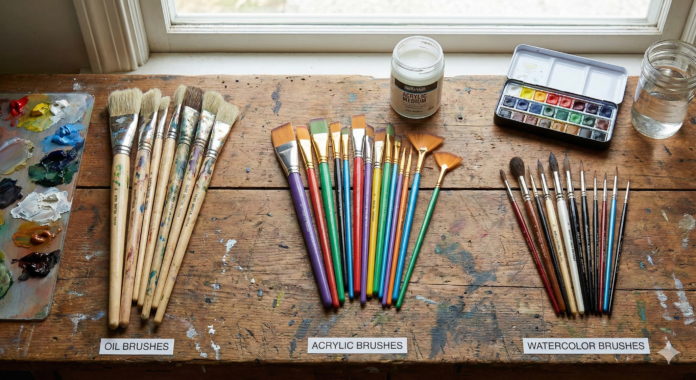
The three major painting media—oil, acrylic, and watercolor—each have distinct physical properties that demand specific brush characteristics for optimal results. Oil paint’s thick, buttery consistency requires brushes that can push and manipulate heavy pigment. Acrylic paint’s quick-drying nature and variable viscosity calls for resilient bristles that maintain their shape under repeated use. Watercolor’s fluid, translucent washes need soft, absorbent brushes that hold and release diluted pigment with precision. Understanding these relationships between paint properties and brush design helps artists build an effective toolkit and achieve the results each medium can offer.

Oil Painting Brushes: Built for Body and Texture

Oil painting brushes are engineered to handle paint at its thickest and most substantial. Traditional oil painting involves applying layers of pigment suspended in linseed or other oils, creating mixtures that range from thick impasto to thinner glazes. The brushes must be robust enough to move this heavy material across canvas without collapsing or losing their shape.

Natural hog bristles have been the standard for oil painting for centuries, and for good reason. These coarse, stiff fibers possess natural strength and a slightly rough texture that grips oil paint effectively. The bristles’ natural flagged tips—split ends at a microscopic level—help distribute paint evenly while creating the characteristic textured brushstrokes many oil painters prize. Hog bristle brushes can withstand the physical demands of moving thick paint and scrubbing color into canvas weave. They create visible, expressive marks that become part of the painting’s surface character.

High-quality synthetic brushes designed for oil painting offer a viable alternative, especially for artists seeking animal-free options or working in educational settings where budget matters. Modern synthetic bristles for oil painting are manufactured to mimic the stiffness and resilience of hog bristle while offering greater consistency from brush to brush. They maintain their shape well, clean more easily, and can be more affordable while delivering performance that rivals natural bristles for many applications.

Oil painting brushes typically feature long handles, usually twelve to fifteen inches or more. This extended length serves multiple purposes beyond simple reach. Long handles allow artists to work at arm’s length from the canvas, providing better perspective on the overall composition rather than focusing too closely on isolated details. This distance encourages looser, more confident brushwork and helps artists see relationships between colors and forms more accurately. The handle length also provides leverage, making it easier to apply pressure when working with thick paint or covering large areas.

The brushwork itself becomes part of oil painting’s visual language. The stiff bristles leave traces of their passage—ridges, grooves, and directional marks that catch light and create surface interest. This visible texture, whether subtle or pronounced, distinguishes oil painting from smoother media. Choosing brushes that complement your desired surface quality, from heavily textured impasto to smoother, more refined passages, becomes an essential part of developing your artistic voice.

Acrylic Painting Brushes: Engineered for Resilience

Acrylic paint presents unique challenges that have driven brush innovation. This relatively modern medium, developed in the mid-twentieth century, combines aspects of both oil and watercolor while introducing characteristics all its own. Acrylics dry quickly through evaporation rather than oxidation, can be used thick like oils or thin like watercolors, and when dry form a tough, water-resistant plastic film. These properties demand brushes that can handle both consistency extremes while surviving the medium’s harsh nature.

Synthetic bristles reign supreme for acrylic painting. Materials like taklon, a high-grade synthetic fiber, offer the perfect combination of strength, resilience, and what brush manufacturers call “snap”—the ability to return quickly to the bristle’s original shape after bending. This spring-like quality proves essential when working with acrylics, as the paint’s body and quick-drying nature constantly test the brush’s structure. Quality synthetic bristles maintain their shape stroke after stroke, neither splaying outward nor clumping together as inferior brushes do.

Natural bristles perform poorly with acrylics for several reasons. The water content in acrylic paint causes natural hairs to absorb moisture, becoming soft and losing the firmness needed to control the medium. More critically, dried acrylic paint is notoriously difficult to remove completely, and its plastic nature can destroy natural bristles’ delicate structure. Natural hair brushes used with acrylics often become permanently damaged after just a few uses, making them an impractical choice despite their effectiveness with other media.

The resilience of synthetic brushes for acrylics extends beyond their performance with paint. They withstand aggressive cleaning, which becomes necessary given acrylic’s tendency to dry quickly on bristles. They tolerate the solvents and soaps sometimes needed to remove stubborn dried paint. They maintain consistent performance through hundreds of painting sessions when properly cared for, offering long-term value that justifies investment in quality synthetic brushes.

Like oil painting brushes, acrylic brushes typically feature long handles. Artists working on canvas or board benefit from the same perspective advantages and leverage that oil painters enjoy. The handle length facilitates working on vertical surfaces like easels while maintaining comfortable posture and viewing distance. For studio painting where the artist stands or sits at a comfortable distance from the work, long handles feel natural and support effective technique.

Acrylics’ versatility means these brushes must perform across a range of consistencies. Used straight from the tube, acrylics approach the thickness of oil paint, requiring brushes that can push substantial material. Thinned with water or medium, acrylics become fluid enough for watercolor-like techniques, asking the same brushes to handle delicate washes. Quality acrylic brushes navigate this spectrum effectively, demonstrating the engineering sophistication behind modern synthetic bristle design.

Watercolor Painting Brushes: Designed for Absorption and Release

Watercolor painting operates on entirely different principles from oil or acrylic work. The paint itself is transparent pigment bound with gum arabic, always diluted with water to varying degrees of transparency. Success in watercolor depends on controlled wetness—managing how much water-diluted paint the brush holds and how it releases that liquid onto absorbent paper. Brushes for watercolor prioritize softness, absorbency, and the ability to form fine points or edges for precise work.

Natural sable brushes represent the traditional pinnacle of watercolor brush quality. Sable hair, particularly from the tail of the Kolinsky sable (actually a type of weasel), possesses remarkable properties. The hairs are exceptionally soft yet springy, returning to their shape after each stroke. They absorb substantial amounts of water while maintaining their form. Most notably, quality sable brushes come to extremely fine points when wet, allowing for detailed work despite the brush’s overall size. A large sable round might hold enough diluted paint for broad washes yet still create delicate lines with its pointed tip.

The cost of genuine Kolinsky sable brushes reflects both the material’s rarity and its superior performance. A single quality sable brush can cost as much as an entire set of synthetic alternatives. For professional watercolorists and those who can justify the investment, sable brushes offer unmatched responsiveness and longevity. A well-maintained sable brush can serve an artist for decades, developing a familiar feel that becomes integral to their working method.

Modern synthetic watercolor brushes have evolved dramatically, with premium synthetics approaching natural sable’s performance at a fraction of the cost. High-quality synthetic watercolor brushes made from fine nylon or taklon fibers form good points, hold reasonable amounts of water, and perform admirably for most watercolor techniques. While connoisseurs might detect differences in how synthetic bristles release water compared to natural sable, many artists work exclusively with synthetics and achieve excellent results. For students, hobbyists, and those building initial collections, synthetic watercolor brushes offer outstanding value and performance.

Watercolor brushes traditionally feature shorter handles than those used for oil or acrylic painting. This design reflects watercolor’s typical working position—artists usually sit close to their paper, which lies flat or at a slight angle on a table or drawing board. Short handles provide maximum control for the precise, detailed work watercolor often demands. The brush becomes an extension of the hand in a more direct way than with longer handles, facilitating the delicate touch watercolor techniques require.

The shapes common to watercolor brushes serve the medium’s specific needs. Round watercolor brushes are fundamental, used for everything from broad washes to fine details depending on their size. Flat watercolor brushes create distinctive rectangular strokes useful for architectural elements or geometric shapes. Mop brushes, with their large, soft, rounded shapes, excel at applying even washes across large areas. Rigger or liner brushes, featuring long, thin bristles, create the continuous fine lines needed for branches, rigging on ships, or delicate botanical details.

The Crossover Question: Can Brushes Serve Multiple Media?

The dream of a universal brush collection that serves all media appeals to practical and economic sensibilities. In practice, some overlap exists, though compromises inevitably arise when asking one tool to serve multiple distinct purposes.

High-quality synthetic brushes represent the most versatile option for artists working across multiple media. Premium synthetics, particularly those marketed as multi-media or featuring advanced fiber technology, can perform credibly with watercolor, acrylic, and even some oil painting techniques. They won’t match specialized brushes’ performance in each medium, but they offer respectable results across the board. For artists exploring different media, building an initial collection of quality synthetic brushes in various shapes and sizes provides the flexibility to experiment without investing in separate brush sets for each medium.

Acrylic brushes transition to oil painting reasonably well. Their synthetic bristles handle oil paint’s body effectively, and the stiff resilience that serves acrylics works similarly with oils. Artists can confidently use their acrylic brushes for oil painting, though they should dedicate specific brushes to each medium rather than switching back and forth. Once a brush has been used with oils, cleaning it thoroughly enough for water-based acrylics becomes difficult, and residual oil can contaminate acrylic paint.

Oil painting brushes perform poorly for watercolor, however. Their stiffness, designed for moving heavy paint, proves far too coarse for watercolor’s delicate washes and details. Using an oil painting brush for watercolor would be like writing calligraphy with a housepainting brush—technically possible but missing the point entirely. The stiff bristles don’t absorb water effectively, won’t form the points needed for detail work, and create harsh, uncontrolled marks on delicate watercolor paper.

Watercolor brushes can technically be used with thinned acrylics, though this practice risks damaging these often-expensive tools. Acrylic paint, even when diluted, maintains its tendency to dry into a tough plastic that can ruin the delicate structure of fine watercolor brushes. Artists who work in both media typically maintain separate brush collections to preserve their watercolor brushes’ condition and performance.

Building a Practical Brush Collection

For artists beginning to assemble their toolkit or those looking to work across media, a thoughtful approach balances versatility with specialization. Start with quality synthetic brushes in fundamental shapes—rounds in small, medium, and large sizes, flats of varying widths, and perhaps an angled brush. These form the core of a functional collection suitable for acrylic painting and decent for watercolor work.

As you develop preferences for particular media, invest in specialized brushes that elevate your work in that direction. If oil painting becomes your focus, add natural bristle brushes that create the texture and handle the paint body this medium offers. If watercolor captures your attention, gradually acquire sable or premium synthetic watercolor brushes that bring out the medium’s subtle beauty. If acrylics remain your primary medium, expand your synthetic brush collection with shapes and sizes that support your evolving techniques.

Consider brush care as integral to building a collection. Properly maintained brushes last exponentially longer than neglected ones. Clean brushes thoroughly after each session, using appropriate cleaners for your medium. Store them properly to maintain bristle shape. Rotate through your collection rather than relying on a few favorites until they wear out. Quality brushes represent an investment that pays dividends through years of reliable performance.

The relationship between painter and brush becomes intuitive with experience. You’ll develop preferences for certain brushes for specific tasks, reaching for familiar tools that feel right for the mark you want to make. This personal relationship with your tools represents part of painting’s deeper satisfaction—the harmony between intention, tool, and result that transforms technique into expression.

The Path Forward: Choosing Wisely for Your Practice

Understanding brush characteristics for different media empowers better choices, but actual use teaches more than any guide can convey. Purchase a few quality brushes rather than large sets of mediocre ones. Experiment with how different bristle types interact with your chosen medium. Pay attention to which brushes feel responsive in your hand and which produce marks that match your vision. Notice how brush size, shape, and bristle stiffness affect your work’s character.

The market offers overwhelming options, from student-grade brushes costing pennies to handcrafted artisan brushes priced like precious tools. The sweet spot for most artists lies somewhere between these extremes—professional-grade brushes from reputable manufacturers that offer excellent performance without extreme cost. These brushes reward the investment by maintaining their quality through extensive use, making them more economical than cheap brushes that quickly deteriorate.

Your brush collection will evolve with your practice. Techniques you explore will suggest new brush types to try. Frustrations with existing brushes will clarify what characteristics matter most for your work. Over time, you’ll accumulate favorites that become extensions of your artistic vision, tools so familiar they disappear from conscious thought, leaving only the direct connection between what you envision and what appears on canvas or paper. This journey from confusion to confidence, from basic understanding to intuitive mastery, represents part of every artist’s development—and having the right brushes for your chosen media accelerates that growth considerably.

Why Visual Artists Trust AMM for Off-Page SEO

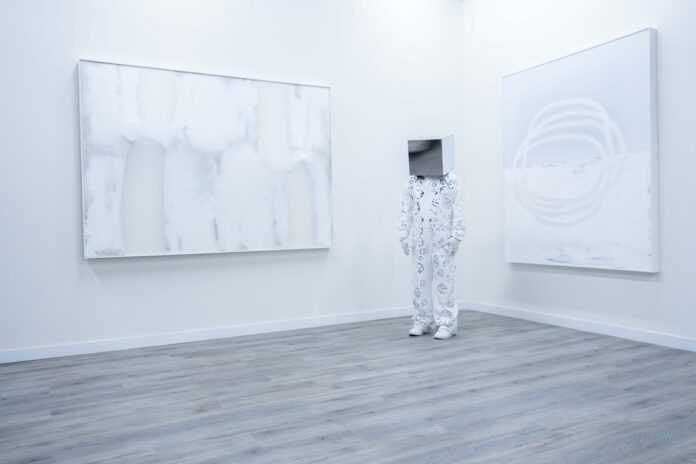
Kube Man by Rafael Montilla - photo Ricardo Cornejo

Why Visual Artists Trust AMM for Off-Page SEO

Art-Focused Expertise
Our team of writers and SEO specialists understands the art world. We craft compelling content that speaks your artistic language while following best SEO practices to increase your reach.

Customized Strategies for Artists
Every artist is unique. That’s why we tailor our link-building and content strategies to fit your medium, goals, and audience—whether you’re promoting gallery exhibitions, online sales, or growing your personal brand.

Results You Can See
We don’t just create content—we deliver visibility. Our data-driven approach tracks the impact of your content and SEO, refining it as needed to ensure continued growth.

How We Work with Artists

  1. Discovery Call
    We start by getting to know you, your art, and your goals for visibility and engagement.
  2. Strategy Design
    We build a personalized plan focused on content writing and high-quality backlinks from trusted art and culture platforms.
  3. Creative Execution
    We produce blog posts, artist features, and social content that highlight your practice and elevate your voice.
  4. Monitoring & Growth
    With detailed reporting and real-time insights, you’ll see how your audience grows and where your traffic is coming from.
  5. Ongoing Refinement
    Art evolves—and so should your strategy. We keep optimizing to help you stay visible and relevant.

Services for Visual Artists

Content Writing

  • Artist Spotlights: Articles that tell your story and connect with new audiences
  • Exhibition Features: Promote your shows with engaging, SEO-optimized write-ups
  • Social Media Content: Increase engagement with posts tailored to your visual brand
  • Website Copy: Elevate your portfolio with compelling bios and project descriptions

Let’s Make Your Art Discoverable

Ready to get more eyes on your work? Contact us today for a free consultation. At AMM, we’re passionate about helping artists expand their reach and build lasting visibility. Let’s create a digital presence that does justice to your talent.

New West Palm Beach gallery spotlights overlooked postwar American artists, underrepresented groups

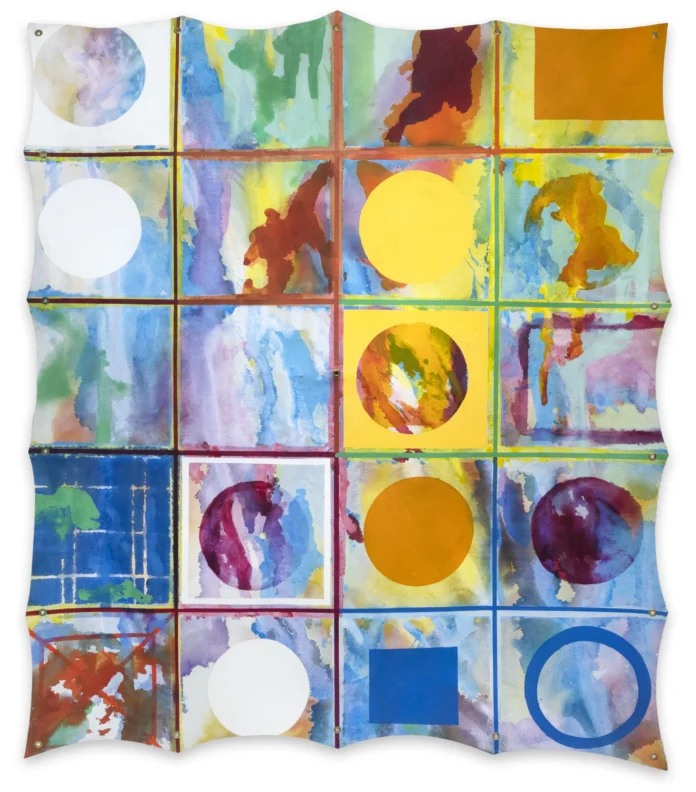
Joe Overstreet
The exhibition Cross Generational: 1950 to Now at the new Eric Firestone Gallery in West Palm Beach includes a focused look at the late Joe Overstreet, the legendary Black abstract painter and activist who first gained recognition in California’s Bay Area. Untitled, 1970 acrylic on canvas

New West Palm Beach gallery spotlights overlooked postwar American artists, underrepresented groups

WLRN Public Media | By Wilkine Brutus

Seven decades’ worth of overlooked postwar American artists and underrepresented groups will see the light at a newly expanded art space in the historic Flamingo Park neighborhood of West Palm Beach.

By pairing historical works with contemporary artists, the inaugural exhibition — “Cross Generational: 1950 to Now” — at the new Eric Firestone Gallery strives to foster dialogue around shared themes, ideas and techniques.

Curator and gallery owner Eric Firestone told WLRN that the show will feature works by 25 emerging and established artists, with an official opening on Jan. 31.

Firestone, a Florida native “who  used to be dragged to a lot of art antique shows when he was a young kid in South Miami,” has a knack for scholarly reexaminations of artists he says are too often overlooked by the art world.

“ Reexamining American artists tends to be women artists and minority artists. And the reason why is 40, 50 years ago, if not further, there really wasn’t as much visibility for the demographics in the market,” Firestone told WLRN.

“ Become aware. And the only way that we really become aware is by familiarity.”

The exhibition includes a focused look at the late Joe Overstreet, the legendary Black abstract painter and activist who first gained recognition in California’s Bay Area. His Civil Rights–inspired abstractions date to the late 1950s, and after moving to New York, he and his partner Corrine Jennings founded Kenkeleba House, a gallery that has championed artists of color and women.

Firestone’s exhibition also highlights works by the late Pat Passlof, a prominent New York–based Abstract Expressionist active in the late 1950s and earlier, who lived and worked in a former synagogue. Her work is widely recognized for its abstracted landscapes, and she was a student of the late Dutch-American artist Willem de Kooning.

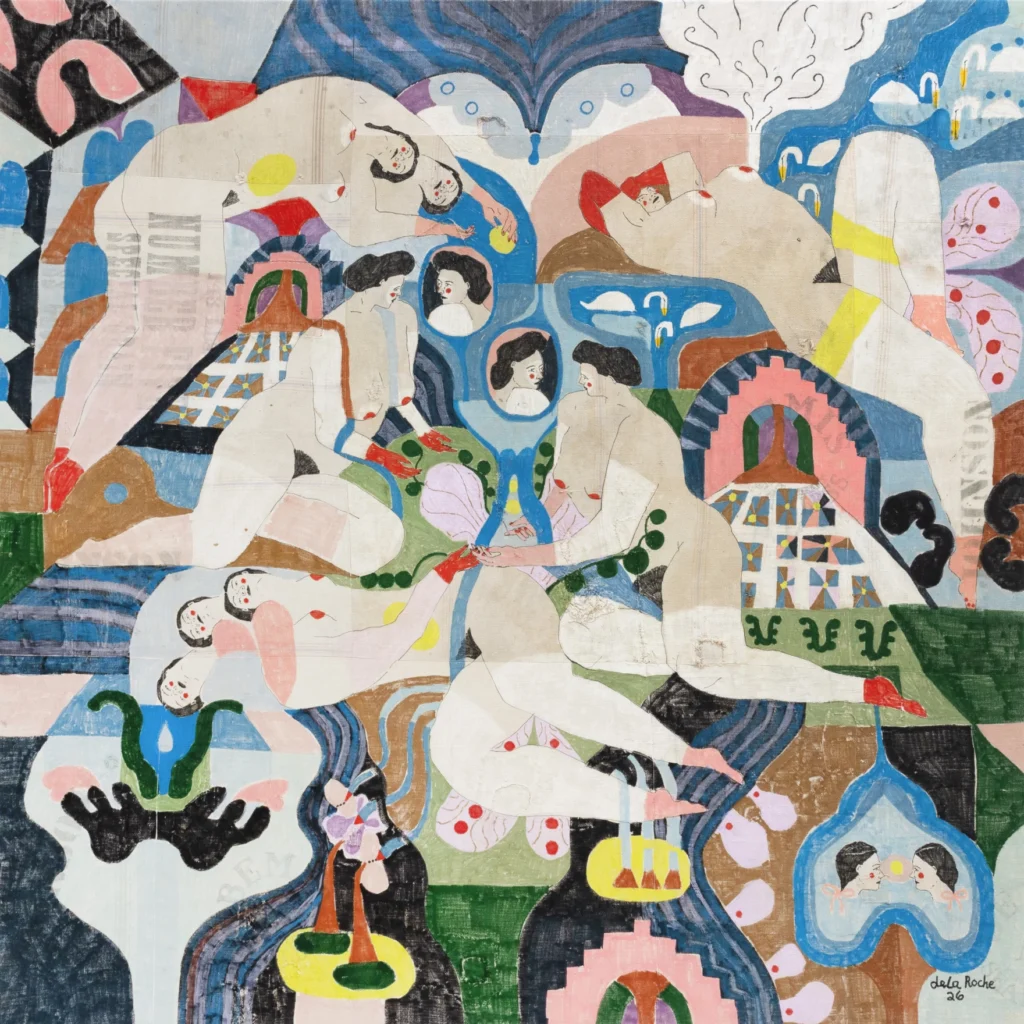
Contemporary artists featured include Huê Thi Hoffmaster, a Connecticut-based artist known for large-scale floral abstractions inspired by Eastern and Western traditions, and Lauren dela Roche, a St. Louis–based artist recognized for her dreamlike paintings of elongated nude female figures.

Firestone said there’s a “whole wave of younger artists” inspired by those who came before them.

Lauren dela Roche
Lauren dela Roche is a St. Louis–based artist recognized for her dreamlike paintings of elongated nude female figures.

A new space in a growing creative hub

The New York–based gallery, with current locations in New York City and East Hampton, has grown from a pop-up in the area into a permanent space in the historic Flamingo Park neighborhood of West Palm Beach.

The neighborhood has emerged as a growing arts hotspot, surrounded by several notable museums and galleries, including the Norton Museum of Art, the Armory Art Center, the Ann Norton Sculpture Gardens, Kristin Hjellegjerde Gallery and The Peach.

Eric Firestone Gallery is going to be a rotating exhibition space where curators will change works throughout the season. And it will include community engagement programs with panel discussions.

It’s “necessary” for there to be a burgeoning creative hub in a residential area like Flamingo Park, Firestone said.

IF YOU GO
What: Cross Generational: 1950 to Now
When: From Saturday, January 31, through April 2026
Where: Eric Firestone Gallery: 2412 Florida Avenue West Palm Beach, FL 33401

Weaving Pine Needles into Baskets

Tom Firth textile artist
Tom Firth has made hundreds of baskets along with other pine needle creations. -ANDREA STETSON / FLORIDA WEEKLY

One man’s yard waste is a Bonita man’s basket art

BY ANDREA STETSON
FLORIDA WEEKLY CORRESPONDENT

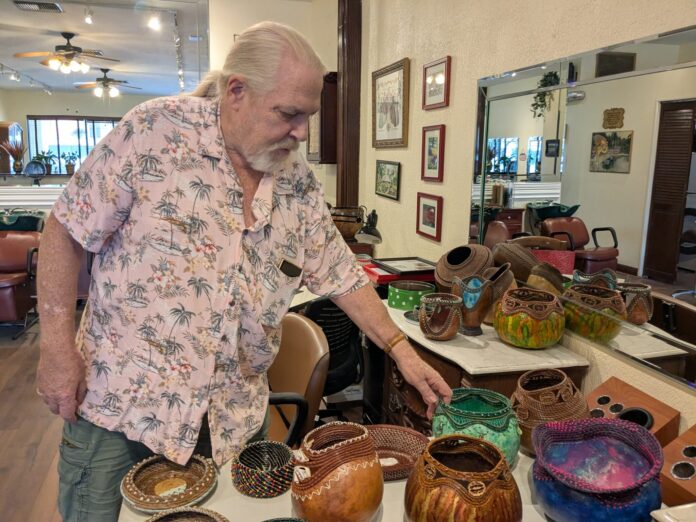
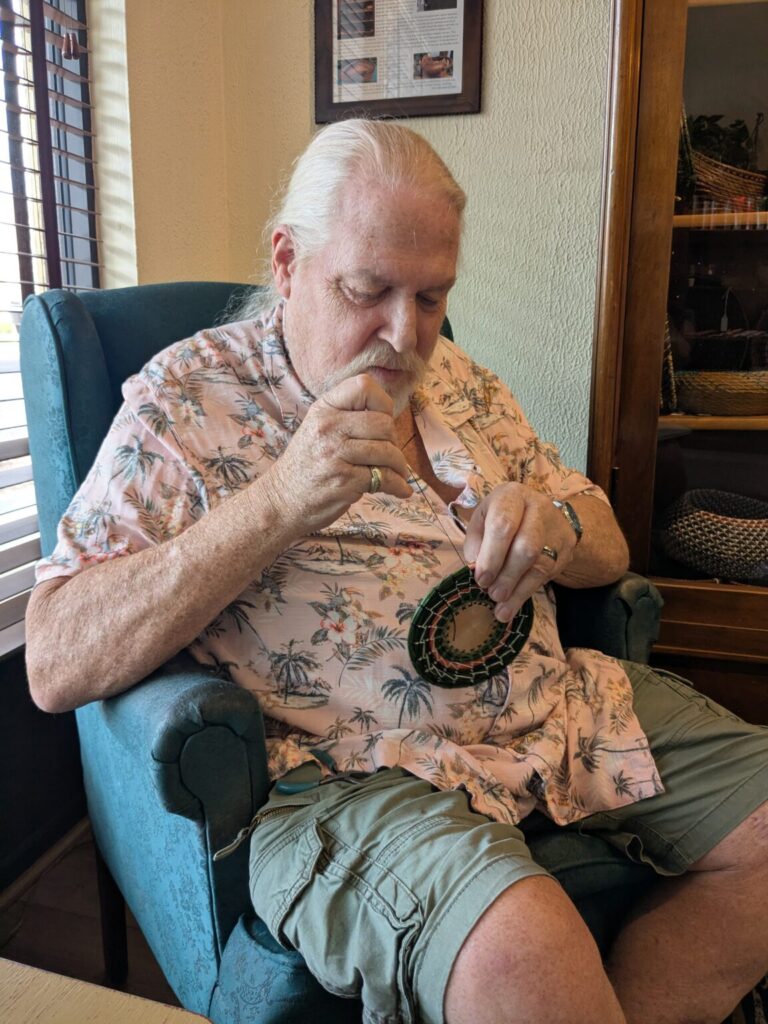
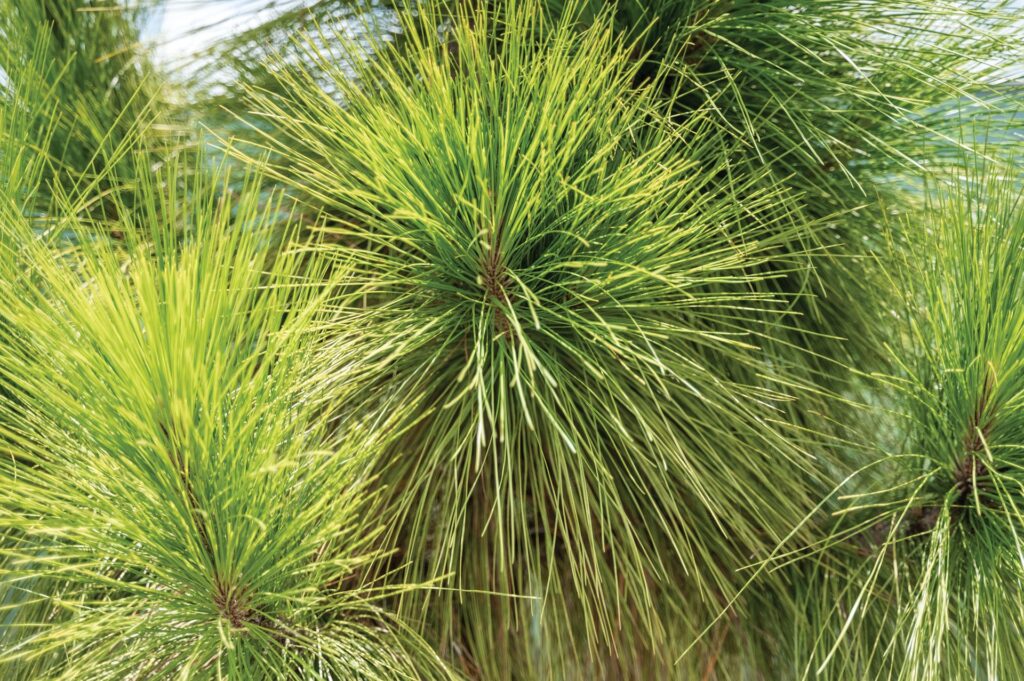
Piles of fallen pine needles carpet the ground by many homes in Southwest Florida. They can be raked up, used as mulch, as an aid in composting or just left to slowly disintegrate. But Bonita Springs resident, Tom Firth, has another use for these needles that fall from the tall pine trees. He turns them into baskets. It is an art he has been perfecting since 2018 when he made his first basket and became hooked on the hobby.

Tom Firth textile artist
Tom Firth weaves the bottom of a basket he is making out of pine needles. -ANDREA STETSON / FLORIDA WEEKLY

“It is fun, and it is creative,” Firth began. “I think of all these designs myself. I lay in bed at night and think ‘I have this color needles and this color thread what should I make’. Half the fun is thinking about it and coming up with a plan. Sometimes it does not come out like I planned, but there is no wrong. It is my own creation.”

It all began when the local hair stylist was cutting a customer’s hair, and she suggested he join a pine needle basket weaving group.

“I started by watching this friend of mine and I was just taking to it and liking it,” he described.

Firth said the group was originally taught by a retired local elementary school teacher named Georgia Horton, who died at age 100 shortly before Firth started weaving.

“When Georgia was doing it, it was sort of like a class, but by the time I started, it was not a class. It was just a group of people doing it. You just watched people, and they gave pointers, and then there was a show and tell where you would show people what you were doing. It is like an old-fashioned quilting bee where people just sit around and work on baskets and talk about things.”

That’s how Firth learned, and soon he was dying his own needles and making unique creations. It’s a complicated process of getting the needles pliable enough to weave without using too much water that makes them expand and then contract.

“I usually put them in some water with vegetable glycerin and when I dye them, I simmer them in an electric turkey roaster 4-5 hours and put in dye and vegetable glycerin,” he described.

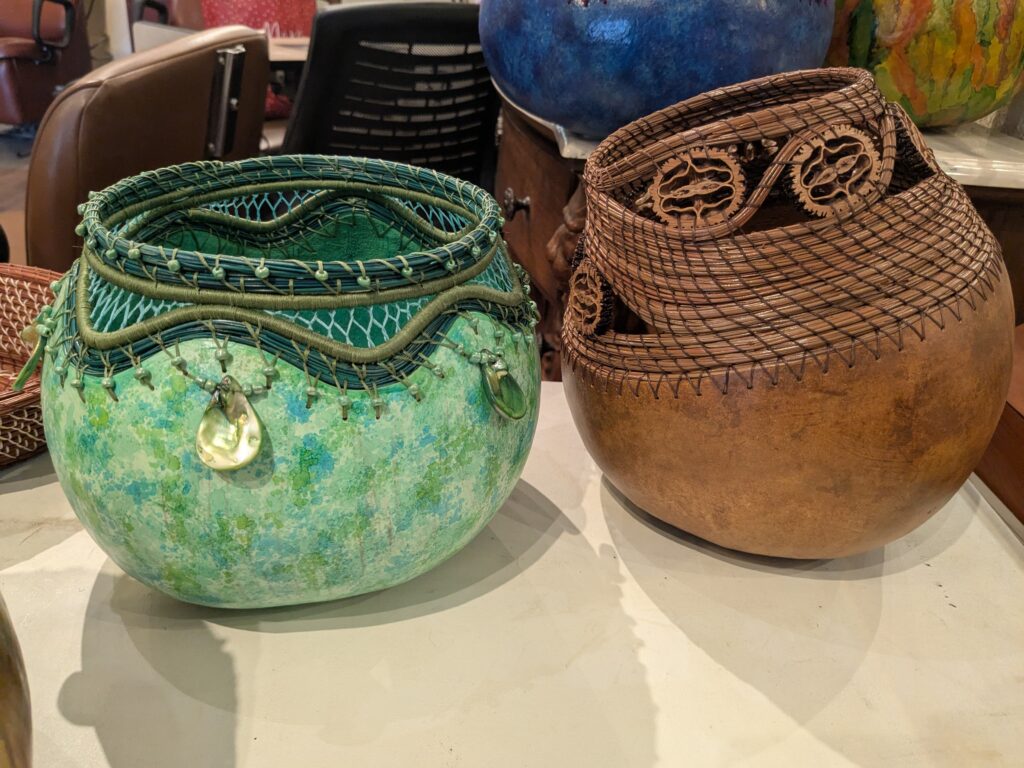
Other times he uses a special powder that makes brighter colors with less work. After making dozens of baskets, Firth started to expand his hobby by making a variety of items. He takes hollowed out gourds, paints the base and then adds intricate pine needle stitching on top. He also makes bowls, trivets, holiday ornaments and hair clips.

Tom Firth textile artist
Tom Firth paints gourds and then weaves pine needles to decorate the top of the baskets that he makes. -ANDREA STETSON / FLORIDA WEEKLY

“It started out as just baskets and at some point it gets to ‘I am tired of making round baskets’, so you start to think outside the box,” he described.

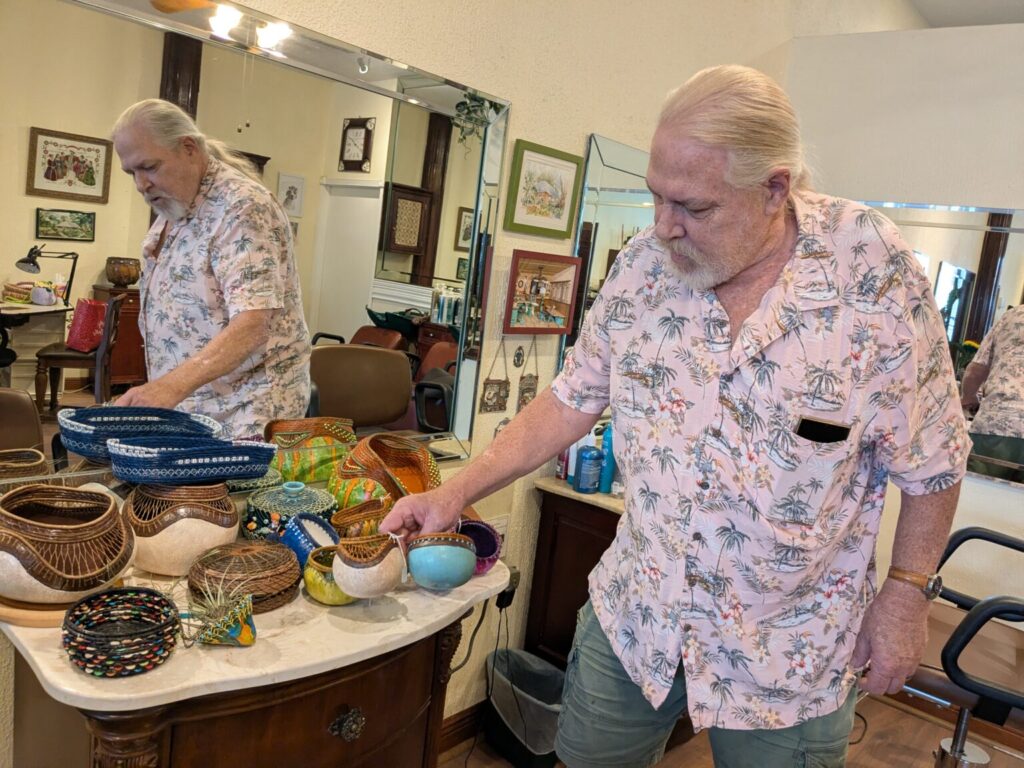
For the first year, Firth kept everything he made. Then he started running out of room and decided to sell some. He goes to markets and festivals and special events where he sells pieces that range in price from $50 to more than $400. During season he is at the monthly craft show at Shangri La in Bonita Springs. He also does events in Ave Maria. Firth is excited that he was recently chosen to be part of a huge craft festival in Mount Dora Oct 25-26. He also does commissioned work and he sells items at his workplace, About Face Salon in Bonita Springs.

“I don’t do anything online. I am kind of a neanderthal,” Firth admitted.

Some of his customers love the baskets so much they have made numerous purchases.

“He is amazing,” exclaimed Monica Mier of Bonita Springs. “I bought a lot of his baskets for gifts and for my house. I am a sound healer, and I needed a basket for my mallets, and he made me the most beautiful basket.”

Mier likes the quality and the uniqueness.

“It lasts. It is durable and you never get that kind of workmanship anymore,” she stressed. “The things that he makes is so amazing. There is so much you can do with them, and they are so sturdy. The love that he is putting into it is just so amazing.”

“They are fabulous,” added Terry Reel of Bonita Springs. “I probably bought 12-15 baskets from him. I am going to buy more at Christmas. He is a real treasure. I see all the time he puts into it. He is a real artist. And he is the nicest person as well. If I want to give something special to someone, I give them a basket, because they are so unique. It is not like you are buying something off the shelf. He puts so much into each one and each basket has a story.”

Tom Firth textile artist
Tom Firth has made hundreds of baskets along with other pine needle creations. -ANDREA STETSON / FLORIDA WEEKLY

Tom Firth has made hundreds of baskets along with other pine needle creations. -ANDREA STETSON / FLORIDA WEEKLY

Linda Waterhouse, of Bonita Springs, commissioned Firth to create some special pieces. She had one made for her granddaughter with an underwater theme and unique beads. She has another in her guest bathroom that she fills with toiletries for visitors.

“I have quite a variety,” Waterhouse described. “I have some hanging up in my office on the wall. I have some that I bought as Christmas baskets as a gift to give away, but then I liked them so much I felt like I had to keep them. They are so unique. I don’t even know where he gets all his creativity. I just feel like the quality of them is just perfect. You would think that a machine made them.”

Many of his first creations are quite large, but Firth added smaller baskets to his inventory.

“People have to think about paying $300 to $400 on a basket,” he explained. “So, I started whipping out these little $50 baskets and 5-6 little baskets can equal one big one, and people don’t think as much about dropping 50-60 bucks.”

While his baskets and bowls might seem expensive, Firth said they are much more than a simple place to put things, they are a work of art. Each one takes one to two weeks to complete, and the stitching is quite intricate.

“People look at my things and the price, and they can buy a basket (at a store) for $10, but that is something made in Vietnam. Mine is made right here. Mine is art,” Firth stressed.

Tom Firth textile artist
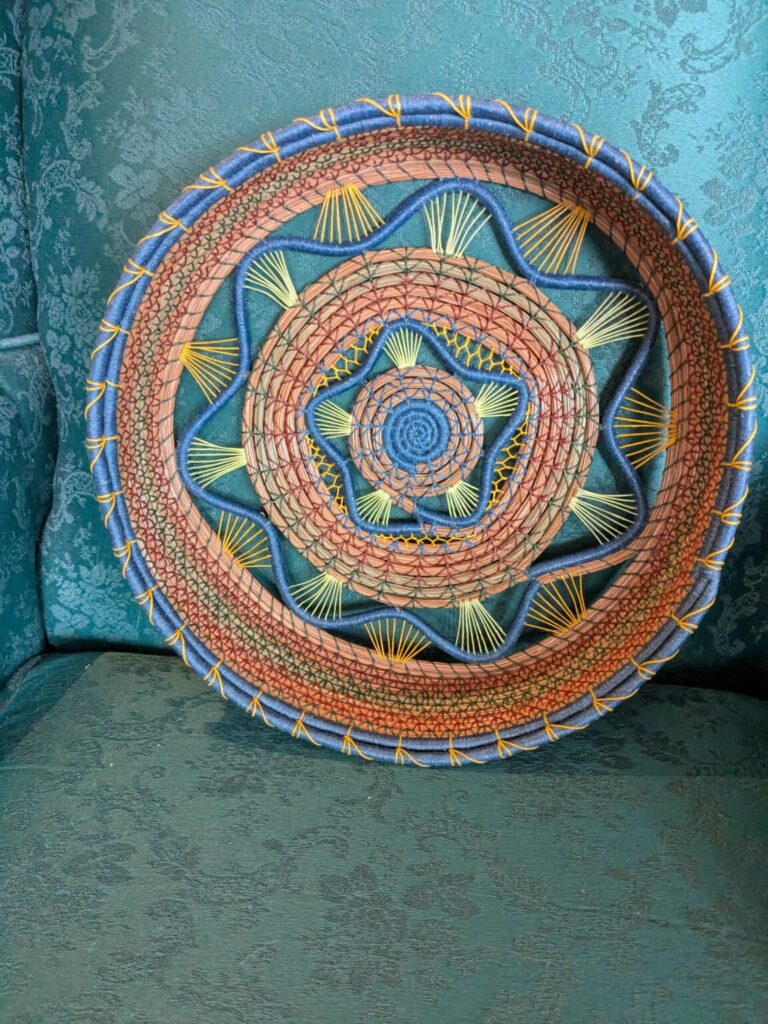
An intricate basket woven by Tom Firth. -ANDREA STETSON / FLORIDA WEEKLY

Firth collects all his pine needles locally. He doesn’t waste time picking up individual ones off the ground. Instead, he looks for fallen branches and grabs them by the fistful. Once the needles are dyed and dry, he creates a center and coils around that. Firth said that method is quite different from traditional basket weaving. The artist says there is a lot people can do with his creations.

“People ask what can you put in these. You can put anything that you want in them: cell phones, keys, letters, bread, plants, remotes whatever you want, or you can just have them sit empty and they are pretty. I have a friend that has three hanging on the wall.”

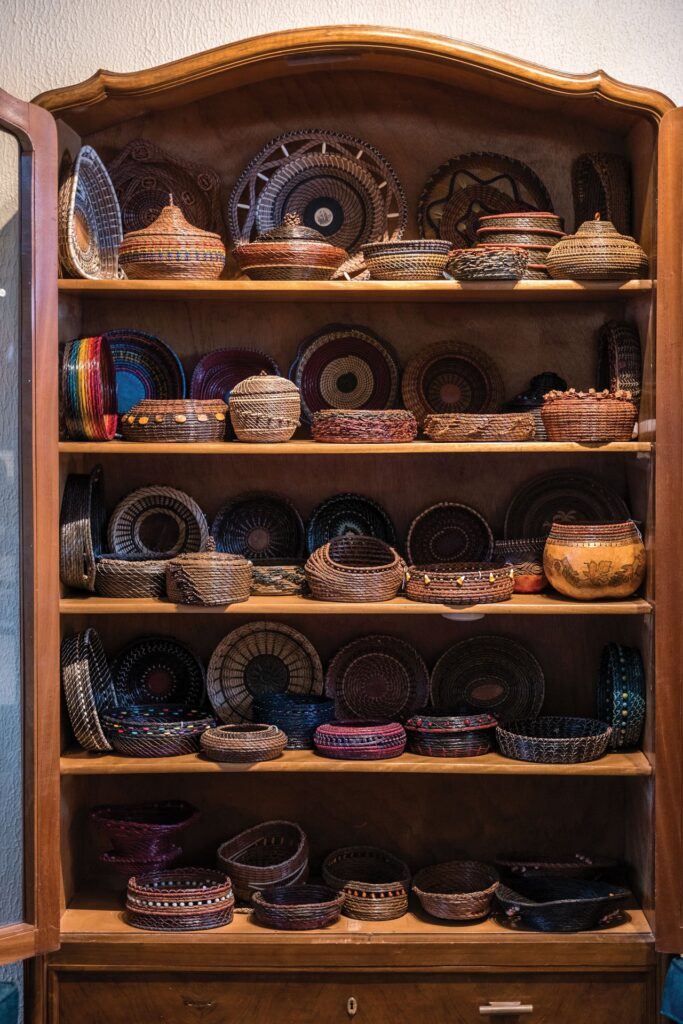
Firth makes his baskets at home and at his salon. His creations fill cabinets, bookcases and the counters around his hair cutting stations.

“I love the creativity and the thrill of the completed project,” Firth concluded. “Sometimes it still surprises me that I made this. I am really proud of this. It is pride in what you create. It is thinking things up and making it happen. Being a hairdresser, I have always been creative. I can’t draw, but I have done hair since 1973. I have done macrame, embroidery and stained glass and all the different fads, but this one has taken something as basic as a pine needle and made something beautiful out of it.”

Master Weavers Lead a Fiber Art Revival in Southwest Florida

Master Weavers Lead a Fiber Art Revival in Southwest Florida

Master Weavers Lead a Fiber Art Revival in Southwest Florida

Local artisans are weaving cultural heritage and reviving time-honored techniques for a new generation of collectors in Naples, Fort Myers and beyond.

by Emma Witmer

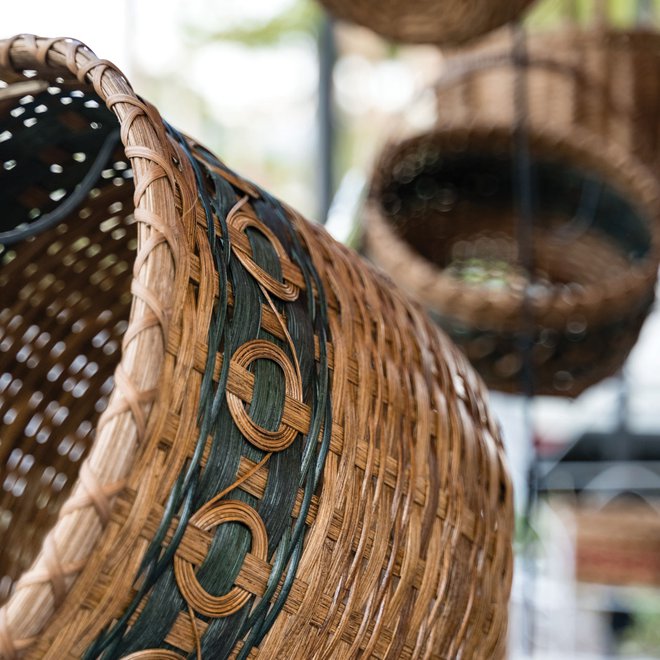
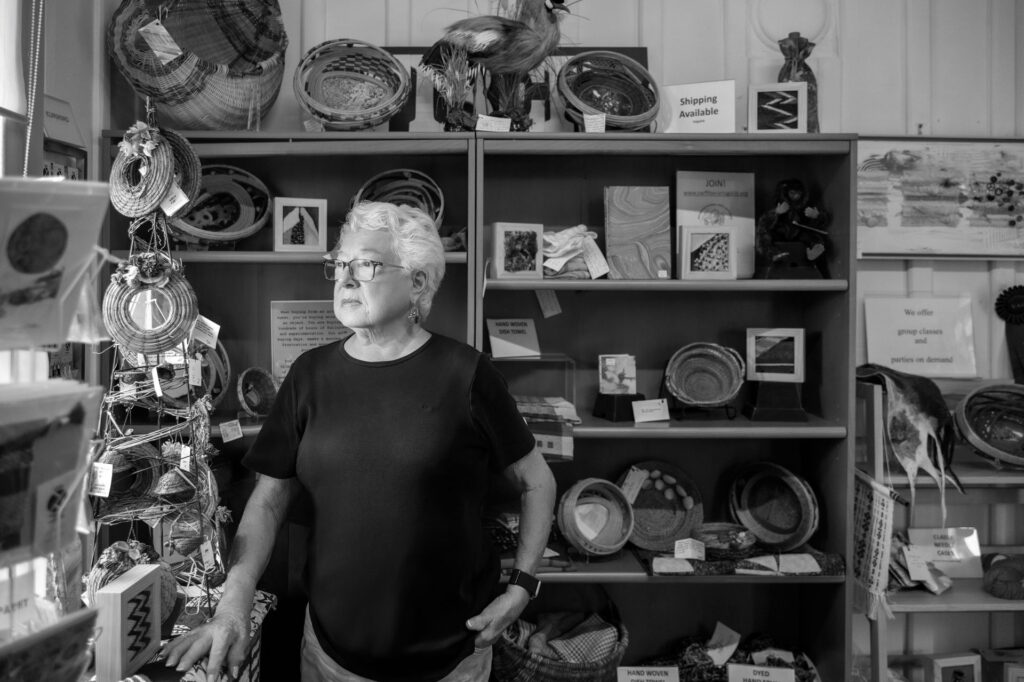
askets line the walls of Punta Gorda’s one-year-old Southwest Florida Fiber Arts Guild. Some have amethyst bottoms; others are woven with beads. Simple, handwritten tags hang from undulating lines of coiled pine needles and muhly grass, denoting the artful vessels’ price, title and materials.

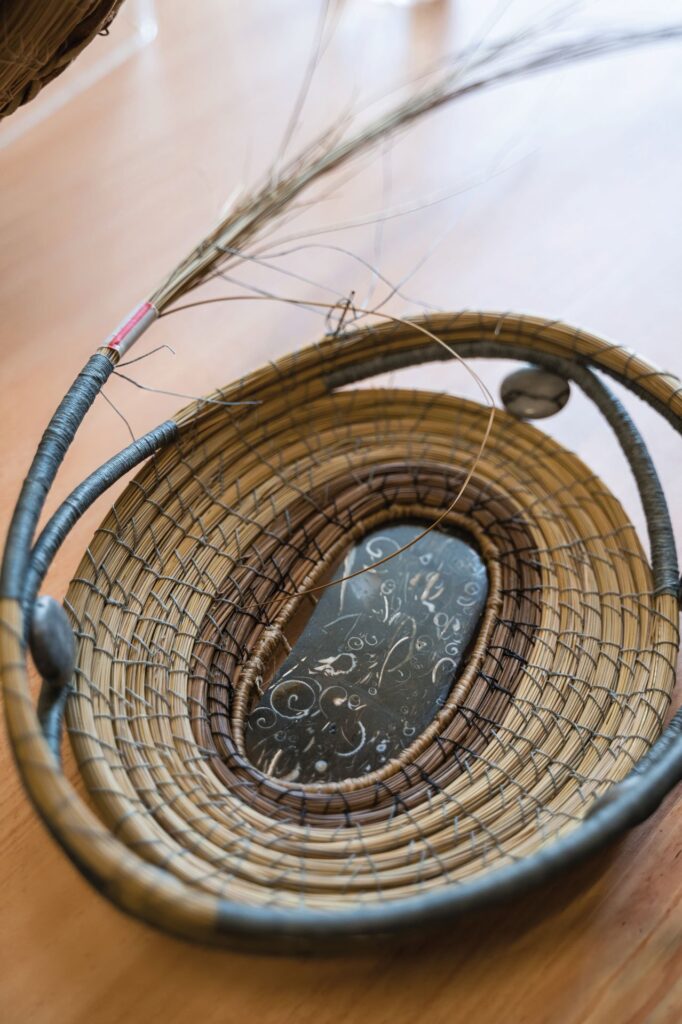
Despite the evident artistry, there’s no signature. But a peek around the corner reveals the sculptural vessels’ maker, a petite woman with a stoic focus and shock of white hair. There, guild vice president Kathryn Erickson muscles walnut staves into a frame for bundled coils and a central fossilized shell. The 80-year-old has been practicing the art of basketry for more than 20 years, but the circular design at hand is only her second wall hanging. “I don’t know how big it’s going to get,” she says matter-of-factly. “I work on them until they tell me, ‘I’m done.’”

In Southwest Florida, a quiet class of basketry artists practices the craft on living room couches, in guilds and clubs, during downtime at their day jobs, and at markets and fairs. The most skilled local weavers hold years of experience, inventing techniques, stitches and patterns to craft impossibly complex sculptures beautiful enough for display, yet functional enough to carry home a garden harvest. Their creations take days, if not months, to complete, from foraging and processing materials to coiling and stitching. 

Tom Firth textile artist
Photography by Anna Nguyen
Tom Firth textile artist
Photography by Anna Nguyen

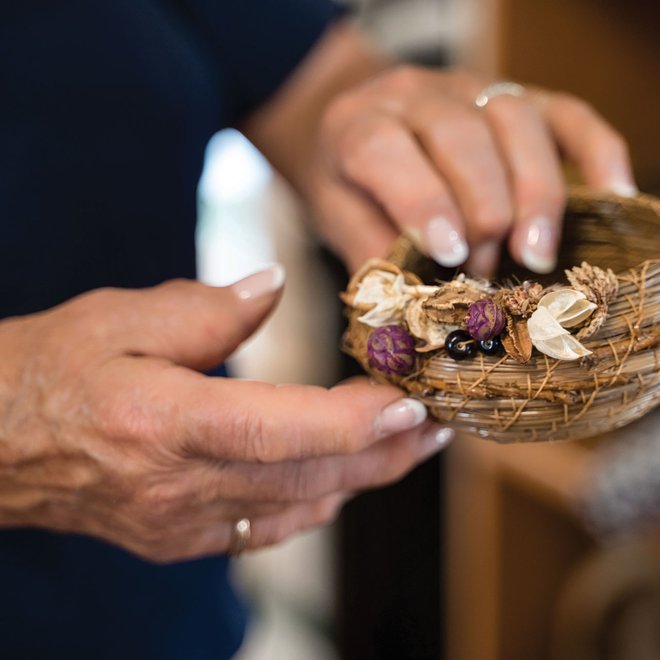
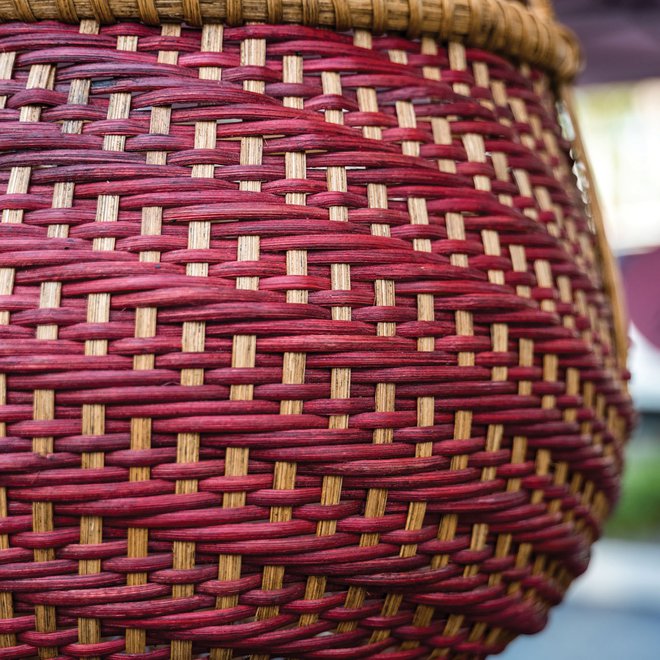
Bonita Springs pine needle coiler Tom Firth melds traditional and unexpected materials, like mismatched jewelry and dried gourds.

Still, until recent years, the art world saw basketry—and fiber arts more broadly—as little more than a hobbyist enterprise, better suited to clubs and craft fairs than gallery exhibitions and museum displays. Years ago, Kathryn and her cohorts had to lobby local arts centers for fiber arts programming and fight for their place among exhibits dominated by paintings. “It’s a craft. That’s a nasty word,” she says with a sarcastic glint. That attitude seems to be changing. Over the last decade, American art hubs like Los Angeles and New York City have embraced fiber arts, coaxing smaller arts agencies to broaden their programming. Some point to the COVID-19 pandemic as the catalyst for the rise in craft arts. Others take a broader view, crediting the reclamation of stereotypical ‘women’s work’ that emerged as part of the second wave of feminism. 

Regardless of the genesis of the genre’s popularity boom, the catalyst of individual creation rings true—somewhere along the line, a woman with knotted hands paved the way. She would speak in family recipe terms, explaining the art, not the science: Use a thread about this thick to connect your bundles; soak the reeds until they look right.

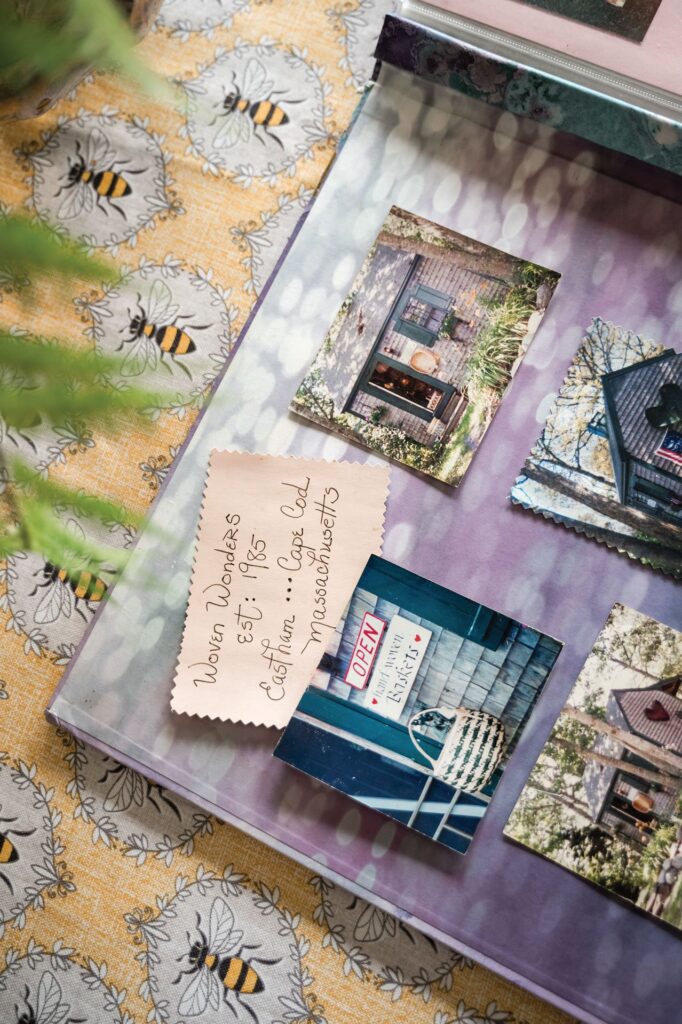
Nancy Weeks—known for her 15-year-old Woven Wonders stall filled with colorful, New England-style baskets at Third Street Farmers Market—learned first from a long line of family fiber artists who introduced her to the art of weaving, then from a Cape Cod teacher who applied the technique to basketry. “I think it was passed down for generations,” she says. Sanibel coiler and instructor at BIG ARTS, Gisela Damandl, was taught by a longtime Pennsylvania basketeer more than 40 years ago. Now, she devours books on modern basketry and travels the country visiting shows for inspiration—explorations that have led her to experiment with media like imported seagrass.

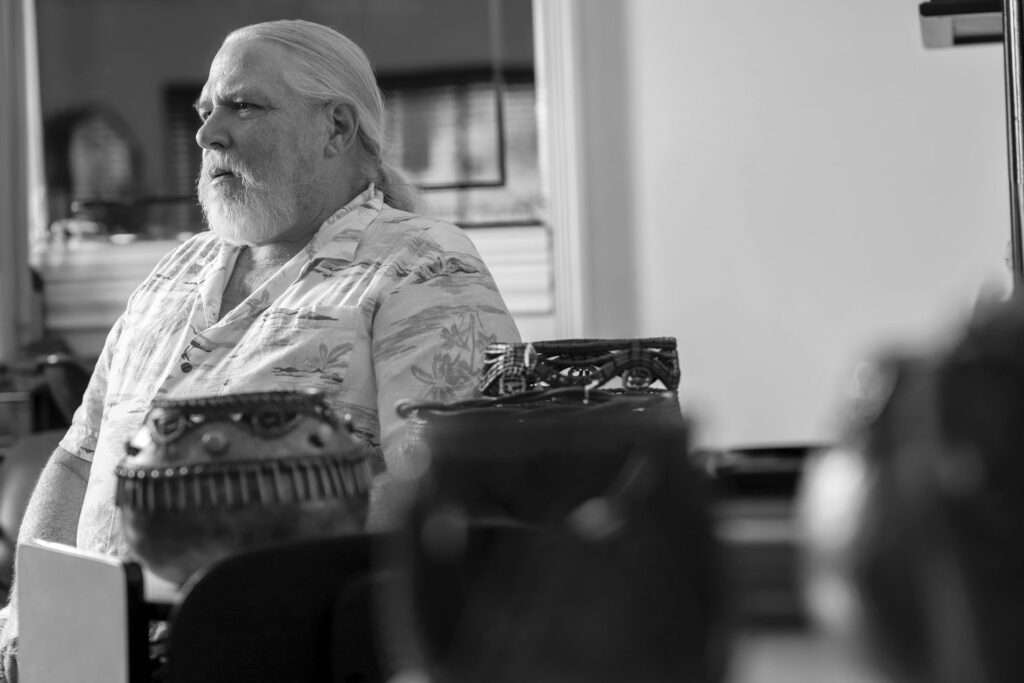
For Bonita Springs-based pine needle coiler Tom Firth, mentorship came from a woman he never actually met. A hairstylist of more than five decades, Tom started tinkering with pine needle baskets about seven years ago when he saw a friend’s creations. “She invited me to join the Brookdale Basketeers,” he says. “It was a group started here a long time ago by an old woman in Bonita, and I unfortunately started seeing them about four months after this woman had died at nearly 100 years old.” Though the two never met, he pored over interviews and memories shared about the club’s matriarch, and in turn, the club poured back into him—not as formal teachers, but as models of what was possible. 

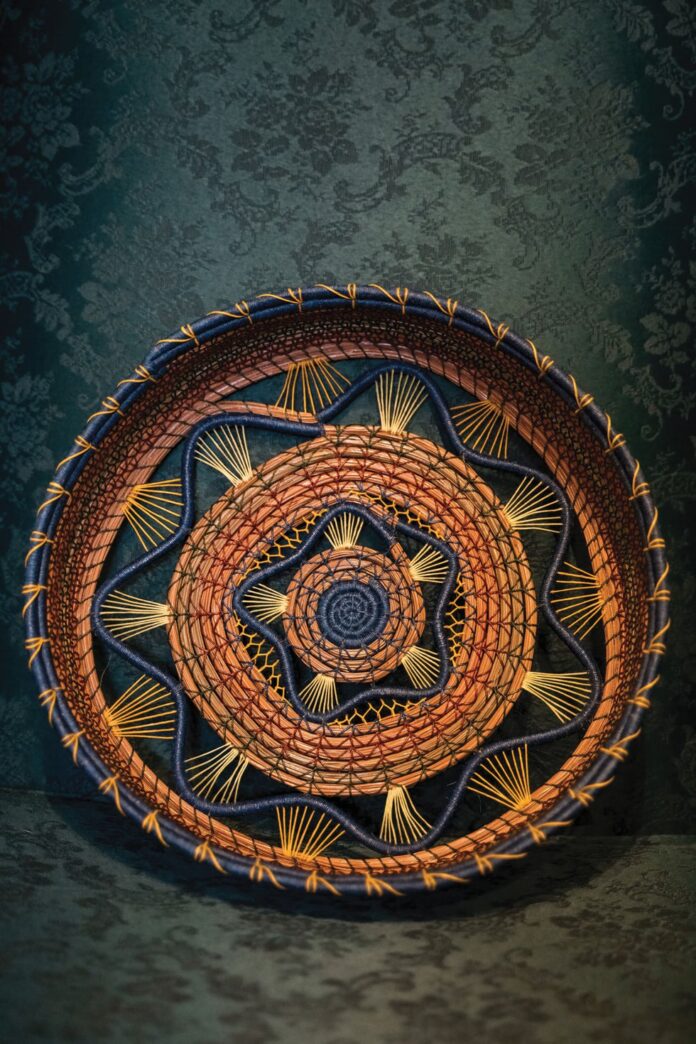
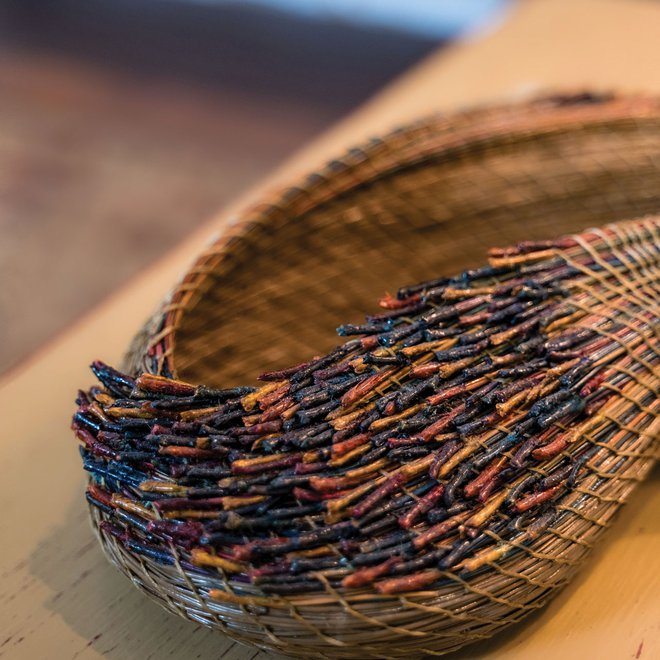
As Tom learned the pine needle coiling technique—a process of bundling the slender fibers and stitching them together in an ascending circular pattern—he began to experiment with a wider range of materials. Dyed needles, walnut slices and antique brooches sourced from his travels through the United Kingdom make regular appearances, as do dried gourds, which form the base of some of his most avant-garde vessels. In one, thick bundles of rich, amber needles seem to defy gravity, weaving in and out of three large holes in the gourd’s sides. In others, alcohol-based ink creates a splotchy, watercolor-like finish on gourds with yawning openings flourished by rippling coils.

Like Kathryn, who keeps a muhly grass patch in her front yard and scours parks for fibers from queen palms, and Gisela, Tom forages the majority of his materials. “I wait until somebody clears a lot or a storm knocks down a branch,” he says. “You grab the whole side of the branch and pull against the grain and pull off 200 needles at one time.” Once gathered, needles must be dried (if used green, they’ll shrink as they dry, loosening the coils and compromising the basket’s structure). “If you dry them in the dark, they dry a lighter color—that takes about a month. If you let them dry on the ground in the sun, they get that pine needle color that’s kind of an orangey brown.” 

From drying onward, the consistency among Tom, Gisela and Kathryn’s approaches begins to fade. Tom never soaks his needles (a process used to prevent breakage while bending coils) and only dampens his needles for the most precarious curves. Gisela soaks overnight, but only uses the wetted needles for her first three rows of coiling. For dyeing, Tom simmers his needles in an electric turkey roaster with a touch of glycerin for sheen. “To heck with the glycerin,” Kathryn says. “I tell my students to soak them for 10 minutes with fabric softener—just dampen them.”

Nancy Weeks textile artist
Photography by Anna Nguyen
Nancy Weeks textile artist
Photography by Anna Nguyen

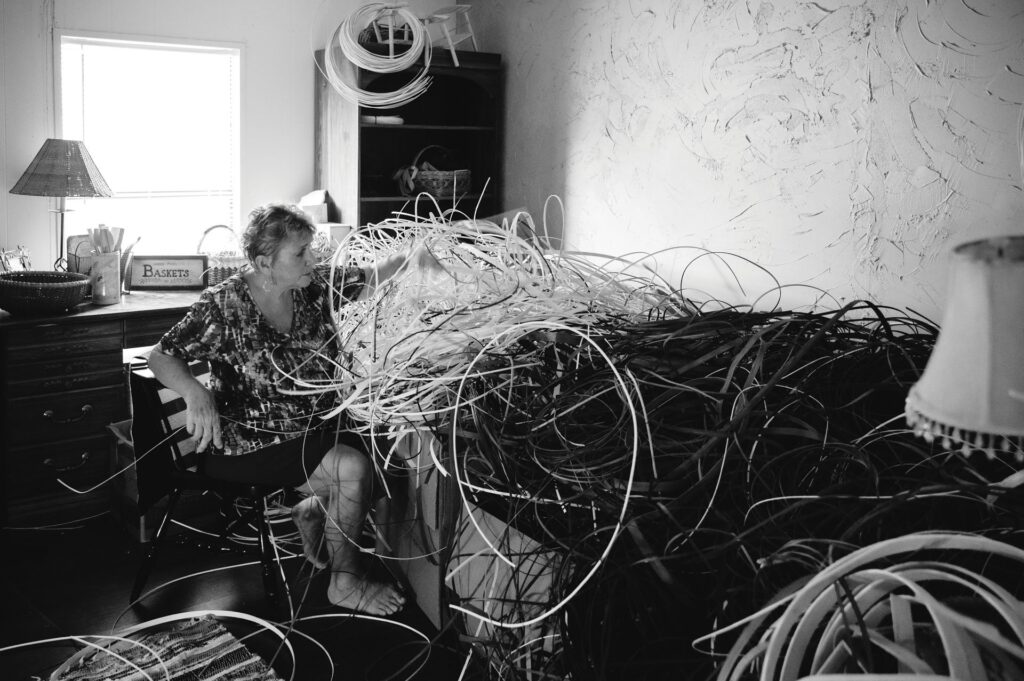
Nancy takes a different approach altogether. Rather than following the region’s dominant coiling technique, the 71-year-old Neapolitan weaves imported oak reeds one over the other. Home-dyed reeds (“I cook them on the stove and make a mess,” she says with a laugh.) fold into intricate patterns—some taught, others adapted through years of trial and error. “At the end, I write my name and date with a burning tube on the bottom. I blowtorch the hairs off [the reeds] and stain them with Minwax, either natural or golden oak,” she says. Her creations range from simple Easter baskets—like those made for her children and grandchildren—to complex, leather-bound backpacks and vessels with swirling handles muscled together over weeks of work.

“There have been a few where I’ve gotten frustrated and thrown across the room and went back to later,” she says. After 40 years making baskets, those frustrations still happen, but only when she pushes herself to try something new. A recent commissioned project—a woven staircase rail at Naples’ Patina Collection—tested her mettle, but the results are eye-catching. For Nancy, it was just one more way to shine a light on the craftsmanship created locally and often overlooked. 

Like Tom at the Bonita Springs Farmers Market, Nancy weaves baskets live at her stall. “I do it because they need to know who’s making the baskets. Sometimes I’m weaving, and they still ask,” she says, chuckling. “Each of my baskets is a work of art made by me and only me.”  

Técnicas de Pintura Acrílico para Principiantes – Lo Que Debes Saber y Los Materiales Para Comenzar

Técnicas de Pintura Acrílico para Principiantes

Técnicas de Pintura Acrílico para Principiantes – Lo Que Debes Saber y Los Materiales Para Comenzar

La pintura acrílica es uno de los medios más versátiles y fáciles de usar para principiantes. Seca rápidamente, se limpia con agua y funciona en casi cualquier superficie. Pero cuando entras a una tienda de arte, la enorme variedad de productos puede resultar abrumadora. Esta guía te ayudará a entender qué necesitas realmente para empezar y qué técnicas puedes explorar a medida que avanzas.

Hay Muchos Tipos de Pintura Acrílica

No todas las pinturas acrílicas son iguales, y entender las diferencias te ahorrará dinero y frustración.

Grado Estudiantil vs. Grado Artista

  • Las pinturas de grado estudiantil son más económicas y contienen menos pigmento, lo que puede hacer que los colores se vean apagados o calcáreos.
  • Las pinturas de grado artista tienen una mayor concentración de pigmento, colores más intensos y mejor capacidad de mezcla.

Para comenzar, el grado estudiantil es ideal. Marcas como Liquitex Basics, Amsterdam o Arteza ofrecen excelente calidad a buen precio.

Heavy Body vs. Soft Body

  • Heavy Body: consistencia espesa, similar al óleo; ideal para marcar textura con pincel o espátula.
  • Soft Body: más fluida; excelente para mezclas suaves y detalles.

Para principiantes, las Heavy Body ofrecen mayor control.

Acrílicos de Manualidades (Craft Acrylics)

Son económicos, pero su calidad es inferior. Menos pigmento, menor durabilidad y riesgo de agrietamiento. No son ideales para obras serias.

Paleta básica recomendada

  • Blanco titanio
  • Negro Marte
  • Rojo cadmio (o rojo pirrol)
  • Azul ultramar
  • Amarillo cadmio
  • Sombra tostada

Con estos seis colores puedes mezclar casi cualquier tono.

Materiales Esenciales Para Pintar con Pincel o Espátula

Pintura

Es mejor invertir en un set pequeño de buena calidad que en muchas pinturas baratas. Un set de 6 a 12 colores heavy body de grado estudiantil es suficiente.

Pinceles

No necesitas una gran colección. Comienza con:

  • Pinceles planos (tamaños 4, 8, 12): para áreas grandes y bordes definidos
  • Pinceles redondos (2, 6, 10): para detalles y líneas
  • Pinceles lengua de gato (filbert) (6 u 8): excelente para difuminados

Los pinceles sintéticos funcionan perfectamente con acrílico y son económicos.
Marcas recomendadas: Princeton, Royal & Langnickel.

Limpia siempre tus pinceles inmediatamente: el acrílico seco los arruina.

Espátulas (Palette Knives)

Producen texturas y trazos marcados. Solo necesitas:

  • Una espátula en forma de paleta
  • Una espátula angular

También sirven para mezclar colores sin dañar pinceles.

Paleta (Palette)

Opciones:

  • Paletas desechables de papel – prácticas y sin limpieza
  • Paletas de plástico – reutilizables
  • Stay-wet palettes – mantienen la pintura húmeda por días
  • DIY: plato de cerámica, vidrio o papel para congelador

Recipientes de Agua

Usa dos recipientes: uno para el enjuague inicial y otro para la limpieza final.
Cambia el agua con frecuencia para evitar colores sucios.

Superficies Para Pintar

Los acrílicos se adhieren a muchas superficies:

Lienzo

La opción clásica. Elige lienzos pre-entelados y pre-imprimados.

Paneles de cartón entelado (canvas panels)

Económicos y perfectos para prácticas.

Papel para acrílico o mixed media

Ideal para estudios y bocetos.

Paneles de madera

Superficie lisa; deben estar sellados o imprimados.

Papel acuarela

Usa 300 g/m². Puedes aplicar gesso para más textura.

Superficies no convencionales

Tela, piedra, vidrio, metal, cerámica: si puedes aplicar gesso, puedes pintar encima.

Caballete (Opcional)

Puede ayudarte a trabajar cómodo:

  • De mesa: económico y portátil
  • A-frame o H-frame: más estables
  • Alternativa: inclinar el lienzo sobre libros

Muchos principiantes pintan sobre una mesa, lo cual está bien.

Mediums (Aditivos Acrílicos)

Los mediums modifican la pintura:

  • Gesso: imprimación esencial
  • Medium mate o brillante: cambia el brillo y extiende la pintura
  • Retardador: ralentiza el secado para mezclar
  • Geles y pastas de textura: para efectos tridimensionales
  • Flow improver: mayor fluidez para detalles

Comienza sin mediums y agrégalos de a uno mientras exploras.

Materiales Esenciales Para Todos los Acrílicos

  • Toallas de papel o trapos
  • Botella de spray para humedecer la pintura
  • Delantal o ropa vieja
  • Espátula para mezclar
  • Cinta de pintor (masking tape)
  • Gesso para imprimar
  • Un espacio de trabajo estable y limpio

Pintura en Spray y Plantillas (Stenciling)

Los aerosoles acrílicos permiten técnicas urbanas y capas grandes:

  • Usa marcas como Montana, Liquitex Spray, Krylon
  • Trabaja al aire libre o con excelente ventilación
  • Usa máscara respiratoria, no solo mascarilla de polvo

Stencils:
Permiten patrones limpios y repetitivos.
Asegúralos con cinta de baja adherencia y aplica pintura en capas delgadas.

Marcadores Acrílicos

Puente entre dibujo y pintura, ideales para detalles:

Marcas: Posca, Molotow, Artistro.

Perfectos para:

  • Detalles finos
  • Letras y caligrafía
  • Piedras decoradas
  • Contornos y líneas
  • Arte sin pinceles

Agítalos bien antes de usar y cebalos presionando la punta hasta que fluya la pintura.

Acrylic Pouring (Pintura por Vertido)

Muy popular para efectos abstractos y marmoleados.

Materiales:

  • Acrílicos fluidos o pintura diluida con pouring medium
  • Pouring medium: Floetrol o mediums específicos
  • Aceite de silicona (opcional)
  • Vasos para mezclar
  • Lienzo elevado
  • Pistola de calor o soplete

Técnica básica:

Mezcla cada color con medium hasta lograr consistencia miel.
Vierte capas en una taza, vuélcala en el lienzo y mueve para expandir.
Usa calor para crear “células”.

Es muy desordenado: protege bien tu área de trabajo.

Cómo Mantener Todo Limpio

  • Paleta: limpia inmediatamente, o deja secar y despega la pintura
  • Pinceles: enjuaga constantemente; el acrílico seco arruina el pincel
  • Superficies: limpia pintura fresca al instante
  • Ropa: actúa rápido con agua fría; una vez seco, el acrílico no sale

Barniz Final

El barniz protege tu obra terminada:

Tipos:

  • Brillante: colores vibrantes
  • Mate: acabado suave y sin reflejos
  • Satinado: equilibrio entre ambos

Aplica 2–3 capas delgadas con brocha suave y espera dos semanas antes de barnizar.

Conclusión

Comenzar con acrílicos no requiere mucha inversión. Solo necesitas pinturas básicas, algunos pinceles, superficies para practicar y la curiosidad de experimentar. A medida que descubras qué técnicas te gustan—ya sea pincel tradicional, espátula, pouring o arte mixto—podrás ampliar tu kit.
La belleza de los acrílicos es su versatilidad: crecen contigo a medida que tu estilo y habilidades

El MoMA NY presenta un conversatorio sobre Wifredo Lam con destacados curadores internacionales

Wifredo Lam
Wifredo Lam

El MoMA NY presenta un conversatorio sobre Wifredo Lam con destacados curadores internacionales

Nueva York, NY — El próximo 4 de febrero a las 18:30 h, el Museum of Modern Art (MoMA) de Nueva York será sede de un conversatorio especial dedicado a la obra y legado del artista cubano Wifredo Lam en el marco de la exposición Wifredo Lam: When I Don’t Sleep, I Dream, abierta desde noviembre de 2025 y con funciones hasta el 11 de abril de 2026.

Este encuentro reunirá a tres figuras prominentes del mundo del arte: Gerardo Mosquera, Lowery Stokes Sims y John Yau, quienes explorarán la práctica artística de Lam y su continua influencia en la historia del arte moderno y contemporáneo. La conversación será moderada por Beverly Adams, curadora de Arte Latinoamericano del MoMA y responsable de la muestra dedicada al artista cubano, y se realizará en inglés.

La participación es gratuita, pero requiere registro previo, ya sea para asistir de forma presencial en el teatro Roy and Niuta Titus Theater 1 del museo o de manera online para público internacional.

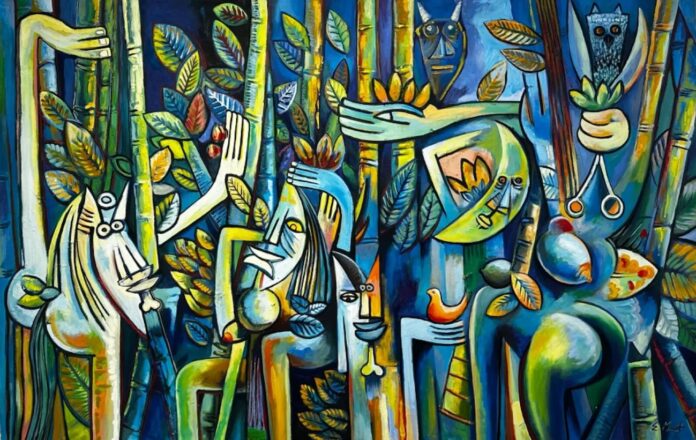
La exposición Wifredo Lam: When I Don’t Sleep, I Dream representa la retrospectiva más extensa sobre el artista en los Estados Unidos, con más de 130 obras — incluyendo pinturas, dibujos, libros ilustrados, cerámica y materiales de archivo — que recorren seis décadas de su carrera. Lam (1902–1982), conocido por fusionar influencias modernistas con tradiciones afrocubanas y simbolismos híbridos, buscó crear un lenguaje visual propio que desafió las estructuras coloniales y expandió los límites del arte moderno.

Gerardo Mosquera es un curador e historiador del arte con trayectoria internacional, cofundador de la Bienal de La Habana y con una amplia experiencia en proyectos curatoriales globales; Lowery Stokes Sims es una destacada curadora y académica estadounidense especializada en arte moderno y contemporáneo, con una carrera que incluye roles en importantes museos de Estados Unidos; y John Yau es poeta, crítico de arte y editor reconocido por su escritura sobre artistas y movimientos clave del siglo XX.

El MoMA ofrece así una oportunidad única para profundizar en la obra de Wifredo Lam, cuya producción artística ha sido valorada por su relevancia estética, política y cultural, trascendiendo fronteras geográficas y conceptuales.

Registros e información adicional sobre el evento y la exposición están disponibles a través de los canales oficiales del MoMA y sus redes sociales.

Tomas Kepets entrevistado por Eduardo Planchart Licea

Tomas Kepets

Tomas Kepets entrevistado por Eduardo Planchart Licea

Entrevista con Eduardo Planchart Licea – junio del 2016

“Fundé la galería hace 20 años, en 1996.  La pasión por las artes plásticas venía progresando en mí mucho antes de esa fecha, esa pasión desembocó en la idea de pasar a ser una parte activa en el mundo del arte, el mundo de las galerías. La ilusión de tener una galería me venía rondando desde hacía tiempo y significaba un cambio trascendental en mí.”

Tomas Kepets, fundador de la Galería Medicci, entre los primeros pasos que dio para materializar el proyecto cultural y gerencial  que deseaba realizar, seleccionó obras de artistas con lenguajes plásticos en expansión, para lo cual diseño un espacio  expositivo en el cual el arte se mostraría y dignificaría sin interferencias visuales, con la peculiaridad de tener una amplia sala  central  y  otra en forma de una amplia vitrina  que llevó  la dimensión estética a una de las calles más concurrida del este de Caracas. La galería, desde sus inicios, se destacó por el profesionalismo de su director, quien, como un conocedor y amante del arte, era consciente de su deseo de crear    un espacio que fuera   punto de referencia del arte nacional, y en función de esto logró mantener y acrecentar en el tiempo la calidad de las pinturas, dibujos, esculturas y ensamblajes expuestos.

En los momentos que ha existido físicamente, no solo ha sido solamente un espacio expositivo y de comercialización del arte, sino de encuentro entre artistas, intelectuales, coleccionistas y gente   de la cultura. Era común escuchar en la galería los ingeniosos y poéticos usos de la palabra, que emitía el poeta y escritor José Pulido, o las risas del Maestro Asdrúbal Colmenárez que pasaban del chiste al abrupto comentario de estudioso y creador   vanguardista. Entre estas conversaciones se mezclaba la voz   de Tomas Kepets que siempre intervenía con la suspicacia y la ironía que lo caracteriza, convirtiendo así el espacio en un lugar amable donde el dialogo y las conversaciones de los diversos temas regionales y globales siempre terminaban vinculándose a la cultura. 

Además de este diario ajetreo se dieron en cada oppening un encuentro del mundo artístico y noches inolvidables de conversatorios de artistas, coleccionistas y público con   investigadores del arte. Era usual que cada domingo posterior a la inauguración de una exposición se presentara una tertulia donde el artista y un panel de críticos interactuaba con nutrido público, además anualmente se realizaron en la galería las reuniones de AICA, generándose    interesantes ponencias y discusiones que con paciencia registraba el equipo humano y profesional que lo acompañó durante años en su labor. Así fue creando una memoria del arte registrada en diversos formatos pues tenía y tiene, aún hoy, clara conciencia de que dentro de las funciones del perfil de lo que consideraba debía ser una galería, no solo está el exponer, promocionar y comercializar obras de arte, sino dejar huella en la historia del arte de Venezuela. A través de sus numerosos catálogos y publicaciones donde se incorporaron  investigadores e historiadores de la cultura  tales como: Juan Carlos Palenzuela, Bélgica Rodríguez, Peran Erminy, Katherine Chacón, Eduardo Planchart, Eddy Reyes, Susana Benko, Carlos Maldonado entre otros, los cuales fueron editados con criterios integrales no solo con textos curatoriales, sino con entrevistas con reconocidos periodistas, biográficas artísticas completas e imágenes de las obras expuestas en cada una de las exposiciones. 

Realizó a su vez la edición de libros como el de Iván Petrovszky, y las poesías de Oswaldo Vigas, como una vía de difundir la cultura evidenciando así la importancia que le da al registro y memoria de la dimensión artística. En este sentido se caracterizó por la innovación al grabar   las entrevistas radiales que patrocinó durante años la galería en La Emisora Cultural de Caracas, que acostumbraba hacer con los artistas de mayor relevancia, al igual que una serie de video-entrevistas filmadas y editadas en la galería, registros que se convirtieron en referencias necesarias para el acercamiento de investigadores y aficionados al arte.  

Es importante mencionar que durante los años que existió la Feria Iberoamericana del Arte (FIA) fue constante y significativo el “stand” de la Galería Medicci, caracterizado por   la calidad de las obras que exponía en este espacio expositivo internacional que lamentablemente dejo de realizarse desde el 2015, debido a la crisis que ha llevado al país el actual régimen, al hacerle vivir   uno de los momentos más aciagos de su historia política y económica. Actualmente la galería   sigue presente en las diversas ferias internacionales en las cuales participa con artistas tales como: Manuel Mendive, Manuel Carbonell, Carlos Luna, Alejandro Mendoza, Oswaldo Vigas, Iván Petrovszky……   

El éxito de una Galería se puede percibir, en la relación que se establece en la calidad de la inserción de obras    entre el mundo del coleccionismo, lo cual es determinado por la calidad de lo expuesto por las galerías.  Tomas Kepets  era consciente de esta responsabilidad y por esto,   más allá de imponer su estética,   exponía  obras de creadores  que consideraba  relevantes basándose en  criterios lo más objetivo posible, como el haber recibido premios de importancia en la plástica, como son las premiaciones nacionales  en los  casos de Oswaldo Vigas, Luisa Richter, Miguel von Dangel y Manuel Quintana Castillo y     que hubieran   representado a Venezuela en muestras internacionales como la impactante serie de Luisa Richter en la  Bienal de Venecia de 1978, o la de Miguel von Dangel en las misma Bienal en 1993. A su vez buscó la participación de creadores que tuvieran lenguajes plásticos que dejaran eco e influencias en las nuevas generaciones del arte venezolano, como lo es la obra del Maestro Oswaldo Vigas en los jóvenes artistas.  

Gracias en parte a estos criterios, Galería Medicci se convirtió en un punto de referencia obligatorio en Venezuela para creadores, coleccionistas y público aficionado al arte desde el momento que abrió sus puertas. Los artistas que inauguraron con muestras individuales eran y son puntos de referencias en el mundo cultural actual,  tal como es el caso  de Onofre Frías con su tropical cromática con la exposiciones “ Flores del Alma”,1997;  de Enrico Armas en “Del Color a la Intimidad”,1998, propuesta pictórica y escultórica que se caracteriza por la tensión entre la abstracción y la figuración; y  Diego Barboza con “Enseres, Mitología de lo Cotidiano”, 1998 artista de la vanguardista que trascendió nuestras fronteras por lo que es percibido como un  representante  emblemático  de la contemporaneidad y sus nuevas tendencias  por  investigadores del rango de  Frank Popper. Este prestigioso historiador del arte refleja esto en su libro “La participación en el Arte, Acción y Participación”. El artista zuliano obtiene el Premio Nacional de Artes Plásticas en 1997, en él su trazo y pincelada mutan la dimensión estética   de lo cotidiano, en una realidad plena de belleza al evidenciar la   humanización y espiritualización de los espacios privados.  Barboza fue puntual creador en Galería Medicci con varias exposiciones individuales. Las exposiciones de estos tres artistas muestran obras contundentes, caracterizadas por su expresividad y el manejo del color entre figuraciones arriesgadas, afirmándose, así como lenguajes emblemáticos de la plástica caribeña.

Esto enfrentó a Tomas Kepets al reto de   continuar y profundizar esa línea artística y acercase a los lenguajes visuales que están haciendo historia en este país caribeño.   Dichos criterios determinaron el éxito de estas muestras entre coleccionistas y el público al incorporar la Galería Medicci a artistas paradigmáticos y establecer una relación digna, honesta y asertiva con los artistas y coleccionistas, ganándose la confianza del mundo cultural.  Así se fueron integrándose a sus espacios el Maestro Oswaldo Vigas, ganador del Premio Nacional de Artes Plásticas en 1952, cuyas obras   han recorrido museos importantes de Europa y América, y han sido exitosas en subastas internacionales por expresar a través de su lenguaje plástico la esencia espiritual de un continente, tanto en su pintura como en su escultura. En su momento su figuración   provocó   una fuerte polémica que abrió la discusión entre la contemporaneidad en el arte Latinoamericano y las tendencias tradicionales del arte

A este selecto grupo se incorporó Luisa Richter, inmigrante alemana que llega a Venezuela en 1955, por el puerto de la Guaira a innovar el arte nacional con su inquietud, y vocación pedagógica con una formación en el informalismo y la abstracción expresionista de la Europa de posguerra, tendencias artísticas que eran censuradas en Alemania   a principios de los cuarenta por impulsar la voluntad crítica y el espíritu cosmopolita, valores que negaban la ideología nacionalsocialista. Impactó Richter la plástica nacional desde su llegada y a los pocos años de haberse enraizado con su familia en Caracas y hacer de la pequeña Venecia su hogar, tiene su primera exposición individual en el Museo de Bellas Artes en 1967 y gana el Premio Nacional de Dibujo y Grabado en 1965 y el Premio Nacional de Artes Plásticas, en 1982.

De igual manera se suma a estos creadores Miguel von Dangel, polémico artista caracterizado por una obra que hace un uso de técnicas mixtas, de lo objetual, del ensamblaje junto a la pintura y el dibujo creando una obra y un pensamiento profundo y un lenguaje pleno de autenticidad.  Obtuvo el Premio Nacional de Artes Plásticas en 1991, y ha demostrado a lo largo de su obra, madurez al crear su propia sintaxis visual, que creando una visión del trópico desde una perspectiva personal. 

Siguiendo esta tendencia del arte que indaga en lo sagrado, se incluyó entre los artistas a Luis Alberto Hernández quien asume la creación con la rigurosidad   de un eremita, reflejando en su obra la tensión que se da en el espíritu y la cultura, entre la luz y la tiniebla. 

Otro representante paradigmático de estos espacios fue el pintor, dibujante y grabador Iván Petrovszky, inmigrante de origen húngaro, merecedor del Premio Nacional de Dibujo y Grabado en 1959, con una figuración sintética, plena de sosiego y armonías que transmiten al espectador los silencios del alma, con una línea precisa y a la vez inquietante como se evidencia en sus dibujos sobre papel periódico. 

No menos significativa es también la representación del gran pintor venezolano Manuel Quintana Castillo cuya pintura constructivista recuerda la escuela del Sur, con una vitalidad y misticismo cromático que transmite climas de sacralidad a cada una de sus piezas, siéndole otorgado el Premio Nacional de Artes Plásticas, 1973.

Como un representante del arte experimental se encuentra Asdrúbal Colmenárez, radicado en Paris, Francia, de quien se realizaron varias exposiciones y un homenaje de una colectiva por su influencia en el arte nacional titulada “Re-invención”, 2010. Él le dio el toque de vanguardismo a esta la galería y es considerado dentro del ámbito de Venezuela y Latinoamérica como uno de los   representantes por excelencia de las tendencias vanguardistas y experimentales de su obra.   Creador de series plásticas que son parte de la historia cultural    como son los alfabetos Polisensoriales, y los Psicomagneticos y creador de exposiciones que marcaron un hito en   el arte contemporáneo de Venezuela como fue “Mare Nostrum”, 1993, la cual tuve el honor de ser el curador en el MACCSI bajo la dirección de Sofía Imber.

En esta tendencia del arte experimental tuvo otro exponente en la Medicci, el creador estadounidense Frank Hyder, caracterizado por uso de técnicas mixtas en sus series de rostros, y la pintura con materiales contemporáneos como es la resina sintética con que creo la serie Piscis, y a su vez dio gran aporte al lenguaje de la tropicalidad con   series inspiradas en la flora y fauna selváticas y las culturas amazónicas.

En el año de 2014 y 2015 Kepets abrió la galería a obras de artistas reconocidos en Estados Unidos, el Caribe y Latinoamérica como el Maestro Manuel Mendive, el Cubano Americano Carlos Luna y del escultor Norteamericano Manuel Carbonell, así como los venezolanos radicados en Paris, Francia, Annette Turrillo y Karim Borjas. Son solo 20 años, definitivamente los primeros 20 años y estamos a la espera de los próximos 20 años que indudablemente serán aún mejores.

“Durante estos primeros 20 años Galería Medicci ha funcionado con un equipo compacto y eficiente, solo tres empleados de alta talla y entera confianza que desde el principio y a través de todo este tiempo me han acompañado en lo que al inicio pareció una aventura y terminó siendo una de las mayores motivaciones de toda una vida.”

Tomas Kepets

Entrevista con Eduardo Planchart Licea – junio del 2016


EDUARDO PLANCHART LICEA 

Nace en México en el año 1954. Se gradúa en Filosofía en Universidad Central de Venezuela y obtiene su Maestría en Filosofía en la Universidad Simón Bolívar. Viaja a México y obtiene el Doctorado en Historia del Arte Latinoamericano en la Universidad Nacional Autónoma de México. Cursó también algunos estudios de Ecología Cultural y Medicina. Ha sido docente del Instituto Universitario Superior de Artes Plásticas Armando Reverón, Universidad Central de Venezuela, Universidad Metropolitana y la Universidad Nueva Esparta. Coordinador editorial en numerosas publicaciones, ha trabajado en investigación de diversos proyectos de carácter cultural e histórico. Curador en el Museo de Arte Contemporáneo de Caracas en las exposiciones individuales de Oswaldo Vigas, Asdrúbal Colmenárez, Antonio Lazo, Gaudí Esté, Jorge Salas y Marius Snajderman. 

Ha sido curador y crítico en numerosas exposiciones y en galerías privadas. Trabajó en la producción de documentales y eventos fotográficos de índole cultural y antropológico. Ha publicado 20 libros sobre temas histórico-culturales. En la actualidad está por publicar la novela “El mago de la niebla” inspirada en la vida y obra de Juan Félix Sánchez. Es frecuente articulista en diarios y revistas culturales

Source: https://www.medicci.com/es/noticias-de-arte/435-tomas-kepets-entrevista-por-eduardo-planchart-licea

Page 17 of 277
1 15 16 17 18 19 277