Australian Aboriginal Artists in Contemporary Perspective


To approach Australian Aboriginal art from a contemporary curatorial perspective is to confront a fundamental misunderstanding embedded in Western art history: the assumption that abstraction is a modern invention. Long before the emergence of modernism, Aboriginal artists were already producing complex visual systems—maps, narratives, and cosmologies—encoded through pattern, repetition, and symbolic form.
At the core of this practice lies Country—not as landscape, but as a living, relational system that encompasses land, ancestry, law, and time. These works do not depict Country; they activate it.
Tjukurrpa: The Ontology of Image
Central to many Aboriginal traditions—particularly in the Western Desert—is the concept of Tjukurrpa (often translated as Dreaming). Yet this translation is insufficient. Tjukurrpa is not myth; it is a structure of reality, a system through which knowledge, law, and existence are organized.
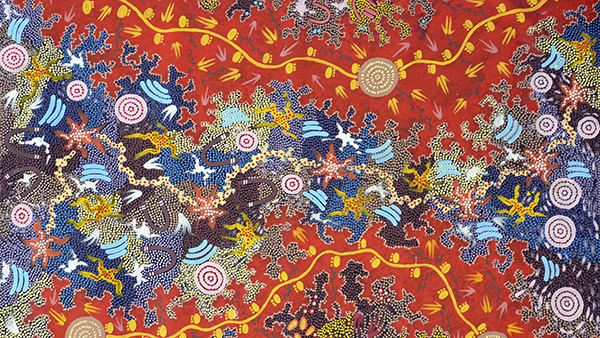
In visual terms, this results in a language of signs:
- concentric circles (sites, waterholes)
- lines (paths, journeys, ancestral movements)
- fields of dots (topography, energy, presence)
From a Western perspective, this may resemble abstraction. From within its own epistemology, it is precision.
From Papunya to the Global Stage


The contemporary visibility of Aboriginal painting is closely tied to the Papunya movement of the early 1970s, where artists began translating ceremonial ground paintings into acrylic on canvas. This moment—often associated with the founding of Papunya Tula Artists—was not the beginning of the practice, but its material transformation.
Artists such as Clifford Possum Tjapaltjarri and Emily Kame Kngwarreye brought these visual systems into a global art context, where they were initially misread as formal abstraction rather than as carriers of knowledge.
Women, Fiber, and Expanded Practices


4
While painting has dominated international attention, contemporary Aboriginal art extends far beyond the canvas. Women artists, in particular, have expanded the field through fiber practices, sculpture, and installation.
Collectives such as Tjanpi Desert Weavers exemplify this expansion, transforming traditional weaving into sculptural forms that engage with ecology, storytelling, and community. These works resist categorization as “craft,” instead asserting themselves within the discourse of contemporary art.
Misreading Abstraction
A critical issue persists: the Western tendency to interpret Aboriginal art through its own frameworks—Minimalism, abstraction, conceptual art—rather than recognizing its distinct ontology.
This misreading reduces:
- knowledge to pattern
- law to decoration
- cosmology to style
From a curatorial standpoint, the challenge is to resist aesthetic appropriation and instead foreground:
- authorship
- cultural specificity
- the relationship between image and knowledge
The Contemporary Condition
Today, Aboriginal artists operate within a dual context:
- maintaining cultural continuity
- engaging global contemporary discourse
Artists such as Rover Thomas and John Mawurndjul demonstrate how tradition is not static, but adaptive—capable of responding to political, environmental, and institutional pressures.
Conclusion: Beyond the Western Frame
Australian Aboriginal art is not simply an aesthetic category; it is a knowledge system made visible. Its power lies not in its formal beauty—though that is undeniable—but in its capacity to hold relationships: between people, land, time, and memory.
For the contemporary viewer, the task is not to decode it as one would a modern painting, but to approach it with a different question:
What does it mean for an image to carry law, history, and existence simultaneously?
In that question lies the true challenge—and the enduring relevance—of Aboriginal art in the global contemporary landscape.
Abie Loy Kemarre
Alison Munti Riley
Amanda Westley
Andrew Tjupurrula Highfold
Angelina Ngal Pwerle
Athena Nangala Granites
Belinda Golder Kngwarreye
Bella Kelly
Bernadine Johnson
Biddee Baadjo
Bill Whiskey Tjapaltjarri
Clarise Tunkin
Cowboy Louie Pwerle
Damien Marks
Yilpi Marks
David Downs
Debra Nangala McDonald
Debra Young Nakamarra
Dennis Nona
Djambu Barra Barra
Doris Gingingara
Dorothy Napangardi
Dulcie Long Pwerle
Edward Blitner
Elizabeth Kunoth Kngwarray
Esther Bruno Nangala
Fiona Omeenyo
Freddie Timms
Gabriella Possum Nungurrayi
Genevieve Kemarr Loy
George Hairbrush Tjungurrayi
George Tuckerbox
George Ward Tjungurrayi
Gloria Petyarre
Gracie Morton Pwerle
Jack Britten
Jack Dale Mengenen
Jackie Wirramanda
Janet Golder Kngwarreye
Janice Stanley
Jeannie Mills Pwerle
Jill Jack
Jimmy Pike
Judy Napangardi Martin
Katherine Marshall Nakamarra
Kudditji Kngwarreye
Kurun Warun
Lily Karadada
Lily Kelly Napangardi
Linda Syddick Napaltjarri
Long Jack Phillipus
Lorna Fencer Napurrula
Maisie Campbell Napaltjarri
Makinti Napanangka
Margaret Lewis Napangardi
Mary McLean
Maureen Hudson Nampijinpa
Michelle Butler Nakamarra
Michelle Cooper
Michelle Possum Nungurrayi
Minnie Pwerle
Mitjili Napurrula
Nada Rawlins
Nellie Marks Nakamarra
Ningura Napurrula
Paddy Bedford
Patrick Tjungurrayi
Penny K Lyons
Polly Ngale
Queenie McKenzie
Ronnie Tjampitjinpa
Rosella Namok
Rosemary Petyarre
Rosie Goodjie
Rover Thomas
Samantha Hobson
Sarrita King
Sonya Edney
Stumpy Brown
Tarisse King
Thomas Tjapaltjarri
Tjungkara Ken
Tommy Watson
Trevor Turbo Brown
Walala Tjapaltjarri
Walangkura Napanangka
Wentja Napaltjarri
Willie Kew
Yinarupa Gibson Nangala
Yondee Shane Hansen
Yukultji Napangati
Represented Artists
Ann Thomson
Arwin Hidayat
Bernard Ollis OAM
Carlos Barrios
David Hayes
Dylan Sarra
Franck Gohier
Idris Murphy
Jeff Makin
Jorge Mariño Brito
Kim Wilson
Margaret McIntosh
Matthew Cheyne
Min-Woo Bang
Mirra Whale
Peter Hudson
Sophie Cape
Steve Lopes
Susie Choi
Stockroom Artists