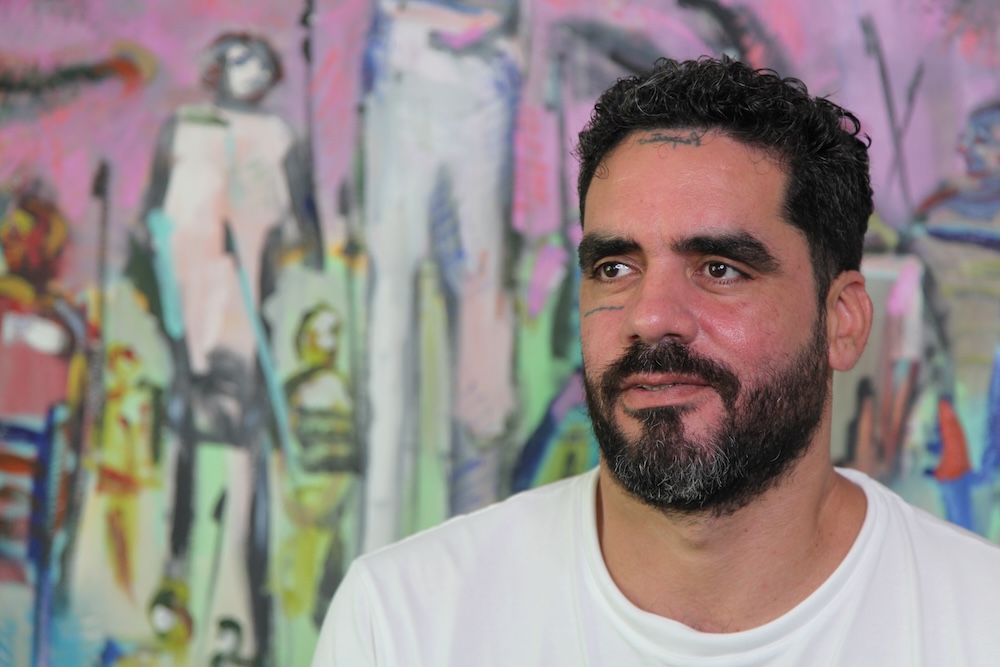
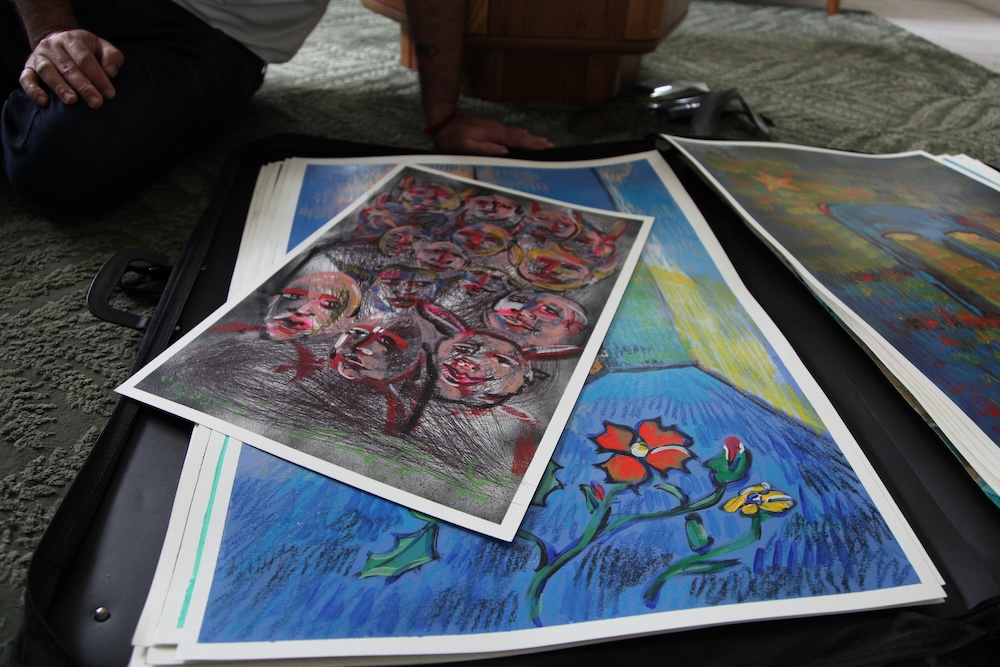
It is noon, and I enter the studio of Danilo Maldonado Machado, “El Sexto.” I arrive in a territory where painting, memory, and freedom coexist. A blues song is playing, we uncork a bottle of red wine, and sit on the floor to look at canvases, blurred faces, colors, scattered materials, and a stained rug. The characters emerge as if they had just crossed over from another world. They are Danilo’s creations, his demons, and his saviors too.
Born in Nuevitas, Camagüey, Danilo remembers that his relationship with images began very early.
“Since I was a child, I fell in love with images,” he confessed. The first thing he painted was a clown. Then another, and another, and more. He was fascinated by the makeup, the shrillness of their laughter, their wit, and the clown’s ability to reveal, in an exaggerated and grotesque way, a different way of looking at life.
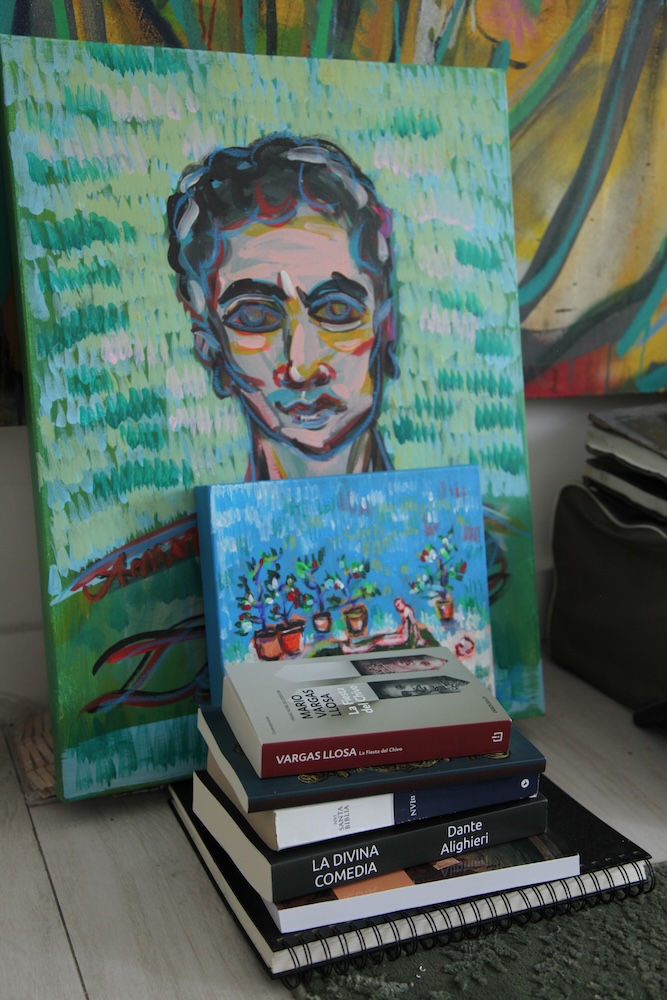
When his parents discovered his love of drawing, they did what they could to nurture their son’s imagination, even though they had few resources. That is how cardboard toys, sheets of paper, and crayons came into his life. “It comes from a necessity. There was no other way out,” he said about that initial impulse to draw.
And that urgency for images, for bringing so many characters to the surface so they can develop their stories, can still be felt in his studio.
Within the figurative realm, Danilo prefers to construct beings whose faces are not completely defined. They are entities that seem to come from an inner space that is difficult to describe, one that is very much his own: “There are things I see, and that begin to reveal themselves. That is how I create.”
His work has always been tied to his personal history. During his time as a graffiti artist in Havana, “El Sexto” was born, an alter ego whose messages began flooding the streets and becoming part of the popular imagination. He had a language of his own. He was, and remains, an irreverent and restless artist.
“I wanted to create a character that had something to do with a kind of Cuban Zorro or Superman, and that had a mystical charge, like things related to ancient writings, meaning, on the sixth day, God made man, and He made him free, that is why he has a star,” he explained.
As his graffiti and flyers became more widely recognized, the surveillance around him also increased: “One day I already felt there was a lot of commotion around my work.”
One day he met the writer Orlando Luis Pardo Lazo, who wrote about his work in the article “The Noise of the People.” That caused his name to become troublesome for the Castro regime.
“They would take away my charcoal sticks, my spray cans, they would enter the places where I was and search my backpack, they would take away my materials. They would go into the houses where I was painting and take away my paintings,” he said.
In 2014, his intention to stage a performance with two pigs painted olive green and named Fidel and Raúl ended with his arrest before he could complete the action. It was one of several occasions on which he was imprisoned in Cuba because of his work and activism. In 2015, he received the Václav Havel Prize for Creative Dissent, an award presented by the Human Rights Foundation.
He emigrated to the United States in 2017, and in Miami he continues his activism as well.
But in his studio, all of that history is transformed into painting, sculpture, and performance. Danilo experiences creation as a permanent state of attention, of wonder before the image.
“I am receptive. The exercise of creating is like physical exercise, the muscle grows. When you are constantly creating, you become more sensitive. Whether it is a performance, a sculpture, a drawing, I try to be there and write it down,” he observed.
That is why being in his studio is an experience that goes beyond observing finished works and ideas in motion. Here, the faces speak, criticize, hurt, but above all, they are free.
“The statement of my work is to show that you can exercise your freedom. It does not matter how or where, you have the right to project yourself as a free individual.”
Danilo Maldonado conceives only one way of creating, connected to his most intimate vision, where making art is also a way of existing without asking permission or being accountable to anyone.