What Makes Geometric Abstraction So Exciting in 2026?
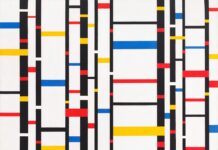
Geometric abstraction remains exciting because it turns the most elementary visual means—line, angle, grid, color, repetition—into an arena for perception, philosophy, and structure. What once seemed austere now reads as inexhaustible. At its core, geometric abstraction is built from simple forms arranged in nonrepresentational space, but its real subject is never mere geometry; it is how order, rhythm, tension, and vision are constructed. As both the Met and MoMA describe it, the language of geometric abstraction emerged through Cubism’s dismantling of illusionistic space and evolved into a distinct field of hard-edge, linear, and nonobjective form.
The classic origin story still matters. Malevich’s Suprematism, Mondrian’s De Stijl, Constructivism, and the Bauhaus transformed painting into a site of radical reduction, where geometry could carry metaphysical, political, and perceptual force. Yet by 2026, the field is understood far more broadly than an early-20th-century European achievement. MoMA’s historical framing of abstraction and geometric form, along with Tate’s treatment of hard-edge painting, makes clear that geometric abstraction persisted as a critical counterweight to gestural modernism, especially in the postwar period.
What is most compelling now is how the narrative has expanded. Geometric abstraction is no longer read only through Malevich, Mondrian, Albers, or Stella, but through artists who complicated the category from within. Sophie Taeuber-Arp’s work, for example, has been newly emphasized for dissolving boundaries between fine art, design, craft, and architecture—showing that geometry can be playful, embodied, and socially embedded rather than doctrinaire.
The same expansion is visible in the renewed institutional attention to Latin American abstraction. Tate has described Gego as one of the most significant figures in Latin American abstract geometric art, and recent Guggenheim programming around Beatriz Milhazes, as well as the museum’s 2025 acquisitions of works by Colombian abstractionist Fanny Sanín, show that the contemporary vitality of geometric abstraction depends in part on recognizing histories once treated as peripheral.
That is why geometric abstraction still feels alive: it is not closed. It can be severe or ecstatic, systemic or ornamental, architectural or intimate. It can move from painting into sculpture, textiles, design, installation, and digital systems without losing its rigor. Even contemporary photography and drawing exhibitions at MoMA continue to frame geometric and systems-based abstraction as an active field rather than a finished chapter.
The excitement of geometric abstraction, then, lies in its paradox. It is reductive but expansive, impersonal yet deeply affective, historical yet perpetually renewable. Geometry gives art a skeleton; artists keep giving it breath.