Under the Red Tent: Fiber, Memory, and Collective Presence at The CAMP Gallery
From March 8 through April 25, 2026, Under the Red Tent transformed The CAMP Gallery in North Miami into an immersive environment shaped by fiber, memory, storytelling, and collective participation. Presented by Red Thread Art Studio Miami, the exhibition brought together twenty women artists whose practices approached textiles not simply as materials, but as vehicles for connection, identity, labor, resistance, and shared experience.
Opening on International Women’s Day, the exhibition immediately established its emphasis on feminine community and intergenerational exchange. Rather than presenting a conventional sequence of individual artworks, Under the Red Tent functioned as a shared environment in which separate practices became interconnected through thread, color, material, conversation, and participation.
The artists included Aida Tejada, Angela Bolaños, Anna Biondo, Aurora Molina, Bella Cardim, Cynthia Passavanti, Debora Rosental, Eva Llarena, Fernanda Froes, Flavia Fortuna, Flor Godward, Juliana Torres, Katia Bandeira de Mello, Marine Fonteyne, Mila Hajjar, Mirele Volkart, Paola Mondolfi, Robertha Blatt, Sarah Laing, and Susanne Schirato.
A Gallery Reimagined as Sanctuary
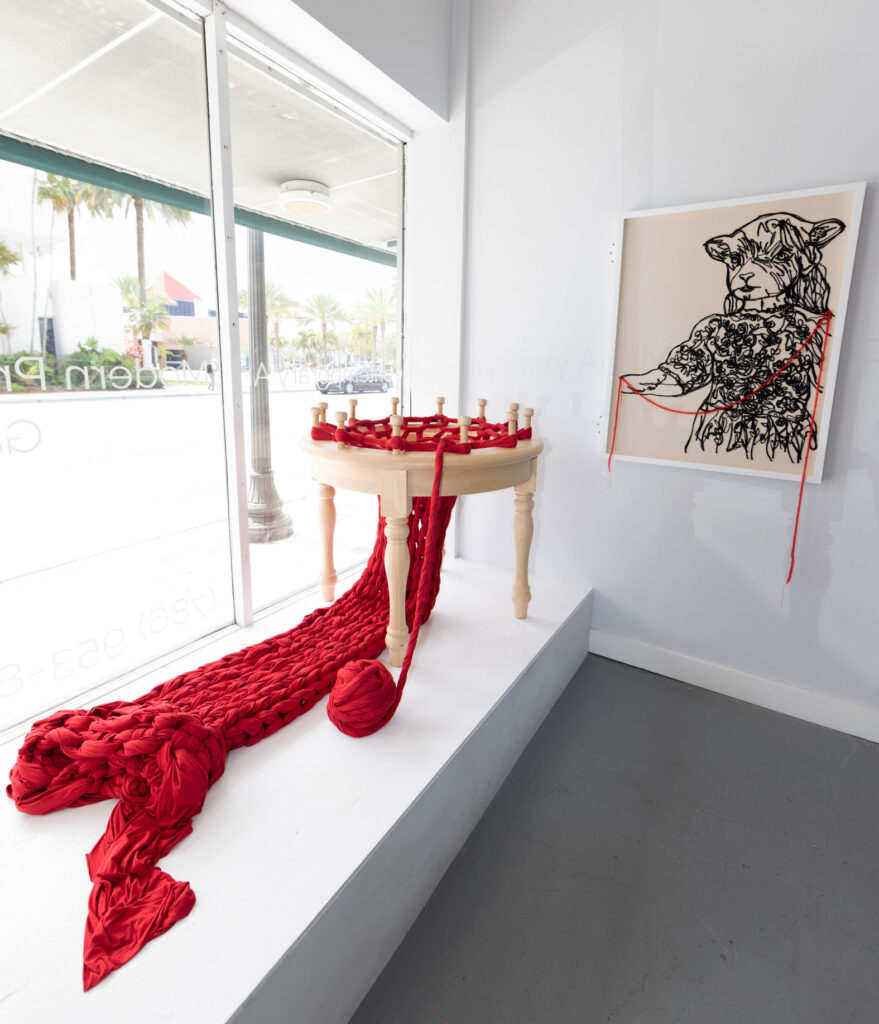
The exhibition moved away from the neutrality traditionally associated with the white-cube gallery. Red threads, woven structures, layered fibers, hanging elements, sculptural forms, and tactile surfaces altered the architecture of the space, producing an environment that felt simultaneously intimate and expansive.
Red became the exhibition’s unifying visual language.
Throughout the installation, the color carried multiple associations: blood, childbirth, vitality, danger, passion, protection, fate, and visibility. Rather than operating merely as an aesthetic choice, red connected individual artworks into a larger symbolic field.
Within this environment, thread assumed both a literal and metaphorical role. It connected objects physically while suggesting relationships between people, memories, generations, and experiences. Fragile individually but stronger through accumulation and interconnection, fiber became an especially appropriate material through which to examine ideas of community and interdependence.
The Red Tent as a Space of Transmission
The exhibition took its title from Anita Diamant’s novel The Red Tent, introduced to the group by participating artist Sarah Laing.
In the novel, the red tent represented a communal space in which women gathered during menstruation and childbirth, exchanging stories, knowledge, support, and generational wisdom. That idea of transmission became central to the exhibition.
Under the Red Tent translated the literary metaphor into physical space. The gallery became a contemporary sanctuary where women’s experiences could be shared, preserved, questioned, and transformed through artistic practice.
The exhibition suggested that identity was not formed solely through individual introspection. It also emerged through stories inherited from families, communities, cultures, and other women. Memory became relational: one person’s experience could become part of another’s understanding of herself.
In this context, storytelling was not secondary to the artworks. It became another material.
A Living Oral-History Archive
One of the exhibition’s most distinctive elements was its living oral-history archive.
Through performances, activations, community gatherings, and informal exchanges, participants were invited to contribute personal narratives that became integrated into an evolving audio component.
As a result, the exhibition never remained entirely fixed.
Visitors were not positioned only as observers looking at completed objects. They could become contributors to the developing history of the project. Their voices entered the work, extending the exhibition beyond the visual and introducing memory, speech, and lived experience as additional forms of material.
This participatory structure softened conventional distinctions between artist and audience. The gallery became a place of exchange rather than simply a site of display.
The project therefore reflected one of the central principles of Red Thread Art Studio Miami, founded by fiber artist Aurora Molina: artistic production could function simultaneously as creative practice, social encounter, and civic dialogue.
Fiber as Labor and Knowledge
Throughout Under the Red Tent, the physical qualities of textile processes remained visible.
Knots, woven structures, loose threads, layered surfaces, frayed edges, stitching, and accumulated materials revealed the time and labor embedded in making. Instead of concealing process behind polished surfaces, many works allowed evidence of the hand to remain present.
That emphasis on labor carried particular significance.
Textile practices have historically existed at the intersection of art, craft, domestic work, community knowledge, and cultural tradition. In Under the Red Tent, fiber was placed firmly within contemporary artistic discourse without abandoning those histories.
Weaving, sewing, knotting, and assembling became forms of thinking.
The repetitive actions required by fiber work also reflected the exhibition’s broader concerns with patience, care, continuity, and collective support. Each gesture accumulated slowly, just as relationships and communities are constructed through repeated acts rather than singular events.
Individual Voices Inside a Collective Structure
Although the exhibition emphasized collaboration, it did not erase individual artistic identity.
Each artist contributed a distinct practice, history, and visual vocabulary. Yet the works were installed in ways that encouraged relationships between them rather than reinforcing isolation.
This was one of the exhibition’s most significant curatorial ideas: collectivity did not require sameness.
Individual works retained their independence while participating in a larger environment. The exhibition therefore proposed a model of community based not on uniformity but on coexistence.
That structure was echoed materially through thread itself. Separate fibers remained identifiable, yet their ability to form something larger depended upon their connections.
Between Solitude and Community
Under the Red Tent also resisted presenting community as an uncomplicated ideal.
The exhibition acknowledged that growth could emerge through solitude as well as through participation. Personal reflection remained necessary, but the project suggested that certain forms of understanding became possible only through relationships with others.
The works moved between these two conditions.
Some moments encouraged quiet contemplation and introspection. Others expanded outward through conversation, performance, sound, and collective interaction.
This tension between the individual and the communal gave the exhibition psychological depth. The red tent was not simply a protected space where everyone agreed. It was a space in which people could encounter one another, recognize vulnerability, exchange knowledge, and reconsider their own experiences through the perspectives of others.
Red as Visibility
The recurring presence of red intensified these ideas.
Red could evoke vulnerability through its association with blood, yet simultaneously signal strength and vitality. It could communicate warning while also suggesting celebration. Across different cultural traditions, it could function as protection, luck, passion, danger, or life.
Within the exhibition, these contradictory meanings were not resolved. They were allowed to coexist.
The color ultimately became associated with visibility—with the refusal to disappear.
Against histories in which women’s labor, domestic practices, oral traditions, and textile production were frequently overlooked or treated as secondary forms of cultural production, the exhibition made these practices emphatically visible.
The red thread connected not only artworks but histories.
Art as a Living Collective Practice
What distinguished Under the Red Tent was its refusal to treat an exhibition as something completed before the public arrived.
Its oral histories continued to accumulate. Conversations altered the experience of the space. Performances and activations introduced new temporal dimensions. Visitors could leave traces of themselves within the evolving project.
The exhibition therefore existed as both artwork and process.
By the time Under the Red Tent closed on April 25, 2026, what had been created extended beyond the physical objects installed at The CAMP Gallery. The exhibition had generated encounters, recorded voices, conversations, memories, and temporary communities.
Its central metaphor remained remarkably simple: the thread.
A thread could be broken easily, yet many threads woven together could form something resilient. A single narrative could disappear, but stories transmitted between generations could survive. An individual artwork could speak independently, while a collective installation could allow multiple voices to coexist without demanding that any one of them dominate.
In Under the Red Tent, fiber became a language for precisely this condition.
The exhibition demonstrated how contemporary textile practice could operate simultaneously as material investigation, storytelling, social history, and communal action. More importantly, it proposed that art did not need to remain confined to the production of objects.
For those weeks in North Miami, art became a place to gather, remember, listen, contribute, and weave something together.