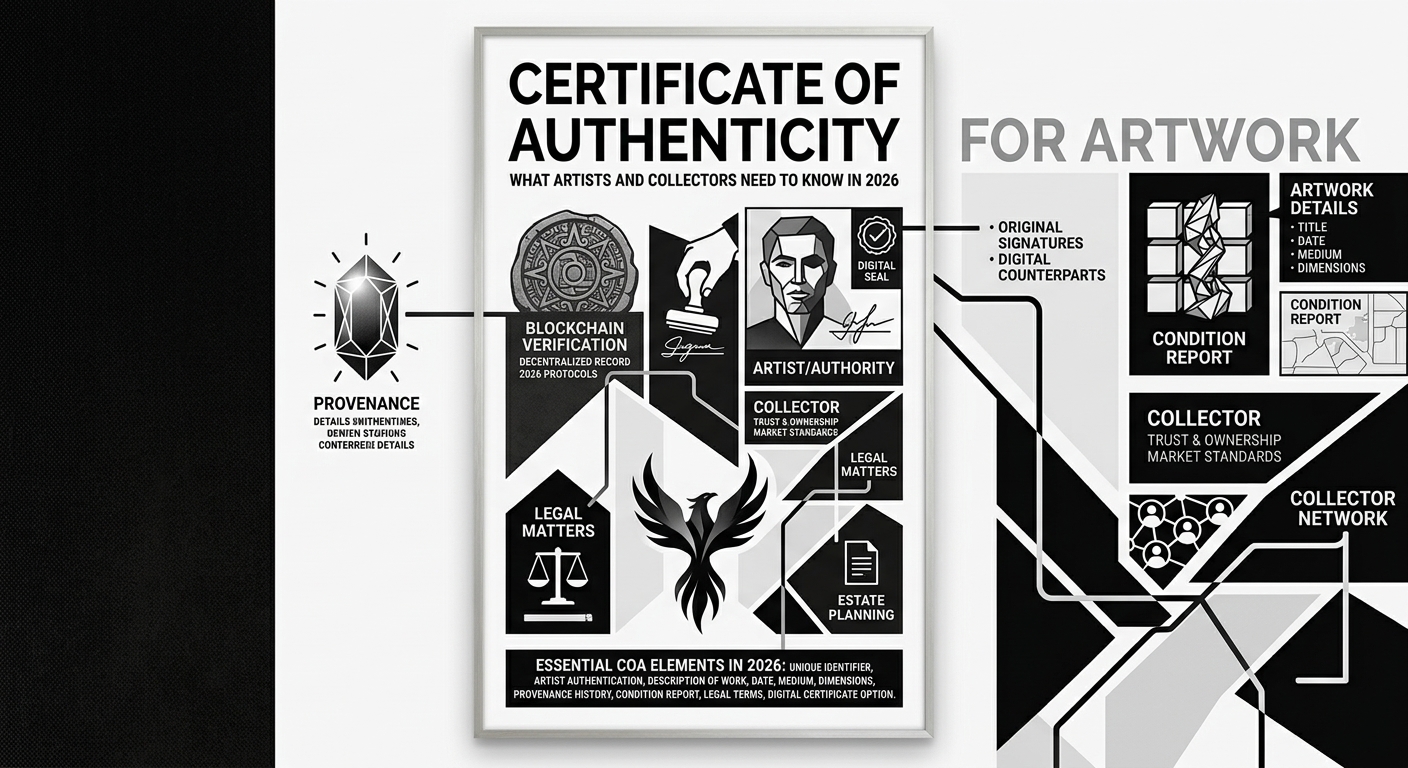
Certificate of Authenticity for Artwork: What Artists and Collectors Need to Know in 2026
A Certificate of Authenticity (COA) is one of the most useful documents an artist can provide with an artwork, but it is also one of the most misunderstood.
A COA identifies a specific artwork and records who is affirming its authorship or authenticity. For living artists, it is commonly issued by the artist, studio, representing gallery, or another authorized party. For historical or deceased artists, authentication can be more complex and may depend on an artist’s estate, foundation, archive, catalogue raisonné, recognized expert, provenance, technical examination, or a combination of these sources.
A certificate should therefore be understood as part of an artwork’s documentation and provenance, not as a magical guarantee of authenticity or financial value.
What Is a Certificate of Authenticity?
At its most basic level, a COA is a document linking an identifiable artwork to the artist who created it.
New York law, for example, defines a certificate of authenticity issued by an art merchant as a written statement confirming or attesting to the authorship of a work of fine art or a multiple. The law also specifically addresses false certificates and warranties relating to works of art.
The authority behind the document is therefore extremely important. A certificate signed directly by a living artist or issued by an artist’s recognized estate or authentication body carries a very different significance from an attractive certificate produced by an unknown third party.
Major auction records demonstrate this distinction. Sotheby’s, for example, may describe a work as being accompanied by a certificate issued by the relevant artist’s archive, while other works may have certificates signed directly by the artist.
A COA Is Not the Same as Provenance
One of the most important distinctions for collectors is the difference between authenticity documentation and provenance.
Provenance is the documented history of an artwork’s ownership, ideally tracing the object from its creation to the present. It can include gallery invoices, previous owners, auction records, exhibition histories, collection labels, photographs, catalogues, and other documentary evidence. Christie’s describes provenance as essentially the biography of an artwork and notes that strong ownership documentation can play an important role in authentication.
A COA can become part of that provenance, but it does not replace it.
For a newly created artwork purchased directly from the artist, the combination of the artwork, signed COA, invoice, photographs, correspondence, and sales record can establish the beginning of a strong provenance trail.
Collectors should preserve all of these documents.
What Information Should a Professional COA Include?
A useful certificate should identify the artwork precisely enough that the certificate cannot easily become separated from the object it describes.
A strong contemporary COA should generally include:
- Artist’s full professional name
- Artwork title
- Year of creation
- Medium and materials
- Dimensions
- Edition number and total edition size, when applicable
- Whether the work is unique or part of an edition
- Clear photograph of the artwork
- Artist or authorized issuer’s signature
- Date the certificate was issued
- Unique inventory, registration, or certificate number
- Artist, studio, gallery, estate, or issuing organization’s contact information
- Relevant inscriptions, signatures, stamps, labels, or identifying characteristics
- Installation or display instructions when essential to the identity of the work
- For digital, video, generative, or time-based works, information identifying the files, software, hardware, edition, installation requirements, or other components necessary to realize the work
International museum documentation standards reinforce the importance of recording this type of information. Object ID, supported by ICOM and INTERPOL, recommends documenting measurements, materials and techniques, artist or maker, distinguishing features, inscriptions, and photographs so cultural objects can be reliably identified.
The Getty’s documentation standards similarly recommend persistent unique identifiers for artwork records.
For artists, this means that a COA should not merely look professional. It should contain professionally useful information.
Photography Is More Important Than Many Artists Realize
Including a good photograph on the certificate—or associating the certificate number with a permanent digital artwork record—greatly reduces ambiguity.
INTERPOL’s Object ID guidelines specifically emphasize photographs as important tools for identifying cultural property and recommend documenting inscriptions, marks, damage, and repairs in addition to overall images.
For paintings, sculptures, textile works, assemblages, and mixed-media works, photographing the front, reverse, signature, labels, and distinctive physical characteristics can be especially valuable.
This documentation can later help collectors, galleries, conservators, insurers, auction specialists, estates, and heirs identify the artwork.
Certificates for Limited Editions Require Additional Detail
Prints, photographs, sculptures cast in editions, and other multiples require particularly careful documentation.
The certificate should make clear whether the object is, for example, 3/20, an artist’s proof, a printer’s proof, or another type of editioned work, as well as identifying the production method and relevant edition information.
This is more than good professional practice in some jurisdictions. California law contains specific disclosure requirements relating to fine-art multiples sold by art dealers, and its statutory definition of a certificate of authenticity refers specifically to the written or printed description of the multiple being sold, exchanged, or consigned.
New York law likewise contains specific provisions concerning express warranties for art multiples.
Artists and galleries selling internationally should therefore understand that legal requirements surrounding certificates and art sales can vary by jurisdiction.
Digital Certificates, QR Codes, and Unique IDs
The traditional COA printed on quality paper is no longer the only option.
Artists increasingly supplement physical certificates with digital records, QR codes, registration numbers, databases, and other digital verification systems.
These technologies can be extremely useful. A QR code, for example, can connect a physical certificate to a continually maintained artwork record containing photographs, exhibition history, installation information, and ownership documentation.
But the technology itself does not create authenticity.
A beautifully designed QR code or blockchain entry proves that a particular digital record exists; its usefulness still depends upon who created the record, what information was entered, and whether the issuer actually has authority to authenticate the artwork.
The strongest system therefore combines technological verification with authoritative documentation.
Digital and Time-Based Art Require More Than a Traditional COA
Contemporary art increasingly includes video, performance, software, generative art, interactive installation, AI-based work, and works that may need to be reconstructed differently each time they are exhibited.
For these artworks, the certificate may be only one component of a larger documentation package.
The Guggenheim’s Variable Media Initiative, for example, has examined systems in which a work is accompanied not only by a certificate but also by documentation or a “score” specifying how an installation should be realized.
Research at Tate has similarly emphasized the role of artist instructions and documentation in maintaining the authenticity of time-based media installations as technologies and exhibition conditions change.
For contemporary artists working in these media, the question is therefore not only:
Is this the authentic artwork?
It may also be:
What must remain unchanged for this work to continue being the same artwork?
That distinction is increasingly important in twenty-first-century art.
Does a COA Guarantee That an Artwork Is Authentic?
No.
A certificate is only as credible as its issuer and the evidence supporting it.
Authentication of important historical works can involve provenance research, stylistic analysis, comparison with catalogued works, signatures and inscriptions, scientific examination, archival evidence, and consultation with recognized specialists. Christie’s notes that provenance, materials, signatures, technique, and specialist research can all contribute to the authentication process.
There are also cases in which one particular authentication body becomes essential. For Banksy, for example, Christie’s notes the importance of certification from Pest Control, the artist’s official authentication service.
Collectors should therefore be cautious of statements such as “It has a COA, therefore it must be authentic.”
The better question is:
Who issued the certificate, and why is that person or organization qualified to authenticate this particular artist’s work?
Does a Certificate Increase the Value of an Artwork?
A COA can make an artwork easier to document, insure, transfer, catalogue, and eventually resell. Clear authenticity documentation and provenance can contribute to confidence in the marketplace. Sotheby’s notes that provenance, authenticity documentation, condition, scarcity, artist importance, and collector demand can all influence how artworks are evaluated.
However, a certificate does not guarantee that an artwork will increase in value.
This is an important correction to a common misconception.
Art values can rise, remain stable, or decline. Market demand is affected by many factors including the artist’s career, institutional recognition, critical reception, rarity, condition, provenance, exhibition history, gallery representation, broader economic conditions, and changing collector preferences.
A COA is documentation—not an investment promise.
A Certificate Is Also Important for the Artist
Artists should think about COAs not simply as documents demanded by collectors but as part of building their own professional archives.
Twenty or thirty years after an artwork leaves the studio, the artist may no longer remember precisely when it was created, its dimensions, materials, original buyer, exhibition history, or whether another similar work exists.
A systematic certificate and inventory process establishes that information while it is still available.
Ideally, every certificate number should correspond to a record in the artist’s private archive or inventory system.
For example:
RM-2026-0047
could identify the 47th registered artwork in an artist’s 2026 inventory.
The same identifier can appear in the artist’s database, COA, invoice, condition photographs, exhibition records, loan agreements, and eventually catalogue raisonné.
The objective is not bureaucracy. It is continuity of information.
COA, Copyright, Ownership, and Appraisal Are Different Things
Another frequent source of confusion is treating all art documentation as interchangeable.
A Certificate of Authenticity identifies and authenticates an artwork. It does not necessarily establish the artwork’s current monetary value, and it is not the same thing as a professional appraisal.
Likewise, buying a physical painting does not automatically mean that the collector acquires the artist’s copyright. Copyright in visual artworks is a separate legal right. The U.S. Copyright Office specifically treats paintings, photographs, sculptures, and other visual works as copyrightable subject matter and provides a separate registration system for copyright protection.
This distinction is particularly important when collectors want to reproduce an artwork commercially, license an image, produce merchandise, or authorize other uses.
What Collectors Should Keep With an Artwork
The strongest artwork file is not simply a certificate.
A collector should ideally preserve the COA together with the original invoice, purchase agreement, gallery correspondence, provenance documents, exhibition catalogues, conservation reports, condition photographs, shipping records, loan paperwork, appraisal documents, and any relevant publication history.
Over decades, these records can become almost as important to the history of the object as the original certificate.
Labels, inscriptions, stamps, and notes on the reverse of works should also be preserved whenever possible. Christie’s notes that the backs of paintings can contain valuable evidence relating to exhibitions, collections, provenance, materials, and even instructions left by artists.
The Certificate Should Travel With the Artwork
When an artwork changes ownership, its documentation should remain connected to it.
The original COA should normally stay with the artwork, while collectors and sellers should retain appropriate copies for their records. New invoices and ownership documentation can then extend the provenance without replacing the original artist-issued certificate.
An important principle follows:
Do not casually create a new artist certificate merely because the original has been lost.
For living artists, the artist or authorized studio may decide whether a replacement or updated document can legitimately be issued. For deceased artists, authentication should be handled through the appropriate estate, foundation, archive, catalogue raisonné committee, recognized specialist, or other qualified authority where one exists.
Creating a new certificate without proper authority can create more problems than it solves.
Why Certificates of Authenticity Matter in 2026
As art moves increasingly between studios, galleries, fairs, collectors, online platforms, digital archives, auction houses, and museums, reliable documentation becomes more—not less—important.
The contemporary COA should therefore be thought of as part of a larger identity system for the artwork.
For the artist, it records authorship and strengthens the professional archive.
For the collector, it helps preserve the object’s history.
For galleries and auction specialists, it provides useful evidence when researching provenance and attribution.
For conservators and museums, it can record materials, artist instructions, and conditions essential to preserving the work.
And for future generations, it may become an important piece of evidence explaining where the artwork came from and how it was intended to exist.
A strong Certificate of Authenticity does not tell us whether an artwork is good, whether it will become historically important, or whether its market value will increase.
What it does is far more practical:
it helps ensure that the identity and history of an artwork do not disappear as the artwork moves through time.