Miami Art in August 2026: From Louise Nevelson and John Baldessari to a New Generation of South Florida Artists
August is traditionally regarded as one of Miami’s quieter months, but the 2026 visual-arts calendar tells a different story. Across museums, galleries, artist-run spaces, and public institutions, the region is presenting exhibitions that move between major figures of twentieth-century art and a younger generation addressing identity, ecology, memory, migration, psychology, and the unstable relationship between nature and contemporary life.
Louise Nevelson: Dawn to Dusk at the Frost Art Museum
Louise Nevelson transformed discarded wood into some of the most commanding sculptural environments of twentieth-century American art. Her monochromatic assemblages—often painted an uncompromising black, but also white or gold—turned fragments of furniture, architectural remnants, boxes, spindles, and found wood into structures that hover somewhere between sculpture, architecture, altar, cityscape, and memory.
Opening at the Patricia & Phillip Frost Art Museum in August, Louise Nevelson: Dawn to Dusk offers an opportunity to look beyond the monumental black constructions for which the artist is best known. Organized from the holdings of the Farnsworth Art Museum in Maine, which maintains one of the most important concentrations of Nevelson’s work, the traveling exhibition includes more than forty works spanning early paintings and drawings, figurative sculpture, abstract wood constructions, collage, and even her handcrafted jewelry. In this broader context, Nevelson emerges not simply as the maker of a recognizable sculptural style, but as an artist who spent decades investigating accumulation, shadow, repetition, fragmentation, and the psychological possibilities of space.
Nevelson’s biography also complicates the conventional story of American modernism. Born Leah Berliawsky in the Russian Empire in 1899 and brought to the United States as a child, she eventually became one of the most recognizable sculptors of postwar New York. Her work occupied an artistic culture still overwhelmingly dominated by men, yet she developed both an unmistakable visual language and an equally deliberate public persona. Dawn to Dusk consequently provides a valuable opportunity to reconsider her not as an “underrated female artist,” but as a major architect of postwar sculpture whose manipulation of found materials anticipated later developments in installation and environmental art.
On view: August 20, 2026–January 17, 2027, Patricia & Phillip Frost Art Museum, Florida International University, Miami.
John Baldessari: The End of the Line at Pérez Art Museum Miami
Few artists did more to dismantle the conventional separation between image and language than John Baldessari (1931–2020). His influence extends far beyond the instantly recognizable photographs punctuated by colored circles that obscured faces or redirected the viewer’s gaze. Baldessari’s larger project questioned what qualifies as art, who determines meaning, how images acquire authority, and what happens when language is treated as a visual material rather than merely an explanation.
Pérez Art Museum Miami’s John Baldessari: The End of the Line is the first major South Florida survey devoted to the artist. The exhibition brings together approximately forty works across painting, photography, video, and installation, largely drawn from the collection of Miami collector Craig Robins, a longtime friend and supporter of the artist. It covers roughly five decades of Baldessari’s practice, from his formative experiments of the 1960s and 1970s through his serial photography and later investigations into mass-media imagery.
Central to the story is Baldessari’s legendary Cremation Project of 1970, in which he destroyed much of the painting he had produced between 1953 and 1966. The act was not simply theatrical destruction: it represented a conceptual declaration that the artist could reject his own previous identity and begin again. The exhibition also revisits his use of appropriated film and television imagery and his persistent interrogation of the relationship among photographs, words, narrative, and artistic authorship. His importance as an educator is equally substantial: he taught generations of artists at CalArts and later UCLA.
Curated by Karen Grimson, with the PAMM presentation organized by José Carlos Diaz and Fabiana A. Sotillo, The End of the Line makes an especially appropriate exhibition for Miami, a city where image production, advertising, architecture, collecting, design, and popular culture continuously collide.
On view: August 20, 2026–May 9, 2027, Pérez Art Museum Miami.
Gabriel Rico: X Mural from the series — Reduccion Objecta Orquestada at The Bass
Mexican artist Gabriel Rico approaches objects almost as though they were elements in an unknown scientific formula. Natural materials and manufactured objects appear together in carefully constructed systems in which relationships seem logical while remaining resistant to any single interpretation.
At The Bass, X Mural from the series — Reduccion Objecta Orquestada extends that methodology across the wall. Rico borrows the visual logic of the mathematical equation but replaces the certainty normally associated with mathematics with ambiguity. Organic and inorganic objects function as if they were variables, symbols, or operators within a problem whose final answer is intentionally left to the spectator.
That distinction makes the work more than a playful visual puzzle. Mathematics traditionally promises consistency: given the proper information and operations, one should arrive at a solution. Rico adopts the appearance of this rational structure while introducing objects carrying social, ecological, material, and cultural associations that cannot be reduced to numerical value. The “equation” consequently becomes a philosophical proposition about how humans classify the world and attempt to impose systems of meaning upon things that resist stable categorization.
Rather than asking visitors merely to solve the work, Rico asks something more interesting: why do we expect everything to have a solution?
The installation is organized for The Bass by Executive Director Silvia Karman Cubiñá.
On view: August 29, 2026–August 2028, The Bass, Miami Beach.
Johel Pereira: Holy Red at Supermarket Gallery
Photography’s relationship with architecture is often assumed to be documentary: buildings are photographed so that they may be recorded. Johel Pereira’s Holy Red begins somewhere else. Presented by the nomadic Supermarket Gallery at Homebase Studios, the photographer’s debut solo exhibition treats historic South Florida churches not simply as buildings but as vessels for memory, belief, disappearance, and cultural continuity.
The project moves across photography, moving image, and sound, focusing attention on sacred architecture that has become so embedded in the urban landscape that many residents may no longer consciously notice it. Pereira has described the project as emerging from curiosity and reverence for architecture that has been overlooked.
By invoking visual qualities associated with early photographic processes and directing sustained attention toward structures threatened by changing urban conditions, Holy Red establishes an intriguing tension between photography’s capacity to preserve and architecture’s vulnerability to transformation. South Florida is a particularly charged location for such a project: demolition, redevelopment, migration, climate, speculation, and rapid shifts in neighborhood identity continually rewrite the visual archive of the city.
The exhibition opens Friday, August 14, from 6:30 to 9:30 p.m., and remains on view through September 4.
The Undoing at Antonio Urrutia Art
The title of Antonio Urrutia Art’s new group exhibition comes from a specific concept in psychoanalytic theory. In Freudian psychology, undoing describes a defense mechanism in which a person symbolically attempts to cancel an unacceptable thought, feeling, or act by performing something that functions as its opposite.
But The Undoing moves beyond psychology into a larger philosophical question: Can we ever truly begin again?
The exhibition brings together Chantae Elaine Wright, Brigette Hoffman, Gabriella Ayza Aschmann, Connor Dolan, Nicolas Beltran, Vicente Hirmas, and Paul Glaw. The gallery frames their works through ideas of reversal, renewal, release, shedding, washing away, transformation, and the possibility—or impossibility—of returning to a metaphorical blank slate.
The exhibition’s connection between Freud’s “undoing” and the philosophical notion of tabula rasa creates a productive tension. The question is not whether the past can literally be erased, but whether transformation requires erasure at all. Perhaps renewal instead occurs by acknowledging the layers that already constitute the self and creating space for another configuration to emerge.
The material range reinforces that instability: the presentation includes mixed-media painting, works on paper, oil painting, and Connor Dolan’s striking combination of water, glass, ultramarine blue, and vinyl acetate copolymer. Rather than presenting “undoing” as pure destruction, the exhibition proposes unraveling as a possible precondition for reconstruction.
Opening reception: Saturday, August 15, 2026, 6–9 p.m., Antonio Urrutia Art, Miami Design District.
Lea Nickless: The Magic of Miami Beach at Miami Beach Regional Library
Miami Beach has been mythologized so effectively that its constructed image—hotels, palms, beaches, nightlife, celebrities, Art Deco façades—can obscure the far more complicated physical and human processes through which the city came into existence.
Curator, researcher, and author Lea Nickless excavates those deeper histories in The Magic of Miami Beach. Rather than beginning with glamour, the exhibition begins with mangroves, coral, water, geology, ecology, and labor. It examines the barrier island before its transformation into an internationally marketed resort and pays particular attention to workers whose contributions have often disappeared from official accounts of the city’s development.
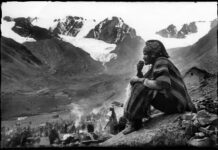
The project was catalyzed by a remarkable 1924 photograph depicting a Black laborer standing among enormous mangroves. From that image, Nickless traces a network of histories surrounding the transformation of Miami Beach: mangroves were cleared, Biscayne Bay was dredged, limestone fill reshaped the terrain, and fossilized coral rock from Windley Key became an architectural material used in landmarks including the building that now houses The Bass.
The exhibition therefore asks viewers to reconsider the familiar postcard image of Miami Beach as an artificial cultural construction built upon an older ecological landscape—and through human labor that has often remained invisible. Photography here functions as evidence, but also as an instrument through which forgotten historical relationships can re-enter collective memory.
The exhibition is listed from August 7 through November 5, 2026, with an opening reception on Saturday, August 8, from 11 a.m. to 1 p.m. at Miami Beach Regional Library.
Preliminary Structure for a Hurricane Forum at Tunnel Projects
For South Florida, the hurricane is never simply weather.
It is forecast and memory, architecture and insurance, migration and anxiety, preparation and aftermath. It is simultaneously natural phenomenon, media spectacle, political event, economic condition, and an organizing principle of everyday life.
Curated by Rivers Plasketes, Preliminary Structure for a Hurricane Forum uses that expanded understanding as its conceptual point of departure. Bringing together Éric Baudelaire, Loriel Beltrán, Aliénor Dufetel, Liam Gillick, and Rachel Zaretsky, the exhibition examines the hurricane not merely as a meteorological occurrence but as a structure through which experience can be predicted, represented, remembered, and politically organized.
This framework is particularly resonant in Miami, where climate is not an abstract subject. The approaching storm changes language, movement, social behavior, commerce, architecture, and perceptions of time. Before landfall, an event that has not yet happened already begins reorganizing reality.
The title’s word “preliminary” is therefore revealing. A hurricane is perpetually preliminary until it arrives: composed of probabilities, trajectories, maps, warnings, historical comparisons, and imagined futures. The exhibition’s conceptual strength lies in approaching that suspended condition as cultural material.
On view: August 8–September 5, 2026. Opening reception: August 8, 6–8 p.m., Tunnel Projects, Miami.
Three Exhibitions at Mindy Solomon Gallery
Mindy Solomon Gallery’s summer program brings three distinct exhibitions together under the curatorial direction of Sophia Ballesteros, each examining transformation through very different material and symbolic languages. All three opened July 26 and continue through September 3.
Cuando el gato no está brings together Hannah Banciella, Kate MacDowell, and Ella Stouse, using animals as proxies through which human behavior, authority, vulnerability, conflict, and social hierarchy can be reconsidered. The title derives from the Spanish proverb cuando el gato no está, los ratones hacen fiesta. MacDowell’s hand-built porcelain animals merge ecological concern with psychological allegory; Stouse draws upon fairy tales, folklore, and fables; and Banciella uses magical realism and animal symbolism to explore transformation and human fallibility.
Beyond the Veil brings together Miami artists Pangea Kali Virga, Andrea Spiridonakos, and Lisu Vega, positioning textile not simply as material but as a carrier of ancestry, grief, memory, inheritance, and passage. Felting, weaving, stitching, assemblage, inherited materials, upcycled fashion waste, and hand-painted silk become mechanisms through which intimate histories can acquire physical form. Among the works are Vega’s textile memorial to her grandmother, Spiridonakos’s monumental hand-painted silk installation, and Kali Virga’s layered works constructed partly from community and family materials.
Finally, Joyce Billet: That Which Comes Together marks Billet’s first exhibition with the gallery. Trained in architecture, she moves between painting, sculpture, design, digital processes, and wood fabrication. Her works investigate the strange journey through which natural material becomes industrial product and then returns, through artistic intervention, to a tactile evocation of organic form. The exhibition includes wall compositions, paintings, freestanding sculptures, 3D-printed components, and carved and etched wood, establishing a dialogue between nature and technology rather than treating them as opposites.
On view: through September 3, 2026, Mindy Solomon Gallery, Allapattah.
Ralph Coburn: Land, Sea, Sky at the Norton Museum of Art
The Norton Museum of Art has inaugurated Florida Roots, a new exhibition series examining the influence of Florida upon artists and cultural production, with an especially appropriate inaugural figure: Ralph Coburn (1923–2018).
Born in Minneapolis but raised largely in Miami Beach, Coburn developed an abstraction in which the visual environment of South Florida—its horizons, shorelines, flatness, architecture, and Art Deco geometry—could be compressed into sharply organized planes of color. Ralph Coburn: Land, Sea, Sky takes its title from the trisected compositions inspired by landscapes he encountered while moving among South Florida, Boston, New York, and Paris.
But Coburn’s importance cannot be limited to Color Field painting. During the 1940s and 1950s, he formed relationships with figures including Ellsworth Kelly, Jean Arp, and John Cage, and developed what the Norton describes as a participatory approach to art. In certain works, other people could influence either the composition or how the work was installed, destabilizing the traditional assumption that artistic authority must remain entirely with the artist.
That experimental dimension makes Coburn particularly relevant today. His work asks whether an artwork is a fixed object or a system capable of variation—and whether the spectator must remain outside it.
As the opening chapter of Florida Roots, the exhibition also advances a larger proposition: Florida should not be understood merely as a place where artists happen to live, but as an environment capable of generating distinctive visual languages.
On view: through January 3, 2027, Norton Museum of Art, West Palm Beach.
Sites of the Self and From Within at Oolite Arts
At Oolite Arts, two concurrent exhibitions approach identity from different generations but share a central proposition: the self is not necessarily something finished; it is something continually constructed.
Curated by René Morales, Sites of the Self brings together current Oolite resident artists Diego Gabaldon, Gonzalo Hernández, Pangea Kali Virga, Sepideh Kalani, Shayla Marshall, Bex McCharen, Lucía Morales, Genesis Moreno, Ana Mosquera, Sheherazade Thénard, Nadia Wolff, Ricardo Zulueta, and José Delgado Zúñiga. Rather than treating identity as a stable essence waiting to be revealed, the exhibition considers it as something produced through psychological experience, social relationships, culture, history, belonging, exclusion, and contact with difference.
The curatorial framework draws explicitly upon Édouard Glissant, whose thinking about identity and relation rejected the idea that meaningful contact with difference necessarily threatens one’s own cultural identity. Within the exhibition, this idea expands from interpersonal encounter toward larger social spaces in which identity is created, constrained, negotiated, and resisted.
Presented simultaneously in Oolite’s Vitrine Gallery, From Within introduces work by the inaugural Teen Residency cohort: Ana Blanco, Noa Garcia, Emely Yanji, Melina Walsh, and TJ Wright. Developed through experimentation in drawing, painting, sculpture, and mixed media, the exhibition focuses on memory, environment, identity, emotional experience, and the formation of an emerging artistic voice.
Seen together, the exhibitions create an intergenerational conversation. One asks established and emerging professional artists to consider how identity is socially constructed; the other shows young artists at precisely the stage when an artistic identity is beginning to take recognizable form.
On view: July 8–October 4, 2026, Oolite Arts, Miami Beach.
A Summer of Looking More Closely
What makes this group of exhibitions interesting is not merely its variety. Across institutions and generations, similar questions keep resurfacing: How is identity constructed? How does memory survive material change? What do we preserve and what do we erase? How does the natural environment shape culture? And how can an artwork reorganize the way we understand objects, histories, and ourselves?
From Nevelson turning fragments of discarded wood into monumental environments to Baldessari dismantling the authority of images and language; from Gabriel Rico’s impossible equations to Lea Nickless’s excavation of Miami Beach’s buried ecological and labor histories; from the hurricane as conceptual structure to younger artists using textiles, painting, photography, and installation to reconstruct the self, August 2026 demonstrates that South Florida’s art season no longer waits for December to become intellectually ambitious.