AWE: When the World Becomes Larger Than the Self
There are moments when perception changes scale.
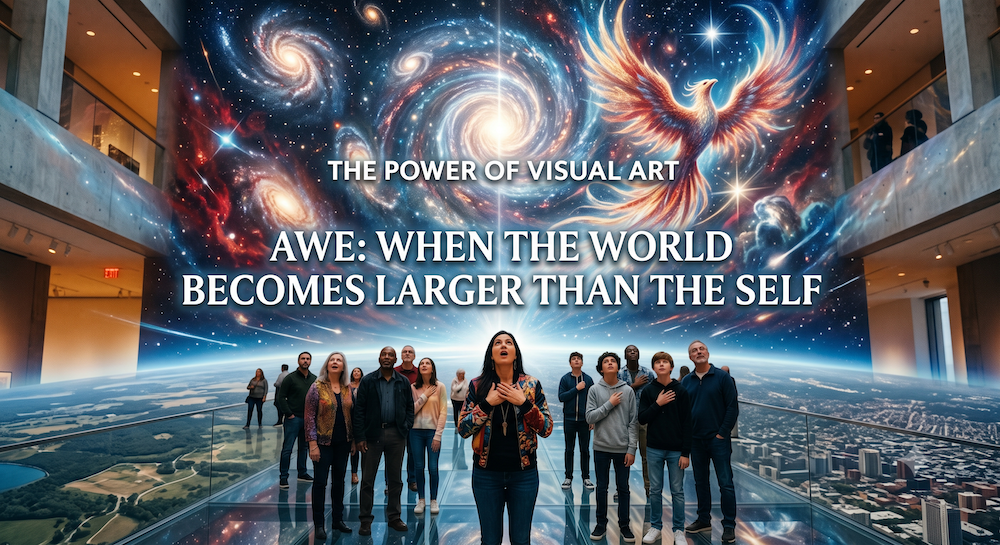
A mountain suddenly emerges beyond a narrow trail. The ceiling of a cathedral rises beyond what the eye can comfortably measure. A Rothko envelops the viewer in a field of color that seems simultaneously material and infinite. A night sky dissolves our ordinary sense of proportion. A scientific image reveals structures invisible to the naked eye. A piece of music expands until the individual listener feels absorbed into something larger than personal experience.
For a few seconds, the world becomes bigger.
And the self becomes smaller.
Psychology calls this experience awe.
Yet awe is more complicated than amazement, pleasure, beauty, or surprise. It belongs to an unusual family of emotions capable of disturbing our ordinary relationship with reality. Awe occurs when perception encounters something so vast—physically, intellectually, socially, temporally, aesthetically, or conceptually—that our existing mental framework struggles to contain it.
Dacher Keltner and Jonathan Haidt’s foundational psychological account proposed two defining components of awe: perceived vastness and a need for accommodation. Vastness means encountering something experienced as greater than oneself or one’s ordinary frame of reference. Accommodation occurs when existing cognitive structures become inadequate and must be modified to understand what is being perceived.
This makes awe extraordinarily important not only to psychology but also to art.
Because one of art’s deepest capacities is precisely this:
to confront us with something that our previous way of seeing cannot fully contain.
Awe Is Not Simply Beauty
Beauty and awe frequently coexist, but they are not identical.
A beautiful object can be immediately comprehensible. It may produce harmony, pleasure, attraction, or admiration while leaving our underlying conception of reality untouched.
Awe asks for something more radical.
The encounter must somehow exceed us.
Keltner and Haidt understood vastness broadly. It can be physical—the Grand Canyon, an ocean, a monumental sculpture—but it can also be conceptual. A mathematical idea, the immensity of geological time, biological evolution, the scale of the universe, an extraordinary human achievement, or the realization of one’s place within an ecosystem can all produce the cognitive conditions associated with awe.
This distinction is especially important for contemporary and conceptual art.
A work of art does not have to be physically enormous to create perceptual vastness.
A small object can contain an enormous idea.
A nearly empty gallery can transform one’s awareness of space.
A fragment of stone may invoke millions of years.
A mirror can turn the spectator into part of the artwork.
A geometric form can suggest infinity, order, containment, balance, or the relationship between the individual and the cosmos.
Thus, in art, vastness is not necessarily a question of dimensions. It can be a question of implication.
The physical artwork may be finite while the thought it activates becomes almost limitless.
The Moment Our Mental Model Fails
The second element of awe—accommodation—is perhaps even more important.
Human beings interpret reality through models. We organize experience into categories: object, person, landscape, building, painting, danger, beauty, familiar, unfamiliar.
These categories allow perception to function efficiently.
But occasionally something refuses to fit.
We encounter an image whose meaning cannot immediately be resolved. We enter an architectural space that distorts our sense of proportion. We confront a work in which familiar materials have been transformed into something conceptually unfamiliar.
A gap appears between perception and understanding.
This gap is frequently treated as a problem.
In awe, it becomes productive.
The mind must reconsider itself.
Instead of simply asking:
What am I looking at?
a deeper question emerges:
Is my existing way of understanding sufficient to explain what I am experiencing?
This is where awe becomes philosophically powerful.
The world has not necessarily changed.
Our model of the world has become insufficient.
And this moment of insufficiency is extraordinarily close to what great art has repeatedly attempted to produce.
From the Sublime to the Psychology of Awe
Long before contemporary psychology developed experimental methods for studying awe, aesthetics was preoccupied with experiences that exceeded ordinary perception.
The philosophical concept of the sublime explored encounters with magnitude, power, infinity, obscurity, danger, and experiences that strain the capacity of imagination.
Modern awe should not simply be equated with the philosophical sublime. They arise from different intellectual traditions and are studied through different methods. But their conceptual proximity is unmistakable: both concern what happens when human perception confronts something exceeding its usual scale of comprehension. Contemporary experimental research has consequently examined nature and art as possible elicitors of experiences related to sublimity and awe.
The difference is that psychology now allows portions of this ancient aesthetic question to become experimentally measurable.
Researchers can examine changes in attention, self-perception, autonomic physiology, behavior, emotional reports, and brain activity while people experience awe.
The sublime has entered the laboratory.
But it has not ceased to be mysterious.
The Small Self
One of the most consistent findings in awe research concerns what psychologists call the small self.
When people experience awe, their individual concerns can temporarily become less dominant.
Across five studies involving more than two thousand participants, Paul Piff and colleagues found that awe was associated with a diminished sense of the individual self and increased prosocial tendencies. In one field experiment, participants standing among towering trees subsequently showed more helping behavior than participants in a control environment.
Further work by Yang Bai and colleagues examined this phenomenon across cultural contexts and again found a relationship between awe, diminished self-focus, and collective engagement, while also documenting important cultural variations in how the small self is experienced.
The small self should not be confused with low self-esteem.
Awe does not necessarily communicate:
I am insignificant.
It may instead communicate:
I am part of something larger than myself.
That difference is profound.
The individual has not disappeared.
The individual has been rescaled.
And this rescaling has enormous relevance to art.
Much of ordinary visual culture is organized around the self:
Look at me.
Buy this.
Desire this.
Identify with this.
Express yourself.
Promote yourself.
Awe can temporarily reverse the direction of attention.
Instead of asking the world to reflect us back to ourselves, we become absorbed in something outside ourselves.
The artwork stops functioning merely as an object in front of the spectator.
The spectator begins to feel situated inside a larger field of meaning.
What Happens in the Brain?
Neuroscience provides intriguing—but still developing—evidence for this experience of decentering.
In an fMRI study, Michiel van Elk and colleagues found reduced activity in parts of the default mode network while participants experienced awe-inducing audiovisual stimuli. The default mode network is strongly involved in self-referential thought and internally oriented mental processing. The researchers interpreted the findings as consistent with the reduced self-focus often reported during awe.
This does not mean that awe simply “switches off the ego.”
That formulation is far too simplistic.
The self is not located in a single neural circuit, and the default mode network performs many functions.
But the finding is theoretically fascinating because it converges with psychological research: people experiencing awe often report feeling less preoccupied with themselves, while neural systems associated with internally focused processing show altered activity.
The subjective experience and the neural evidence point in a similar direction:
awe temporarily loosens the self’s monopoly over attention.
The Body of Awe
Awe is not merely intellectual.
It is embodied.
Goosebumps, changes in breathing, altered heart rate, shifts in sympathetic and parasympathetic activity, widened eyes, stillness, and vocalizations such as “wow” or “whoa” can accompany the emotion.
Michelle Shiota and colleagues compared autonomic responses across five positive emotional states and found that awe displayed a physiological profile distinguishable from other positive emotions.
More recent physiological research demonstrates why simplistic claims such as “awe activates the parasympathetic nervous system” should be treated cautiously. Awe can involve combinations of sympathetic and parasympathetic responses depending upon the intensity, timing, and type of awe experienced. Researchers have observed both calming autonomic changes and moments of physiological arousal.
This complexity makes sense.
Awe can be peaceful.
But awe can also be terrifying.
A thunderstorm.
An enormous wave.
A volcanic eruption.
A monumental building.
A threatening crowd.
The universe itself.
Awe occupies the strange emotional territory where wonder and fear can touch one another without becoming identical.
Art as a Technology of Awe
Nature generates awe without human intention.
Art is different.
Art can design the encounter.
Scale can be manipulated.
Light can be directed.
Sound can surround the body.
Perspective can be distorted.
The viewer can be physically immersed.
Repetition can suggest infinity.
Darkness can eliminate ordinary spatial reference.
A conceptual proposition can abruptly expand the temporal or intellectual scale of an otherwise simple object.
Architecture offers an especially clear demonstration. Research examining building interiors has found that features including spatial immensity can predict reported awe.
Museums provide another natural laboratory.
Using mobile eye-tracking inside a science museum, Krogh-Jespersen and colleagues found relationships between visitors’ visual attention and different dimensions of their reported awe. Their work demonstrates that awe is not merely something retrospectively described by visitors; it can be investigated while people actively move through designed environments.
Visual art itself also produces distinct emotional and reflective experiences. In experimental research comparing actual paintings with visually matched non-art photographs, engagement with art intensified aesthetic emotional experience—including awe and being moved—although it did not improve the specific social-cognitive abilities measured in those experiments.
That negative finding is important.
Science does not support the romantic claim that simply looking at art automatically makes people morally or cognitively superior.
The power of art is subtler.
Art can change the quality of experience.
It can intensify emotion.
It can provoke reflection.
It can destabilize ordinary recognition.
And sometimes it can generate awe.
From Small to Vast
One of the most compelling ideas in the conversation between Andrew Huberman and Dacher Keltner is the transition from small to vast.
A leaf becomes a tree.
A tree becomes a forest.
A single star becomes a galaxy.
An individual sound becomes an orchestra.
A person becomes a crowd.
A moment becomes history.
The perceptual transformation matters because awe may emerge not merely from vastness itself but from suddenly becoming conscious of a larger scale of organization.
This concept has an important artistic parallel.
Artists constantly manipulate scale.
Microscopic structures become monumental.
Domestic objects become sculptures.
Individual bodies become symbols of humanity.
Fragments become systems.
A single geometric unit becomes a repeated field.
The personal becomes universal.
The local becomes cosmic.
The transformation from small to vast can therefore be understood not merely as a perceptual effect but as an artistic strategy of consciousness.
The artist changes scale in order to change thought.
The Awe Walk
Perhaps one of the most beautiful findings in this research is that awe does not require extraordinary circumstances.
Virginia Sturm, Dacher Keltner, and colleagues asked older adults to take weekly “awe walks” for eight weeks. Participants were encouraged to approach ordinary environments with an openness to novelty and vastness.
Compared with control walkers, those practicing awe walks reported greater awe during their walks, increasingly represented themselves as smaller within photographs of their surroundings, experienced more prosocial positive emotions, and showed decreasing daily distress. Importantly, the researchers did not find improvements in every measure: post-intervention anxiety, depression, and life satisfaction did not significantly change.
This finding is philosophically significant.
Awe does not necessarily require traveling to Machu Picchu, standing beneath Michelangelo’s ceiling, or looking into the Grand Canyon.
It can emerge from attention.
A pattern of shadows.
The complexity of a tree.
A child’s laughter.
An unexpected architectural space.
The reflection of light on water.
The human hand.
The organization of a city.
The movement of clouds.
A work of art encountered slowly enough to stop being merely an image.
The extraordinary may already exist inside the ordinary.
What changes is our scale of attention.
Awe, Stress, and Well-Being
The psychological-health literature has become increasingly interesting.
During the COVID-19 pandemic, Maria Monroy and colleagues followed community adults and healthcare professionals for 22 days. On days when participants experienced more awe than usual, they tended to report less subjective stress and greater well-being; associations with somatic symptoms were also observed, although some weakened after accounting for other positive emotions.
A 2025 randomized controlled trial extended this work to 68 people living with long COVID. Participants in the intervention learned a brief practice structured around attention, waiting, exhaling, and expanding their experience of ordinary moments. They were encouraged to practice very brief moments of awe several times per day.
After four weeks, the intervention group showed lower perceived stress, fewer depressive symptoms, and higher well-being than the wait-list control group. Anxiety did not significantly differ between groups.
This is where the podcast transcript requires an important correction.
The study does not demonstrate that one minute of awe cures long COVID or directly eliminates its physical pathology.
The participants had long COVID, but the measured improvements concerned primarily psychological health outcomes.
That distinction matters.
Promising evidence should become a reason for further investigation—not a reason for exaggeration.
What About Inflammation?
Another frequently repeated claim is that awe reduces inflammation.
The evidence is intriguing but narrower than that phrase suggests.
Jennifer Stellar and colleagues measured inflammatory cytokines and found that people reporting greater positive affect had lower levels of the proinflammatory cytokine IL-6; among the positive emotions examined, awe showed a particularly strong association.
But this was an association.
It does not by itself demonstrate that viewing a beautiful landscape or artwork directly causes a clinically meaningful reduction in inflammation.
A scientifically responsible formulation would therefore be:
Awe has been associated with lower inflammatory markers, and researchers are investigating whether psychophysiological pathways linking awe, stress regulation, social connection, and health may explain such relationships.
That statement is less spectacular.
It is also more accurate.
Awe Against the Tyranny of the Self
Perhaps the most culturally important dimension of awe has little to do with medicine.
It concerns attention.
Modern life is extraordinarily efficient at directing attention toward the individual self.
Our image.
Our status.
Our success.
Our outrage.
Our purchases.
Our metrics.
Our followers.
Our anxieties.
Our identity.
Our visibility.
Awe disrupts this closed circuit.
Research consistently associates awe with reduced self-focus and greater orientation toward others and larger collectives.
This may explain why nature, art, music, ritual, architecture, scientific discovery, and collective gatherings can feel strangely related despite their obvious differences.
They can all produce a similar transformation:
the boundaries of personal importance temporarily become more porous.
I am still here.
But I am no longer the entire horizon.
Aesthetic Awe in an Age of Endless Images
This may be one of the greatest challenges facing contemporary visual culture.
We have never consumed so many images.
Yet consuming more images does not necessarily mean seeing more deeply.
Scrolling produces novelty without necessarily producing wonder.
An image appears.
We recognize it.
Judge it.
Like it.
Reject it.
And continue.
Awe behaves differently.
Awe slows recognition because recognition alone is insufficient.
It creates cognitive friction.
It demands perceptual accommodation.
It leaves a residue.
The truly awe-producing artwork cannot be exhausted in the half-second necessary to identify its subject.
It asks the viewer to remain.
To look again.
To alter distance.
To question scale.
To surrender certainty.
To discover something that was not already contained within expectation.
For this reason, the future importance of visual art may not depend only upon producing more images.
It may depend upon producing conditions of attention strong enough to resist the disappearance of attention itself.
Give Me Some Awe
So perhaps the challenge to artists, architects, curators, designers, educators, and cities should be simple:
Give me some awe.
Give me a space that changes my sense of scale.
Give me an artwork that makes my categories insufficient.
Give me a material I recognize transformed into something I cannot immediately name.
Give me darkness that makes light meaningful again.
Give me silence that makes me hear.
Give me an object small enough to hold but conceptually large enough to destabilize me.
Give me something that interrupts the endless repetition of myself.
Because awe does something extraordinary.
It does not necessarily give us answers.
It changes the scale of the questions.
For a moment, the self contracts and reality expands.
The familiar becomes mysterious.
The ordinary becomes immense.
And the mind confronts a world larger than the model it previously used to understand it.
Perhaps that is why awe belongs so naturally to art.
Both begin at the same threshold:
the moment when what we encounter becomes larger than what we already know.
And both offer the same invitation:
Look again.
Academic References
Bai, Y., Maruskin, L. A., Chen, S., Gordon, A. M., Stellar, J. E., McNeil, G. D., Peng, K., & Keltner, D. (2017). Awe, the diminished self, and collective engagement: Universals and cultural variations in the small self. Journal of Personality and Social Psychology, 113(2), 185–209. DOI: 10.1037/pspa0000087.
Keltner, D., & Haidt, J. (2003). Approaching awe, a moral, spiritual, and aesthetic emotion. Cognition and Emotion, 17, 297–314. DOI: 10.1080/02699930302297.
Krogh-Jespersen, S., Quinn, K. A., Krenzer, W. L. D., Nguyen, C., Greenslit, J., & Price, C. A. (2020). Exploring the awe-some: Mobile eye-tracking insights into awe in a science museum. PLOS ONE, 15(9), e0239204. DOI: 10.1371/journal.pone.0239204.
Monroy, M., et al. (2023). The influences of daily experiences of awe on stress, somatic health, and well-being: A longitudinal study during COVID-19. Scientific Reports.
Monroy, M., Amster, M., Eagle, J., Zerwas, F. K., Keltner, D., et al. (2025). Awe reduces depressive symptoms and improves well-being in a randomized-controlled clinical trial. Scientific Reports, 15, 16453.
Monroy, M., & Keltner, D. (2023). Awe as a pathway to mental and physical health. Perspectives on Psychological Science, 18(2), 309–320. DOI: 10.1177/17456916221094856.
Piff, P. K., Dietze, P., Feinberg, M., Stancato, D. M., & Keltner, D. (2015). Awe, the small self, and prosocial behavior. Journal of Personality and Social Psychology, 108(6), 883–899. DOI: 10.1037/pspi0000018.
Shiota, M. N., Neufeld, S. L., Yeung, W. H., Moser, S. E., & Perea, E. F. (2011). Feeling good: Autonomic nervous system responding in five positive emotions. Emotion, 11(6), 1368–1378. DOI: 10.1037/a0024278.
Stellar, J. E., John-Henderson, N. A., Anderson, C. L., Gordon, A. M., McNeil, G. D., & Keltner, D. (2015). Positive affect and markers of inflammation: Discrete positive emotions predict lower levels of inflammatory cytokines. Emotion, 15(2), 129–133. DOI: 10.1037/emo0000033.
Sturm, V. E., et al. (2022). Big smile, small self: Awe walks promote prosocial positive emotions in older adults. Emotion, 22(5), 1044–1058. DOI: 10.1037/emo0000876.
van Elk, M., Arciniegas Gomez, M. A., van der Zwaag, W., van Schie, H. T., & Sauter, D. (2019). The neural correlates of the awe experience: Reduced default mode network activity during feelings of awe. Human Brain Mapping, 40(12), 3561–3574. DOI: 10.1002/hbm.24616.
Ozbay, Y., Oosterwijk, S., & Stamkou, E. (2024). Beyond beauty: Does visual art facilitate social cognitive skills? PLOS ONE, 19, e0308392. DOI: 10.1371/journal.pone.0308392.
AWE: When the World Becomes Larger Than the Self
There are moments when perception changes scale.
A mountain suddenly emerges beyond a narrow trail. The ceiling of a cathedral rises beyond what the eye can comfortably measure. A Rothko envelops the viewer in a field of color that seems simultaneously material and infinite. A night sky dissolves our ordinary sense of proportion. A scientific image reveals structures invisible to the naked eye. A piece of music expands until the individual listener feels absorbed into something larger than personal experience.
For a few seconds, the world becomes bigger.
And the self becomes smaller.
Psychology calls this experience awe.
Yet awe is more complicated than amazement, pleasure, beauty, or surprise. It belongs to an unusual family of emotions capable of disturbing our ordinary relationship with reality. Awe occurs when perception encounters something so vast—physically, intellectually, socially, temporally, aesthetically, or conceptually—that our existing mental framework struggles to contain it.
Dacher Keltner and Jonathan Haidt’s foundational psychological account proposed two defining components of awe: perceived vastness and a need for accommodation. Vastness means encountering something experienced as greater than oneself or one’s ordinary frame of reference. Accommodation occurs when existing cognitive structures become inadequate and must be modified to understand what is being perceived.
This makes awe extraordinarily important not only to psychology but also to art.
Because one of art’s deepest capacities is precisely this:
to confront us with something that our previous way of seeing cannot fully contain.
Awe Is Not Simply Beauty
Beauty and awe frequently coexist, but they are not identical.
A beautiful object can be immediately comprehensible. It may produce harmony, pleasure, attraction, or admiration while leaving our underlying conception of reality untouched.
Awe asks for something more radical.
The encounter must somehow exceed us.
Keltner and Haidt understood vastness broadly. It can be physical—the Grand Canyon, an ocean, a monumental sculpture—but it can also be conceptual. A mathematical idea, the immensity of geological time, biological evolution, the scale of the universe, an extraordinary human achievement, or the realization of one’s place within an ecosystem can all produce the cognitive conditions associated with awe.
This distinction is especially important for contemporary and conceptual art.
A work of art does not have to be physically enormous to create perceptual vastness.
A small object can contain an enormous idea.
A nearly empty gallery can transform one’s awareness of space.
A fragment of stone may invoke millions of years.
A mirror can turn the spectator into part of the artwork.
A geometric form can suggest infinity, order, containment, balance, or the relationship between the individual and the cosmos.
Thus, in art, vastness is not necessarily a question of dimensions. It can be a question of implication.
The physical artwork may be finite while the thought it activates becomes almost limitless.
The Moment Our Mental Model Fails
The second element of awe—accommodation—is perhaps even more important.
Human beings interpret reality through models. We organize experience into categories: object, person, landscape, building, painting, danger, beauty, familiar, unfamiliar.
These categories allow perception to function efficiently.
But occasionally something refuses to fit.
We encounter an image whose meaning cannot immediately be resolved. We enter an architectural space that distorts our sense of proportion. We confront a work in which familiar materials have been transformed into something conceptually unfamiliar.
A gap appears between perception and understanding.
This gap is frequently treated as a problem.
In awe, it becomes productive.
The mind must reconsider itself.
Instead of simply asking:
What am I looking at?
a deeper question emerges:
Is my existing way of understanding sufficient to explain what I am experiencing?
This is where awe becomes philosophically powerful.
The world has not necessarily changed.
Our model of the world has become insufficient.
And this moment of insufficiency is extraordinarily close to what great art has repeatedly attempted to produce.
From the Sublime to the Psychology of Awe
Long before contemporary psychology developed experimental methods for studying awe, aesthetics was preoccupied with experiences that exceeded ordinary perception.
The philosophical concept of the sublime explored encounters with magnitude, power, infinity, obscurity, danger, and experiences that strain the capacity of imagination.
Modern awe should not simply be equated with the philosophical sublime. They arise from different intellectual traditions and are studied through different methods. But their conceptual proximity is unmistakable: both concern what happens when human perception confronts something exceeding its usual scale of comprehension. Contemporary experimental research has consequently examined nature and art as possible elicitors of experiences related to sublimity and awe.
The difference is that psychology now allows portions of this ancient aesthetic question to become experimentally measurable.
Researchers can examine changes in attention, self-perception, autonomic physiology, behavior, emotional reports, and brain activity while people experience awe.
The sublime has entered the laboratory.
But it has not ceased to be mysterious.
The Small Self
One of the most consistent findings in awe research concerns what psychologists call the small self.
When people experience awe, their individual concerns can temporarily become less dominant.
Across five studies involving more than two thousand participants, Paul Piff and colleagues found that awe was associated with a diminished sense of the individual self and increased prosocial tendencies. In one field experiment, participants standing among towering trees subsequently showed more helping behavior than participants in a control environment.
Further work by Yang Bai and colleagues examined this phenomenon across cultural contexts and again found a relationship between awe, diminished self-focus, and collective engagement, while also documenting important cultural variations in how the small self is experienced.
The small self should not be confused with low self-esteem.
Awe does not necessarily communicate:
I am insignificant.
It may instead communicate:
I am part of something larger than myself.
That difference is profound.
The individual has not disappeared.
The individual has been rescaled.
And this rescaling has enormous relevance to art.
Much of ordinary visual culture is organized around the self:
Look at me.
Buy this.
Desire this.
Identify with this.
Express yourself.
Promote yourself.
Awe can temporarily reverse the direction of attention.
Instead of asking the world to reflect us back to ourselves, we become absorbed in something outside ourselves.
The artwork stops functioning merely as an object in front of the spectator.
The spectator begins to feel situated inside a larger field of meaning.
What Happens in the Brain?
Neuroscience provides intriguing—but still developing—evidence for this experience of decentering.
In an fMRI study, Michiel van Elk and colleagues found reduced activity in parts of the default mode network while participants experienced awe-inducing audiovisual stimuli. The default mode network is strongly involved in self-referential thought and internally oriented mental processing. The researchers interpreted the findings as consistent with the reduced self-focus often reported during awe.
This does not mean that awe simply “switches off the ego.”
That formulation is far too simplistic.
The self is not located in a single neural circuit, and the default mode network performs many functions.
But the finding is theoretically fascinating because it converges with psychological research: people experiencing awe often report feeling less preoccupied with themselves, while neural systems associated with internally focused processing show altered activity.
The subjective experience and the neural evidence point in a similar direction:
awe temporarily loosens the self’s monopoly over attention.
The Body of Awe
Awe is not merely intellectual.
It is embodied.
Goosebumps, changes in breathing, altered heart rate, shifts in sympathetic and parasympathetic activity, widened eyes, stillness, and vocalizations such as “wow” or “whoa” can accompany the emotion.
Michelle Shiota and colleagues compared autonomic responses across five positive emotional states and found that awe displayed a physiological profile distinguishable from other positive emotions.
More recent physiological research demonstrates why simplistic claims such as “awe activates the parasympathetic nervous system” should be treated cautiously. Awe can involve combinations of sympathetic and parasympathetic responses depending upon the intensity, timing, and type of awe experienced. Researchers have observed both calming autonomic changes and moments of physiological arousal.
This complexity makes sense.
Awe can be peaceful.
But awe can also be terrifying.
A thunderstorm.
An enormous wave.
A volcanic eruption.
A monumental building.
A threatening crowd.
The universe itself.
Awe occupies the strange emotional territory where wonder and fear can touch one another without becoming identical.
Art as a Technology of Awe
Nature generates awe without human intention.
Art is different.
Art can design the encounter.
Scale can be manipulated.
Light can be directed.
Sound can surround the body.
Perspective can be distorted.
The viewer can be physically immersed.
Repetition can suggest infinity.
Darkness can eliminate ordinary spatial reference.
A conceptual proposition can abruptly expand the temporal or intellectual scale of an otherwise simple object.
Architecture offers an especially clear demonstration. Research examining building interiors has found that features including spatial immensity can predict reported awe.
Museums provide another natural laboratory.
Using mobile eye-tracking inside a science museum, Krogh-Jespersen and colleagues found relationships between visitors’ visual attention and different dimensions of their reported awe. Their work demonstrates that awe is not merely something retrospectively described by visitors; it can be investigated while people actively move through designed environments.
Visual art itself also produces distinct emotional and reflective experiences. In experimental research comparing actual paintings with visually matched non-art photographs, engagement with art intensified aesthetic emotional experience—including awe and being moved—although it did not improve the specific social-cognitive abilities measured in those experiments.
That negative finding is important.
Science does not support the romantic claim that simply looking at art automatically makes people morally or cognitively superior.
The power of art is subtler.
Art can change the quality of experience.
It can intensify emotion.
It can provoke reflection.
It can destabilize ordinary recognition.
And sometimes it can generate awe.
From Small to Vast
One of the most compelling ideas in the conversation between Andrew Huberman and Dacher Keltner is the transition from small to vast.
A leaf becomes a tree.
A tree becomes a forest.
A single star becomes a galaxy.
An individual sound becomes an orchestra.
A person becomes a crowd.
A moment becomes history.
The perceptual transformation matters because awe may emerge not merely from vastness itself but from suddenly becoming conscious of a larger scale of organization.
This concept has an important artistic parallel.
Artists constantly manipulate scale.
Microscopic structures become monumental.
Domestic objects become sculptures.
Individual bodies become symbols of humanity.
Fragments become systems.
A single geometric unit becomes a repeated field.
The personal becomes universal.
The local becomes cosmic.
The transformation from small to vast can therefore be understood not merely as a perceptual effect but as an artistic strategy of consciousness.
The artist changes scale in order to change thought.
The Awe Walk
Perhaps one of the most beautiful findings in this research is that awe does not require extraordinary circumstances.
Virginia Sturm, Dacher Keltner, and colleagues asked older adults to take weekly “awe walks” for eight weeks. Participants were encouraged to approach ordinary environments with an openness to novelty and vastness.
Compared with control walkers, those practicing awe walks reported greater awe during their walks, increasingly represented themselves as smaller within photographs of their surroundings, experienced more prosocial positive emotions, and showed decreasing daily distress. Importantly, the researchers did not find improvements in every measure: post-intervention anxiety, depression, and life satisfaction did not significantly change.
This finding is philosophically significant.
Awe does not necessarily require traveling to Machu Picchu, standing beneath Michelangelo’s ceiling, or looking into the Grand Canyon.
It can emerge from attention.
A pattern of shadows.
The complexity of a tree.
A child’s laughter.
An unexpected architectural space.
The reflection of light on water.
The human hand.
The organization of a city.
The movement of clouds.
A work of art encountered slowly enough to stop being merely an image.
The extraordinary may already exist inside the ordinary.
What changes is our scale of attention.
Awe, Stress, and Well-Being
The psychological-health literature has become increasingly interesting.
During the COVID-19 pandemic, Maria Monroy and colleagues followed community adults and healthcare professionals for 22 days. On days when participants experienced more awe than usual, they tended to report less subjective stress and greater well-being; associations with somatic symptoms were also observed, although some weakened after accounting for other positive emotions.
A 2025 randomized controlled trial extended this work to 68 people living with long COVID. Participants in the intervention learned a brief practice structured around attention, waiting, exhaling, and expanding their experience of ordinary moments. They were encouraged to practice very brief moments of awe several times per day.
After four weeks, the intervention group showed lower perceived stress, fewer depressive symptoms, and higher well-being than the wait-list control group. Anxiety did not significantly differ between groups.
This is where the podcast transcript requires an important correction.
The study does not demonstrate that one minute of awe cures long COVID or directly eliminates its physical pathology.
The participants had long COVID, but the measured improvements concerned primarily psychological health outcomes.
That distinction matters.
Promising evidence should become a reason for further investigation—not a reason for exaggeration.
What About Inflammation?
Another frequently repeated claim is that awe reduces inflammation.
The evidence is intriguing but narrower than that phrase suggests.
Jennifer Stellar and colleagues measured inflammatory cytokines and found that people reporting greater positive affect had lower levels of the proinflammatory cytokine IL-6; among the positive emotions examined, awe showed a particularly strong association.
But this was an association.
It does not by itself demonstrate that viewing a beautiful landscape or artwork directly causes a clinically meaningful reduction in inflammation.
A scientifically responsible formulation would therefore be:
Awe has been associated with lower inflammatory markers, and researchers are investigating whether psychophysiological pathways linking awe, stress regulation, social connection, and health may explain such relationships.
That statement is less spectacular.
It is also more accurate.
Awe Against the Tyranny of the Self
Perhaps the most culturally important dimension of awe has little to do with medicine.
It concerns attention.
Modern life is extraordinarily efficient at directing attention toward the individual self.
Our image.
Our status.
Our success.
Our outrage.
Our purchases.
Our metrics.
Our followers.
Our anxieties.
Our identity.
Our visibility.
Awe disrupts this closed circuit.
Research consistently associates awe with reduced self-focus and greater orientation toward others and larger collectives.
This may explain why nature, art, music, ritual, architecture, scientific discovery, and collective gatherings can feel strangely related despite their obvious differences.
They can all produce a similar transformation:
the boundaries of personal importance temporarily become more porous.
I am still here.
But I am no longer the entire horizon.
Aesthetic Awe in an Age of Endless Images
This may be one of the greatest challenges facing contemporary visual culture.
We have never consumed so many images.
Yet consuming more images does not necessarily mean seeing more deeply.
Scrolling produces novelty without necessarily producing wonder.
An image appears.
We recognize it.
Judge it.
Like it.
Reject it.
And continue.
Awe behaves differently.
Awe slows recognition because recognition alone is insufficient.
It creates cognitive friction.
It demands perceptual accommodation.
It leaves a residue.
The truly awe-producing artwork cannot be exhausted in the half-second necessary to identify its subject.
It asks the viewer to remain.
To look again.
To alter distance.
To question scale.
To surrender certainty.
To discover something that was not already contained within expectation.
For this reason, the future importance of visual art may not depend only upon producing more images.
It may depend upon producing conditions of attention strong enough to resist the disappearance of attention itself.
Give Me Some Awe
So perhaps the challenge to artists, architects, curators, designers, educators, and cities should be simple:
Give me some awe.
Give me a space that changes my sense of scale.
Give me an artwork that makes my categories insufficient.
Give me a material I recognize transformed into something I cannot immediately name.
Give me darkness that makes light meaningful again.
Give me silence that makes me hear.
Give me an object small enough to hold but conceptually large enough to destabilize me.
Give me something that interrupts the endless repetition of myself.
Because awe does something extraordinary.
It does not necessarily give us answers.
It changes the scale of the questions.
For a moment, the self contracts and reality expands.
The familiar becomes mysterious.
The ordinary becomes immense.
And the mind confronts a world larger than the model it previously used to understand it.
Perhaps that is why awe belongs so naturally to art.
Both begin at the same threshold:
the moment when what we encounter becomes larger than what we already know.
And both offer the same invitation:
Look again.
Academic References
Bai, Y., Maruskin, L. A., Chen, S., Gordon, A. M., Stellar, J. E., McNeil, G. D., Peng, K., & Keltner, D. (2017). Awe, the diminished self, and collective engagement: Universals and cultural variations in the small self. Journal of Personality and Social Psychology, 113(2), 185–209. DOI: 10.1037/pspa0000087.
Keltner, D., & Haidt, J. (2003). Approaching awe, a moral, spiritual, and aesthetic emotion. Cognition and Emotion, 17, 297–314. DOI: 10.1080/02699930302297.
Krogh-Jespersen, S., Quinn, K. A., Krenzer, W. L. D., Nguyen, C., Greenslit, J., & Price, C. A. (2020). Exploring the awe-some: Mobile eye-tracking insights into awe in a science museum. PLOS ONE, 15(9), e0239204. DOI: 10.1371/journal.pone.0239204.
Monroy, M., et al. (2023). The influences of daily experiences of awe on stress, somatic health, and well-being: A longitudinal study during COVID-19. Scientific Reports.
Monroy, M., Amster, M., Eagle, J., Zerwas, F. K., Keltner, D., et al. (2025). Awe reduces depressive symptoms and improves well-being in a randomized-controlled clinical trial. Scientific Reports, 15, 16453.
Monroy, M., & Keltner, D. (2023). Awe as a pathway to mental and physical health. Perspectives on Psychological Science, 18(2), 309–320. DOI: 10.1177/17456916221094856.
Piff, P. K., Dietze, P., Feinberg, M., Stancato, D. M., & Keltner, D. (2015). Awe, the small self, and prosocial behavior. Journal of Personality and Social Psychology, 108(6), 883–899. DOI: 10.1037/pspi0000018.
Shiota, M. N., Neufeld, S. L., Yeung, W. H., Moser, S. E., & Perea, E. F. (2011). Feeling good: Autonomic nervous system responding in five positive emotions. Emotion, 11(6), 1368–1378. DOI: 10.1037/a0024278.
Stellar, J. E., John-Henderson, N. A., Anderson, C. L., Gordon, A. M., McNeil, G. D., & Keltner, D. (2015). Positive affect and markers of inflammation: Discrete positive emotions predict lower levels of inflammatory cytokines. Emotion, 15(2), 129–133. DOI: 10.1037/emo0000033.
Sturm, V. E., et al. (2022). Big smile, small self: Awe walks promote prosocial positive emotions in older adults. Emotion, 22(5), 1044–1058. DOI: 10.1037/emo0000876.
van Elk, M., Arciniegas Gomez, M. A., van der Zwaag, W., van Schie, H. T., & Sauter, D. (2019). The neural correlates of the awe experience: Reduced default mode network activity during feelings of awe. Human Brain Mapping, 40(12), 3561–3574. DOI: 10.1002/hbm.24616.
Ozbay, Y., Oosterwijk, S., & Stamkou, E. (2024). Beyond beauty: Does visual art facilitate social cognitive skills? PLOS ONE, 19, e0308392. DOI: 10.1371/journal.pone.0308392.