
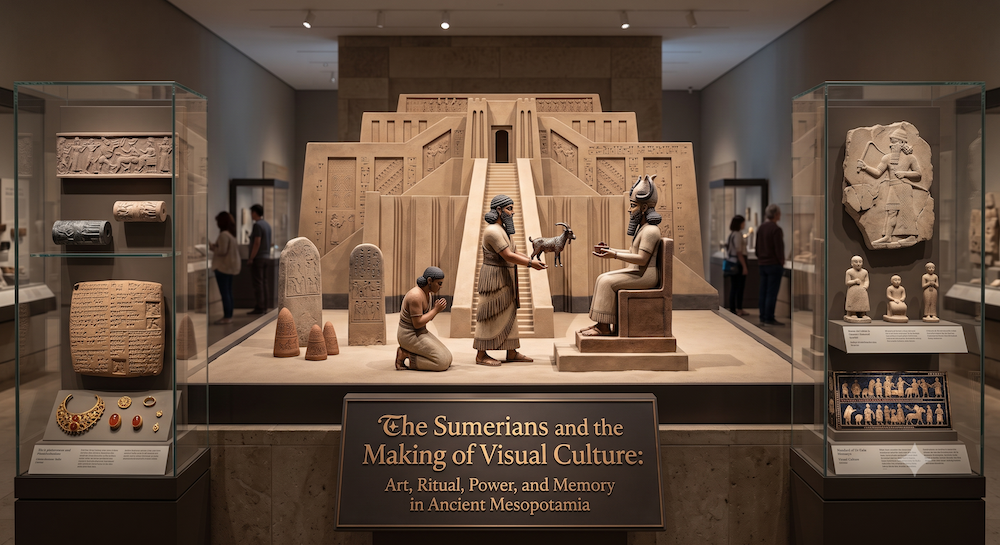
The Sumerians and the Making of Visual Culture: Art, Ritual, Power, and Memory in Ancient Mesopotamia
From the monumental temples of Uruk to the votive statues of the Early Dynastic period and the carefully inscribed images of Gudea, Sumerian art developed as a visual system through which ancient communities negotiated religion, authority, identity, exchange, and historical memory.
The artistic traditions associated with ancient Sumer emerged in southern Mesopotamia, in the territory of present-day Iraq. They developed across several historical phases, particularly the Late Uruk, Early Dynastic, and Neo-Sumerian periods. The objects now classified as Sumerian art were not produced within a single political state or according to one unchanging style. They belonged to different cities, workshops, institutions, rituals, and historical moments.
By approximately 3200 BCE, Uruk had become an exceptionally large urban center distinguished by monumental mud-brick architecture, clay-cone wall mosaics, sculpture, relief carving, metal casting, cylinder seals, and early administrative writing. The development of urban institutions encouraged new relationships among artistic production, temple administration, political authority, and economic organization.
Art within the first cities
Sumerian art cannot be understood merely as decoration. Much of it operated within temples, administrative systems, elite burials, public monuments, and ritual environments. Images helped establish relationships between humans and deities, identify individuals, commemorate transactions, represent military victories, preserve acts of devotion, and communicate the authority of rulers.
The rise of cities created a demand for visual forms capable of organizing increasingly complex social structures. Temple estates received, stored, and distributed agricultural products, while early tablets recorded commodities and labor. Sculpture, architecture, seals, and writing consequently developed within related systems of religious, administrative, and political power. The visual arts flourished in the service of temples and ruling institutions, while imported materials connected Mesopotamia to extensive exchange networks reaching beyond the alluvial plains.
This context is essential. A carved vessel, statue, seal, or inlaid object did more than represent an image. It could participate in worship, authenticate property, preserve a legal transaction, embody a donor, or establish a ruler’s place within divine and earthly hierarchies.
The Warka Vase and the organization of the world
One of the best-known works associated with Late Uruk is the Warka Vase, an alabaster vessel dating to approximately 3500–3000 BCE. It was discovered in the sacred precinct of Inanna at Uruk. Its carved registers move from water and vegetation to animals, human figures carrying agricultural goods, and an upper scene involving an elite male figure, a woman associated with Inanna, attendants, vessels, and offerings.
The arrangement produces a carefully ordered visual sequence connecting the natural environment, agricultural fertility, human labor, temple offerings, and divine authority. In the conventional interpretation, the upper register presents a ritual encounter involving the ruler or priestly leader and the goddess Inanna or her representative. The work therefore links political leadership with the maintenance of agricultural abundance and divine favor.
Nevertheless, the precise meaning of the vase remains debated. Daniel Hockmann has proposed that certain elements in the upper register may be related to semi-pictographic signs and archaic city symbols, suggesting that the scene could refer to an organized exchange of goods rather than exclusively to a sacred-marriage ceremony. This disagreement is significant because it demonstrates that Sumerian images cannot always be reduced to a single modern explanation. Ritual, administration, exchange, and political symbolism may have overlapped within the same object.
The Warka Vase also illustrates an important principle of Mesopotamian visual culture: hierarchy could be expressed through scale, placement, repetition, and ordered registers. The image does not reproduce a casual moment. It constructs a model of society in which plants, animals, laborers, offerings, rulers, and divinity occupy interdependent positions.
Monumental architecture and sacred space
Architecture was another central expression of Sumerian religious and political organization. Uruk’s monumental complexes were built primarily from mud brick and could be decorated with colored clay cones inserted into wall surfaces to create geometric patterns. These structures transformed the city into a ceremonial landscape dominated by sacred institutions.
In later periods, stepped temple platforms known as ziggurats became among the most imposing architectural forms in Mesopotamian cities. Leonard Woolley described the ziggurat of Ur as a massive staged structure composed of successively smaller levels, approached by stairs and originally supporting a shrine dedicated to the city’s patron deity. Although much of the upper construction has disappeared, the surviving mass demonstrates the importance of elevation, monumentality, and controlled access within Mesopotamian sacred architecture.
Such buildings should not be treated simply as ancient equivalents of modern museums or public gathering spaces. The temple was understood as the dwelling and estate of a deity. Architecture organized movement, visibility, offerings, administration, and the separation between ordinary urban space and sacred presence.
Votive statues and perpetual devotion
During the Early Dynastic period, statues of male and female worshippers were placed in temples. These figures frequently stand or sit with hands clasped, shoulders squared, and eyes enlarged. Their appearance is highly formalized, but their function was not merely commemorative portraiture.
According to the Metropolitan Museum of Art’s analysis of Early Dynastic sculpture, these statues embodied the worshipper so that the represented person could remain symbolically present before the deity even when physically absent. A standing male worshipper from Tell Asmar, for example, was placed in a temple to pray continuously on behalf of the individual it represented.
The wide eyes should therefore be interpreted within a devotional context rather than judged according to modern standards of naturalistic portraiture. The gaze suggests sustained attention toward the divine, while the clasped hands communicate reverence and controlled ritual behavior.
These statues also demonstrate that Sumerian representation was selective. Artists did not necessarily seek to reproduce the temporary appearance of a person. Instead, they created a durable body suited to a particular religious function. The image became an active substitute capable of maintaining a relationship between donor and deity.
Images, writing, and social authority
Sumerian visual culture developed in close association with writing. Images and inscriptions frequently appeared together on tablets, seals, statues, foundation deposits, and stone monuments.
The Stele of Ushumgal and Shara-igizi-Abzu, dated to approximately 2900–2700 BCE, combines figures with a Sumerian inscription concerning fields, houses, and livestock. Although the precise legal action remains uncertain because of the archaic writing, the object appears to record a property transaction and possibly its witnesses. It demonstrates that images could support the public or institutional documentation of ownership and exchange.
Writing did not make images obsolete. Instead, text and representation reinforced one another. A figure could identify a participant, while an inscription provided names, titles, dedications, property descriptions, prayers, or accounts of historical events. Together they created forms of authority more durable than spoken memory.
Cylinder seals: miniature images with institutional power
Cylinder seals were among the most widespread and sophisticated forms of Mesopotamian visual culture. These small carved cylinders were rolled across wet clay to produce continuous impressions. They could be used on tablets or on clay closures securing doors, jars, baskets, and other containers.
Their impressions functioned as marks of identity, ownership, or authorization. Because cylinder seals survive from many chronological periods and preserve imagery that has disappeared from larger monuments, they are also essential sources for the study of Mesopotamian style and iconography.
Early Dynastic seals frequently present complex combat scenes involving lions, bulls, heroes, human-animal beings, and interlocking figures. These compositions are often described as “contest scenes.” Their imagery may be associated with the management of dangerous natural forces, the defense of herds, heroic strength, and the restoration of order.
The cylinder seal united artistic invention with administrative function. Its owner carried a portable carved object whose impression could operate as both image and signature. In this sense, Sumerian visual culture was not limited to monumental works. It also entered everyday systems of bureaucracy, storage, exchange, and personal identification.
War, kingship, and historical narrative
Sumerian rulers also used monuments to preserve accounts of conflict and victory. The Stele of the Vultures, created for Eannatum of Lagash around 2450–2425 BCE, combines inscriptions with scenes of soldiers, defeated enemies, corpses, vultures, ritual offerings, divine figures, and the ruler leading his army.
The accompanying Sumerian text commemorates Eannatum’s victory over the neighboring city of Umma. The monument presents the battle simultaneously as a human political event and as part of a divinely sanctioned order. One side emphasizes military action and its aftermath; the other introduces mythological imagery in which defeated enemies are contained within a net associated with divine power.
Irene J. Winter treated the monument as a foundational work in the development of historical narrative in ancient Near Eastern art. Her research emphasizes that the stele does not merely illustrate a written report: its composition constructs a meaningful account of victory, leadership, divine support, and restored order.
Kazuya Maekawa’s study compares the military formation represented on the stele with textual evidence. He argues that the relief shows an organized group of spearmen and shield-bearers led by Eannatum, rather than an undifferentiated mass of troops. The research demonstrates how images can preserve information about institutions and practices while still operating as political representations.
The stele is therefore both historical evidence and ideological construction. It records a conflict, but it also controls how that conflict should be remembered.
The Royal Cemetery at Ur and the art of elite identity
The Royal Cemetery at Ur produced extraordinary examples of jewelry, vessels, musical instruments, sculpture, games, and inlaid objects. These works reveal the technical skill of Mesopotamian craftspeople and the importance of precious materials within elite funerary display.
Among the most famous objects is the so-called Standard of Ur, dated to approximately 2550–2400 BCE. Its original function remains uncertain; the British Museum cautiously classifies it as a possible box. Its surfaces are decorated with mosaics made from shell, red limestone, and lapis lazuli set into bitumen. One principal panel represents warfare, captured enemies, soldiers, and a dominant ruler. The other presents tribute, animals, attendants, music, and an elite banquet.
The work organizes society through horizontal registers and differences of scale. The largest figure occupies the highest level, while soldiers, laborers, animals, prisoners, musicians, and attendants appear according to their roles within the composition.
The Royal Cemetery’s jewelry also provides evidence about identity, privilege, gender, age, and ceremonial role. Amy Rebecca Gansell’s study of bodily adornment at Ur emphasizes that jewelry assemblages must be analyzed in relation to their archaeological placement and burial context rather than treated only as isolated luxury objects.
Gold, lapis lazuli, carnelian, silver, shell, and other materials also testify to long-distance networks. Mesopotamia lacked many of the raw materials used in its most prestigious works, making artistic production inseparable from trade, diplomacy, access to resources, and political control.
Gudea and the Neo-Sumerian image of rulership
Late third-millennium images of Gudea, ruler of Lagash, present a different model of authority from the military narratives of the Stele of the Vultures.
A diorite statue of Gudea dating to approximately 2090 BCE represents him with clasped hands and a solemn expression. The cuneiform inscription identifies him as a builder of the divine house and asks that his life be prolonged. The statue was probably installed in a temple to maintain his presence before the gods.
The material itself was significant. Diorite is extremely hard and was not locally abundant. Its durability supported an image of permanence, while the inscription connected Gudea’s authority with temple construction, piety, and service to the divine world.
These statues do not eliminate political power; they reformulate it. The ruler is represented not primarily at the moment of violent conquest but as a disciplined, devout builder whose legitimacy rests upon his relationship with the gods and his contribution to sacred architecture.
Art as action, not merely representation
A modern viewer may be tempted to separate Sumerian art into familiar categories—sculpture, architecture, jewelry, illustration, or design. Such divisions can be useful, but they risk obscuring the original functions of the objects.
A votive statue could perpetually worship. A cylinder seal could authorize a transaction. A stele could commemorate victory and define political memory. An inlaid object could establish elite hierarchy within a funerary environment. A temple platform could organize the relationship between city and deity. An inscribed statue could preserve a ruler’s prayer and presence.
Sumerian images were therefore not passive reflections of society. They participated in the construction of social and sacred reality. Their materials, locations, inscriptions, scale, repetition, and ritual use were fundamental to their meaning.
Conclusion
The importance of Sumerian art does not lie only in its antiquity. Its deeper significance emerges from the sophisticated ways in which images, objects, architecture, and writing were integrated into the life of the first cities.
Sumerian artists and craftspeople developed visual languages capable of organizing complex relationships: nature and agriculture, humanity and divinity, labor and wealth, ruler and subject, individual and institution, victory and memory, life and death.
Their work demonstrates that art was already serving many of the functions it would retain throughout history. It could legitimize power, communicate belief, preserve identity, organize collective memory, materialize social difference, and give visible form to ideas that could not be expressed through practical language alone.
Yet responsible interpretation requires caution. Some objects remain uncertain in function, and major works such as the Warka Vase continue to generate competing scholarly explanations. Rather than weakening the study of Sumerian art, these debates reveal its complexity.
Sumerian visual culture should therefore be approached not as a collection of primitive beginnings, but as a highly developed system in which aesthetic form, sacred presence, political authority, material value, and historical consciousness were inseparably connected.
Selected academic and museum references
- Aruz, Joan, and Ronald Wallenfels, eds. Art of the First Cities: The Third Millennium B.C. from the Mediterranean to the Indus. New York and New Haven: Metropolitan Museum of Art and Yale University Press, 2003.
- Gansell, Amy Rebecca. “Identity and Adornment in the Third-Millennium BC Mesopotamian ‘Royal Cemetery’ at Ur.” Cambridge Archaeological Journal.
- Hockmann, Daniel. “Die Warka-Vase—eine neue Interpretation.” Altorientalische Forschungen 35, no. 2 (2009): 326–336.
- Maekawa, Kazuya. “Battle Formation of the Sumerian Phalanx: The Stele of the Vultures and Textual Evidence.” Bulletin of the Society for Near Eastern Studies in Japan 46, no. 2 (2003): 28–51.
- Winter, Irene J. “After the Battle Is Over: The Stele of the Vultures and the Beginning of Historical Narrative in the Art of the Ancient Near East.” Studies in the History of Art 16 (1985): 11–32.
- Winter, Irene J. “Eannatum and the ‘King of Kiš’?: Another Look at the Stele of the Vultures and ‘Cartouches’ in Early Sumerian Art.” Zeitschrift für Assyriologie und vorderasiatische Archäologie 76, no. 2 (1986): 205–212.
- Woolley, C. Leonard. “The Ziggurat of Ur.” The Museum Journal (1924).