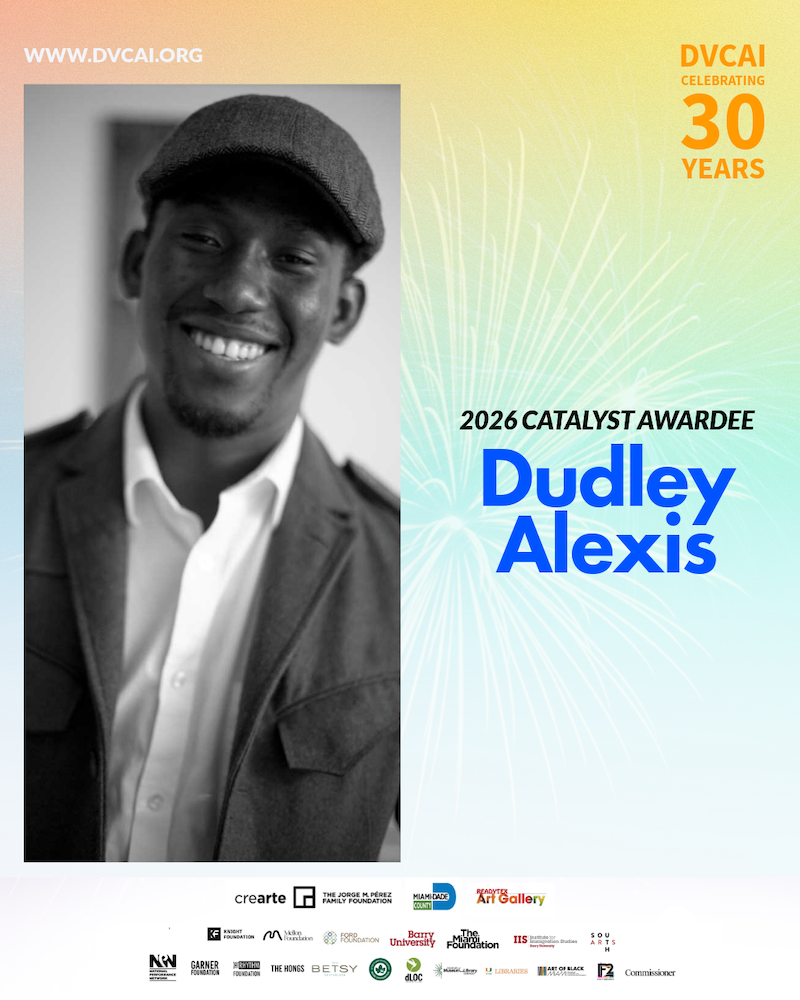
Dudley Alexis Named Recipient of the 2026 DVCAI Catalyst Award
The Haitian-born filmmaker, visual artist, cultural anthropologist, and historian is recognized for a multidisciplinary practice that brings overlooked histories and marginalized voices into public view.
MIAMI, FL — 2026 — Independent filmmaker and visual artist Dudley Alexis has been named a recipient of the 2026 DVCAI Catalyst Award, honoring a creative practice distinguished by cultural inquiry, historical research, social engagement, and a sustained commitment to illuminating stories too often excluded from mainstream narratives.
Working across documentary film, fine art, cultural anthropology, and historical investigation, Alexis approaches art as a form of testimony. His projects uncover the intimate details through which communities preserve identity, confront adversity, and assert their right to live with dignity and equality.
At the center of his practice is an uncommon ability to establish trust. The individuals who enter his films and artworks frequently share deeply personal experiences shaped by displacement, injustice, tragedy, perseverance, and triumph. Alexis does not treat these lives as subjects to be observed from a distance. Instead, he creates conditions in which people can speak with complexity, agency, and emotional truth.
The 2026 Catalyst Award recognizes this commitment to transforming personal memory into a wider cultural record.
Revealing the Histories Hidden in Plain Sight
Alexis sees the world through a distinctly multicultural lens informed by his experiences as an immigrant, artist, filmmaker, anthropologist, and historian. His mission is to recover the human meaning contained within stories that public institutions, dominant histories, and conventional media frequently overlook.
His work asks viewers to look beyond simplified representations of marginalized communities and encounter the individuals behind them: their aspirations, fears, losses, humor, intelligence, resilience, and capacity for reinvention.
Through this process, Alexis identifies what he describes as the hidden treasures within ordinary lives. These details become the foundation of a practice that is simultaneously artistic, historical, and socially conscious.
His films and visual works do not merely document hardship. They reveal the determination of individuals and communities to thrive in circumstances that repeatedly attempt to diminish their visibility or deny their equality.
From Haiti to Miami
Born in Haiti, Dudley Alexis immigrated to the United States during his teenage years. He attended high school and college in Miami, where he began studying fine art and developing the multidisciplinary perspective that would later define his career.
His Haitian heritage and Miami upbringing placed him at the intersection of several cultural histories: Caribbean identity, immigration, Black history, Indigenous narratives, urban transformation, and the political realities of the United States.
Rather than separating these experiences into distinct fields, Alexis allows them to inform one another. His work moves fluidly between moving image and visual art, between personal testimony and historical analysis, and between the local experiences of South Florida and broader global questions about race, power, memory, and belonging.
Documentary Film as Cultural Memory
Alexis has produced an extensive body of short documentary work, including stories concerning Florida’s Miccosukee community, created during his time working with Miccosukee Magazine. These early projects strengthened his ability to approach culturally specific histories with attentiveness, patience, and respect.
In 2016, he completed his first feature-length documentary, Liberty in a Soup, which he wrote, filmed, directed, and edited.
The film examines the cultural and historical significance of Soup Joumou, Haiti’s national dish. Once denied to enslaved Haitians under French colonial rule, the soup became a powerful symbol of liberation following the Haitian Revolution. Its preparation and consumption commemorate Haiti’s independence and the creation of the first independent Black republic in the Western Hemisphere.
Through the history of a dish, Liberty in a Soup reveals how food can preserve political memory, ancestral knowledge, collective pride, and national identity. Alexis transforms a familiar culinary tradition into an expansive meditation on freedom and the survival of culture.
Confronting the Arthur McDuffie Story
Following Liberty in a Soup, Alexis began developing work centered on the story of Arthur McDuffie, whose death after an encounter with Miami-Dade police officers became a defining moment in Miami’s history.
The case and the unrest that followed remain essential to understanding the city’s racial, political, and civic development. Alexis’s engagement with the subject reflects his continuing interest in histories of injustice whose consequences remain present long after the immediate event.
His approach brings together archival inquiry, testimony, artistic interpretation, and social analysis. By revisiting these histories, Alexis resists the cultural amnesia that can emerge when difficult events are reduced to headlines or omitted from official narratives.
A Practice Beyond the Moving Image
Although widely recognized for his documentary filmmaking, Alexis has continued to produce and exhibit fine art throughout his career.
His work was featured in Kingdom of This World, Reimagined, an exhibition curated by internationally recognized artist Édouard Duval-Carrié and presented during Miami Art Week in 2019. The exhibition placed Alexis’s practice within a broader conversation about Haiti, Caribbean history, colonial memory, mythology, identity, and contemporary visual culture.
His participation demonstrated the continuity between his filmmaking and visual art. Across both forms, Alexis investigates how history is represented, who is permitted to speak, and how art can restore complexity to people and communities frequently described from the outside.
A Contemporary Renaissance Figure
Dudley Alexis may be understood as a contemporary Renaissance figure: an artist whose intellectual and creative curiosity refuses the limitations of a single discipline.
He is a filmmaker, editor, director, visual artist, researcher, historian, and cultural observer. His willingness to move between mediums is not motivated by novelty, but by necessity. Each story demands its own form, rhythm, and method of communication.
This versatility is supported by focused perseverance, self-discipline, and a sustained desire to learn. Alexis continues to expand his command of multiple media while maintaining a clear ethical foundation: art should increase public awareness, confront injustice, preserve memory, and contribute to greater social parity.
His work demonstrates that aesthetic achievement and civic responsibility need not exist in opposition. Art can be visually compelling while remaining historically rigorous, emotionally honest, and socially engaged.
The Significance of the Catalyst Award
The 2026 DVCAI Catalyst Award recognizes not only Alexis’s past accomplishments but also the continuing potential of his work to generate dialogue and cultural change.
The term “catalyst” is particularly appropriate. Alexis’s practice creates movement: between silence and testimony, invisibility and recognition, historical trauma and public understanding. His work invites audiences to reconsider stories they may believe they already know and to encounter lives that have too often been treated as peripheral.
By honoring Dudley Alexis, the award also affirms the importance of independent artists and filmmakers who preserve community memory outside traditional institutional structures.
His practice reminds us that some of the most urgent cultural histories do not arrive fully documented. They must be recovered through trust, careful listening, sustained research, and the courage to look where others have chosen not to see.
Celebrating a Powerful and Necessary Voice
The recognition of Dudley Alexis as a 2026 DVCAI Catalyst Award recipient celebrates an artist committed to revealing the dignity, complexity, and resilience of people living at the margins of dominant narratives.
His work brings Haitian history, Miami’s racial and cultural memory, Indigenous stories, immigrant experiences, and global questions of equality into meaningful conversation.
Through film and visual art, Alexis continues to demonstrate that hidden histories are not minor histories. They are essential to understanding who we are.
The 2026 Catalyst Award honors an artist who does more than represent communities. He listens to them, earns their confidence, preserves their voices, and transforms their experiences into a cultural record capable of educating and moving future generations.
Congratulations to Dudley Alexis, recipient of the 2026 DVCAI Catalyst Award.