Public Art Under Asphalt: Florida’s Battle Over Memory, Beauty, and Civic Expression
The destruction of Robin Haines Merrill’s Aquifer Intersections raises urgent questions about government authority, artists’ rights, public safety, and who controls the visual identity of Florida’s cities.
Original reporting credit: WGCU | Bob Norman / Florida Trident.
This independently written arts and cultural analysis is based on Bob Norman’s reporting for the Florida Trident, published by WGCU on July 24, 2026, and is supplemented by official transportation policy, federal law, and public-art safety research.
In Fort Lauderdale, a work of public art disappeared beneath a layer of black asphalt.
The destruction was physically simple: machinery, pavement material, labor, darkness. Culturally, however, the act was far more consequential. What vanished was not merely pigment applied to a roadway. It was a decade-old civic artwork created through the participation of a neighborhood, commissioned by a city, associated with pedestrian safety, and embedded within the visual identity of North Beach Village.
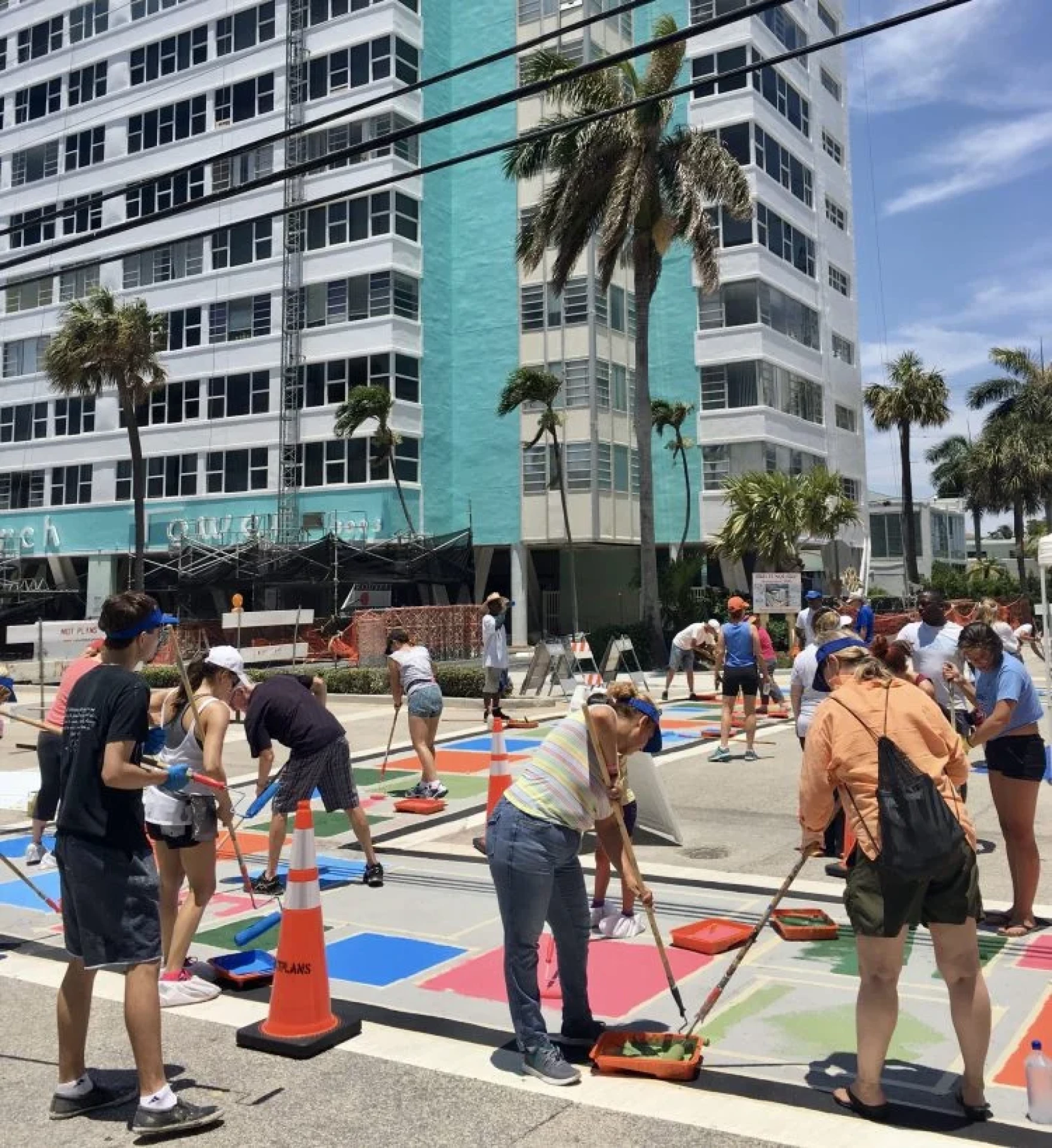
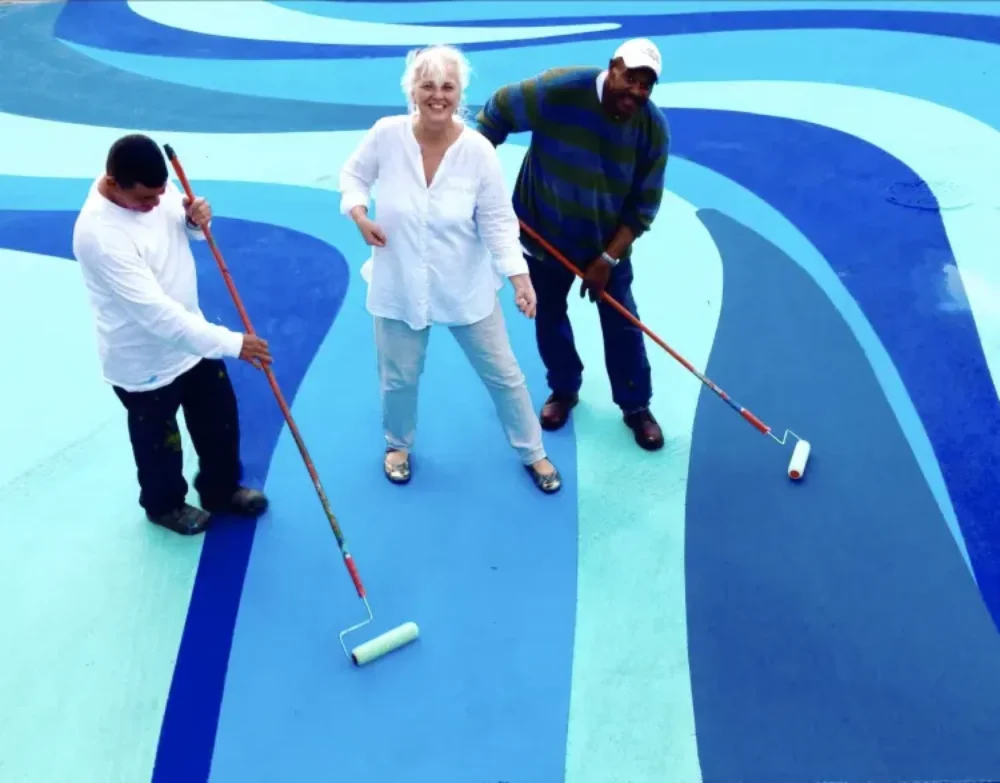
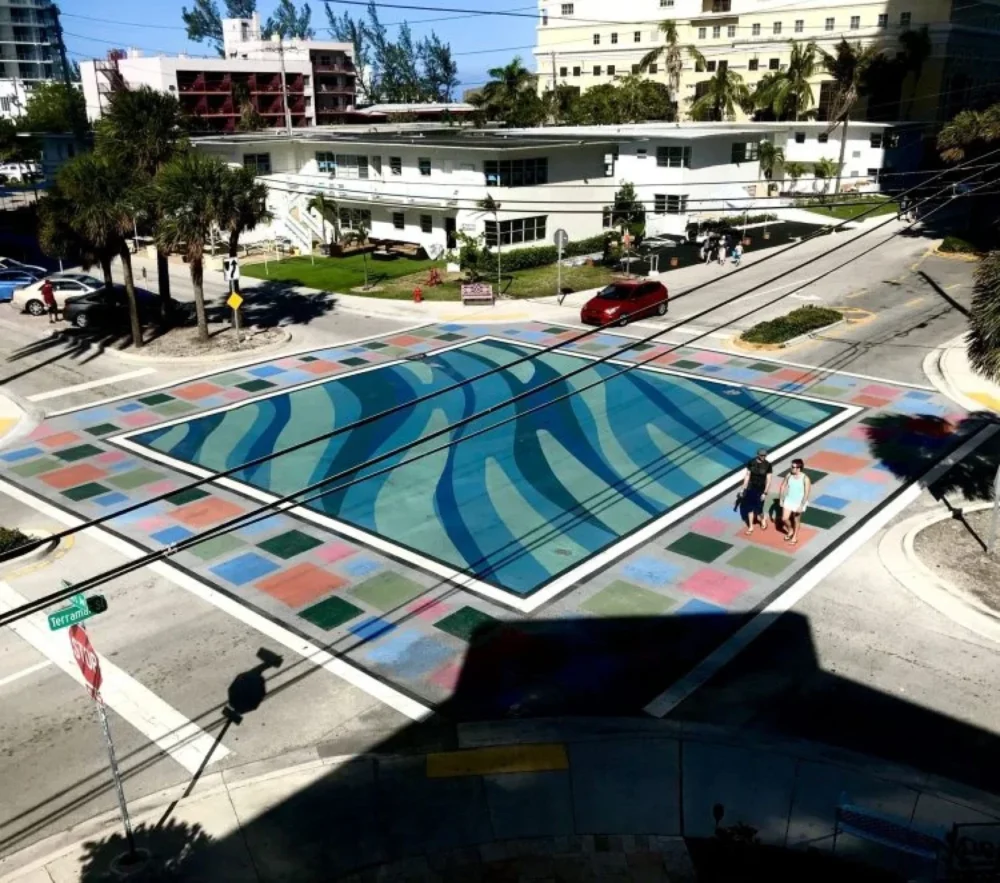
Local artist Robin Haines Merrill designed Aquifer Intersections, a pair of bright-blue roadway paintings installed along Breakers Avenue in 2016. More than 100 neighbors reportedly participated in painting the project, turning ordinary intersections into a collective expression of water, movement, interconnection, and place. The work was originally endorsed for its traffic-calming potential and became closely associated with the area’s mid-century modern architecture and community identity.
Ten years later, crews covered it with asphalt.
For Merrill, the action was not routine maintenance. It was an act of destruction. In the words that gave Bob Norman’s original report its unforgettable title, the artist declared: “My art was murdered by DeSantis.”
Her accusation is political and personal, and it should be understood as the artist’s characterization rather than a judicial finding. Yet the force of the statement reveals something fundamental about public art: when the state destroys an artwork, it does not eliminate only a physical object. It may also erase authorship, community participation, memory, identity, and the public’s right to experience the place it helped create.
Special to the Trident
A community artwork, not decorative pavement
Aquifer Intersections was never simply an ornamental pattern. Its blue wave-like forms referred to the “connecting power of water,” linking the work conceptually to Florida’s ecology and to the relationships among residents who participated in its creation.
Public art often derives its importance from this relationship between artistic authorship and collective experience. A painting in a private collection can be moved from one room to another without radically changing the meaning of a city. A work integrated into a street, plaza, school, park, or neighborhood becomes part of the place itself.
The community does not merely look at such work. It lives around it. Residents use it to give directions, identify their neighborhood, take photographs, welcome visitors, remember events, and distinguish one urban environment from another.
This is why the destruction of public art frequently produces grief disproportionate to the monetary value of the paint or materials. The loss is symbolic. It alters the emotional and visual geography of the community.
In the case of Aquifer Intersections, that loss is especially striking because neighbors participated directly in its realization. The project operated simultaneously as artwork, civic ritual, urban design, and community-building exercise. Its destruction therefore eliminated not only Merrill’s composition but also the visible record of a shared public action.
Florida’s new doctrine of visual uniformity
The removal occurred within a broader statewide campaign against roadway and surface art.
A Florida Department of Transportation memorandum dated June 30, 2025, states that pavement or surface art is prohibited on travel lanes, paved shoulders, intersections, crosswalks, and sidewalks when it does not directly serve traffic control or public safety. The document identifies noncompliant markings as those that depart from approved colors, shapes, and dimensions, including art associated with social, political, or ideological messages. It also states that FDOT may direct removal and withhold state funds from public agencies found out of compliance.
FDOT presents the policy as a question of clarity, consistency, traffic safety, and the standardized operation of transportation systems. From this perspective, streets are functional systems whose visual language must remain predictable.
But cities are not engineering diagrams.
They are cultural environments inhabited by human beings. Streets carry traffic, but they also carry history, protest, celebration, grief, identity, commerce, ritual, and memory. The attempt to remove all forms of visual difference from public pavement may produce technical uniformity, but it can also impoverish the civic realm.
The language of the state memorandum is particularly significant because it does not limit the prohibition to designs proven dangerous through site-specific evidence. It establishes a categorical restriction against pavement and surface art across numerous public areas.
That distinction matters. A government may legitimately regulate a marking that demonstrably confuses motorists or conceals essential traffic information. But a universal prohibition treats all surface artworks as equivalent, regardless of their design, location, history, community function, or documented safety record.
Robin Haines Merrill/The Florida Trident
The unresolved conflict over safety
The official justification for removing roadway art rests heavily on safety and standardization. Yet the evidence surrounding asphalt art is more complicated than the policy suggests.
A 2022 safety study prepared for Bloomberg Philanthropies examined crash histories at 17 asphalt-art locations and observed driver and pedestrian behavior at five additional sites. Across the locations studied, researchers reported a 50 percent decrease in crashes involving pedestrians or other vulnerable road users, a 37 percent reduction in injury-producing crashes, and a 17 percent decrease in the overall crash rate. The observational portion also found improvements in driver yielding and reductions in pedestrian-driver conflicts.
These findings do not prove that every roadway mural is safe in every environment. Designs differ, intersections differ, and transportation decisions should be informed by site-specific evaluation. But the study directly challenges the assumption that asphalt art is inherently incompatible with safety.
Indeed, Aquifer Intersections was initially celebrated as a traffic-calming project. According to the original WGCU and Florida Trident report, the artwork was associated with fewer reported crashes and had previously received government support for its safety-related effects.
The resulting contradiction is difficult to ignore: a public artwork once embraced as a means of making an intersection safer was later eliminated under a policy justified in the name of safety.
When governmental standards reverse so dramatically, the public deserves transparent evidence explaining what changed. Was the work reevaluated through a new traffic study? Was a specific danger identified? Were less destructive alternatives considered? Or was the project removed because it belonged to a newly prohibited category?
Without clear answers, safety risks becoming not an empirical conclusion but a rhetorical shield.
From Pride imagery to a broader cultural purge
The political controversy intensified because Florida’s pavement-art crackdown became publicly associated with the elimination of LGBTQ+ symbols, including the rainbow memorial crosswalk outside Orlando’s Pulse nightclub and Pride-related street imagery in several cities. State officials have argued that roads should not carry political or ideological messaging, while critics contend that the policy selectively suppresses visible representations of marginalized communities.
Fort Lauderdale initially challenged the state’s authority to remove its roadway art, arguing in part that the streets were locally owned and that the state was interfering with municipal home rule. The city later reached a settlement and created a nearby rainbow-colored installation on private land known as the Circle of Love.
Yet Merrill’s experience reveals that the policy extends beyond explicitly political or LGBTQ+ imagery.
Her blue composition was centered on water, ecology, community, and connectivity. Its removal demonstrates how a rule introduced amid culture-war controversy can expand into a much broader elimination of public visual expression.
When governments erase everything in order to avoid defending anything, neutrality becomes indistinguishable from cultural emptiness.
The state may claim that a universal prohibition is fair because it treats every artwork equally. But equal destruction is not necessarily cultural fairness. Eliminating a Pride flag, an environmental artwork, a historical tribute, and a community mural under the same policy does not resolve political conflict. It removes the public forum in which communities make themselves visible.
Does the artist have legal protection?
Merrill has raised concerns under the Visual Artists Rights Act of 1990, commonly known as VARA. The federal law grants qualifying visual artists certain moral rights, including limited protection against intentional distortion, mutilation, modification, or destruction of a work of recognized stature.
The legal question, however, is more complex than simply determining whether the artist received 90 days’ notice.
The specific 90-day provision commonly discussed in relation to VARA appears in Section 113 of the Copyright Act and concerns certain artworks incorporated into buildings that can be removed without being destroyed, distorted, mutilated, or otherwise modified. Under those circumstances, written notice can give the artist an opportunity to remove the work or pay for its removal.
Whether a roadway painting qualifies under these provisions is not automatically established. A court may need to consider several questions: Does the work meet the statutory definition of a protected work of visual art? Does it possess recognized stature? Was it created under an agreement containing a waiver? How should a street or intersection be classified? Who legally authorized and carried out the destruction? Who owned the physical site? And which governmental entity had control at the moment of removal?
The answers are not self-evident.
Merrill reportedly maintains that she was excluded from the negotiations and received no formal opportunity to document, relocate, or respond before the artwork was covered. Fort Lauderdale Mayor Dean Trantalis, meanwhile, told the Florida Trident that FDOT—not the city—was responsible for obliterating the design.
These competing positions reveal one of the central dangers facing public artists: government agencies may commission and celebrate an artwork when it is politically convenient, then disavow responsibility when another authority orders its destruction.
The artist is left between institutions, while the artwork disappears.
Public commissioning creates ethical obligations
Even when legal liability remains unsettled, the ethical obligation is clear.
A government that commissions an artist should not treat that artist as a disposable contractor once the work is installed. Public art requires communication, documentation, stewardship, conservation planning, and clearly defined procedures for alteration or removal.
At minimum, the artist should be informed.
The community should also be consulted, particularly when residents participated in creating the work. Public property belongs to the public, but public ownership should not be interpreted as unlimited administrative permission to erase cultural assets without dialogue.
A responsible process might include:
- A condition assessment.
- A site-specific safety evaluation.
- Consultation with the artist.
- Public notice and community discussion.
- Professional photographic documentation.
- Consideration of conservation or relocation.
- A written explanation of the decision.
- Fair compensation when contractual or legal rights are affected.
What reportedly occurred at Breakers Avenue appears to have been the opposite: the work was covered during the night, and residents discovered the loss afterward.
That process communicates its own message. It suggests that public participation was welcomed when the artwork was created but considered irrelevant when the state decided to destroy it.
Art, authority, and the right to the city
The controversy surrounding Aquifer Intersections is not solely about one artist, one governor, or one neighborhood. It concerns the larger struggle over who has the authority to define public space.
Is a street only a transportation corridor? Or can it also be a cultural surface?
Do residents have a meaningful role in shaping the visual identity of their communities? Or can that identity be erased by distant administrative decree?
When a city commissions an artwork, does it acquire only a painted object, or does it accept a long-term responsibility toward the artist and the public?
These questions will become increasingly important as governments incorporate murals, projection works, digital installations, temporary monuments, and participatory projects into public infrastructure. Artists must demand contracts that address ownership, maintenance, modification, documentation, removal, insurance, moral rights, and notice.
Municipalities must also recognize that public art cannot be defended only when it supports the political message of the moment. Artists’ rights must apply consistently—whether the work celebrates LGBTQ+ identity, environmental interdependence, local history, racial justice, veterans, religious belief, or civic pride.
The color of erasure
Black asphalt may appear neutral, but in this context it carries meaning.
It covers the blue waves created by an artist and more than 100 residents. It conceals a decade of neighborhood memory. It replaces a site-specific composition with administrative uniformity. And it turns the absence of art into the most visible image at the intersection.
The destruction of Aquifer Intersections may ultimately be judged in court. Its political meaning will continue to be debated. But from the perspective of art history and civic culture, one conclusion is already evident:
Public art is not an expendable accessory placed on top of the city. It is one of the ways a city understands itself.
When authorities erase that art without meaningful consultation, they do not merely restore pavement. They alter the cultural record. They reduce the public’s role in creating place. And they remind artists that government patronage, without legal protection and institutional accountability, can quickly become government control.
The asphalt may have covered Merrill’s composition, but it has not silenced the questions the artwork now raises.
In destruction, Aquifer Intersections has acquired another meaning: it has become a symbol of the struggle between artistic freedom and administrative power, between community memory and political authority, and between the city as a regulated surface and the city as a living work of art.
Source