
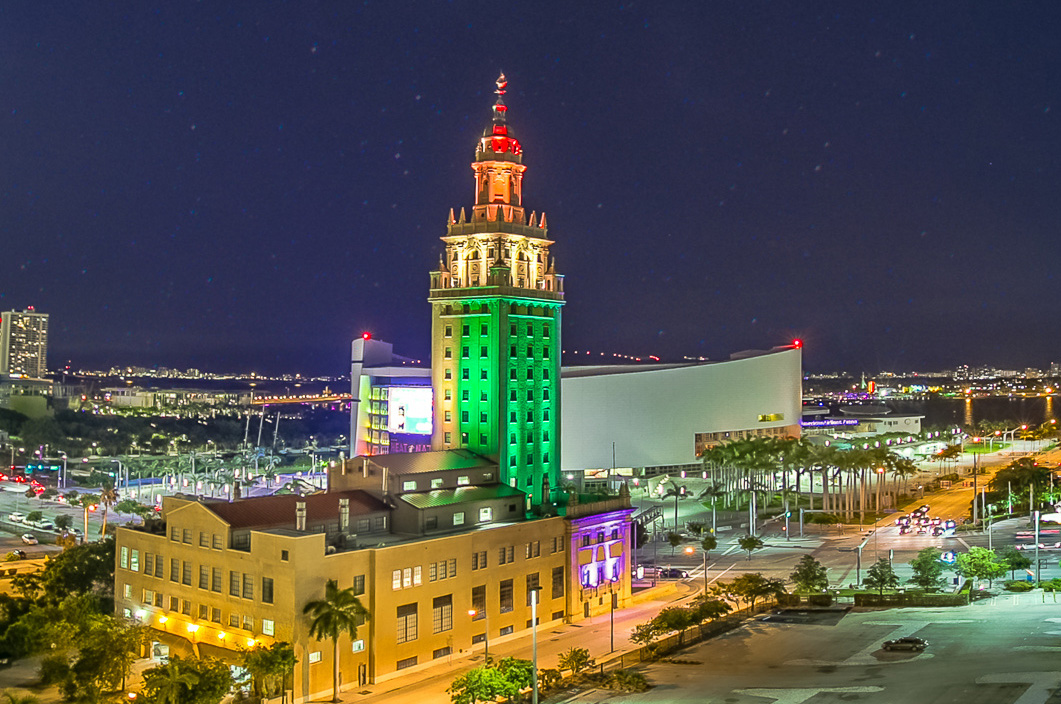
The Freedom Tower at 100: Miami’s Monument to Memory, Migration, and Reinvention
Opened on July 26, 1925, the Freedom Tower celebrated its centennial in 2025. Few buildings in Miami have carried so many identities, witnessed so many transformations, or accumulated such emotional significance. Rising above Biscayne Boulevard with its Mediterranean Revival silhouette, the tower is more than an architectural landmark. It is a civic emblem, a repository of collective memory, and one of the clearest physical expressions of Miami’s evolution from an ambitious young city into an international center shaped by migration, culture, and reinvention.
In a city famous for perpetual change, the Freedom Tower possesses the rare authority of permanence. Miami continually reconstructs itself through new towers, shifting populations, speculative development, and expanding cultural ambitions. Against that accelerated rhythm, the Freedom Tower remains a historic anchor. Its survival allows the city to see itself across time.
A Monument to Miami’s Early Ambition
The building was completed in 1925 as the headquarters of The Miami News, during one of the most dramatic periods of urban growth in South Florida. At the time, Miami was presenting itself to the world as a modern metropolis emerging from the tropical landscape. The tower’s verticality, ornamentation, and commanding presence reflected the confidence of that moment.
Its architecture transformed the newspaper headquarters into a civic image. The structure did not merely accommodate offices and printing operations; it communicated power, progress, and metropolitan aspiration. As one of Miami’s earliest skyscrapers, it announced that the city intended to become an important cultural and commercial center.
The relationship between architecture and journalism was especially meaningful. Newspapers were among the principal institutions through which cities imagined and narrated themselves during the early 20th century. From this building, The Miami News chronicled the expansion, crises, personalities, and ambitions of a rapidly developing city.
The Freedom Tower was therefore connected to Miami’s identity from its beginning. It served as both an architectural landmark and a place where the city’s public narrative was produced.
From Newspaper Tower to Refuge
Its most emotionally powerful chapter began in 1962, when the building became the Cuban Refugee Center. Until 1974, it served as a place of assistance for Cubans arriving in the United States after fleeing political upheaval and repression.
Within its walls, refugees received essential support as they began rebuilding their lives. The building became associated with arrival, uncertainty, separation, survival, and hope. For many families, it represented one of their first institutional encounters with the United States.
This period transformed the meaning of the tower. A building originally created to report the history of Miami became a place where that history was actively remade.
The Cuban refugees who passed through the center would become educators, business owners, professionals, artists, political leaders, and cultural figures. Their influence permanently altered Miami’s language, economy, food, music, politics, and cultural imagination. The city that emerged in the following decades could not be understood without the contributions of those exile communities.
For this reason, the Freedom Tower is often compared symbolically to the Statue of Liberty. Both monuments are associated with arrival and the search for freedom. Yet the Freedom Tower carries a distinctly Miami narrative: one shaped by the Caribbean, Latin America, exile, adaptation, and the continuous negotiation of identity.
Architecture as a Vessel of Memory
Buildings acquire meaning not only through design but through the lives that unfold inside them. The Freedom Tower demonstrates how architecture can become a container for personal and collective memory.
To one generation, it represented journalism and urban modernity. To another, it signified refuge and the beginning of a new life. To later generations, it became a monument to Cuban American history and to the larger immigrant experience that continues to shape Miami.
This layering of meanings gives the tower its exceptional cultural depth. Its historical importance does not belong exclusively to one community or period. Rather, it emerges from the relationship among multiple histories: the development of Miami, the power of the press, political exile, migration, cultural resilience, and the transformation of memory into civic identity.
The building also demonstrates that preservation is never purely about architecture. To preserve a landmark is to preserve the ability of a community to encounter its own history materially. The tower’s walls, windows, stairways, and galleries create a physical connection between the present and the events that shaped the city.
Rescue, Stewardship, and Renewal
After years of deterioration and uncertainty, Cuban American civic leaders and preservation advocates helped rescue the Freedom Tower from decline. Their efforts reflected a recognition that the building was too historically and symbolically important to disappear.
The tower was donated to Miami Dade College in 2005, placing its future in the care of one of the city’s most significant public educational institutions. This transfer represented more than a change in ownership. It established a new civic purpose for the landmark.
In 2008, the Freedom Tower was designated a National Historic Landmark, confirming its significance within the broader history of the United States. Its story—although deeply rooted in Miami—belongs to the national histories of immigration, freedom, journalism, and cultural transformation.
Under Miami Dade College, the tower developed into a center for education, exhibitions, public dialogue, and cultural programming. It has been associated with institutions and initiatives including the Miami Book Fair, the Miami Film Festival, Live Arts Miami, and the Museum of Art and Design.
Through these programs, the building has continued to serve as a meeting place for ideas. Its historical identity has not been frozen. Instead, it has been activated through contemporary culture.
The Centennial Restoration
The restoration of the Freedom Tower became a major institutional priority under Miami Dade College President Madeline Pumariega. Supported by the MDC Board of Trustees, public agencies, cultural organizations, preservation advocates, and philanthropic partners, the project sought to protect the historic structure while preparing it for a new century of public service.
The Florida Governor’s Office provided $25 million in support for the capital project. Additional recognition and funding came from organizations including the Florida Department of State, the National Endowment for the Humanities, the Institute of Museum and Library Services, and historic-preservation institutions.
The restoration was not simply an effort to recover the visual appearance of the building. It was also an investment in interpretation, education, and public access. Reimagined museum galleries now present the tower’s many histories through exhibitions designed to engage new generations.
Reopened in connection with its centennial celebration, the renewed Freedom Tower offers visitors an opportunity to explore the building’s evolution from newspaper headquarters to refugee center, cultural institution, and national landmark.
The galleries position history not as a distant sequence of events but as a living inheritance. Visitors encounter stories of displacement and belonging, ambition and survival, political conflict and civic renewal. They are also invited to consider their own relationship to Miami and to the broader human desire for freedom, security, and opportunity.
A Cultural Crossroads
Today, the Freedom Tower stands at the intersection of history and contemporary culture. It is simultaneously a museum, monument, educational environment, architectural treasure, and gathering place.
Its importance extends beyond nostalgia. The tower remains relevant because the questions embedded in its history are still urgent. What does freedom mean to those forced to leave their homeland? How does a city absorb and transform through migration? Who preserves public memory? How can cultural institutions honor the past without reducing it to a static narrative?
These questions resonate far beyond Miami.
The Freedom Tower’s renewed galleries allow the building to function as a place of reflection rather than merely commemoration. Its story encourages visitors to examine the relationship between political events and private lives, between architecture and identity, and between the preservation of history and the creation of a more inclusive future.
The Story of the Tower Is the Story of Miami
The Freedom Tower embodies Miami’s most defining contradictions. It is historic yet continually reinvented. It is rooted in one location yet shaped by international movements of people and ideas. It speaks to loss, but also to possibility. It commemorates exile while celebrating the cultural vitality produced by immigrant communities.
Its centennial offered Miami an opportunity to recognize that the city’s identity was not formed through a single narrative. It emerged through overlapping histories—Indigenous, American, Caribbean, Latin American, European, and global. The Freedom Tower stands prominently within that complex geography of memory.
At 100 years old, the building has outlived many of the structures, institutions, and political moments that surrounded its creation. Yet its meaning has continued to expand.
It began as a monument to modern communication. It became a sanctuary for people rebuilding their lives. It survived neglect through the determination of a community that understood the value of memory. It now enters its second century as a cultural institution dedicated to education, dialogue, and public history.
The Freedom Tower does not simply preserve the past. It reveals how the past continues to shape the present.
In its illuminated cupola, restored galleries, and enduring presence above downtown Miami, the tower remains a beacon—not only of freedom, but of the courage required to begin again.