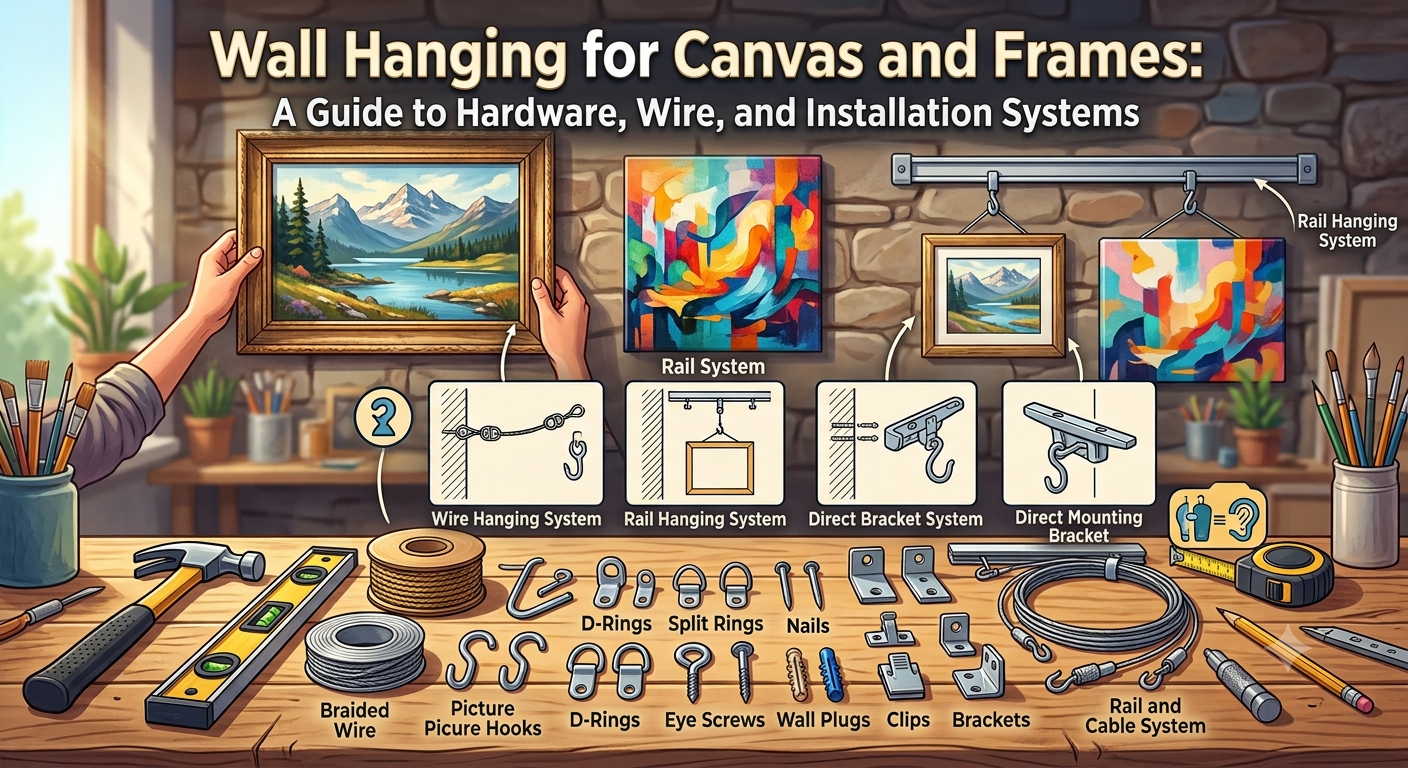
Wall Hanging for Canvas and Frames: A Guide to Hardware, Wire, and Installation Systems
Properly hanging a work of art requires much more than placing a nail in the wall. Both stretched canvas and framed artwork need an installation system that is compatible with the work’s weight, dimensions, structure, and exhibition location. Choosing the right wire, hooks, rings, and frame-back hardware protects the artwork, prevents falls, and helps it remain level.
From a professional exhibition to residential décor, wall-hanging accessories perform an essential function: they safely connect the artwork to the wall without interfering with its visual presentation.
What Does Wall Hanging Mean?
The term wall hanging refers to the materials and methods used to install objects on a wall. In the visual arts, it may include systems for hanging:
- Stretched canvas
- Framed paintings
- Photographs
- Works on panel
- Textiles
- Mirrors
- Reliefs
- Mixed-media works
- Small wall-mounted sculptures
A properly selected system should hold the artwork securely, distribute its weight correctly, and allow it to be removed without causing unnecessary damage.
Installation is also part of the aesthetic experience. A work that is crooked, tilted too far forward, or unevenly separated from the wall can affect how viewers perceive the composition.
Picture-Hanging Wire
Picture-hanging wire is one of the most common materials used to install canvases and frames. It is attached to the back of the artwork and typically connected to two side rings or mounting points.
Although it may appear to be a simple material, picture wire is available in several types, each with a specific weight capacity.
Types of Wire
The most common options include:
Braided Wire
Braided wire is made from multiple metal strands woven together. It is flexible, easy to handle, and suitable for lightweight or moderately heavy artworks.
Coated Wire
Coated wire has a protective plastic or vinyl layer. This coating makes it easier to handle and reduces direct contact between the metal and the frame.
Stainless-Steel Wire
Stainless-steel wire offers greater resistance to corrosion and may be appropriate for humid environments. It is often used in professional or long-term installations.
Steel Cable
Steel cable is designed for heavier works. It should be used only with rings, screws, and wall supports capable of carrying a similar load.
Wire should never be selected only for its appearance. Its rated strength should safely exceed the total weight of the artwork.
Wire Is Not Used Only for Framing
Metal wire is also used in many creative and educational processes, including:
- Jewelry making
- Sculpture
- Model building
- School projects
- Installations
- Papier-mâché structures
- Assemblage
- Crafts
- Mixed-media projects
However, wire intended for jewelry or crafts is not necessarily suitable for supporting framed artwork. Each product should be used according to its strength, diameter, and intended purpose.
Frame-Back Hardware
Frame-back hardware refers to the components installed behind a canvas or frame. Although they remain hidden during display, these elements are essential to the artwork’s safety.
The most common types include the following.
D-Rings
D-rings are attached to the rear sides of the frame with screws. They may be used with picture wire or placed directly onto two wall hooks.
When used without wire, they provide greater stability and reduce the likelihood that the artwork will tilt.
Screw Eyes
Screw eyes are small metal fasteners with a circular opening. They are screwed into wood and used as attachment points for wire.
They are most suitable for small, lightweight frames. On heavier works, they may place too much stress on a limited area of the wood.
Sawtooth Hangers
Sawtooth hangers are attached near the upper center of the back of a frame. They are convenient for photographs, prints, and small pieces.
They are generally not the best choice for large, heavy, or valuable works because they concentrate the load at a single point.
Strap Hangers
Strap hangers are elongated metal supports attached with multiple screws. They distribute the load more effectively and are appropriate for medium-sized or heavy frames.
French Cleats
A French cleat system consists of two interlocking pieces: one is attached to the wall and the other to the back of the artwork. When joined, they distribute the weight horizontally.
This system is especially useful for:
- Heavy artworks
- Panels
- Mirrors
- Reliefs
- Large frames
- Installations that must remain close to the wall
Corner Braces and Reinforcement Plates
Corner braces help maintain the structural stability of a frame. They do not replace the hanging system, but they can prevent joints from weakening or becoming distorted.
How to Choose the Right Hanging System
Several factors should be evaluated before installing an artwork.
Total Weight
The weight of every component must be considered, including:
- Canvas
- Stretcher bars
- Frame
- Glass or acrylic glazing
- Mat board
- Backing panel
- Added materials
- Hardware
A seemingly small artwork can become considerably heavier when it includes glass, solid wood, or mixed-media materials.
Dimensions
Wide artworks require proper weight distribution to prevent tilting. In these cases, two support points usually provide greater stability than a single one.
Frame Material
Not every frame can accept the same type of screw. Solid wood may support certain fasteners, while a narrow profile, fragile molding, or metal frame may require specialized hardware.
Screws should never pass through the front of the frame or be installed too close to its edges.
Type of Wall
The installation system must be compatible with the wall surface, such as:
- Drywall
- Wood
- Concrete
- Brick
- Plaster
- Decorative wall panels
A hook intended for drywall may not work correctly in concrete. Some surfaces require specific anchors, screws, drill bits, or installation tools.
Duration of the Exhibition
A temporary installation may require a different method from an artwork that will remain on display for several years.
Museums and galleries also consider how easily a work can be removed, adjusted, and repositioned while minimizing damage to the wall.
How to Install Picture Wire Correctly
Picture wire should be attached between two secure points located on the rear sides of the frame. These points should be positioned at the same height and sufficiently below the upper edge.
The wire should not be completely tight. It needs a slight curve so it can be placed over the wall hook. However, it should not be so loose that it extends above the frame when the artwork is hanging.
The ends should be wrapped securely around the main wire to prevent slipping. Any exposed metal ends should be covered or trimmed so they do not scratch the wall, damage the artwork, or injure the person handling it.
Installing an Unframed Canvas
A stretched canvas may be installed directly from its wooden stretcher frame. Suitable options include:
- D-rings and picture wire
- Two D-rings without wire
- French cleats
- Specialized canvas hangers
- Security hardware used in galleries
Screws should not be placed in weak sections of the stretcher bars, and the canvas fabric should never be punctured. The hanging system must be attached only to the rear structure.
When a canvas is deep, heavy, or includes attached materials, it should be treated as a three-dimensional artwork rather than as a conventional lightweight painting.
Textile and Mixed-Media Artworks
Textiles, assemblages, and irregularly shaped works require special evaluation. A fiber artwork may appear lightweight, but its materials can place uneven stress on specific areas.
Depending on its construction, it may require:
- A concealed rod
- A continuous support
- Multiple suspension points
- Conservation-grade hook-and-loop fastener
- A cleat system
- A secondary support structure
- Reinforced rings
The system should not distort the material or transfer the entire weight to a single seam or attachment point.
Common Installation Mistakes
One of the most common mistakes is selecting hardware based only on the visible size of the artwork. Its actual weight and load distribution are more important.
The following practices should also be avoided:
- Using craft wire for a heavy artwork
- Installing screws that are too short
- Placing hardware too close to the frame’s edge
- Relying on one support point for a very wide artwork
- Failing to verify the weight capacity of the wall hook
- Hanging a work on drywall without the appropriate anchor
- Reusing damaged, bent, or corroded wire
- Carrying an artwork by its hanging wire
- Installing a heavy frame with a small sawtooth hanger
- Using household adhesives on valuable artwork
Safety in Galleries, Museums, and Public Spaces
In a professional exhibition, the installation system must consider not only the artwork’s weight but also the movement of people around it.
The work may require:
- Anti-theft hardware
- Locking systems
- Seismic restraints
- Rear spacers
- Safety anchors
- Barriers or signage
- Review by professional art handlers
The artist should provide the museum or gallery with the artwork’s weight, dimensions, and installation instructions. When the work contains multiple components, every element should be clearly identified.
Basic Installation Tools
A basic installation kit may include a tape measure, level, pencil, drill, screwdriver, stud finder, screws, wall anchors, and art-handling gloves.
Before drilling, verify the artwork’s exact position, exhibition height, and the possible presence of electrical wiring or plumbing inside the wall.
Heavy, fragile, or large-format works should be installed by qualified professionals.
Conclusion
Hanging a canvas or frame may seem simple, but it requires the correct combination of materials, measurements, and technical knowledge. Wire, rings, frame-back hardware, wall hooks, and anchors must function together as a complete system.
Good hanging hardware remains discreet, yet it supports everything the viewer sees. Whether an artwork is presented in a gallery or displayed as part of the décor that transforms an empty house into a home, a secure installation allows art to occupy its place with stability, confidence, and presence.