Fake AI, Real Sugar: Inside Samantha Salzinger’s Handmade Hyperreality
By Sophie Bonet
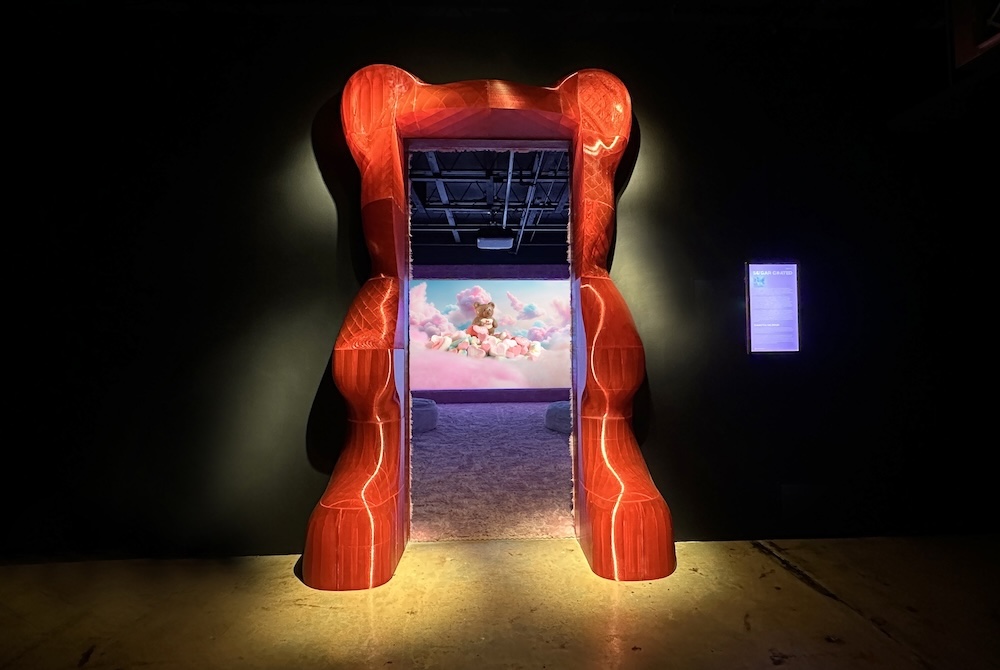
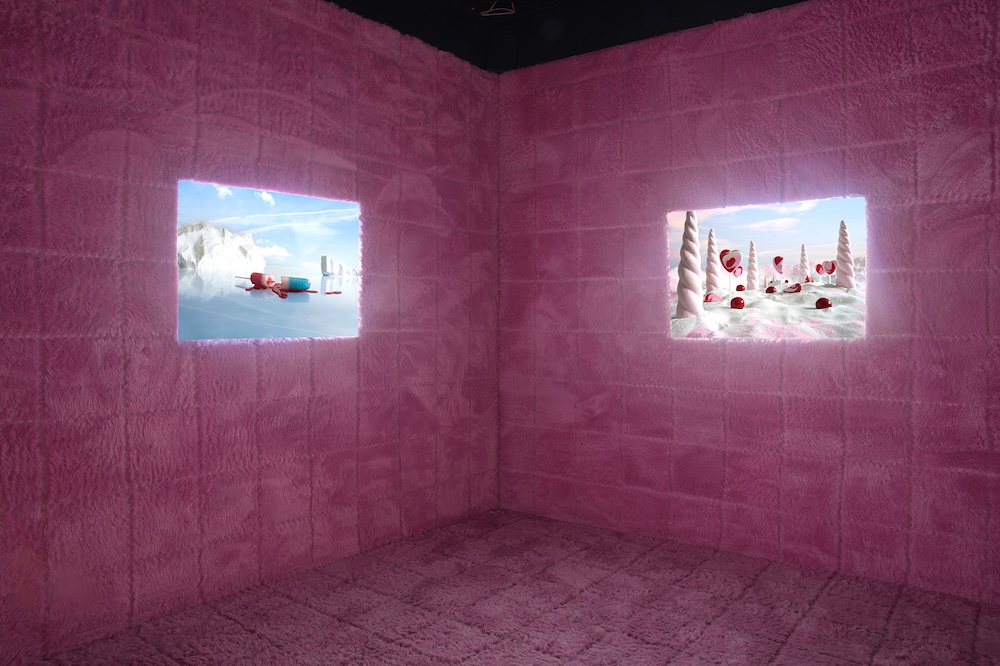
When I first encountered Samantha Salzinger’s Sugar Coated at MAD Arts in early spring, the installation did not announce itself through critique. It arrived through softness. Pink carpet, sweetness in the air, pastel colors, plush surfaces, and a seductive atmosphere that felt almost too easy to trust. The space was inviting, even tender, but something about it resisted comfort. The longer I stayed, the more the sweetness began to curdle.
At first glance, the exhibition feels playful, almost innocent. Candy-colored forests, melting confectionery forms, plush seating, projections, immersive environments — that feel somewhere between childhood fantasy and digital simulation. But the longer you spend with the work, the more another structure begins to emerge: collapse.
Nothing inside Sugar Coated remains stable for long.
Chocolate forms sink into sugary terrain while smiling creatures slowly melt into themselves. Some of the candy landscapes look like they are collapsing under invisible heat, or maybe just overstimulation. The installation keeps building on excess — sweetness, softness, color, texture — until the atmosphere begins to shift into something stranger. What first feels comforting eventually stops feeling entirely innocent.
That tension sits at the center of Salzinger’s practice.
“I’m attracted to beauty,” she told me during our conversation. “So I feel like I almost have to force myself to break it. The images that are just purely beautiful — those are the images that I end up throwing away. That tension is really important to me.”
Entirely built by hand, Salzinger’s environments mimic the visual language of digital rendering, advertising, and artificial simulation with surprising precision. Before learning about her process, I initially assumed parts of the work had been digitally generated. The surfaces felt too glossy, too cinematic, too hyperreal to belong entirely to physical space.
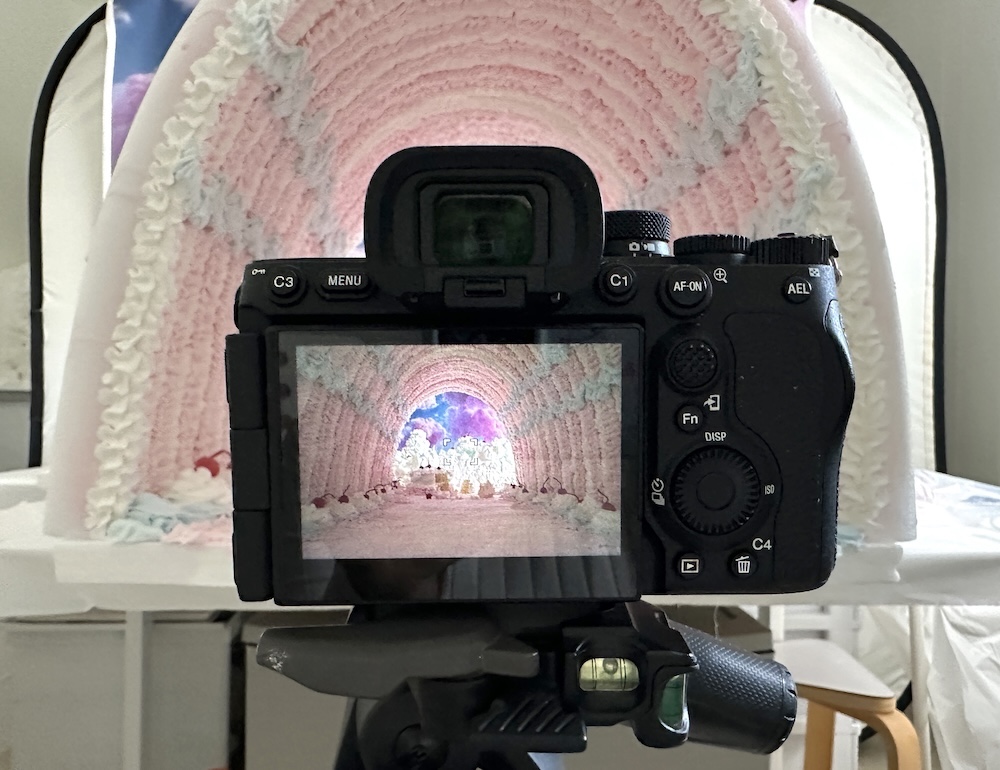
But nothing in Sugar Coated is accidental. The candy forests, collapsing animals, sugary textures, and immersive environments are sculpted, staged, lit, photographed, and filmed by hand.
“I build these for a specific lens,” Salzinger explained. “So I’m often looking through the camera as I’m building it. I can figure out how to create the depth and make them look like real places. I feel more like a mini filmmaker sometimes. I’m the set designer, the lighting director — all of those things too.”
That relationship between physical construction and artificial appearance becomes central to the work’s conceptual force. The installation constantly oscillates between handmade materiality and simulated reality.
“One of my biggest influences is Baudrillard’s Simulacra and Simulation,” she said. “For a while, I was calling my work fake AI because I was trying to simulate the simulation.”
The phrase lingered with me long after our conversation.
Fake AI.
At a moment when so much of our visual culture is shaped by generated imagery, algorithms, and synthetic aesthetics, Salzinger’s work moves in the opposite direction. Instead of using digital tools to imitate reality, she builds these environments entirely by hand until they begin to resemble something artificially produced. At times, the illusion becomes convincing enough that viewers begin questioning whether what they are looking at is actually handmade at all.
She recalled overhearing someone at a previous exhibition dismiss her work as AI-generated.
“They were looking at the image and said, ‘Oh, this is just AI.’ And honestly, I was flattered,” she laughed. “It made me think, okay, maybe I’m simulating the simulation.”
What makes Sugar Coated compelling is that the work never settles into a single critique. Salzinger is not simply condemning consumer culture from a critical distance. She repeatedly returns to the idea that she herself remains implicated within the systems she examines.
“I’m part of it,” she admitted. “I’m observing it more than I am standing outside of it.”
That honesty gives the work its complexity.
Sugar becomes less a literal material than a metaphorical structure — one capable of carrying ideas about desire, consumption, dopamine, comfort, and emotional compensation.
“Sugar is such an interesting metaphor because it’s so innocuous,” she explained. “It’s highly addictive. It’s in just about everything we eat. We give it to children as a treat and connect it to celebration and happiness. But underneath that surface there’s something else happening.”
The installation repeatedly cycles between craving and collapse. The looping video projection at the center of the exhibition feels less narrative than psychological—an atmosphere of perpetual searching in which pleasure can never fully stabilize.
“It’s about dopamine hits,” Salzinger said. “You’re searching for relief, for the next thing that makes you feel good. And then there’s saturation, collapse, and the loop starts again.”
Walking through the installation, I kept thinking about the contemporary rhythms of scrolling. The constant transition from one image to the next. The speed at which emotion, catastrophe, advertising, pleasure, and distraction now coexist within the same visual feed.
Salzinger spoke directly about this fragmentation.
“You can be scrolling and see a bomb that just went off, then an ad for face cream, then food, then another tragedy,” she said. “You shouldn’t be seeing all those things in the same thirty seconds.”
That disjointed visual logic permeates the exhibition. Sugar Coated behaves almost like a physical manifestation of digital overstimulation — seductive, excessive, immersive, and exhausting at the same time.
Even the materials themselves carry a strange sense of unsteadiness. Marshmallows, icing, candy, cereal, syrup — objects associated with comfort and innocence — begin to function as symbols of overproduction and emotional excess.
“There’s something both silly and sad about watching them collapse,” Salzinger said about the smiling lambs and confectionery creatures that populate the work.
The installation’s immersive environment intensifies that tension even further. Plush textures, sweetness in the air, soft surfaces, and the use of Baker-Miller pink — a color historically used in institutional settings to supposedly reduce aggression — create an atmosphere that initially feels calming and comforting. But the imagery unfolding inside the space keeps interrupting that sense of ease.
“What surprised me,” she admitted, “was people’s reactions to the space. I thought it would feel comforting, but then the imagery creates another emotional layer.”
That tension between comfort and unease may be one of the exhibition’s strongest achievements.
The work never abandons pleasure entirely. Instead, it asks what happens when pleasure becomes industrialized, aestheticized, and endlessly reproduced. What happens when consumption stops functioning as satisfaction and becomes a permanent condition?
Throughout our conversation, Salzinger repeatedly returned to ideas of instability, simulation, and emotional displacement. Although the work references consumer culture, advertising, digital aesthetics, and ecological anxiety, the installation’s emotional register feels deeply personal.
“There’s a lot about loss in the work for me,” she reflected at one point. “Things don’t last. Everything eventually disintegrates.”
That awareness of impermanence quietly structures the entire exhibition.
The melting forms are not catastrophic in a cinematic sense. The collapse unfolding inside Sugar Coated is slower, quieter, and perhaps more recognizable precisely because of that. At times, it resembles the emotional exhaustion of overstimulation, the fatigue of perpetual consumption, the anxiety of existing inside systems that no longer feel sustainable.
When I asked her what kind of collapse the work addresses — ecological, psychological, cultural — her answer was simple.
“All of those things.”
And perhaps that is why the exhibition lingers.
Not because it offers resolution, but because it refuses to.
The landscapes remain suspended somewhere between seduction and deterioration, innocence and artificiality, comfort and distress. Even the handmade quality of the work becomes difficult to fully trust. The viewer oscillates constantly between enchantment and awareness.
Toward the end of our conversation, I asked Salzinger what she hoped viewers might carry with them after leaving the installation.
“I guess I want people to question reality,” she said. “Even if they’re just questioning whether something is handmade or not. I think I personally question reality all the time — what’s real, what’s constructed, what’s being sold to us.”
That questioning becomes the exhibition’s lasting sensation.
Not a moral lesson. Not a definitive critique.
A destabilization.
Inside Sugar Coated, pleasure remains seductive, beauty remains irresistible, and collapse arrives slowly enough that we almost mistake it for comfort.
Sugar Coated by Samantha Salzinger is on view at MAD Arts, Dania Beach, FL, USA, through June 14, 2026.
*All images are courtesy of the artist.
About the Artist
Samantha Salzinger is a multidisciplinary artist based in South Florida. Her work encompasses sculpture, photography, video, and installation, primarily through the creation of intricate, handcrafted dioramas. Drawing from traditions of landscape, theatrical staging, and contemporary image culture, she constructs hyperreal environments that blur the line between the artificial and the sublime.
Salzinger earned her MFA in Photography from Yale University and her BFA from Florida International University. Her work has received significant recognition, including the 2026 Ellies Creator Award from Oolite Arts and the 2025 Artist Innovation Grant from the Broward County Division of Cultural Affairs. She is also a three-time recipient of the South Florida Cultural Consortium Fellowship.
Her work is included in public and private collections, such as the Pérez Art Museum Miami, Young at Art Museum, Yale University, and the Girls’ Club Collection. In addition to her studio practice, Salzinger is a Professor and Chair of the Art Department at Palm Beach State College.