Lisu Vega: Lo Que Me Habita / That Which Inhabits Me
By Sophie Bonet, Chief Curator, The Frank C. Ortis Gallery
Lo Que Me Habita unfolds as a lived terrain rather than a linear narrative. Venezuelan artist Lisu Vega constructs an environment where memory is not recalled but inhabited—felt through gesture, material, silence, and repetition. Across three interrelated installations—Raíces Difusas (Faded Roots), Los Vacíos (entre la presencia y la ausencia), and Lo Que Me Habita—Vega gathers fragments of language, textile, image, and sound into a sensorial ecology shaped by migration, ancestral inheritance, and embodied knowledge.
Rather than offering memory as a fixed archive, Vega approaches it as something unstable and unfinished. Her work resists totality. What emerges instead is a constellation of partial gestures: photographs that refuse completeness, verses that trail off, fibers that oxidize and soften with time. In this way, Lo Que Me Habita aligns with a lineage of artists and writers—from Theresa Hak Kyung Cha to Gloria Anzaldúa—for whom language, exile, and the body are inseparable, and where silence itself becomes a form of transmission.¹
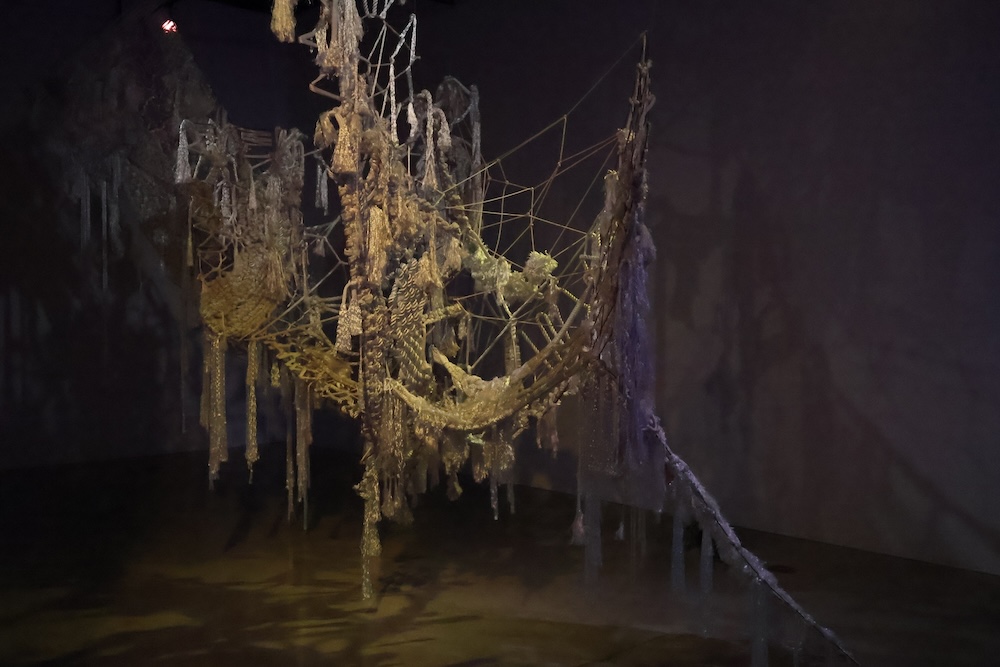
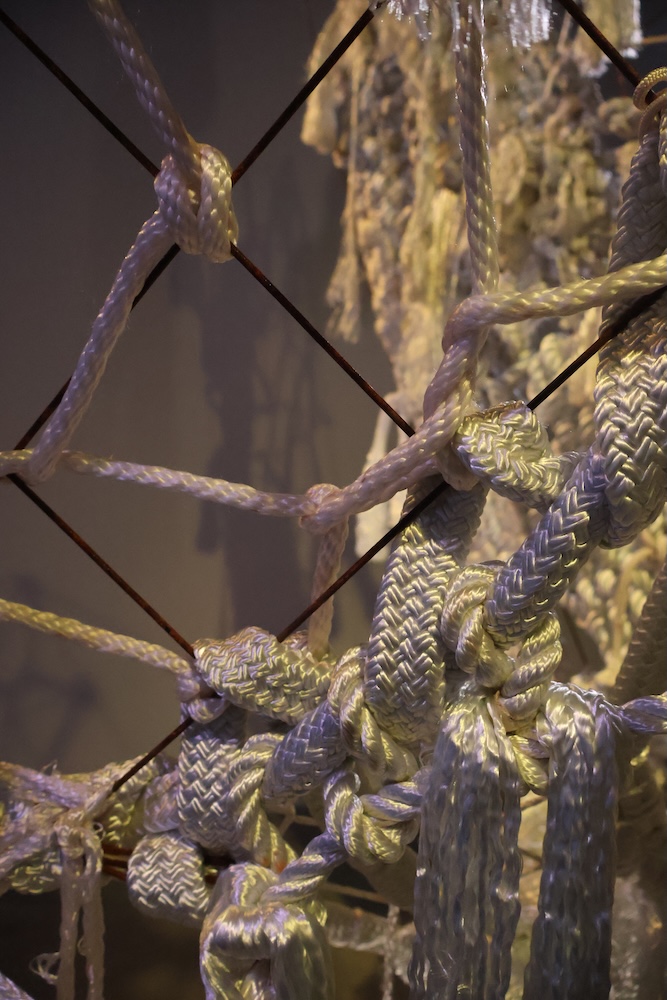
Vega’s practice is grounded in an ethic of care—toward materials, toward inherited labor, and toward what remains after use. Repurposed textiles, oxidized cords, family photographs, and the byproducts of sublimation printing—residual papers, faded “ghost” images, misprints—are not treated as failures or waste. They are preserved as evidence of process, time, and touch.
This attention to material afterlife situates Vega’s work within a material ecology of memory, where transformation is not symbolic but physical. Fibers stain, metals corrode, images soften. Nothing is erased. Everything bears the trace of having been handled, carried, or left behind. Over time, these materials cease to function as objects alone and begin to register as extensions of the body itself—repositories of gesture, repetition, and lived experience.
Her approach resonates deeply with Wayuu weaving traditions, in which fiber is both cosmology and continuity—a matrilineal system of knowledge transmitted through hands rather than text.² Vega carries this sensibility not as a static inheritance, but as a living method, shaped equally by the ruptures of her Spanish and Portuguese colonial lineages. Rather than resolving these tensions, she allows them to coexist—layered, frayed, and reworked into a poetics of rupture and repair.
Vega’s installations are activated through the body—hers and ours—where material memory shifts from object to gesture, and from surface to lived archive. Weaving, inscribing, and translating become ritual actions, echoing what Diana Taylor describes as the repertoire: a mode of knowledge transmission enacted through embodied practice rather than stored in static form.³
Fragments are not treated as remnants of loss but as vessels of knowing. Photographic shards, incomplete verses, and faint impressions printed on metal operate as tactile records—quiet, intimate, and resistant to spectacle. In this sense, Vega’s work finds affinity with Louise Bourgeois’ fabric cells and Tecla Tofano’s domestic interventions, where memory is held not as narrative but as pressure, intimacy, and affect. What appears fragile is, in fact, deliberate: a refusal of monumentality in favor of proximity.
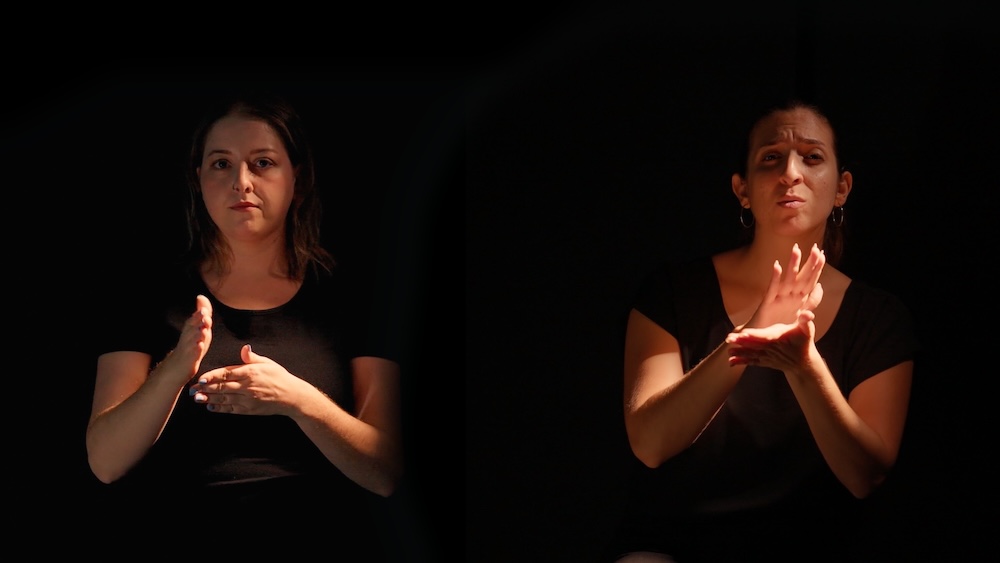
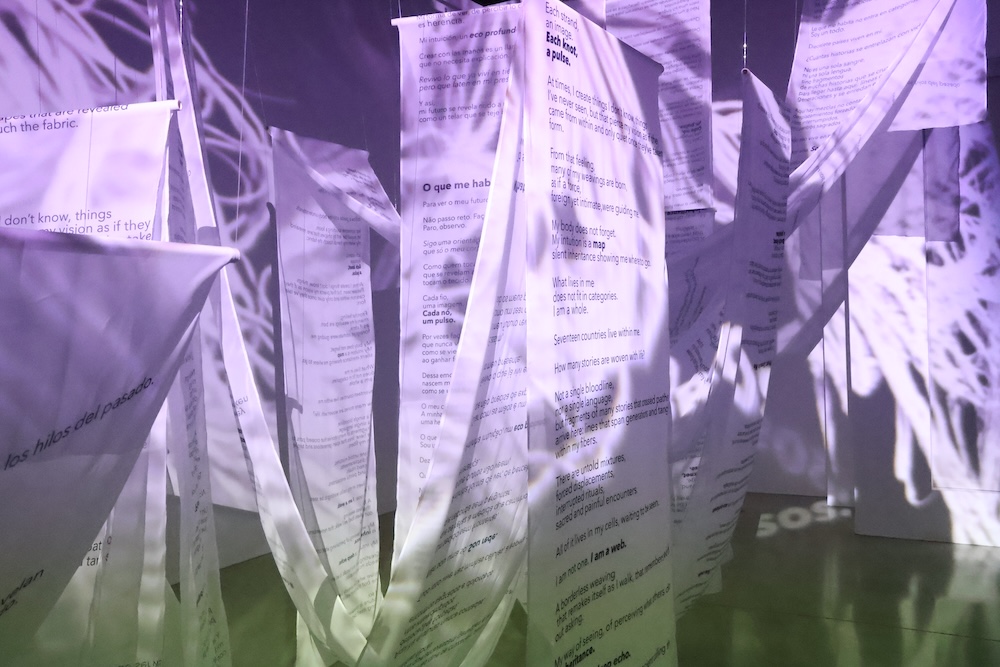
Language in Lo Que Me Habita refuses hierarchy. Poems appear in English, Spanish, Portuguese, Wayuunaiki, and American Sign Language, moving across banners, bodies, and sound. Translation is not offered as a tool for clarity but as an act of care—an acknowledgment that meaning shifts as it travels.
This polyphony situates Vega’s practice within a decolonial framework, where hybridity is not a compromise but a condition of survival. As Anzaldúa reminds us, the border is not merely geographic but linguistic, corporeal, and emotional.⁴ Vega extends this insight spatially, allowing languages to overlap, interrupt, and obscure one another. Silence here is not absence; it is a generative interval—space for breath, listening, and recognition.
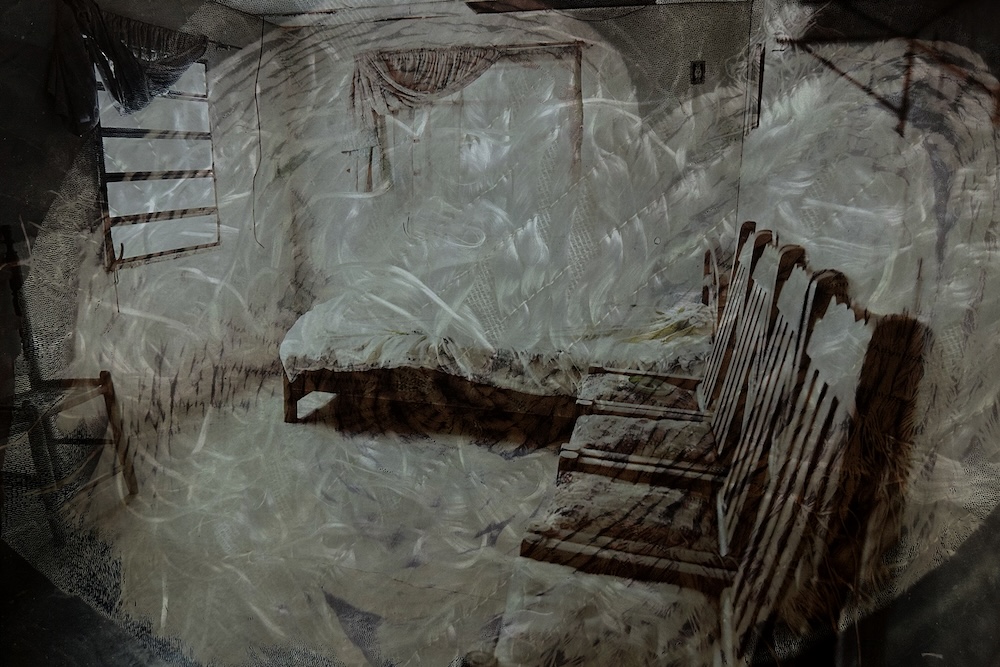
Across the exhibition, the domestic reappears as a recurring presence: Vega’s grandmother’s abandoned home, a bathtub, a sewing machine, a mattress, a mango tree. These elements surface not as documentation but as spectral architecture—what Gaston Bachelard described as the emotional residues embedded in space.⁵
The home becomes a ghost-body: porous, layered, marked by absence yet animated by memory. It is both shelter and wound. In Vega’s hands, domestic space mourns, but it also regenerates—offering a site where grief and continuity coexist. Memory here is not only inherited; it is inhabited, carried forward through attention, repair, and repetition.
Works in the Exhibition
Raíces Difusas (Faded Roots), 2025
Video installation with sign language, audio, braille, and printed poetry
Video projection by Isangela Verdu
Sign language interpretation by Lauren Mathes and Denisse Simonian
In Raíces Difusas, Vega’s poem is translated into multiple sensory registers—spoken, signed, tactile, and visual—foregrounding the body as a vessel of memory. The silent projection of hands interpreting poetry resists the dominance of spoken language, proposing a haptic poetics where gesture itself becomes text.
Los Vacíos (entre la presencia y la ausencia), 2025
Photographic installation with poetic fragments
Twelve metal photographs paired with fragments of poetry form an intimate architecture of looking. Magnifying lenses compel proximity, making memory an embodied act. Photography here becomes elegy—not as spectacle, but as quiet witnessing.
Lo Que Me Habita / That Which Inhabits Me, 2025
Dual installation: woven metal sculpture and suspended textile poetry
Video by Pedreáñez (Ocovisual)
Poem translated into Portuguese by Paola Gato Pacheco
Translated into Wayuunaiki by Nerri Gómez Montiel (Uliana clan)
The exhibition culminates in a suspended net woven from oxidized rope and thread, surrounded by translucent banners printed with Vega’s central poem. As viewers move through the space, verses overlap and dissolve, sound circulates, and the body becomes part of the weave. Identity here is not fixed but porous—what Vega describes as a borderless weave.
Conclusion: What Remains, What Holds
Lo Que Me Habita is both elegy and invocation. It acknowledges the fractures of migration and the incompleteness of inheritance while insisting on continuity through gesture, repetition, and care. Vega does not offer resolution. Instead, she invites us to dwell within what remains—to listen, to touch, and to recognize that what inhabits us is not only memory, but the ongoing labor of holding it.
____________________________________________________________________________
Notes
- Theresa Hak Kyung Cha, Dictee (Berkeley: University of California Press, 1982).
- S. C. Noguera Saavedra, “Wayuu Culture and Traditional Weaving,” Arts and Design Studies (2015).
- Diana Taylor, The Archive and the Repertoire (Durham: Duke University Press, 2003).
- Gloria Anzaldúa, Borderlands/La Frontera: The New Mestiza (San Francisco: Aunt Lute Books, 1987).
- Gaston Bachelard, The Poetics of Space (Boston: Beacon Press, 1994).
Selected Bibliography
Anzaldúa, Gloria. Borderlands/La Frontera: The New Mestiza. San Francisco: Aunt Lute Books, 1987.
Bachelard, Gaston. The Poetics of Space. Boston: Beacon Press, 1994.
Cha, Theresa Hak Kyung. Dictee. Berkeley: University of California Press, 1982.
Noguera Saavedra, S. C. “Wayuu Culture and Traditional Weaving.” Arts and Design Studies (2015).
Taylor, Diana. The Archive and the Repertoire. Durham: Duke University Press, 2003.
Sophie Bonet (b. 1986) is a South Florida–based curator whose practice is deeply informed by her background in social and cultural anthropology. She approaches exhibitions as living ecosystems—responsive spaces shaped by memory, ritual, and transformation. Her transdisciplinary work is research-driven and grounded in the belief that art functions as a site of dialogue, cultural inquiry, and collective imagination.
Bonet has led exhibitions and public programs across prominent institutions in the United States and abroad, including the Contemporary Arts Museum Houston (CAMH), the Barcelona Museum of Contemporary Art (MACBA), and the Museum of Contemporary Art North Miami (MOCA), where she served as Exhibition Manager for landmark presentations such as Juan Francisco Elso: Por América (in collaboration with El Museo del Barrio), Didier William: Nou Kite Tout Sa Dèyè, and Jamea Richmond-Edwards: Ancient Future. Her early research at MACBA focused on the archival documentation and critical interpretation of Espai 13’s history, tracing three decades of artist-led experimentation at the Joan Miró Foundation.
Currently Chief Curator of The Frank C. Ortis Gallery in Pembroke Pines, Florida, Bonet leads an ambitious exhibition program centered on accessibility, sensory engagement, and community-rooted storytelling. Curating across disciplines—from ecological installation to fiber art and new media—she explores themes of identity, migration, belonging, and place through an anthropological and phenomenological lens.
Bonet holds degrees in Fine Arts, Art History, and Anthropology. She is currently pursuing graduate research examining curating as a ritual and phenomenological practice shaped by memory, embodiment, and cultural translation. She is a member of IKT – the International Association of Curators of Contemporary Art.